Up next in 10



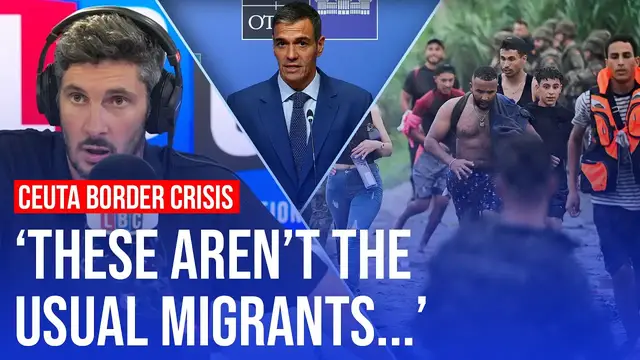
Nearly 49,000 migrants crossed into the Spanish enclave of Ceuta in the space of just one day, as they rushed by sea and land from Morocco.
Spain deployed military units to Ceuta in North Africa as migrants surged by sea and land into the territory - one of only three land borders with Europe on the African continent.
Video footage showed thousands of migrants, mostly young men, swimming or floating on inner tubes from the Moroccan side, and others breaking through a gate on land and running into the city.
In Melilla, Spain's second autonomous city in northern Africa, footage from local media and human rights organisations appeared to show clashes at the Beni Ansar border point late Thursday.
That has been the only open crossing between Morocco and Melilla for the past six years.
According to Omar Naji of the Moroccan Association for Human Rights, at least three vehicles were set ablaze and injuries were reported among migrants and security forces.
#tomswarbrick #spain #immigration #border #ceuta #news #politics #lbc
LBC is the home of live debate around news and current affairs in the UK.
Join in the conversation and listen at https://www.lbc.co.uk/
Sign up to LBC's weekly newsletter here: https://l-bc.co/signup
Show More Show Less View Video Transcript
0:00
The pictures from this are actually incredible. I don't think I've ever seen something like this
0:05
before. I've been covering the the migration crisis as it's been called for a decade or so now. I've
0:10
been to the the camps of Calais. I've met the people who have arrived in this country on the
0:15
back or underneath lorries. I've even found someone climbing out from underneath the lorry
0:19
at a service station in Britain. I've been on the beaches of the Greek island of Lesbos 10 years ago
0:24
when those boats began to arrive from Turkey as the crisis in Syria took hold. The children
0:29
in those life jackets that were so big for them that if they fell into the water
0:35
the so-called life jacket would come over their head and drown them
0:40
The world has been on the move for a long time and Europe is no closer, it would seem
0:47
to finding a response to this. But what do you do when 50,000, nearly 60,000 people
0:54
storm your border. This is what happened in the Spanish enclave de Suesta and here's the challenge
1:01
as we are facing in the UK when it comes to the difference between the interpretations of laws
1:07
and the majority of people who agree that this situation is unsustainable. As is reported the
1:12
influx of those people who are swimming through the water, landing on beaches, running up through
1:17
the roads, the influx comes as Spain's Supreme Court ruled this month that migrants stopped at sea
1:24
while trying to reach Sueta or Melilla, another Spanish enclave, cannot be summarily returned to Morocco
1:32
Right, so if you arrive by sea in any of these places, the court says you can't be sent back
1:37
Well, there is your green light. If the law effectively brings down national borders
1:43
there are no national borders. The Italian Prime Minister, Giorgi Maloney, has said that Italy would consider suspending the Schengen Zone agreement
1:50
with Spain on free movement, something that Finland's interior minister has agreed with her on
1:56
They've said Spain had failed to protect its borders. The German Chancellor Friedrich Mertz demanded Morocco take back illegal migrants immediately
2:04
Here's what Andy Burnham has said this afternoon. It's a concerning situation and I know people will see those scenes
2:09
and want something to be done, more to be done. What I have done is firstly keep the current Home Secretary in place
2:17
because the plan she has implemented has started to make a difference
2:22
Although this is the peak period of the year for crossings overall the number of crossings is down the number of removals of people is up So there is progress but we both recognise that we need to do more And I will make a visit very shortly to Border Force on the south coast to see the situation for myself
2:43
assess it, and then agree with the Home Secretary what further we need to do
2:48
We've made headway, but certainly more is needed. He's not wrong, Andy Burnham, when it comes to the problem with Britain about the numbers
2:55
But when you... I don't know whether you've seen this yourself. There are plenty of pictures of it now available
2:59
it is absolutely astonishing what has happened at the tip of North Africa
3:03
And it strikes me that the issue here is the law. It's the same to some extent with the migrant channel crossings
3:08
Same with the court ruling that if you arrive by boat, you can't be sent back to Morocco
3:12
If you arrive by sea, you can't be sent back. It's obviously unsustainable
3:17
And in the end, European countries, having gone through this now for probably 15 years, 12, 15 years
3:24
European countries will have to agree on a migrant or asylum quota
3:31
and then agree to disperse people across the continent, including in Britain
3:35
And then we have sustainability of numbers. 03456060973. Stephen Bergen is a journalist based in Barcelona
3:44
Thank you very much indeed for coming on the programme. Would you mind, first of all, Stephen, just explaining the geography of this
3:49
because it's quite important in understanding how this is possible? Yeah, well, Ceuta is an enclave in what is basically Morocco
3:58
There's, as you mentioned, another one called Melilla. And Ceuta has been under Spanish control since 1640
4:07
So it is no more a part of Spain than Gibraltar is part of the UK, geographically speaking
4:15
What happened, there have been, over the years, numerous attempts to cross the border
4:21
in both Malia and Ceuta. But today was extraordinary, both in the numbers
4:28
which were close to 60,000, although I should say that nearly half of those people
4:32
have voluntarily returned to Morocco now. But who the people were? Normally, the people crossing the border
4:39
are people from sub-Saharan Africa or further beyond who have made a long journey from war zones
4:47
as far away as Afghanistan, And where what you see in the pictures is a very large number of adolescent Moroccans
4:57
or nearly all male. So there something odd about this incursion and particularly odd about the fact that half of them have so willingly gone back whereas people have made the journey from Sierra Leone or Mali and been through all sorts of hell to get to Morocco are not about to go back
5:17
How do we know that half have returned? Because that's what the president of Sainte has said
5:25
Right. This afternoon? This afternoon, yeah. and this thing that they're this court ruling that they're not allowed to be summarily returned
5:34
this was to prevent the police doing what they were doing which was when people swam over they
5:40
basically picked them up and chucked them back into the sea it doesn't actually mean they can't
5:45
be returned um president pedro senchez has made it clear that these people are not going to set
5:51
foot on the spanish mainland and therefore have access to europe and um most of the shops and
5:57
closed. I think the great majority of these people are going to go back and there's something
6:03
not quite right about it. Sanchez says it's to do with people trafficking mafia. Other people say
6:11
that Moroccans deliberately turned a blind eye to it. As I said, the profile of these people
6:17
is completely different from the people who usually cross into Mania and Theta
6:23
To what extent do you think there is a connection between the two things then
6:26
of the Spanish Supreme Court ruling and this extraordinary, you call it
6:31
influx, Stephen, of people who have arrived who aren't sort of the normal type of people
6:35
who are arriving there? Well, possibly Pedro Sanchez is right. The trafficking mafia said
6:42
you know, you've got a clear run. Yeah, you've got a green light
6:46
You're not going to get sent back. And it would appear that a lot of people
6:50
did it actually just to see. And there were no words, actually migrants in the usual sense of, as I said, they're mostly from further south in Africa
7:01
What is being said in Spain, the sort of the mainland of Spain, as it were
7:05
when they see these pictures? Well, I think everyone like yourself is rather horrified
7:10
at the scale of it. But on the other hand, the Spanish government has rather pragmatically
7:19
legalized close to a million illegal immigrants who are needed in this country because we have
7:26
an elderly population and a very low birth rate, but shut the door. So, I mean, the deadline for
7:32
being regularized has passed. Even if these people were to get into mainland Spain
7:38
they not going to get legal status And I think you know that message is quite clear And it doesn mean that they not going to be returned to Morocco and in fact Morocco is under a lot of pressure to do its own bit and to
7:52
take these people back. So again the run-up to this as you say involves a decision by the Spanish
7:57
government to effectively have an amnesty on illegal migration up to a point is that right
8:04
the million people who were regularized? Yes so there was people who could prove that they'd been
8:09
in the country for a certain length of time. And they would be given basically resident status
8:15
they're not given citizenship. But it means that close to a million people who are working
8:20
illegally can now work legally and pay taxes and become contributors. If they were working illegally, does that mean they were in the country illegally? They didn't
8:29
have a right to be there? Yes, people who either came ashore on the various boats that come across
8:37
the Mediterranean, people who come from other countries by plane and simply overstayed their
8:42
visas. And to what extent, Stephen, because a similar thing happened to an extent, slightly
8:46
lesser extent, I guess, in Germany with Angela Merkel at the start of the Syrian crisis when a
8:50
million people came into Germany. To what extent was that seen in some quarters in Spain as, again
8:56
a kind of green light? Well, I mean, obviously, you know, in Spain, as in Britain, immigration is
9:04
being used as a popular tool by certain political parties, and there's no exception here. And
9:11
there's been quite a lot of opposition to it. But you have to bear in mind that two thirds of the
9:17
people who have been given immigration, have been given resident status are Latin Americans
9:22
they're Spanish speaking people, they're people who are, you know, will very easily integrate
9:27
into the culture, and in fact, are already integrated into the culture
9:31
And the response from the rest of Europe, or at least some of the rest of Europe, whether it's Finland or Germany or Italy, there's a degree of concern about what this would mean for the Schengen era, even though, as you say, these enclaves are not actually in Europe
9:45
Well, obviously, because Malia and Theta are Europe's only borders, actually, in Africa
9:52
And so, I mean, I think the reaction of Maloney and the Finnish president were quite understandable
9:57
that if all these people were allowed to come onto the Spanish mainland on the Schengen
10:03
they're also allowed to go to any other Schengen country. So that won't be happening. And the Spanish government said that won't be happening
10:10
They say that will definitely not be happening. very interesting times really appreciate your time spent with us going through it
10:17
Stephen Bergen is a journalist based in Barcelona
#news