Up next in 10



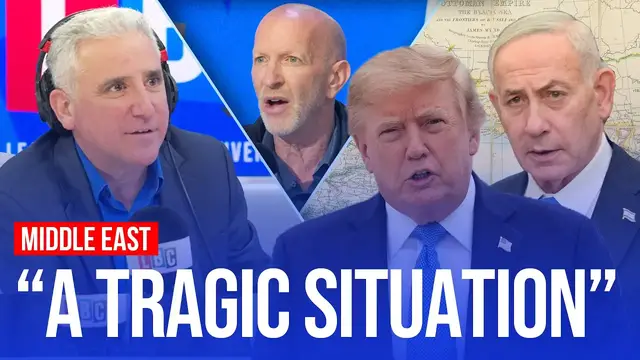
Simon Marks is joined by historian Simon Sebag Montefiore to explore the history and turmoil of the modern Middle East, following the release of his new book, The Cauldron: The Making of the Modern Middle East.
Montefiore explains why the collapse of the Ottoman Empire is "key" to understanding the region's modern history and the conflicts that continue to shape it today.
The conversation then turns to the present, including the crisis in Gaza, which Montefiore describes as a "tragic situation." While acknowledging that Donald Trump is easy to criticise, he argues that the president's 20-point plan is "sensible."
On Israel's political future, Montefiore suggests that Eisenkot, Netanhyu's main challenger in the upcoming elections, could offer "more reasonable governance".
Listen to the full show on the all-new LBC App: https://app.af.lbc.co.uk/btnc/thenewlbcapp
#simonmarks #middleeast #uspolitics #worldpolitics #LBC
LBC is the home of live debate around news and current affairs in the UK.
Join in the conversation and listen at https://www.lbc.co.uk/
Sign up to LBC's weekly newsletter here: https://l-bc.co/signup
Show More Show Less View Video Transcript
0:00
Really delighted to be here helming our next segment on the programme
0:04
because if you are interested in the politics and history of the Middle East, my next guest on the programme has the book for you
0:11
It is called The Cauldron, The Making of the Modern Middle East
0:15
It's a brilliant effort to chart the history of the entire region
0:19
from 1900, the collapse of the Ottoman Empire, to the current day
0:25
and to explain how the Middle East became the cauldron that we are all continuing to navigate and deal with today
0:33
The book's author, historian and broadcaster Simon Seabag-Montefiore is with me in the studio now
0:39
It's an absolute pleasure to have you with us here on LBC this afternoon
0:44
Lovely to be with you. Let me start by asking you just to go back to the beginning of the book
0:48
you know, the early 1900s, the collapse of the Ottoman Empire. Why does everything sort of flow from that
0:56
Well, you can't really understand the Middle East today unless you understand how all these states emerged
1:01
And they emerged mainly from the Ottoman Empire. So most books on the Middle East start, you know
1:08
the end of World War I or more recently. But I've gone right back to 1900
1:13
when the Ottoman Empire ruled the whole Arab world, really. And Britain and France ruled other bits of the Middle East
1:20
and out of that empire came the states that are today fighting for power and all of them
1:28
you could only understand turkey or israel or iraq or syria or egypt or any of these countries
1:35
including iran if you go back to that period and so i start then but i start with ibn saud the
1:43
founder of Saudi Arabia, in 1902, storming with just 40 men on horseback. He storms Riyadh
1:51
which is now the capital of Saudi Arabia. And that is really the beginning of the modern Middle East
1:57
And talk, if you will, about the Sykes-Picot Agreement, which was forged in 1915, 1916, I think
2:06
never fully implemented, but did result in Britain playing a huge role in the creation of
2:14
the Middle East as we know it today? Well, you know, Britain holds some responsibility for what
2:20
happened, along with France, which we forget here often. But Lloyd George and Clemenceau were the
2:25
two prime ministers. And the idea of Sykes-Picot was that they would divide up the Middle East
2:30
They weren't very keen on the Ottomans. The Ottomans had massacred the Armenians, Maronite Christians, Orthodox Greeks
2:40
And so they were determined to dismantle the Ottoman Empire and to both form Arab states
2:50
but also to take over colonies that they called the mandates. And so the British mandates were basically Iraq and Palestine
2:57
and the French got Lebanon and Syria. And the way they managed those states they formed new countries And none of those countries what people don realise today had really existed before Their old names Syria Lebanon Palestine and Iraq of course but they hadn really existed before
3:19
And they all really became independent actually at the end of World War II
3:24
And obviously that hasn't gone terribly well. Right, and it's fascinating going to some of these countries
3:29
I've been to Syria several times, and you go to Damascus, and you suddenly discover restaurants serving frog's legs
3:35
Yes. I mean, it's just one of those tiny little elements that tells you about that colonial past
3:40
But just to tell you about that, for example, the way these states were formed
3:44
they now seem preordained, but actually the French were planning, for example
3:49
to create five states in greater Syria, which would be a Christian state in Lebanon
3:55
two Sunni Muslim states in Aleppo and Damascus, and then a state for the Alawites
4:01
who later produced the Assad family, and the Druze. And they changed that plan
4:06
But there were lots of ways the Middle East could have turned out and didn't have to turn out the way it did now
4:12
So how did we end up in a situation where what we often refer to as the Arab world
4:18
is dominated by three non-Arab powers, by the Iranians, by the Israelis, and by the Turks
4:25
Well, that's right. That's what's so interesting, because you think of the Arab world, the Arab-speaking world
4:29
and it is overwhelmingly Islamic and Arab-speaking. But you've got these three powers that are incredibly dynamic
4:36
and one of the reasons for them is that they weren't created quite in the same way
4:42
as these other states were. For example, Turkey was really emerged in 1922
4:48
from a brutal war against the Greeks and ultimately challenging the British
4:54
And so Ataturk, who's one of the leading characters, the book's full of these amazing characters
4:59
like Ataturk, Nasser, and he basically defeated all comers and created a new nationalism and a new nation
5:10
the Turkish Republic and the Turks. Iran already existed, is a very ancient and powerful culture
5:17
and had had many empires before. And they are always aware of that
5:23
And of course, Israel, the third one of these military powers, was also created a bit like Turkey
5:28
in an anti-imperialist revolt against the British and in a brutal ethnic war
5:34
So the three of them emerge, and it's no coincidence that those three
5:39
are the most dynamic powers in the region and the leading military powers
5:44
And of course, neither of them are Arabic-speaking. You know, the Persian speak, the Iranians speak Persian, the Turks Turkish and the Israelis Hebrew
5:52
And to that we should add a newcomer into the region, which is Pakistan, which is a nuclear power and a very powerful military power too
6:02
which has just signed the Mecca Treaty with the Turks and the Saudi Arabians
6:08
In the time we've got left, I want to sort of bring this up to date and ask you about three separate but obviously joined and linked areas and issues Let start with Gaza and with the Palestinians The crisis in Gaza and the ongoing difficulties that the Palestinians have faced both in the
6:27
West Bank and Gaza has often been fueled by the fact that they simply haven't had the backing
6:34
of many Arab states to the extent that they would want to have received that kind of support. Why
6:41
is that the case? Well, many of the Arab states were impatient with the Palestinians for turning
6:47
down peace offers from Israel, for example, at 2000 in Camp David. And the Saudis, for example
6:54
were very keen for the two sides to sign those agreements. But where we are now is obviously a
7:02
tragic situation where you have unbearable civilian suffering now in Gaza. You have attacks by
7:10
Israeli Jewish supremacists in the West Bank. And there is some hope, though. I mean, Trump
7:19
it's easy to criticise Trump. But in fact, you know, he has brokered an agreement in Gaza
7:25
with Hamas. And his 20 point plan is actually a sensible plan if it's enacted by both sides
7:33
So we desperately need humanitarian improvement there. Right, but the devil in that is in the details, because there's no sign that that's going to advance, right
7:42
Hamas have to be demilitarized for that to work, and they've promised to do so
7:49
And that's because of pressure from their patrons, who are the Turks and the Qataris, and of course America
7:56
And the real point of this is that America, when it's consistent, when it's coherent, when the governance is sensible
8:04
You're laughing because you're the American correspondent. I can't remember when that was. But when it acts with focus, it can influence things in the right way
8:14
And it did with this Gaza 20-point deal. I want to come back to Donald Trump and Iran in a moment
8:20
But Israel. I was in Tel Aviv before 7-7, a couple of years prior
8:26
And I was talking to one official with the foreign ministry there
8:30
who was saying that, who was very not sympathetic towards Netanyahu at all
8:36
and much more allied with the liberal side politically in Israel. And he was making the point that demographically
8:44
Israel is now on a journey where it is going to be very hard
8:47
because of the way the population is shifting. Religious families on the right having lots of children
8:56
more secular Jews on the left having fewer numbers of children, that the demographics mean inevitably Israel is on a journey
9:02
to being perpetually governed by conservative-leaning governments. Do you accept that? It could happen
9:10
And there are real perils for Israel's situation at the moment. You know, you can see that from the danger of militia-isation
9:18
where Israel the state actually is captured by extreme supremacists But equally there are great opportunities for Israel as well It has you know has an impressive military supremacy There an election in October
9:34
Actually, the supremacists at the moment are sort of 10% of the electorate. So actually
9:41
Netanyahu's main challenger, who I must say, I very much hope wins
9:46
could bring a more sensible and reasonable governance. And that means there are opportunities
9:54
diplomatically with Lebanon, with Saudi Arabia and elsewhere, though all of that depends on a
9:59
pathway to some definition of a Palestinian state. And at the moment, there is no indication of any
10:07
pathway existing for that. Not from either side, not from either side. And that's the point. And
10:12
oftentimes it's said that Israel has to make concessions. It does, but so does the other side
10:17
and we're not there yet. Both sides are in trauma. When you read this book, and the title tells you
10:23
I mean, the title's the giveaway, right? It is a cauldron. The Middle East is a cauldron
10:28
How is it possible that Donald Trump was persuaded to wage a war on Iran that currently looks
10:37
unwinnable. Why is it that American presidents misjudge the nature of that boiling pot that is
10:46
the Middle East? The scale of American power is such that they are in such an imperial and
10:52
magnificent isolation once you're president that, you know, that your information about the outside
10:58
world is always limited. And of course, the Trump administration had fired many of the experts on
11:04
Iran. But they'd had great success. The 12-day war was limited in its aims and measures. The
11:11
bombing of the nuclear sites last year. And if they'd left it at that, that would have diminished
11:17
Iranian power significantly. The problem was that Venezuela gave Donald Trump the feeling that he
11:25
could just, he could have military success and America was capable of anything, which of course
11:30
it wasn't a more sensible line which would have been to have a heavy military blockade economically
11:36
of iran and that could succeed in bringing down the regime it will fall one day and in fact that
11:43
is actually what they're attempting now so even though the war itself failed in its aims um and of
11:51
course donald trump's rhetoric rhetoric has been extremely unhelpful and overblown and erratic
11:57
but the present economic blockade that they are now intensifying could in fact bring results
12:06
Simon Seabag-Montefiore, I'm so grateful to you for coming into the studio today
12:10
The book is called The Cauldron, The Making of the Modern Middle East
12:15
It is published by Wiedenfelt and Nicholson and it is out now and the reviews are in and they are absolutely terrific
12:23
many of them saying that it's which is an achievement in this regard
12:27
it's a page turner because you don't often hear that about this kind of historical work
12:33
thanks so much for being with us on LBC tonight really appreciate it
news