Up next in 10



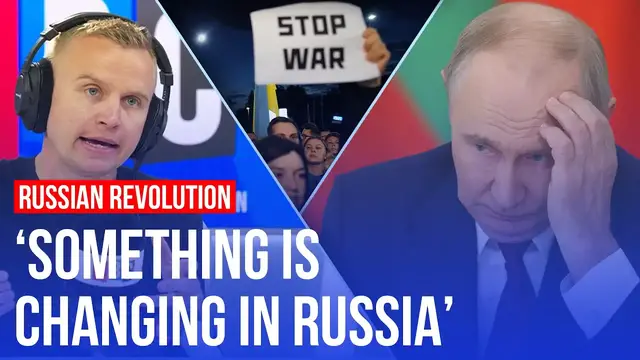
Estonia's spy chief Kaupo Rosin claims 'Russia is in a very bad place' and that a 'revolution could come overnight'. Could Vladimir Putin really be overthrown?
Keir Giles, Associate Fellow of the Russia and Eurasia Programme at Chatham House, joins James Hanson to discuss the growing questions within Russia about the war in Ukraine, Putin's grip on power, and whether Russia could turn its attention to the UK.
Listen to the full show on the all-new LBC App: https://app.af.lbc.co.uk/btnc/thenewlbcapp
#jameshanson #keirgiles #chathamhouse #russia #russiaukraine #putin #vladimirputin #worldnews #politics #russiawar #ukrainewar #nato #estonia #LBC
LBC is the home of live debate around news and current affairs in the UK.
Join in the conversation and listen at https://www.lbc.co.uk/
Sign up to LBC's weekly newsletter here: https://l-bc.co/signup
Show More Show Less View Video Transcript
0:00
The government doubles down on support for Ukraine
0:02
Russia has been ramping up its warnings to the West, but now the head of Estonia's spy agency
0:08
claims Vladimir Putin could be overthrown at any moment. Well, Corporal Rosin has told the Telegraph
0:14
that Russia is in a very bad place and that revolution could come overnight
0:20
Let's bring in Keir Giles, an associate fellow at the think tank Chatham House
0:23
working in their Russia and Eurasia programme. Appreciate your time, Keir. How weak is Vladimir Putin domestically at the moment
0:30
Good afternoon. Well, it's worth paying attention to what Kalkorosan has actually said
0:34
and what's new and what isn't. We've been hearing for years from some people that Russia is about to collapse
0:40
that it can't afford the war, that there has to be some resistance to Putin, that it's all going to come to an end
0:45
What's different is when people say it when they haven't said it before. So something has actually changed
0:49
And the Estonian Foreign Intelligence Service that has now given this interview
0:53
has a good track record of getting things right and they're saying something is shifting within Russia itself
0:59
Not just the public discontent because this is now costing ordinary Russians
1:03
It's inconveniencing them at home instead of just being a war that happens to other people a long way away
1:08
But as they put it, the people with the money and the power and the influence
1:12
are starting to ask questions about how to end the war. And that's why they say, well, there's no visible signs of Russia stopping anytime soon
1:19
If that does change, it could change very quickly. So that it is feasible
1:23
there could be some kind of revolution overthrowing of Vladimir Putin any day
1:28
Well, anything's feasible any day, but they are very careful to say that there are no imminent signs of that change happening
1:36
Just that if and when it does, we have to be prepared for it to happen fast. Now, for the time being, Putin has dismissed all of the warnings
1:43
about the damage that this is doing to Russia. The economists, the bankers, who have spoken up quite bravely within the Russian system
1:48
to say this has to stop, you're doing permanent damage to the country, are not being listened to and Putin is pressing on. But what the Estonians are now saying is that
1:56
there are more and more people within the Russian system with the power to actually do something about it that are starting to question that choice And that is a new development What do you think Vladimir Putin will do next I mean is there an option for him to try and scale things back
2:13
declare victory of a sort, even though he hasn't achieved his war aims
2:18
and kind of retreat but claim victory? Or do you think we will see a kind of General Petraeus-style Iraq surge like in 2007
2:25
where he'll commit even more Russian troops into the meat grinder? Well, the irony is, of course, Putin has always had the choice of declaring victory
2:34
He's always been able to freeze the conflict, especially since 2025, when the Americans were trying to force Ukraine into an unconditional ceasefire in order that the war could come to an end
2:45
Putin could have said at any time, yes, we'll pocket the gains we've made so far because that's a better option for us than continuing to fight on this enormous cost in money and manpower
2:54
But Putin hasn't taken that choice. So for whatever reason, he still thinks that there's more to be gained from continuing the war than there is from freezing it
3:03
And yes, again, some of these consistent rumors that we hear over and over again are about Putin going to launch a mass mobilization to bring lots more people into the armed forces
3:13
It's not completely clear what exactly he would do with them because the character of the war has moved on again
3:18
It's no longer the massive what they used to call meat waves, the human wave assaults to soak up every last Ukrainian bullet
3:25
it's a very different character of conflict on the front line. But you also have to bear in mind that if there's a ceasefire in Ukraine
3:31
if major combat operations come to an end, then Putin's looking around for the next target
3:36
And that too could be the reason why they're still building up the armed forces as rapidly as possible
3:41
not just for fighting Ukraine, but whoever they see as next down the line. Well, and that brings us on to the topic of who would be next down the line
3:47
Apparently, we know the head of the CIA was in Moscow this week, and reportedly that was to warn Russia not to attack a NATO country
3:55
But do you think that that might be on the table? Well, we've heard a lot of different explanations for what John Ratcliffe, the head of the CIA, was doing in Moscow
4:03
Weirdly if they had just said this was a routine intelligence meeting people would have forgotten about it by now But instead because of these half efforts at secrecy people are still trying to guess exactly what was going on there There been the explanation of warning Russia against escalating against NATO
4:19
or of trying to get the message through to Putin that actually they're using the Ukraine war
4:23
or some kind of trade-off, where Russia gets a free hand in Ukraine in exchange for helping America with its own war on Iran
4:30
Those explanations are all floating around, and we simply don't know. And what would an attack on NATO even look like
4:37
Well, that's a huge question that's been exercising people right across the alliance for years now
4:42
And it's sometimes a little dangerous to actually pick one particular thing that Russia could do
4:48
because there's a huge buffet of options available to Russia and it changes all the time
4:52
because the relative military strengths of all of these countries changes, but also so does the overall diplomatic and political situation
4:59
and where Russia thinks it might get an advantage from doing something that would actually make it worthwhile the risk and the resources they put into it
5:06
So we hear some of the standard scenarios for what Russia could do
5:10
that come up over and over again. But the reality is there's just a huge range of different options available
5:16
Could the UK be in the line of fire? Absolutely it could
5:20
And for the UK and also for other countries of Western Europe, when they're thinking about whether they are in the front line or not
5:26
it's really important to look not at a map where it looks kind of reassuring, but instead look at a globe
5:31
because Russia has been practicing for decades doing damage at enormously long distances
5:37
And that's not just their missiles that fly thousands of kilometers. It's also everything that they've done, for example, in cyberspace
5:43
or mobilizing proxies to carry out vandalism and attacks. All of these are things that mean it's not just the frontline states that are a target
5:51
but anywhere Russia thinks it might get an advantage from doing damage
5:55
And that includes particularly soft targets like the UK, which are soft because they haven't invested in resilience, in making sure people are prepared
6:03
in making sure the economy can continue to function when people are attacking it, in the same way that the frontline states have done
6:09
That really interesting So by resilience are you talking about things like if Russia damaged or destroyed an undersea cable that could plunge parts of Britain into a blackout and cause all manner of issues
6:21
Again, so many different options, whether it's power cuts, whether it's interdicting the health
6:25
service, whether it's interfering with food distribution, shutting down airspace. All of
6:29
these are things which are relatively low cost interventions for Russia, but would cause huge
6:33
disruption. And it's worth looking at the government advice on what people are supposed to do
6:38
There is the PREPARE website and a resilience action program, which has in common with the frontline states things like build up your stocks of food and water in case services are interrupted, be ready to survive for three days
6:51
But the big thing that's missing from all of that advice and is present in the frontline states is what's the role of the state then
6:58
What support do you actually get for government? Who's going to organize evacuation routes, central feeding, shelter, and reliable sources of information
7:06
Other countries that take this problem seriously arrange that in advance for their population
7:11
In the UK, if it's happening, it's not visible to ordinary citizens at all
7:16
Just finally, obviously we had Andy Burnham making his first visit to Ukraine earlier this week
7:21
and he helped pass over the blueprints to storm shadow missiles to Ukraine
7:26
Was that the right decision or was that as Russia would allege a provocation? Well, Russia alleges everything is a provocation
7:33
That's a massively overused word and these threats that we've heard coming from Russia most recently
7:38
they're always able to dredge up some retired apparatchik who can issue these blood-curdling threats
7:43
and then will get picked up in British media who, if they don't know what to call them
7:46
they usually say Kremlin advisor, which is usually nonsense. That's the ordinary background noise of dealing with Russia
7:53
Again, what we should pay attention to is if anything changes, if it moves from say to do
7:58
As for supporting Ukraine, absolutely it's the right thing to do. It's still the case that Ukraine is fighting our fight
8:04
because the more damage they do to Russia's ability to harm us
8:08
to project power further, if and when the Ukraine war is over, the better position we're in
8:14
So absolutely, they are in the same fight as we are. It's just that they are the front line and we are for an hour in the rear
news