Up next in 10



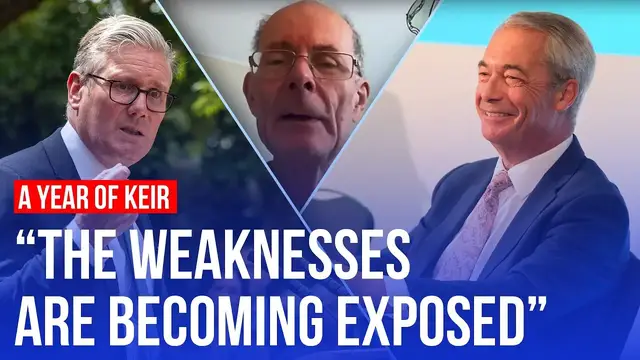
After a year of Keir Starmer's Labour government, Nick Ferrari is joined by Sir John Curtice, a polling expert and politics professor at the University of Strathclyde.
Did Labour 'storm to power' at the election in 2024?
'Oh no, they didn't...' explains John Curtice.
Listen to the full show on the all-new LBC App: https://app.af.lbc.co.uk/btnc/thenewlbcapp
#nickferrari #johncurtice #polling #ukpolitics #keirstarmer #labour #nigelfarage #reform #LBC
LBC is the home of live debate around news and current affairs in the UK.
Join in the conversation and listen at https://www.lbc.co.uk/
Sign up to LBC’s weekly newsletter here: https://l-bc.co/signup
Show More Show Less View Video Transcript
0:00
Let's turn first to Sir John Curtis, who's Professor of Politics at the University of Sasscride
0:05
is the nation's leading sociologist or polling expert. Now, if I was to ask you to sum up in one word, Sir John, his first year
0:13
having watched you on television, filled for enormous times when you have to overnight
0:18
or managed to be as brief as you possibly could be and write it in a headline
0:22
one word, Sir John, what would it be? Modest. Good morning. Can you recall such a choppy, chaotic first year for a prime minister
0:35
Well, if we talk about a chaotic first year for a prime minister, clearly Gordon Brown's first year was relatively chaotic
0:42
because you'll remember that shortly after coming into office, he allowed a lot of speculation to arise about whether or not
0:47
he was going to call an early election. In the end, bottled it and his support in the polls fell back
0:52
I think the point perhaps is more illustrative of the difficulties that Keir Starmer has faced is that if you actually look at the record in the polls of newly elected governments okay so when power changes out so Tony Blair coming to power in 1997 or Margaret Thatcher in 1979 or Harold Wilson in 1964 as compared with those precedents no previous newly elected government has seen its support in the polls fall away as rapidly as Labour has And that despite the fact now you said in your introduction to this item Labour stormed to victory Oh no they didn They managed to creep into Dan Downing Street
1:34
on the back of the lowest share of the vote that any majority government has eventually got
1:38
And I think as you also quite rightly said, in the end, this was, last year was an election that the Conservatives lost
1:45
And in fact, in many respects, it was Nigel Farage who paved the way
1:49
for Keir Starmer's victory because it was reform who took the bulk of votes off the Conservatives
1:55
About one in four of those who voted Conservative in 2019 switched to reform
2:00
as compared with the one in eight who switched to Labour. And reform, by taking so many votes off the Conservatives
2:06
but not doing well enough themselves to be able to take much in the way of seats
2:11
off the Conservatives, paved the way for Labour to have this substantial majority
2:16
So we were always looking at a government whose support in terms of size was relatively low
2:24
And I think we were also looking at a government that had never really sealed the deal with the electorate
2:30
The electorate 12 months ago was still saying, we're not quite sure what Labour has done for
2:35
They certainly weren't, Keir Starmer was certainly not particularly popular. and in so many respects the weaknesses that were evident in Labour's position exactly 12 months ago
2:46
when they won the election those weaknesses have simply become exposed under the pressure of government during the course of the last 12 months What do the numbers now indicate could take place over the next 12 months Sir John
3:01
Well, at the moment, the Labour Party are running at 24% in the polls
3:04
That's 11 points down, and there are six points behind reform. Though in truth, reform are still doing more damage to the Conservatives than they are to Labour
3:14
And indeed, actually, I heard your headline saying that the proportion of people who voted Labour last year who regret their votes gone up from 24 percent in January to 30 percent
3:23
Now, that's consistent with the polls. Labour were already down to 26 in January and they're running at 24 now
3:30
The question now, the problem now for Labour is that with reform at 30 percent, as opposed to the 15 percent last year, that's reform doing well enough
3:39
even though they're taking votes primarily off the Conservatives, that's enough for reform to take a lot of seats off Labour
3:44
And we had a poll from YouGov last week which suggested the reform
3:48
we could potentially get about 270 seats. Labour would be losing a very large chunk of its current parliamentary party
3:56
Now, all that said, one thing we should have taken away from the last parliament
4:01
is do not try to forecast the outcome of an election on the basis of what happens in the first half
4:08
Boris Johnson was never consistently behind Labour in the polls for the whole first two years after the election in 2019 And then along came Partigate and along came Liz Truss And the rest is history and of course that again fundamental to Labour victory So I mean I think the slightly deeper answer to your question
4:26
is that Labour did inherit a very very difficult position and again to that extent at least one
4:33
always wondered whether Labour were going to hit electoral trouble sooner rather than later
4:38
The economy was flatlining, it's still largely flatlining. The health service has high weighting
4:44
is it still has relatively high waiting lists. And unless and until Labour can persuade the electorate
4:50
that they really are making progress in those two areas, and so far they have not really succeeded in doing so
4:56
We've still got about 70% of people saying, no, no, no, they're not handling these things terribly well
5:01
Unless and until they can turn thus around, then Labour are going to struggle
5:05
but they've got four years in which to try to do so
5:09
Lastly, briefly, if you can, how realistic is the prospect that many are talking about
5:13
of a Nigel Farage victory in the next general election, whenever it might be
5:19
It's certainly possible if Labour don't turn things around. We have to remember that under our fragmented politics
5:25
the 30% that reform have is potentially enough to come first and potentially enough to have most seats
5:33
though not necessarily an overall majority. So certainly Nigel Farage is now one of the competitors for power
5:39
between now and 2029. John, as ever, thank you so much. Professor John Curtis, Professor of Politics at the University of Strathclyde
5:45
the nation's leading poll watcher
Government
news
Politics
Political Polls & Surveys