Up next in 10



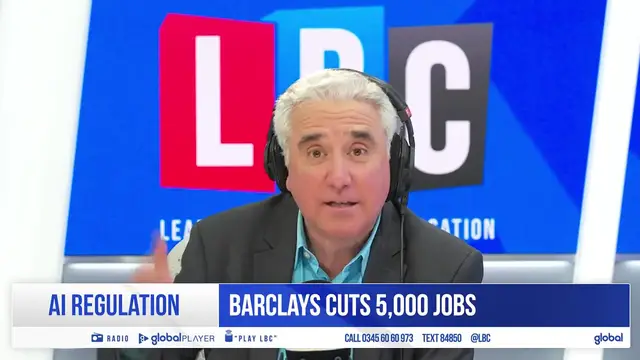
Simon Marks and LBC callers react to the news that Barclays will cut 5,000 jobs by the end of the year in a major AI-driven cull.
00:00 | Simon asks whether we should let tech billionaires keep getting wealthier while people are losing their jobs
03:58 | Piers Linney says AI isn't necessarily a good or bad thing, but that it is inevitable
14:10 | Caller Max says that Simon is 'scaremongering'
20:02 | Caller Tommy thinks people need employment to 'give them a reason to get out of bed'
25:11 | Caller Sam isn't convinced the British government is powerful enough to do anything about AI
30:38 | Simon doesn't think being sceptical about AI makes him a 'luddite'
The job cuts at Barclays is the equivalent of 5% of all of its employees. It comes as the banking group reported a pre-tax profit of £2.3 billion for the three months to the end of September, which was 12% higher than the same period a year ago.
Group chief executive CS Venkatakrishnan, known within the bank as Venkat, said this was "a result of the investments which we've made into technology over a number of years and which we continue to make".
Venkat said the tech investment involved "modernising our platforms and harmonising our systems and having simpler and better processes".
He added, "AI has an important role to play and may have a more important role to play in the future."
Listen to the full show on the all-new LBC App: https://app.af.lbc.co.uk/btnc/thenewlbcapp
#simonmarks #artificialintelligence #technology #employment #uknews #ukpolitics #LBC
LBC is the home of live debate around news and current affairs in the UK.
Join in the conversation and listen at https://www.lbc.co.uk/
Sign up to LBC's weekly newsletter here: https://l-bc.co/signup
Show More Show Less View Video Transcript
0:00
Where is the national conversation about AI and what it is going to do to many of us
0:10
Where are our voices, all of us, in a democracy, in being able to say to governments
0:19
you need to get hold of this, you need to regulate this, you need to have a strategy
0:25
You need to decide. Are you going to take up Bill Gates on his suggestion that legally certain jobs should be the preserve only of human beings as opposed to AI
0:37
Or are we just going to let Elon Musk, Sam Altman, Dario Amadei, Mark Zuckerberg, all the rest of them
0:45
are we just going to let them earn more and more money and accrue more and more power
0:51
while more of you lose your jobs to AI? Because that's happened today to 5,000 people working for Barclays, and it could happen to you tomorrow
1:03
I am genuinely angry about it. Barclays made headlines in all sorts of ways today
1:08
after announcing that 5,000 jobs are going at the bank. That's the last thing the Chancellor of the Exchequer wanted to hear
1:16
days before John Healy delivers his first budget. But it's also down to AI
1:22
In announcing what it called an efficiency drive, the bank embraced its best David Brent
1:28
and told the public that it is, quote, committed to helping colleagues develop and build rewarding careers
1:35
while meeting the changing needs of customers and clients, unquote. Whatever that means
1:41
The bank said 1,000 of the jobs have already gone and the other 4,000 will be cut by the end of the year
1:47
Most of them are here in the UK. And Barclays says they are mostly people in operational and functional roles
1:55
Whatever that means. The bank's group chief executive was a little bit more plain spoken when he said the reductions are part of a greater drive for profitability, no surprise there, and the result of investments we've made into technology over a number of years and which we continue to make
2:16
AI, he said, has an important role to play and may have a much more important role to play in the future
2:26
Translation, the axe is likely to swing further as AI gets its teeth more firmly into the bank's operations
2:35
Now, we've seen other layoffs in the past few weeks, but it seems to me that this, because it is so tied to AI
2:41
may be the real canary in the coal mine. We're destined to see more and more of this as entirely unregulated and unrestricted AI behemoths start proving that they can do so many of the things that you can do for a fraction of the cost
3:00
How far do you worry that this AI jobs cull is going to go
3:05
Are you worried that it's coming after your job or do you think that you are in a job that AI could never do
3:13
What measures do you want the government to take to try and slow things down
3:17
Bill Gates said a few weeks ago that he believes a certain number of roles in society should be officially reserved only for humans
3:28
They should be declared the preserve only of human beings in a bid to make sure that AI never engages in those activities, even if it might be able to do so
3:40
Now, I haven't heard another whisper about that since he made what I thought was a very interesting proposal
3:47
How worried are you tonight after hearing that news today from Barclays
3:51
5,000 job losses that the large language models of AI are going to put you out of a job
3:58
I'm delighted to be joined by Piers Linney, MBE, co-founder of Implement AI
4:04
He starred on TV's Dragon's Den and Implement AI is a platform that lets businesses hire AI workers
4:13
Mr. Linney, it's great to see you again. Thanks very much for being with us on LBC tonight
4:18
I mean, this Barclays news, this 5,000 jobs going in what is clearly an AI efficiency drive
4:27
It's just the beginning, isn't it? Good evening to you. Thanks for having me back
4:31
Well, it's a bit, it's not exactly clear whether it's all AI. I think they called it the icing on the cake
4:37
But I think, and you've seen this in the US as well. Now, some people have said they use it as an excuse to sort of take jobs
4:42
I'm not saying Barclays are doing that. But I think this is definitely the sort of, is it a thin end of a fat wedge
4:48
And I think you are going to see more change. I'm a lawyer by training, right
4:52
And law firms are very sort of triangle-shaped, very sort of fat bottoms of trainees and a few partners at the top
4:58
and they're going to be sort of diamond shaped quite soon, whereas a lot of sort of middle lawyers, a few partners
5:03
and not many trainees. So what you're seeing are fewer, fewer entry jobs
5:07
But what AI is very good at is it's repetitive. It's the mundane
5:13
It's those jobs where, you know, people do them, but these are the linear, clean kind of workflows
5:20
AI is very good at it. So we deploy AI workers into sort of medium to large enterprises
5:24
and they expand what humans do. They augment humans, make them better what they do
5:30
But also they do things that humans just can't do because of the scale of it. So we're going to see more and more of this
5:35
And we as a nation, right, as you know, Simon, the productivity has not been great. We could do something about that
5:40
AI could be a solution to that. But as you see more and more of this technology sort of disperse and diffuse into the economy
5:49
we're going to have to start thinking long and hard about what this looks like in terms of jobs
5:53
You know, you can see the United, the unions, they're going to have a fight on their hands
5:57
But in the long run, in fact, actually today, AI can do probably more than half, maybe 70% of knowledge work
6:05
It's just not cleanly diffused. What's the saying? That the future's here
6:11
It's just not evenly distributed. And, Piers, just to be clear about what your Implement AI does, it puts AI workers into businesses to help them develop AI strategies for their companies
6:24
Is that what it does? Yeah, well, we're a bit more simple. So we have a platform of AI workers
6:30
It tends to be sales, support, customer success, computer use. And they kind of work together as teams, basically
6:36
But are they human workers or are they AI workers? No, these are AI workers
6:40
But as always, a human in the loop. Otherwise, like a tree falling in the woods
6:45
So we have AIs that take phone calls. They make phone calls at scale
6:50
Thousands, tens of thousands of phone calls a day. Inbound, outbound. talking to people across different sectors
6:55
healthcare, energy, you name it. So we do insurance. Is that a job-killing operation
7:05
Well, I kind of thought when we started the company, you kind of think, well, where's this going to go? But right now, what we see is most of what we do
7:11
actually, helping companies grow revenue. It's the top line. So engaging with customers
7:15
Most businesses, Simon, and if you run a business, you know there's just so much slipping through the cracks
7:20
So we help people yse it. We have yst agents. and then deploy agents to try and wring more value
7:26
out of the business you've got initially. But longer term, you are seeing call centres
7:32
A great example, we do a lot of calls. Humans answering phone calls in support or customer service
7:39
even in healthcare, actually, that's kind of going away. You're going to see driving
7:43
So this is job technology In the long run AI there no way of dancing around it is going to displace a lot of human work And I don just mean you know your sort of low workers
7:58
I'm talking about lawyers. Everything I've ever done, I've been a lawyer, I've been a hedge fund manager, I've been an investment banker
8:04
If you're wandering around earning 400 grand a year, you've got a big bullseye on your back
8:09
And to ask the question that I'm sure is on the minds of many of our listeners
8:13
Do you have any qualms about doing what you're doing? Because if you weren't doing it, somebody else would be, right
8:19
Well, you can always say that, right? That's an easy answer, isn't it? But, you know, my background
8:24
even if you know what I've done through my sort of career, I've been on the board of the government, is helping businesses
8:28
So businesses come to us because typically, and our kind of strapline is
8:34
let us help you grow your business without, so growing your workforce, we call it
8:39
but without growing your payroll. So the secret sauce, what we try and do, It's helped you grow your top line, but detach your cost base
8:47
And your cost base, increasingly, as we all know, is often hiring people, which is becoming more expensive to do
8:52
It's very rare, rarely, currently, and that might change over time, that people are getting rid of people
8:57
What they're trying to do is redeploy that human resource that's expensive to hire, to train, to maintain
9:04
and to do more, I'd call it more meaningful work. So I would say automate the mundane and let humans do the meaningful
9:11
but over time the technology is going to get better and better at doing all work and that's
9:17
we're talking about knowledge work okay we're about to start deploying quadruped dogs in in
9:22
for security purposes so when they see something or notice something they should they shouldn't be
9:26
there at four in the morning or who are they going to talk to so they talk to an AI worker
9:31
that triages the situation and decides whether to call wake up a human but there must surely be
9:38
businesses that you're working with who hear your uh strap line you know um grow your business
9:44
without growing your payroll and in fact they say to themselves i'll grow my business and i'll reduce
9:49
my payroll so i mean that would be normal yeah so they're dancing around it sam so if you've got
9:54
people for example let's give real examples right if you've got somebody or seven people sitting in
9:59
a room listening to phone calls all day transcript transcriptions of phone calls and making notes
10:05
about what was said for compliance, for training, for whatever reason. Humans no longer need to do that
10:12
AI is much better at transcribing it and ysing it in multiple dimensions
10:16
at scale, every single call, not a selection of them. You don't think about what do they go and do
10:22
But the humans who are no longer, exactly. I mean, so the humans who are no longer doing that work
10:26
are no longer going to be earning income and therefore are not going to be contributing income tax into the Treasury
10:34
We've seen this proposal from Bill Gates to preserve certain jobs for humans only
10:41
There is no, as far as I can see, government strategy at this point for dealing with developments that are inexorably
10:48
and I suspect faster than people understand, going to reduce the tax base at a point where we're pretty broke as a country to begin with
10:59
So where does all that go? And what do you think, even while you're engaged in this work, what do you think the government should be doing
11:07
Well, I think the government should be taking it far more seriously. OK, you see these like the US and China, they see this as like a Manhattan project, almost like a zero sum game
11:17
If they get to what they call artificial super intelligence, this is beyond Trump's super intelligence
11:21
um then they see that as this is going to be the sort of tool almost almost like a weapon almost
11:27
that means that they can then control the all the global economy so that's happening what i don't
11:33
see the way i look at it sam is this right if we solve or create artificial super intelligence
11:39
this is like a new species right it will do things in ways we'd understand there'll be some great
11:44
news it'll solve most diseases will live longer but we won't lose like we both have done quite
11:49
our fathers when we didn't particularly want to they'll live a lot longer people won't die people
11:54
won't die of silly reasons and diseases so there's some good upsides to it but the economy is going to
12:01
change completely if you go to an extreme people write about what they call a post-labor economies
12:07
so if you think about a new species going to land on earth in five even ten years we'll be having a
12:14
lot more conversations about it and we're not and i just don't see it it's as if you know it's not
12:18
going to happen and it is happening and i think what you've seen is this kind of blip of productivity
12:23
and work and you know you've seen more developers people writing code as this tech started to
12:28
diffuse into the economy but i think eventually you're going to see it drop off because this idea
12:33
of jevon's paradox where if you create more um it's like men with bigger bin liners right you
12:39
get more bigger bin like you'll always fill them that will happen in some cases but that ongoing
12:44
demand will not complete rising if supply rises. Most work, as you create more
12:50
supply, demand doesn't change. Why is any of this a good thing
12:56
Well, whether it's a good or a bad thing, this is inevitable
13:01
Simon. But it's not inevitable, because governments exist to protect the security of the people
13:11
that they govern. and this does not sound to me like it is technology
13:15
that is going to do anything other than attack the personal security
13:19
I mean that in a broad sense of all of us. We're looking for the window of our current system, right
13:26
And that's going to have to change. And the good news is we're going to live longer. But do any of us get a voice in that
13:32
Do any of us get a choice about that? While Elon Musk and Sam Altman and the others are, you know
13:38
where's our voice? Well, the biggest problem, one of the biggest problems is
13:42
is as you create this technology, is wealth is going to become more concentrated
13:47
and that will be the big issue of our time. That wealth cannot be concentrated
13:53
It's got to be distributed somehow more fairly and that's going to be the thing where you will see people in the streets at some point
13:59
Oh, that's just never going to happen. Piers Linney, thank you very much indeed for your time
14:06
I always learn something when I talk to you, even if it is somewhat horrifying
14:10
Let's go to Dubai. Max is there. Evening to you. How are you tonight, Max? Very well, thank you, Simon
14:17
Simon, why are you scaremongering so much? Well, I'm not scaremongering, Max
14:23
5,000 people at Barclays have lost their jobs today. Yes, but is that actually due to AI or is that due to cost-cutting
14:33
Well, there's every indication from what the chief executive at Barclays has said
14:37
that AI absolutely played a role in this. He said, I'm just finding the quotes here now, the reductions are part of a greater drive for profitability and the result of, and this is a quote, investments we've made into technology over a number of years and which we continue to make
14:58
AI has an important role to play and may have a more important role to play in the future
15:06
I mean, you don't have to be a psychic to understand what he's saying
15:12
That's about 17, 18 words, probably out of a statement of about 300
15:17
And you are, honestly, you're rattling the cage and you're making everybody worried about something which will actually add employment
15:28
How's it going to do that? How it going to do that Because Piers Linney who running a company that is providing businesses with AI workers conceded earlier in the hour that absolutely jobs in large numbers are going to disappear Because OK OK so I reverse a bit if you give me time
15:51
I'll reverse a bit. That's exactly the same argument. And that's exactly the same nonsense
15:56
that was made 100 years ago, 150, 200 years ago, about the railroad
16:03
about telecommunications, about the computer. But it's not the same. No, wait, wait, wait
16:09
No, no, it's not the same, Max. It's not the same. It's the advancement of technology
16:13
It's not the same. It's not the same because the railways were regulated
16:18
and the railways created loads and loads of jobs for loads and loads of people
16:23
I wouldn't be sitting here tonight if the printing press hadn't been invented
16:30
But this technology, where are the jobs being created by this technology
16:36
OK, will you give me a second to explain or answer your question, will you
16:41
You've got it. OK, so when did the printing press get regulated after the printing press
16:48
after Gutenberg was actually invented? When did telecom get regulated after telecom was invented
16:56
When did the railroad get regulated? Well, telecom's always been regulated. I mean, telecom was regulated in America
17:02
They had to break the telecommunications apart because they were amassing so much power
17:08
and they belatedly regulated them. After. It's so hot. You don't regulate to stop innovation
17:17
You allow innovation. You allow job growth. You allow people to explore and then you regulate
17:24
You don't fundamentally stop innovation. So you've got no issue, Max, with this report from the United States tonight
17:31
that AI agents are breaking into individual Americans' bank accounts and engaging in transactions that the account holders have not authorised
17:42
We should just let it rip. Just let it go anywhere that it wants to go
17:46
Do whatever it wants to do. if it wants to release a bio... I mean, this is the Sam Altman argument, right
17:51
Release a bioweapon. Well, we'll clean up. It'll all be OK. Just let it go
17:57
Do you think that it is that or that? Do you genuinely think it is either everything or nothing
18:03
Well, no, I don't think it should be nothing. I think it should be regulated. I'm not saying that it should be nothing
18:09
I'm not doing that at all. I'm saying it should be regulated technology
18:15
Bill Gates, a man who knows far more about this than I do, and I suspect probably than you, Bill Gates says this is such dangerous technology in terms of what it's going to do to jobs that some jobs should be reserved only for humans
18:33
That would be sensible regulation. Why is he wrong? Do you know that
18:37
OK, one second. Do you know the context of what he's talking about? Yes
18:42
what we're witnessing today. The context in what he's talking about is what we're witnessing today
18:47
No, no. What is the specific context for that very statement that Bill Gates gave
18:52
That he's deeply concerned about the impact of job killing that AI is going to engage in
18:58
No, no, no. The very context, the specific context is where very specific intelligence
19:03
is being dealt with. That's what Bill Gates is talking about when he made that quote
19:10
But I don't understand what you're talking about. He's talking about, yes, he's talking about very specific roles being preserved for humans only
19:20
Why is he wrong? Yes, yes, we're very specific roles with very specific intelligence that you don't want to escape to other people or other actors
19:29
Well, no, no, no, that's not what he said, Max. With respect, that's not what he said
19:33
He was talking about, for example, one of the examples he gave was, you don't want to be told you've got terminal cancer by an AI agent
19:42
That was the example he gave. Yeah. Very specific roles in very specific circumstances
19:48
So that's regulation. I'm glad we agree. I'm delighted we agree, Max
19:52
There should indeed be some degree of regulation. Max, thanks for calling in. It is always entertaining to joust with you
20:00
And I hope you'll call up again. Tommy is a first time caller in Bournemouth. Tommy, good evening. Thanks for calling LBC. What would you like to say
20:07
hi there yeah with regards to ai i um i don't think it will be taking every job um you know i'm
20:15
i'm in the removals game and um the handyman service and i just i don't see it playing any
20:20
role with regards to you know helping me from a physical standpoint um but going back to the
20:27
gentleman that earlier on that you just had on that said it was just the thing um yeah it is just
20:32
the thing that can do great things but what's the the damage that's going to be had on society
20:37
as a whole um you know in 10 years time where we've got children that already don't need to
20:44
go and knock on their friend's door you know adults that don't need to go out socializing
20:48
through technology and now we've got artificial intelligence that doesn't even need you for
20:53
yourself to be educated you know you type it into a screen you press a button and it gives you the
20:58
answer. And Tommy, worse than that, artificial intelligence, which according to the American
21:03
News website Axios tonight, is breaking into people's bank accounts to the point where banks
21:10
in the United States are apparently all racing around with their heads on fire saying, what are
21:15
we going to do to get these AI agents out of people's bank accounts? I mean, this is totally
21:20
out of control. I mean, it's literally out of control and unregulated. Yeah, I mean, my biggest
21:28
concerned with it is the damage that's going to be had to people's mental health you know as a whole
21:33
because we all need a purpose in life totally you know we all need something to get up for in the
21:38
morning you know like if i have a week off work uh my partner's dying for me to go back to work
21:43
because i've become depressed because my you know my regular day my regular something to get up for
21:48
and go go to work for and bring an income in for my family that fills me with pride you know it
21:53
gives me a purpose you know and i just feel that i mean it's been spoken about by elon musk with
21:58
regards to universal basic income um is going to be inevitable was the words that he used and you
22:05
know going when you look at the i mean the uk at a minute with regards to personal independence
22:10
payments they're just getting handed out willy-nilly i mean i know some people that you
22:15
know very questionable as to why they're on it and although i'm not a doctor you know i i just feel
22:20
that were kind of already preparing society for not being employed. You know, the government's handing out money very easily in today's world
22:30
Yeah, but where does that money come from, Tommy, in an environment in which people are being laid off at pace and at scale
22:37
and therefore they're not paying income tax? I mean, once you lose the tax base
22:43
there isn't going to be any money to pay people benefits. It's I mean, how do you fund universal basic income
22:51
You've got to find a way of doing it absent a tax base if hundreds of thousands, millions of people are going to find themselves losing their jobs
23:00
So who is it that's benefiting from all these AI rollouts? Is it the tech elite
23:05
Absolutely. I think I think we can I think we can see very clearly who's benefiting from them
23:09
So could it be them? Well, that's right. I mean, that's where you have to go
23:14
Clearly, then you have to start taxing them to provide the tax base
23:18
Mary's texted in to say we've just had two major banks announce the same thing here in Australia
23:24
Thousands of jobs gone Paul in Taunton texted in to say what is the point in living longer without purpose or mobility I mean he right isn he
23:34
Yeah, totally. You know, I mean, I've got a 13-year-old daughter and, you know, she was being a little bit naughty about a year ago
23:43
and I took a phone off her for 10 months. And within that 10 months, I discovered that she's a fantastic little artist
23:49
She learned how to cook spaghetti bolognese from scratch. you know her her whole attitude towards life completely done a 180 you know and then she
23:58
become the little girl that she was before technology took hold of her life and i think
24:03
that any parent that's listening to this should maybe just sit back for five minutes and think
24:08
when their child comes in from school do they come in and sit with mum and dad and the rest of
24:12
family or do the majority of them go upstairs and they're lost for the next however long buried
24:17
face buried in the phone. That's the society I feel we're now living in. I couldn't agree more
24:23
Tommy. Thanks so much for calling in. Tommy, a first time caller, hopefully not for the
24:27
last time that he will call us from Bournemouth. I mean Vivian has just texted in from Edinburgh
24:33
to amplify what I was just saying. Where is the national nay global
24:39
conversation about what we actually are living for? She says Angela Merkel, the former German Chancellor, used to say that the economy should be there to serve the people and not vice versa
24:54
Now it seems we're all there to watch on while AI helps the economy to serve itself and its wealthy masters
25:03
What price culture, the arts, sports for fun, etc. That's from Vivian in Edinburgh
25:10
Let's go to Sam in Southwark. Good evening, Sam. Hey, can you hear me
25:15
I can indeed. Cool. I used to work for an AI lab
25:22
And so I spent a lot of time in the space. I think the world or maybe history has gone through a lot of these periods of rapid change
25:32
where people have lost their jobs kind of en masse and then recovered from it
25:38
Maybe I think what's different about this case is we are building
25:42
we being the AI community are building intelligence in terms of traditional IQ points in domains like maps
25:51
and encoding that surpass our own. And so that leads to the lack of control that you guys see
26:01
and you mentioned through the attacks. I basically... Sam, can I just interrupt you for one second
26:09
Yeah, sure. The lack of control is a conscious choice on the part of governments
26:15
I mean, the American government, the British government, the lack of control that they are exercising over these technologies is not passive
26:26
It's a decision. It's a decision they've made not to control them
26:31
Yeah, agreed. I think, look, it's profit-seeking and we are motivated in the West by profit broadly
26:40
And so it does require regulation. Where I disagree with what you're saying so far is that I'm British, as you can hear
26:52
I'm unsure whether Britain has the power to do anything as much as we keep resisting data centers
27:00
So if you think about what is the lifeblood of AI, it is compute
27:05
And compute is data centers and chips and production of those chips
27:10
And so owning that compute gives us the right to turn off that lifeblood
27:15
And so as long as we don't build data centers, we have no seat at the table
27:21
And so we must. And we don't. And because of fair reasons, right
27:27
Like whether it's climate change or whether it's many other reasons, and I'm fully in support of tackling climate change
27:33
But we have to build data centres because therefore OpenAI, Anthropic and DeepMind and XAI and Meta must serve through us
27:43
But the construction of data centres can take place while AI is being regulated
27:53
I mean, you're going to need data centres whether you have regulated AI or unregulated AI
27:58
My view is the sooner the government comes up with a strategy for figuring out which jobs it's going actively to try and protect, how it's going to deal with the tax base and the tax base and how it's actively going to engage in some degree of regulation of this industry
28:16
that to me is of paramount importance. You know, we can all have the national conversation
28:20
about data centres and we should have it. And clearly some data centres are going to be needed
28:25
But do it in a regulated environment. Then if we regulate it
28:32
we must do it in accordance with the whole world. We have things like tragedy of the commons
28:36
which is why climate change hasn't been solved. And so you need the whole world to subscribe to this
28:42
including China, including Saudi Arabia, including the US. Right. But my understanding is, Sam, that the Chinese actually have quite a bit of regulation in place for AI
28:52
They're not going the full Wild West approach, are they? I'm not sure about that. Up until now, the Chinese labs haven't been able to compete because what they've done is using a method called distillation, which basically is kind of like copying, right
29:07
They copy the best in class models that have happened in the West. What we'll see in the future and very soon is that there's a lack of energy in the West because for the past 50 years, we've had like we've all been very developed and therefore we haven't grown energy usage as much
29:26
Whereas in the East or more broadly, they've seen massive population growth and therefore have built infrastructure to overshoot the energy requirements as a population
29:37
And so they've actually been building energy as if they're going to grow massively
29:42
And that's come to fruition in this AI world. And so China can wait
29:48
They can wait until we run out of energy, we'll run out of chips, and then they can take the lead
29:56
Right. And so that's the issue. But it still seems to me that if we continue to engage in Wild West behaviour, that is going to be a completely irresponsible way of doing this
30:07
And it is going to decimate societies in terms of employment opportunities
30:12
And you can't just let that happen to societies without a national conversation
30:17
I think what I'm saying, Sam, is there's got to be a really serious, code red, urgent, front burner national conversation about this stuff
30:27
or we are going to see what happened to 5,000 people at Barclays today
30:31
happening to countless thousands of people and hundreds of thousands of people all over the country
30:36
Sam, thank you so much for calling in. Rob has texted in to say, unlike previous revolutions
30:41
AI could replace both manual and intellectual jobs, potentially leaving millions without work
30:47
If machines do the work and people have no income, who will be left to buy what they produce
30:54
You know, Max in Dubai thinks I'm a Luddite. I'm not a Luddite. I'm not saying unplug the stuff, although I will get to the point where I say unplug the stuff if you don't regulate it
31:06
I'm saying regulate it. Be responsible about the rollout of this, even if that causes Mr. Musk and Mr. Altman and all the others to earn just a little bit less money out of it
news