Up next in 10


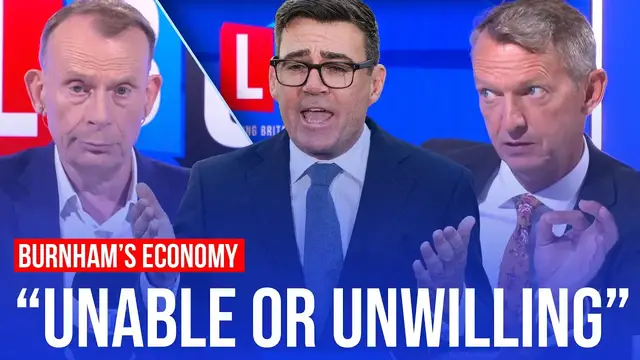
As economic stagnation drives the state pension above £13,000 a year, Andrew Marr talks to Andy Haldane. Haldane is the former Bank of England Chief Economist, who has also been an advisor to the Prime Minister. They discuss the triple lock, market uncertainty, and whether Andy Burnham can do anything about it.
Listen to the full show on the all-new LBC App: https://app.af.lbc.co.uk/btnc/thenewlbcapp
#AndrewMarr #AndyBurnham #economy #uknews #ukpolitics #LBC
LBC is the home of live debate around news and current affairs in the UK.
Join in the conversation and listen at https://www.lbc.co.uk/
Sign up to LBC's weekly newsletter here: https://l-bc.co/signup
Show More Show Less View Video Transcript
0:00
Will Andy Burnham work? I don't mean, by the way, can he get re-elected. I think the continued
0:08
division and acrimony on the right of politics means that, more or less, whenever the next
0:13
election comes, another Labour government, either by itself or with Liberal Democrat support
0:19
is highly likely. No. I mean something much bigger. Will he work for the country? Can he
0:29
get us growing again, self-confident again, with a spring in our steps. During the summer
0:36
he reminded us that we like a leader who patently means well, is on our side, and enjoys the job
0:45
Kemi Badenoch has dismissed him as a people-pleaser. But given that a statistically
0:51
significant proportion of the electorate are also people, that may not be as devastating
0:58
a political put-down as she meant it to be. Nonetheless, as next month's budget hoves into
1:03
view, this is a good day to ask that bigger question. Growth just now? Not bad, but the
1:10
financial pressures on a weak economy are growing. Today, the official figures show the number of
1:16
people in work in Britain has fallen, and so has the number of job vacancies. Wage growth is
1:23
weakening. And we learn today that the UK has the highest borrowing costs since 2007
1:31
Ministers are waiting anxiously for Thursday's interest rate announcement from the Bank of
1:36
England, hoping against hope they don't raise the cost of borrowing further
1:42
So, can Burnham and his Chancellor John Healy turn this around? Some of it is the government's
1:50
fault. The rise in employers' national insurance contributions certainly hasn't encouraged people
1:56
to hire more staff. But much of it is not. Donald Trump's war on Iran continues to drive inflation
2:04
up around the world. Still, it all shows that Mr Healy has very hard choices to make next month
2:12
He needs more for defence. That's why he resigned from that job, precipitating the end of Keir
2:18
Darma's premiership. But he can't really borrow more, and the big tax rises would either break
2:25
election promises or crush business. The obvious answer is to cut government spending, but every
2:33
item of public spending has a vociferous lobby with the national media on speed dial. Will affable
2:40
popular, instinctively leftish Andy Burnham allow him to do that? Somebody who we know he
2:48
listens to is Andy Haldane, the former chief economist at the Bank of England, who advises
2:53
the Prime Minister on growth and who joined me this afternoon. Does he think the Prime
2:58
Minister and Chancellor understand the scale of the challenge ahead this autumn
3:03
Yes, well, it's got a lot steeper over the past two weeks, Andrew, given what's happened
3:08
to borrowing costs. I think the plan had been a low drama, no drama budget. I think that's
3:15
been torpedoed by events over the past couple of weeks. And that will make, I think, next month on the 28th for some hard choices from this government
3:26
Few hard choices so far, but one is looming on the horizon now about how any hole to the budget headroom is made good on
3:38
Is that a question of tax rises or is it a question of taking the knife to public spending
3:43
I've listened to John Healy talking privately and publicly ahead of the budget
3:47
He's being very cautious, of course, but he strikes me as being in himself the most pro-business Labour Chancellor I can remember probably ever
3:56
The question is whether Andy Burnham will allow him to take the knife to public spending if that's what he goes for
4:02
Yes, I agree with that. And I think the Chancellor's speech last Monday bore testimony to that
4:10
talk of the need to unshackle the risk takers the very risk takers that have been taxed by this government over the past two years Indeed that language was echoed by the Prime Minister himself just yesterday ahead of the Business Leaders Summit
4:30
So I think there's hope there in the words that are used. But let's be clear, we've heard some of those words before
4:37
Just how friendly is business-friendly socialism? Very good question. And ultimately, that will hinge on actions rather than words
4:48
The truth is, and the reason for real optimism about this government's growth prospects is because the private sector, businesses and households were in relatively rude financial health
5:01
The government's balance sheet is shot to pieces, let's be honest. But the private sector balance sheet is in pretty good shape
5:09
And the key, therefore, for this government is to enable companies and households to put that balance sheet to work, to stir and revivify those animal spirits
5:21
If they do that, Andrew, then growth will come. Given the surrounding fiscal problems and given the bond markets and the rest of it, does that not mean there's going to have to be another look in some form at the fiscal rules to encourage investment
5:36
Not day-to-day spending, but investment. As you and I have discussed before, I think both the rules themselves and the framework within which they sit are far from optimal
5:46
In fact, I go as far as to say silly. But in the hostile global environment for borrowers, now is not the time for bravery in altering them
5:58
That risks. Too much. At this stage, it is too much. Down the line, perhaps, but not at this moment
6:05
which leads you to a straight choice between doing something with tax
6:12
and doing something on the spending side. Let me ask you about each of those in that case
6:17
On the tax side, there's all the big promises, perhaps unwise promises
6:22
In fact, certainly unwise promises made in the Labour manifesto. But it seems to me that a new Labour prime minister coming in
6:29
not having won his own general election, simply can't tear up that manifesto without political outrage
6:35
of a kind of very, very dangerous kind, which leaves business taxes
6:39
And yet business is already quite heavily taxed. And all the voices that John Healy is hearing will be saying
6:46
no, no, no, please don't go any further. So it seems to me that he has very, very limited room for tax rises of any kind
6:52
That is quite right. So if the manifesto pledges on tax are stuck to..
6:59
By the way, I think Andy could have got himself off that hook had he done so very early on
7:07
Having committed, walking back from that now, I think, is a step too far
7:10
Did he make a mistake by not immediately saying, as he became prime minister, by the way, this is a new government, this is a new leadership, and I don't think that we can make those promises on tax
7:20
I think with hindsight, that may have been a more propitious course to have taken, as it was actually with Rachel two years earlier
7:28
I understand the political cost of that, but equally, you know, his stock of political capital is as high now as it ever will be
7:39
Yeah, this is the moment in the sense. If you're to do it, this is the moment. I suspect on that the moment may have passed
7:44
What you're left with is a ragbag of taxes, which actually by themselves may not even be enough to make up for the size of the whole
7:54
They would infuriate very vocal individual groups who will be in all the media complaining about it
7:59
I'm thinking of the farmers last time, right? That kind of thing without actually solving the problem
8:04
Well, and they would stick in the crawl, not just of business people, but what's already been said by both 10 and 11 Downing Street over the course of the last seven days
8:17
If you serious about providing confidence to the risk takers then imposing windfall taxes on oil and gas or on banks or upping capital gains tax would turn that on its head and repeat the mistake that Rachel made when she came in used the language of business friendly then ramped up NI She wasn forgiven for that and nor would be the current occupants of 10 and 11
8:46
whether to repeat that trick on the 28th of next month. So if you were asked by Andy B
8:51
there are too many Andes involved in this conversation. There's never too many Andes. Perhaps. If you were asked by Andy B
8:57
do you think I should raise taxes? Your answer would be no. Definitively no
9:01
Definitively no. So let's look at the spending side. Yes. Because Lord Hutton, John Hutton, was sitting in that chair the other week and he said there are lots of areas of government spending that could be pruned or cut back entirely
9:14
He cited £4 billion, not on cycleways, but on a national cycling and walking plan
9:22
And he said, and I said, are there other examples like that? And he said lots. So do you think, I mean, you can't go through all the books of all the departments, of course
9:31
Do you think there are areas in government spending that Andy Burnham and John Healy could cut without absolute uproar on the Labour benches and possibly losing the majority in a key vote
9:40
Listen, any step in that direction would cost you something in capital, political capital with the backbenchers and beyond, possibly
9:47
Ultimately, it's only by taking actions that come with a political cost that you convince financial markets that you are serious
9:59
The Achilles heel, the fiscal Achilles heel of this government thus far has been its unwillingness and or inability to cut public spending
10:10
Within financial markets, we've gone from the cautious optimism of the summer months to the studied skepticism of September
10:21
Show us something real. Show us it's for real. You know, the market now suspects that this is a traditional tax and spend socialist government with better TikTok videos
10:33
Right. It will only be an act of doing something on one of the big spending departments
10:42
It could be welfare. It could be triple lock and pensions. It could be NHS. It could be an across the peace productivity improvement across the public sector
10:52
Each of those individually would buy you, one, a lot of money and two, even more in instant credibility
11:00
That would lower borrowing costs, I would say in the UK, 25, 50 basis points
11:05
It would almost pay for itself as a growth dividend. Now, out of all of those, I would have thought the triple lock is the obvious one to go for
11:14
given intergenerational unfairness in the system now. But, of course, pensioners vote and they are quite politically savvy and quite well organised as a lobby
11:23
Yes, that's true. I think there's a way of presenting the ditching of the triple lock
11:33
In a way, I think the previous administration did rather poorly on welfare as being part of a rounded package
11:41
Yes. And that package would be to enable action be taken with those very young people, the one million needs
11:48
So we're going to spend it on these people. and in a sense one of the things that Andy Burnham
11:53
has been able to do in the past is to make a political argument before acting
11:59
If you could make a political argument to older voters saying it's not fair on your children or your grandchildren
12:05
and if you protest, we won't be able to give them this, that would be the way to do it
12:10
I think that would help sweeten the pill. Because actually, the costs being felt by those young people
12:17
aren't just being felt by them. It's been felt by their parents and grandparents as well
12:21
We know that resonates across the age distribution. And that would, I think, help in selling what is otherwise a painful message
12:29
Truth be told, when the triple lock came in, pensioner poverty was sky high and it's done its work
12:35
That's been beaten back to a relatively low level. If not now, Andrew, then when
12:41
Yeah, if not now, when? Quite right. Now, you're outside the bank, so I can, I think, ask you about this because we're all waiting to see what happens on Thursday
12:49
Opinion seems to be assuming the bank will not raise interest rates despite the kind of creeping inflationary risk which is coming mainly from abroad not from inside the system Yes Well there what they should do do what they will do It pretty clear to me what they should be doing which is raising rates
13:06
Because inflation is too deep, too deeply inside the economy and just too high
13:12
Well, it sits today at 3%, 1% above the target. It's been above that target for more than five
13:18
years. This is a real credibility issue, Andrew. And of course, from here, the path isn't down
13:23
It is up by dint of events in all markets in the strait of the moose
13:28
So we're looking now at that going through the gears to be big figure four rather than big figure three
13:34
And a material miss of target. Already we have seen the euro area last week raising rates
13:41
We'll probably see the Fed tomorrow raise rates. And the odds of the bank doing something tomorrow have also been up over the course of the last 10 days or so
13:52
I'd say right now, somewhat contrary to what financial markets are pricing, it's a coin toss whether they go on Thursday
14:00
And if they don't, it's nailed on for November. OK, that's really interesting
14:04
Now, there's one other very technical issue that a lot of you listening won't understand
14:08
But you understand. I'm going to ask you to explain it in as plain English as possible
14:12
There has been argument going on about the banks selling gilts and whether they should carry on so-called quantitative tightening
14:20
Yes. And this matters to the government because it's about the cost of borrowing and therefore it matters to all of us
14:25
Yes. Well, long story short, the bank bought a lot of government bonds
14:33
I was part of that decision, actually, approaching £900 billion of bonds
14:41
And then a few years ago began selling them as the economy felt it could take it
14:47
And it's been selling them over the last year at a rate of around £75 billion per year
14:52
Of course, if the bank is selling bonds, that means someone else needs to be buying them
14:59
And it's adding to indigestion in bond markets and ultimately leading to the costs of borrowing in debt markets picking up
15:08
We now find ourselves with a very disturbed bond market. The bank decides on Thursday how much it will be actively selling next year
15:18
I think the expectation is we'll shrink down from 75 billion to a lower number, perhaps 50 or less
15:25
Let me ask you finally about the world economy. We've had this huge controversy over AI in the last few days
15:31
Clearly, the possibility of a sell-off of AI stocks or the IPOs being delayed is freaking out President Trump
15:40
Clearly, there is a big market problem coming up there if that happens
15:45
And we've still got the Strait of Hormuz, as you mentioned. Just a final thought on the world economy in the AI chaos
15:52
Yes. I mean, the world economy, generally speaking, has been remarkably resilient
15:58
given the slings and arrows have been thrown in its direction over the past few years. Iran this year, Liberation Day the year before
16:05
The list goes on. So among the most important reasons, certainly in the United States, for that resilience is for all the downside shocks I've mentioned, there's been a huge upside wave of AI that has sustained growth across there
16:24
Indeed, I think the fiscal problems the US faces would be even more acute if it was felt that AI bubble was about to burst and with it growth
16:35
So I think... You don't think it's about diverse? Well, I could see..
16:42
Do I think there's currently AI stocks overpriced? Yes. Do I think there's a significant dose of reality, though, in that productivity miracle
16:54
Yes, I think there is as well. You can see that in some of the data for the US. You may even be able to see some of that in the data for the UK
17:00
So I don't think outright collapse in a dot-com bubble type fashion
17:06
But could I see a slow release of air that doesn't collapse the world economy but slows it down
17:15
Yes, I could. Andy Halden, it's been great to talk. Thank you very much indeed for coming in
17:19
Thank you, Andrew
#news