0:00
Thailand has another top men's singles
0:02
player coming up and his name is
0:03
Panitchaphon Teeraratsakul.
0:06
This has been a breakthrough year for
0:08
with three runner-up finishes and two of
0:11
them being super 500 tournaments.
0:14
He has caught many people's eyes already
0:16
with explosive attacking gameplay
0:19
that has had some even compare him to
0:21
players like Lin Dan and Lin Chun-Yi.
0:26
Now for the sake of this video, we're
0:27
going to call Panitchaphon Teeraratsakul
0:32
The focus today is primarily his
0:34
gameplay at the recent 2026 Malaysian
0:36
Masters where he took down players like
0:38
Christo Popov and eventually lost to Li
0:41
Shifeng in the finals.
0:44
Let's begin with some of EQ's strengths
0:46
and what is getting him these wins
0:48
before we have the discussion about the
0:51
EQ's recent success comes at a good
0:54
timing as in the back end, we're
0:56
currently spending a lot of time
0:57
researching more deeply on exactly how
1:02
Throughout our lives as badminton
1:03
players, we've consistently been among
1:05
the fittest and fastest when it comes to
1:07
traditional fitness measurements like
1:09
sprint speeds and weightlifting.
1:12
But despite all this fitness, we would
1:14
lose to retired national team players
1:16
and feel like we're constantly under
1:18
pressure while our opponents didn't
1:19
break a sweat. It was later on that we
1:22
realized our core problem was that we
1:24
were mentally stuck in a slow playing
1:26
rhythm. But how does this relate to EQ
1:28
at the 2026 Malaysian Masters?
1:31
Well, EQ's rhythm on court is fast and
1:34
the speed in his first step was the main
1:35
contributor to his wins.
1:38
One thing we've come to realize is that
1:40
it's not just enough to be fast, you
1:42
have to be fast at the right time.
1:45
And to many of you, this may sound
1:50
your initial split step in reaction to
1:53
has to be the fastest part of your game.
1:56
You can't have a slow split step and
1:58
then try to compensate by moving faster
1:59
in your second step. That faster second
2:02
step will be detrimental to your final
2:04
when you actually play your shot, where
2:06
you may no longer be able to control
2:09
and recovery movement.
2:12
Mastering timing though is one of the
2:14
hardest parts of the game and there are
2:16
levels even among pros.
2:19
We attribute EQ's wins against Lu
2:20
Guangzu and Christo Popov primarily
2:22
because his initial reaction on many
2:24
shots was much quicker than his
2:25
opponents and enables him to gain
2:27
control of the rally.
2:30
And to understand this, let's look at
2:38
Thai singles players are historically
2:39
known for playing a box style with high
2:42
use of fast, flat pushes and quick
2:45
attacking shots in the back court
2:47
designed to cut and feed off fast
2:49
returns from their opponents.
2:51
This is exactly how EQ plays and it is
2:53
why the first step and reaction are so
2:56
In a fast box style of game,
2:59
shots are fast and flat. If you let the
3:01
shuttle past you to take a late forehand
3:03
or backhand in this faster paced game,
3:05
you pretty much lost the rally. There's
3:07
just not enough time for you to move all
3:08
the way back and then forward again, no
3:11
matter how strong you are.
3:14
That is unless if you cut off the shot
3:16
early. This is why that first step and
3:18
initial reaction is so important. You
3:20
don't want to be smashing all the way
3:21
with your feet at the baseline, but if
3:23
you're quick and cut off the shot before
3:25
it even reaches the double service line,
3:27
the shot you'll play will come at a much
3:28
quicker pace that makes it difficult for
3:30
your opponents to react to.
3:32
Now it's important that we don't think
3:34
of this first step concept as a raw
3:37
reaction and movement speed. Training
3:39
reaction speeds could help,
3:42
but this first step really depends more
3:44
on an understanding and anticipation of
3:45
the game's pace. What allowed EQ to take
3:48
down Lu Guangzu and Christo Popov
3:50
was that he was setting the pace of the
3:52
game at a much higher speed than what
3:55
Liu and Christo were prepared for.
3:57
Just take a look at this rally, for
3:59
Although EQ ultimately makes the
4:02
you can see how he is the one
4:04
controlling the rally
4:05
because he is playing at a faster mental
4:09
The higher level you get,
4:11
the more nuanced the game becomes,
4:13
where it's no longer only anticipating
4:15
what's the next shot,
4:17
but also at what time the shot is coming
4:20
Liu's rhythm on court often gives us a
4:21
sense of hit weight split go.
4:24
What happens if Liu's opponent breaks
4:27
Well, the answer is Liu will probably be
4:29
late to the next shot.
4:43
It was often the case that EQ took the
4:46
and didn't let Liu have his waiting
4:51
Liu was more often the one that was
4:55
And your chances of making mistakes
4:57
under pressure is always higher.
4:59
It was a similar story against Christo.
5:02
Typically, Christo is actually really
5:03
good at this style, but likely fatigue
5:05
and other factors has made Christo
5:07
slower in his first step. You can see it
5:09
when you look at things like body turns
5:11
and how the racket comes out in response
5:15
EQ generally has very quick movements
5:17
while Christo's had more of a lagging
5:19
feel at the 2016 Malaysia Masters.
5:35
You know, something that frequently
5:37
comes up in our comment section is how
5:39
we make the subject player look like
5:40
he's the best in the world with zero
5:44
And it probably feels was way for EQ by
5:47
An instantaneous first step that makes
5:49
him always early and constantly
5:50
pressuring his opponents. What can
5:54
Well, as Li Shifeng showed in the
5:59
The problem with EQ is that his gameplay
6:00
is pretty much limited to his box style.
6:03
And the more one-dimensional your
6:04
gameplay is, the easier it is to
6:07
Li Shifeng was almost stylistically the
6:09
perfect counter to EQ.
6:11
He is a player that's extremely
6:13
explosive and has that really quick
6:16
But he uses it more selectively.
6:19
In particular, Li Shifeng prioritizes
6:20
injecting speed in response to EQ's
6:22
flatter attacking pushes.
6:25
And when EQ is not playing those shots,
6:27
the game revolves more around control.
6:33
Li Shifeng's higher lifts and pushes are
6:35
what ultimately won him the game
6:37
and something that EQ didn't make enough
6:39
use of in his own game.
6:43
But if you are moving at max speed in
6:45
every push off, you will quickly burn
6:57
You can train your physical to handle
6:59
playing at max speed.
7:01
But just like we mentioned in our video
7:05
the best players don't just win,
7:07
they win efficiently.
7:09
And to win efficiently,
7:11
it's about selecting the right times to
7:14
Since Li Shifeng was not particularly
7:15
scared of EQ's back court attacking
7:18
when he plays a lift with good height
7:21
the gameplay was simple for him.
7:23
Tire EQ out with front and back
7:26
You can slow down the game and afford to
7:28
be a little late on your shot
7:30
if you can play a high quality lift.
7:33
Mix in some nets just to make sure EQ
7:35
isn't always just waiting back to
7:38
Then Li Shifeng just has to make sure
7:39
the shuttle does not easily pass him in
7:43
And force EQ to move even faster than
7:45
what he's capable of by redirecting the
7:48
quick shots with more speed.
7:51
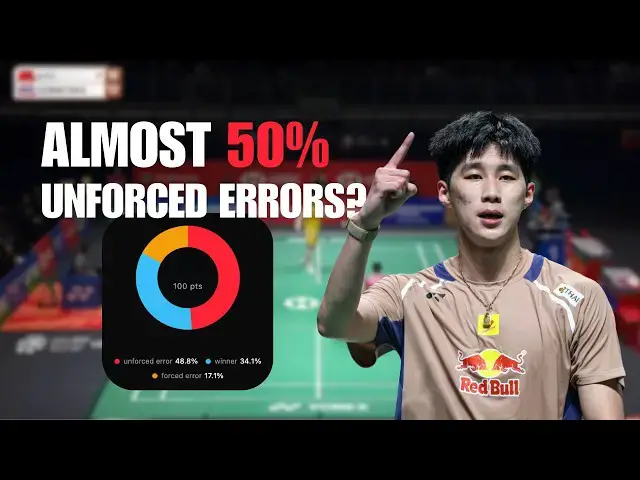
The stats support this story, too. EQ
7:53
had scored the vast majority of his
7:55
points from playing winners.
7:57
Li Shifeng, on the other hand,
7:59
scored mostly from EQ's unforced errors.
8:02
What this shows is that Li Shifeng
8:04
generally scored more efficiently.
8:07
He could get a lot of points just from
8:08
EQ forcing the attack.
8:10
Now, we don't think EQ should have
8:12
always been on the attack. He's
8:13
definitely showed the skill where he
8:15
doesn't need to constantly attack
8:17
and can play more of a patient game.
8:19
There is a tendency for younger players
8:21
to play as fast as they can
8:23
under the impression that trying your
8:25
hardest means playing full speed all the
8:28
But badminton is not always a game of
8:29
speed and power. Skill and strategy is
8:32
just as important and becomes
8:33
increasingly more important the higher
8:35
level you have to play.
8:37
If you like this video,
8:39
make sure to hit the like and subscribe
8:40
button so you don't miss out on future
8:42
content. Let us know what you would like
8:44
to see next in the comments below. And
8:46
as always, thank you for watching.