Up next in 10

👉 Unlock Deep Insights with Data-Driven Badminton Analytics: https://app.getgoodatbadminton.com
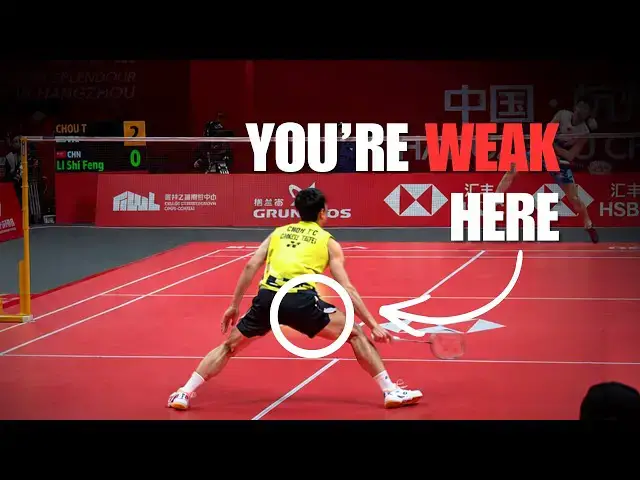
Struggling to get low and wide on court no matter how much you stretch? The problem might not be flexibility, it could be strength. In this video, we break down two neglected muscle groups, the adductors and abductors, and why they're the key to better defense, footwork, and movement in badminton. Learn how pros like Momota, Chou Tien Chen, and Axelsen maintain their low stance, plus the best exercises to train your hips.
🤝 Our Sponsors & Partners
Get Exclusive NordVPN deal here ⬇️ https://nordvpn.com/getgoodatbadminton
It’s risk-free with Nord’s 30-day money-back guarantee! ✌️
📚 Must-Read Books For Athletes
Rising Strong by Brene Brown ➡️ https://amzn.to/4cBFeAR
Ego Is The Enemy by Ryan Holiday ➡️ https://amzn.to/3GbhjvK
Can’t Hurt Me by David Goggins ➡️ https://amzn.to/3Y5YXm3
Atomic Habits by James Clear ➡️ https://amzn.to/3Y6xssC
The Power of Now by Eckhart Tolle ➡️ https://amzn.to/4lHAfmm
As an Amazon Associate, I earn commission from qualifying purchases.
📱 Check Out Our Socials
Check out our blog: https://getgoodatbadminton.com/
Facebook: https://www.facebook.com/getgoodatbadminton
Twitter: https://twitter.com/ggatbadminton
Instagram: https://www.instagram.com/getgoodatbadminton
Pinterest: https://www.pinterest.ca/getgoodatbadminton
Spotify: https://open.spotify.com/show/033oavdmYZ3tZJ00QPfapv?si=4529f2487be24b45
Chapters:
0:00 Intro
1:00 3 Reasons Why You Need To Get Lower
2:00 1st Reason
3:58 2nd Reason
5:58 Lower ≠ More Efficient
6:22 The Weakness
9:04 Solution To Tight Hips
12:04 Conclusion
Affiliate Disclosure:
Some of the links in this description may be affiliate links, which means we may earn a small commission at no additional cost to you if you choose to make a purchase through them. We only recommend products or services that we personally use and believe in. Thank you for your support!
Show More Show Less View Video Transcript
0:00
If you weren't spending hours on the
0:01
court every day since you were 8 years
0:03
old and still want to get better at
0:05
badminton,
0:06
this video is for you.
0:08
Chances are you probably heard a coach
0:09
or someone tell you to get lower and
0:11
wider on court.
0:13
Or maybe even open your hips.
0:15
Particularly when doing drills or
0:17
playing defensively.
0:18
And perhaps you took the advice and did
0:21
your best to get lower and wider, but
0:23
the lower you got and the wider your
0:25
stance became, the more restricted you
0:27
started to feel. You might have gotten
0:28
to a position where your coach said was
0:30
good,
0:31
but now you can no longer move on court.
0:33
So you end up in a narrower stance
0:35
anyway.
0:36
Some people will tell you that your
0:38
muscles are too tight
0:40
and you need stretches or massages to
0:42
fix things. It's partly true, but it
0:44
doesn't necessarily address the root
0:46
cause of your problems.
0:48
Today we're going to take a look at two
0:50
muscle groups that traditional fitness
0:51
training tends to neglect.
0:53
They are muscles that are so important
0:55
in badminton and can completely elevate
0:57
your ability to move on court when
0:58
trained well.
1:00
But before we even discuss the muscles
1:02
themselves, we need to look at why
1:05
getting low and wide on a badminton
1:07
court is important in the first place.
1:10
When you watch the pros play, pretty
1:12
much all of them hold a very low and
1:14
wide stance.
1:15
Someone like Chou Tien Chen,
1:17
despite being 36 years old and standing
1:20
at 180 cm,
1:22
will hold a position where his head is
1:24
pretty much at the net height. Other
1:26
notable players like An Se Young, Kento
1:28
Momota,
1:29
Viktor Axelsen, etc. all do the same.
1:33
And the same happens in doubles as well.
1:36
There are three main reasons why getting
1:38
low and wide is so important. First, it
1:41
lowers your center of gravity.
1:43
Second, it allows you to take a more
1:45
aggressive contact point. Third, it can
1:48
allow you to move more efficiently.
1:50
We're marking this one with an asterisk
1:52
as it is the problem that many badminton
1:54
players face.
1:56
Where getting lower does not simply
1:58
result in better movement. Let's look at
2:00
center of gravity first though.
2:03
The higher level you go in badminton,
2:05
the better and faster your opponents
2:07
get.
2:08
Players rarely play floaty shots that
2:10
you can simply walk up and do anything
2:11
with.
2:13
Center of gravity is particularly
2:15
important on defense when your opponents
2:17
are playing very fast, steep shots, and
2:20
the general idea to understand is that
2:22
moving your center of gravity down to
2:24
play a shot will often be too slow and
2:27
strenuous. You can think of it this way.
2:30
If a shot comes below your center of
2:32
gravity, there are two ways to get the
2:34
shuttle.
2:35
You can either put the load on your back
2:37
and upper body by bending down to reach
2:39
the shuttle, or you lower your center of
2:42
gravity first by squatting down
2:44
and then rotating your core.
2:46
The first way is a no-go cuz even if you
2:49
touch the bird, you generally don't have
2:51
the means to control the shuttle. The
2:53
second way is what pros do.
2:56
But the difference is that they get low
2:57
first. So, by the time their opponents
3:00
hit the shuttle,
3:01
their center of gravity is already low
3:03
and their movements are horizontal
3:05
rather than vertical.
3:07
The following rally between Axelsen and
3:09
Momota is a good one to look at.
3:11
When you watch Momota play, he stays
3:14
unbelievably low on court and it is rare
3:17
for Momota to contact the shuttle below
3:19
his center of gravity.
3:21
Even when he does have to,
3:23
it's only by a little bit and is part of
3:24
the reason why Momota can recover so
3:26
quickly.
3:27
In contrast, Axelsen during this time
3:30
had more difficulty maintaining a low
3:31
center of gravity. Against players like
3:33
Momota who are consistently able to
3:36
place the shuttle at points where
3:38
Axelsen must drop his center of gravity
3:40
to play the shot, you can see why it is
3:42
extremely tiring and difficult for
3:44
Axelsen to play.
3:46
The slightly longer recovery
3:48
may only take milliseconds for a pro
3:50
player,
3:51
but those milliseconds and the energy
3:53
consumed just add up and is often the
3:55
difference between win or lose.
3:58
What you'll also notice in this rally is
4:00
how center of gravity
4:02
affects contact point. If you maintain a
4:04
low center of gravity, the range that
4:06
you're able to contact the shuttle at a
4:08
high point relative to your body anatomy
4:11
increases.
4:13
Momota in this rally had a moment where
4:15
he was approaching the shuttle with his
4:17
racket face facing upward. These general
4:19
racket positions allow the player to
4:20
threaten many different options as you
4:23
can tell by Momota's eventual use of a
4:25
deceptive cross push.
4:27
He didn't have to, though. From here, he
4:30
could have also cross net,
4:32
lift right away, or maybe even drive.
4:35
The key understanding here, though, is
4:37
how there is a comfortable position
4:38
where playing shots at your chest level
4:40
or higher
4:42
generally gives you more options.
4:48
If your center of gravity is too high,
4:50
you become limited in when you can play
4:52
at this level where you have the most
4:54
control. In contrast,
4:56
a lower center of gravity
4:58
opens the range
5:00
to play more at your chest level,
5:02
which is generally better than
5:04
constantly bending down to play shots
5:07
below your waist.
5:09
It's especially important the higher
5:10
level you go because players have better
5:12
shot quality. You still need to be able
5:14
to pressure your opponents even if the
5:16
shuttle is relatively tight to the tape.
5:19
And by the way,
5:21
this applies to both doubles and
5:22
singles.
5:23
In fact, it's probably even more
5:25
important in doubles
5:27
because the moment you're playing shots
5:29
with your racket facing upwards, it's an
5:31
uphill battle. The shuttle has to come
5:33
up from that position,
5:35
and since there are two players on one
5:36
side,
5:38
it's easy for them to attack the moment
5:40
they see you hit the shuttle at a lower
5:42
contact point.
5:43
That's why most doubles players will
5:45
generally not spin that the way that
5:47
singles players often do and often opt
5:49
for [music] up-to-down spins where they
5:51
can play the shuttle down.
5:58
Aside from a higher contact point and
6:00
the benefits of a lower center of
6:01
gravity, getting lower on court will
6:04
also help you move more efficiently.
6:07
Here's where the problem begins for many
6:09
players. If you ever tried to stand as
6:11
wide and low like Momota or Chou Tien
6:13
Chen, it probably felt like you were
6:15
about to pull a muscle.
6:17
For the longest time, we just did not
6:19
understand how these players were able
6:21
to maintain their low and wide position
6:24
and move at the speeds they do
6:26
until we started working with various
6:27
sports scientists.
6:29
The key to these movements is in the
6:31
muscles around the hip, particularly the
6:34
adductors and abductors. [music]
6:35
The adductors are commonly referred to
6:37
as the groin muscles and help bring the
6:40
leg back toward the midline.
6:42
While the abductors
6:44
help move the leg away from the midline.
6:46
These muscles frequently work to help
6:48
players to not only push off, but also
6:50
pull them back in deep lunges and
6:53
various side-to-side movements.
7:00
Court movements are generally more
7:02
efficient when you can take big steps
7:05
with very fast small adjustment steps
7:09
rather than multiple consecutive running
7:11
steps, too.
7:12
And when you really think about how
7:13
badminton players typically move,
7:16
the importance of strong and mobile hips
7:18
becomes very apparent,
7:20
especially the adductors and abductors.
7:27
Movements are pretty much all
7:28
side-to-side and constantly require the
7:30
adductors and abductors to stabilize
7:32
your hips and legs on court.
7:35
Something that many players who started
7:37
playing later in life will experience is
7:39
that their adductors and abductors have
7:42
not been trained for badminton and
7:45
general sports-specific movements,
7:47
which can make it extremely difficult
7:49
[music] to copy some of the movements
7:51
that pros do.
7:53
Squatting, running, and even sitting all
7:56
use the hips, but they do not challenge
7:58
the adductors and abductors in the same
8:00
side-to-side way that badminton
8:01
requires. The adductors and abductors
8:03
are active in stabilizing, but all of
8:05
those movements
8:07
are pretty much front and back
8:08
movements. And as we already pointed
8:10
out, badminton is very much a
8:12
side-to-side activity. It contains heavy
8:15
change of direction. Weak or
8:17
under-trained adductors and abductors
8:18
mean these changes of direction can feel
8:21
slower,
8:21
>> [music]
8:21
>> less stable,
8:23
and harder to control.
8:28
Conversely,
8:29
stronger and mobile adductors and
8:31
abductors will give you the capabilities
8:33
to open and shift your hips to positions
8:35
you need to go.
8:37
Players who started playing very early
8:39
in their lives
8:40
will naturally have pretty good adductor
8:42
and abductor strength, as playing
8:44
badminton itself will help train those
8:46
muscles in the required positions and
8:49
activations.
8:50
Players who start later in life and did
8:52
not necessarily play a number of sports
8:55
with lots of direction changes will
8:57
inherently have a more difficult time
8:59
because those muscles are not as trained
9:01
compared to other ones.
9:04
The solution?
9:05
Spend more time strengthening and
9:06
training the adductor and abductor
9:08
muscles for badminton.
9:10
The good news is that training the
9:11
adductors and abductors is actually much
9:12
simpler than many players think.
9:15
The mistake many players make is
9:16
focusing only on stretching.
9:19
Stretching can certainly help,
9:21
but if the muscles are weak in those
9:22
positions,
9:24
all you're really doing
9:25
is increasing the range that you can't
9:27
control.
9:28
What we need to do instead
9:30
is build strength in the positions that
9:32
badminton actually [music] demands.
9:35
One of the most researched exercises for
9:37
this is called the Copenhagen plank. In
9:40
one study, athletes increased their
9:42
eccentric hip adduction strength by over
9:44
35% after [music] 8 weeks of training.
9:47
The reason this exercise is so effective
9:50
is that it teaches the adductors to
9:51
produce force while lengthened.
9:54
Which is exactly what happens during
9:56
lunges,
9:57
defensive movements,
9:58
and changes of direction on court.
10:01
However, we personally prefer thinking
10:03
about badminton movements rather than
10:05
individual muscles.
10:06
So, a sport-specific exercise that is
10:08
great for the hip adductors
10:11
is the banded lateral walks.
10:13
Not only will this train your hip
10:14
adductor strength,
10:16
but also train your capability to move
10:18
your [music] body
10:19
as one unit.
10:21
Because the adductors and abductors
10:24
don't work alone during a rally. They
10:26
work together with the hips, glutes,
10:29
quadriceps,
10:30
calves, and core.
10:33
Because of that, some of the best
10:34
exercises for badminton players are
10:36
often banded lateral walks,
10:38
Cossack squats, side lunges, and various
10:41
single-leg movements that force you to
10:42
stabilize and produce force in wider
10:45
positions.
10:46
Notice the common theme?
10:48
All of these exercises require you to
10:50
become comfortable in positions that
10:52
typical weightlifters will never get
10:54
into, but are positions badminton
10:56
athletes will frequently be in.
10:59
The goal is not to see how wide you can
11:00
force yourself into a stretch.
11:03
The goal is to become strong enough that
11:04
your body feels comfortable moving
11:07
there. Generally speaking,
11:09
an idea for physical training
11:11
is that if you can handle load at your
11:14
full range of motion,
11:16
then you will be less likely to get
11:17
injured on court and more confident in
11:19
certain movements. Of course, don't
11:21
start with a super heavy load. Start
11:23
small and gradually build up.
11:26
And this is where many players suddenly
11:28
realize that what they thought was a
11:29
flexibility problem
11:31
was actually a strength problem all
11:33
along.
11:34
As your adductors and abductors become
11:36
stronger and more coordinated,
11:38
you'll often find that getting lower
11:40
feels easier,
11:42
wider stances feel more natural,
11:45
and moving side to side requires less
11:47
effort.
11:48
You are no longer fighting against your
11:50
own body every time you try to defend,
11:52
lunge,
11:54
or recover.
11:56
Instead,
11:57
you're finally developing the physical
11:59
qualities
12:00
that high-level has been demanding
12:01
[music] all along.
12:03
So, if you have trouble holding a low
12:06
and wide stance on court, it may not
12:08
just be your glutes
12:10
or quads that are the problem. It may
12:12
also be the muscles that control your
12:15
hips side to side, especially your
12:18
adductors and abductors.
12:20
These muscles are crucial
12:22
in a multi-direction sport like
12:24
badminton, where you're frequently
12:26
moving from side to side. Players who
12:28
start very young
12:29
and play a lot of badminton
12:32
will naturally build this strength
12:33
through gameplay.
12:35
Players who start a bit later might find
12:37
it [music] more difficult as certain
12:39
muscles have become stronger while the
12:40
adductors and abductors are underused.
12:44
Fortunately, these are muscles you can
12:45
train
12:47
and improve.
12:48
Proper strength work done to help you
12:50
move in your full ranges of motion
12:52
will help you move better on court and
12:54
allow you to copy some of the movements
12:56
that pros do more effectively.
12:59
If you guys like this video,
13:01
make sure to hit the like and subscribe
13:03
button
13:04
so you don't miss out on future content.
13:07
As always,
13:08
let us know what you would like to see
13:10
next in the comments below,
13:12
and thanks for watching.
13:33
>> Mhm.
#Sports