0:00
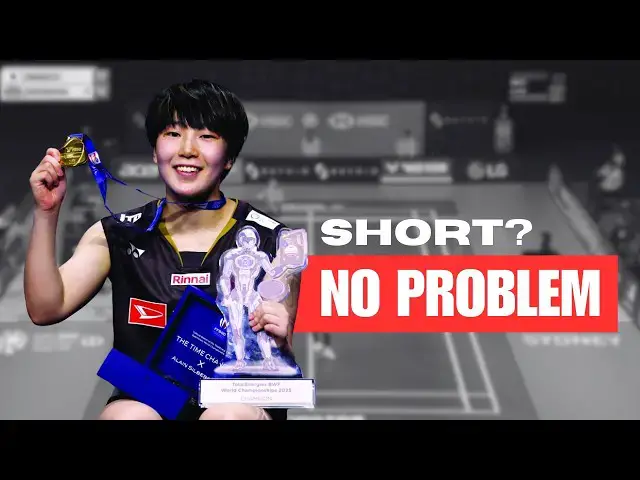
Over the last few years, Akane Yamaguchi
0:01
has been plagued with injuries. In 2023,
0:05
she sustained a right foot injury that
0:07
took her out for 3 and 1/2 months. She
0:09
then got a hip injury
0:11
in 2024 that only allowed her weeks of
0:14
full-scale training and preparation for
0:17
That wasn't the end, either. Another
0:19
right calf injury appeared at the end of
0:22
And another knee injury in early 2026
0:24
caused her to withdraw
0:26
>> at the 2026 Malaysia Open.
0:28
Yamaguchi is 29 years old now.
0:31
And she is also one of the shortest pro
0:32
players at a height of 156 cm, or about
0:36
5 ft 1 in. By all means, Akane Yamaguchi
0:40
shouldn't still be winning.
0:41
But yet, she is. Her recent win at the
0:44
2026 Australia Open now means that
0:46
Yamaguchi has made four consecutive
0:48
finals, winning two of them. And her
0:51
unique play in women's singles contains
0:53
elements we can all learn from. Let's
0:55
take a look at how the three-time world
0:56
champion and current world number three
0:59
plays to consistently contest and win
1:04
>> To understand what makes Akane Yamaguchi
1:06
good, we must first explore the general
1:08
concept of not letting the shuttle fly
1:11
In all badminton play, trying to get the
1:13
shuttle behind your opponent is one of
1:15
the main ways to set up opportunities to
1:18
When the shuttle is behind you,
1:19
you naturally don't have as many shot
1:21
options due to contact point and
1:25
In women's singles, the idea of pushing
1:27
the shuttle behind your opponent is even
1:29
more important because female players
1:31
often don't have the same capability to
1:33
produce shots like Taufik Hidayat's
1:37
And perhaps even more critically, female
1:39
players are often unable to threaten the
1:42
same attacking shots that males can
1:43
threaten when the shot is very flat.
1:47
This brings things back to Akane
1:48
Yamaguchi. Yamaguchi is both good at
1:51
pushing players to the back court, and
1:53
also not getting pushed around in the
1:55
back court herself. We can start with
1:57
the skills that make her good at
1:58
controlling her opponents.
2:01
What immediately stood out when watching
2:02
many of Akane Yamaguchi's matches
2:04
was just how often her opponents went
2:06
for a short serve. We were particularly
2:08
surprised in her match against Pornpawee
2:10
Chochuwong at the Australian Open
2:11
finals, where Chochuwong continuously
2:13
went for a short serve despite
2:14
Yamaguchi's pressure.
2:16
Akane Yamaguchi is probably the best
2:18
player in women's singles at attacking
2:20
short serves, and it really showed
2:24
What you should watch for is her
2:25
variation in rhythm of her serve
2:26
receive. On a short serve, Yamaguchi
2:29
will often receive like doubles, where
2:31
she takes the serve extremely early. She
2:33
doesn't have to play a double shot,
2:34
though, and that's where she becomes
2:37
There are the quick flat drives and
2:39
pushes, but also the ability to play a
2:47
Men's singles players will often just
2:49
cut off really flat shots, but in
2:51
women's singles, it isn't as easy
2:54
and will often require them to stand a
2:57
By standing further back, however,
2:59
then the net opens up for Yamaguchi.
3:01
Add in the fact that Yamaguchi sometimes
3:03
just waits and lifts it really high,
3:07
you're now playing against a player
3:08
that's really hard to read.
3:10
Service return, however, is just one
3:13
and we've only talked about the short
3:15
Yamaguchi is very good at taking the net
3:18
and playing multiple deceptions
3:20
throughout the rally,
3:21
but much of it stems from what she is
3:23
able to do in the backcourt.
3:25
We'd say that Yamaguchi's punch clear is
3:27
her best shot, and it's really effective
3:29
when you consider Yamaguchi's variation
3:31
and ability to play other shots,
3:33
like smashes and drops.
3:35
Now, what enables Akane Yamaguchi's
3:37
backcourt to pressure her opponents is
3:39
also what helps prevent her from being
3:41
pressured in the backcourt, as well.
3:43
When you watch a lot of Yamaguchi's
3:44
games, what you'll notice is that she
3:46
rarely ever takes a late backhand.
3:48
>> Even on her forehand, she will usually
3:51
opt for jump outs instead.
3:53
There two main things that allow her to
3:54
do this. First, her flexibility in her
3:59
Second, her height has been a blessing
4:03
Where she can often still take an
4:06
when taller players might be swinging
4:09
closer to their head.
4:11
These attributes allow Yamaguchi to take
4:12
around the head, even on flat drives,
4:15
which can add significant pressure on
4:20
And it's not the kind of around the head
4:23
where you're forced to drop loosely.
4:25
Yamaguchi's flexibility in her swing
4:28
makes it so that she has numerous
4:30
even when late, like slices,
4:35
and like we mentioned earlier,
4:37
punch clears. The end result is that
4:39
despite Yamaguchi's opponents playing
4:40
shots that [music] are supposed to
4:44
they end up being the one under
4:46
As the faster shot just ends up being
4:48
returned faster because of Yamaguchi's
4:51
contact [music] point.
4:52
Interestingly, it is noted that
4:54
Yamaguchi had done a lot of swimming
4:56
when she was younger that may have a
4:58
major contribution to her overhead
5:01
Swimmers are constantly reaching forward
5:04
and need to develop good lat mobility to
5:08
In badminton, lat mobility is not
5:10
discussed nearly enough when it is the
5:12
key to hitting many of these tricky
5:14
around the head shots. In fact, a 2014
5:16
study found that adequate latissimus
5:20
>> is important for achieving full shoulder
5:22
and allowing the shoulder to rotate
5:24
properly overhead. This is particularly
5:26
important on around the head shots.
5:28
If the lat is too stiff, it becomes
5:30
harder to comfortably get the elbow up
5:32
and the racket behind the head. Players
5:34
often feel cramped when the shuttle gets
5:36
slightly behind them and are forced into
5:38
weaker clears, loose drops, or late
5:45
Yamaguchi rarely seems to have this
5:48
Even when she is slightly late to the
5:50
she can still access slices, punch
5:52
clears, smashes, and other overhead
5:54
variations because she is able to
5:56
maintain a strong overhead position. If
5:58
you want to improve this yourself,
6:00
increasing lat mobility can improve
6:02
shoulder flexion. Practical ways to work
6:04
on this include dead hangs, overhead
6:06
reaches, wall slides, and swimming
6:09
itself, which repeatedly takes the
6:10
shoulder through large overhead ranges
6:13
of motion. And of course, the actual
6:15
badminton movements must be practiced,
6:16
too, where getting used to the overhead
6:18
range of motion will help.
6:21
While Akane Yamaguchi is one of the best
6:23
women's singles players, she's not
6:28
height does make it more difficult for
6:30
Yamaguchi to play defensively.
6:32
And this has been one of Yamaguchi's
6:36
Compared to players like An Se Young and
6:39
Yamaguchi is unable to play a more
6:41
defensive control style where she looks
6:44
rather than always take the initiative
6:47
Height does end up playing a role here
6:49
as reaching out with your racket in one
6:51
step is pretty much always faster than
6:53
having to take multiple steps.
6:56
Against players like An Se Young who
6:57
have extremely good placement with their
6:59
shots, you begin to see how Yamaguchi
7:02
Yamaguchi pretty much always has to play
7:05
a faster game where she's setting up the
7:07
attack for herself. And if you have
7:08
watched some of our recent videos like
7:11
how the Chinese play style revolves
7:14
you'll see that there is an inherent
7:15
difficulty in playing Yamaguchi's way.
7:20
The faster you have to move, the less
7:22
you're able to control the shuttle.
7:24
The faster you have to move, the more
7:26
energy you're consuming as well, and
7:28
more fatigue also equals more mistakes.
7:31
Because Yamaguchi can struggle on
7:32
defense against some opponents,
7:34
she has to maintain her faster play. Her
7:37
faster play wins her points, but the
7:39
longer it goes and the faster she has to
7:41
play, errors begin to surface.
7:47
Yamaguchi is not inconsistent, far from
7:51
This is what will happen naturally
7:53
You're not going to have any control.
7:55
Trying to text and sprint compared to
7:59
That's why across all the matches we
8:01
tracked for Yamaguchi, her biggest
8:03
sources of problems have been from
8:06
When you take a deeper look at the data,
8:08
where Yamaguchi is making the unforced
8:10
errors is really telling.
8:12
Most of her errors consistently come
8:14
from drops and nets across the games we
8:16
tracked. And particularly, more complex
8:19
shots, such as spin nets, cross nets,
8:22
and slices. And if you go into the pro
8:24
comparisons to compare Yamaguchi with
8:26
various players based on the data we've
8:30
you'll see that Yamaguchi consistently
8:32
loses more points off her unforced
8:33
errors than other top women's singles
8:37
She also consistently wins many more
8:39
points compared to others through her
8:41
And that's something worth thinking
8:43
about in your own game as well.
8:45
Most players know when they lose a
8:46
point, but very few actually know why.
8:50
Your footwork? Were you making more
8:52
mistakes late in the game because of
8:55
Or were you actually losing points much
8:56
earlier in the rally without realizing
8:58
it? The problem is that without data,
9:00
it's all just guessing.
9:02
That's exactly why we built the GGAB
9:04
app. With the GGAB app, you can track
9:07
your own matches, identify where points
9:09
are being won and lost, and get
9:11
AI-powered insights that help turn raw
9:13
match footage into actionable feedback.
9:16
And this AI is only going to get more
9:18
powerful as we're currently building
9:20
integrations with various wearable
9:22
companies and training logging, where AI
9:25
can help you manage your own training
9:27
based on your activity. If you'd like to
9:29
learn more, you can check out the link
9:30
in the description. We're still in beta
9:32
right now, so it's not at the stage
9:33
we're envisioning yet, and that's why
9:35
users who get in now get a huge lifetime
9:39
Of course, Akane Yamaguchi is still a
9:40
three-time world champion. Not to
9:43
mention the two bronze medals as well.
9:45
She's made it to four finals in a row
9:46
now and won two of them. So, she's
9:48
clearly doing multiple things right.
9:51
Even if you're not female
9:56
there are still a ton of things you can
9:57
learn from Yamaguchi.
9:59
First, we should remember that one of
10:01
the most consistent ways
10:04
to get scoring opportunities
10:06
is to push the shuttle behind your
10:09
There are a couple of things Yamaguchi
10:10
does that you can copy.
10:12
Against players who don't have extremely
10:14
good jump outs or ability to cut off the
10:17
learning to use punch clears and a
10:18
doubles receive rhythm on a short serve
10:21
can lead to lots of easy points.
10:24
At the same time, it's not just about
10:25
pushing the shuttle past your opponent,
10:27
but also about not letting it pass you.
10:30
One of Yamaguchi's greatest strengths is
10:32
her ability to take around the head
10:34
pretty much every time
10:35
and also play good shots from these
10:37
pressured situations.
10:39
Lat mobility is key to unlocking the
10:41
shot variation. And generally,
10:43
practicing and understanding that the
10:45
swing should not perfectly be in the
10:46
same place every time will help.
10:49
You can't always have the perfect
10:50
contact point, and you can't let perfect
10:52
be the enemy of good.
10:55
If you like this video, make sure to hit
10:57
the like and subscribe button
10:59
so you don't miss out on future content.
11:01
Please let us know what you would like
11:03
to see next in the comments below. And
11:05
as always, thank you for watching.