0:00
Viktor Lai has recently made history
0:01
once again at the 2026 Indonesia Open by
0:05
becoming not just the first Canadian,
0:07
but the first in all of Pan America to
0:10
win a Super 1000 title. With this win,
0:13
he is also the first Canadian men's
0:15
singles player to rank top 10 in the
0:17
world. But this video isn't focused on
0:20
We have made a bunch in the past talking
0:23
about how Viktor plays and things you
0:24
can learn from him. Of course, we would
0:26
love to make more, but it is actually
0:28
Viktor's finals opponent, Jonatan
0:30
Christie, that piqued our interest.
0:33
What we couldn't help but notice in this
0:34
match was the contrast in movement
0:36
between Viktor Lai and Jonatan Christie.
0:38
Viktor has a feeling of being
0:39
astoundingly quick and light, while
0:41
Christie gives more of a strong type of
0:45
And upon seeing the difference,
0:48
it made us completely reconsider how we
0:52
Viktor Lai moves lightly while Jonatan
0:53
Christie moves strongly.
0:55
But what does that actually mean?
0:57
To understand, we must first take a
0:59
brief look at tendons versus muscles.
1:01
Muscles are responsible for producing
1:03
force. When a muscle contracts, it uses
1:06
energy to pull on the tendon, which
1:07
pulls on the skeleton, creating
1:09
movement. Tendons serve a bit of a
1:12
>> Rather than generating force themselves,
1:15
tendons act more like biological
1:17
When a tendon is stretched, it can
1:20
temporarily store elastic energy and
1:23
then release that energy during the next
1:26
You can think of the difference like
1:27
compressing a spring versus pushing a
1:30
sled. The spring stores energy and gives
1:32
some of it back. The sled only moves
1:35
because you continue applying force.
1:37
Of course, no athlete is purely tendon
1:39
driven or purely muscle driven. Every
1:41
movement requires both force production
1:43
from the muscles and energy storage from
1:45
the tendons. The difference is often one
1:49
Some athletes appear to move by
1:51
constantly bouncing off the floor,
1:52
taking advantage of elastic recoil and
1:54
quick energy return. Others appear to
1:57
generate movement through greater
2:00
>> using stronger pushes to drive
2:01
themselves around the court.
2:05
And this is where the contrast between
2:07
Viktor Axelsen and Jonathan Christie
2:08
becomes interesting. Christie gives the
2:10
impression that his movements are more
2:12
dependent on active force production.
2:14
While Axelsen's movements seem to
2:16
revolve around tendon repulsion. When
2:18
you directly compare the two's
2:19
movements, pay particular attention to
2:22
how Axelsen recovers when playing fast
2:24
shots like smashes compared to Christie.
2:27
You'll see that Axelsen recovers much
2:28
like he's skipping around the court
2:30
compared to Christie, whose follow-up
2:32
might feel like a max power sprint.
2:50
And that's one of the main reasons why
2:52
Viktor Axelsen has been so successful.
2:54
His general movements on court just
2:56
don't require as much energy compared to
2:59
So in general, he's going to last longer
3:01
and make less errors.
3:16
For us as viewers and in a sports
3:18
science training perspective,
3:20
the idea is to use these heavyweight
3:21
lifting exercises with a goal of
3:24
strengthening tendons to prevent
3:27
Don't expect that these exercises will
3:29
necessarily speed up your on-court
3:31
movement. And instead,
3:33
that will come from mastering how your
3:35
muscles leverage your tendons.
3:37
Generally, mastering moving quick and
3:39
light is about mastering the timing that
3:41
your muscles activate,
3:43
rather than the raw physical force it
3:46
Think activities like skipping and fast
3:49
plyometrics that are focused around how
3:52
quick you can rebound off of the ground,
3:54
rather than how high you can jump. On
3:56
court, the idea is the same.
3:58
Don't emphasize pushing off the ground
4:01
And instead, focus on how quick and
4:03
lightly you can move. It shouldn't feel
4:05
like you have to use a ton of energy in
4:07
your muscles to push in and out of
4:08
corners. This is important because
4:10
tendons don't fatigue like muscles do.
4:13
You can overuse them and get
4:14
tendinopathy issues, but you don't
4:16
really lose motor control the way you
4:18
might when your muscles get tired.
4:20
In long matches or rallies, you probably
4:23
experienced your muscles becoming
4:24
cramped up and feeling like they're on
4:25
fire. You might get massages or do a ton
4:27
of stretching, but you end up becoming
4:29
the same right after.
4:31
Many pro players look very relaxed on
4:34
because their technique often maximizes
4:37
while minimizing muscle output.
4:40
The muscles only need to activate for an
4:41
instant to transfer power through the
4:45
The more energy transferred that the
4:48
the less muscle activation you'll need
5:00
Studies support this, too.
5:02
Measurements of the Achilles put its
5:03
energy return at as much as 35% of every
5:07
Speed up the activity to things like
5:09
sprinting and similar movements as ones
5:12
>> the tendon is shown to recover
5:13
approximately 60% of total mechanical
5:18
more than half the movement can be done
5:19
through tendon repulsion rather than
5:23
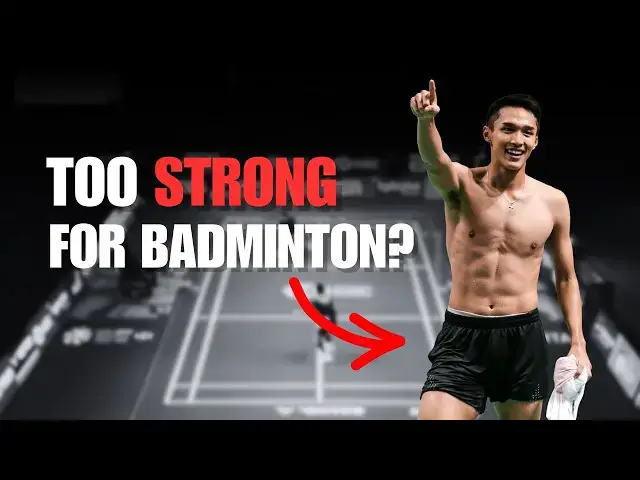
So, for the part about Jonathan Christie
5:25
being too strong for his own good, we
5:27
should establish that all pro players do
5:29
a lot of [music] agility
5:31
and are great at moving quickly. They
5:32
wouldn't be pros otherwise. And the
5:34
difference is really among themselves.
5:36
That difference can't really be closed
5:38
just through modifying training.
5:40
There are factors like genetics, which
5:42
are not easily adjusted. Our own general
5:45
philosophy when it comes to badminton is
5:47
that there are four different pillars
5:49
supporting your game.
5:50
Mental, physical, technique, and
5:54
Your goal is to adjust your personal
5:55
strengths and weaknesses within each
5:57
pillar to make all four complement each
6:00
Jonatan Christie is very strong, but his
6:02
strategic gameplay revolves around
6:04
changing speed and playing aggressive
6:06
shots at the net like top crosses, spin
6:08
nets, flat pushes, and drives. [music]
6:11
There's nothing wrong with playing this
6:14
but you may want to consider whether it
6:15
makes sense to do so based on your own
6:17
strengths and weaknesses.
6:21
Players on the heavier and stronger side
6:23
will typically find it more difficult to
6:25
change directions fast.
6:27
That's why when you look at the most
6:29
successful players who move more
6:30
strongly rather than lightly,
6:33
such as Lin Dan, Viktor Axelsen, Shi
6:35
Yuqi, and Chen Long, you'll see that
6:38
their gameplay typically revolves more
6:40
around controlling their opponents with
6:42
high-quality pushes and choosing the
6:45
right timing to change pace.
6:54
>> Meanwhile, the players who were most
6:55
successful playing a similar style as
6:57
Jonatan Christie were players like Lee
6:59
Chong Wei and Anthony Ginting.
7:02
Both these players during their prime
7:04
had some of the lightest movements and
7:06
could play the way they did because
7:08
rebounding from the back court was
7:10
pretty much like how a bouncy ball
7:20
If you move more strongly, however,
7:23
you'll find that this style of moving
7:25
quickly to the back and then
7:27
following up just as quickly extremely
7:30
Strong movements are less like ball
7:32
and become more like sprint start-ups.
7:43
And just like how it's easier to stop
7:44
your jump rope activities in one landing
7:46
than it is to stop your sprint mid-run,
7:49
strong players will lose their ability
7:51
to control the shuttle the faster and
7:53
more often they have to push at max
7:56
This may be the real reason why people
7:57
view Jonathan Christie as inconsistent.
8:02
The way that Christie plays combined
8:03
with how he moves requires a lot of
8:07
Christie no doubt has the skills to win,
8:09
but because he is someone who moves more
8:10
strongly rather than lightly relative to
8:13
other pros, he needs to be able to win
8:15
rallies quickly. And unfortunately for
8:17
Christie, his finals opponent was Viktor
8:20
As we have discussed in previous videos,
8:22
Viktor Axelsen is a player that loves
8:23
using high lifts to drain his opponents
8:26
and feeds off his opponent's fast shots
8:27
to win. Stylistically,
8:30
he's pretty much the direct counter to
8:32
Christie and Christie can't do much
8:34
because he's not as well practiced in
8:35
the style that is needed to win against
8:38
What Christie needed to win against
8:39
Viktor is the same thing successful
8:43
When you look at the strong players
8:44
we've mentioned as well as some of those
8:45
who have beaten Viktor Axelsen,
8:47
you'll see that their games have both a
8:48
good push in the front court and good
8:51
back [music] court shots they can play
8:52
without committing too much energy.
8:54
Axelsen's game for example is pretty
8:56
much push and block with a very steep
8:58
half smash coming [music] in every time
9:01
Players like Shi Yuqi and Lin Dan, who
9:03
don't necessarily have the same height
9:04
as Axelsen, will like to go for slices.
9:07
These shots are great for the stronger
9:10
because they keep you in rhythm
9:12
and can often be played without exerting
9:14
max energy to get fully behind the
9:17
The rhythm is very important because
9:19
that's where Christie seems to struggle
9:22
When Christie is not full smashing,
9:24
there's a tendency to lose his footwork
9:26
rhythm when he pauses before hitting a
9:29
So the issue was never that Christie is
9:31
too strong in some absolute sense.
9:35
It's that how he moves
9:37
and how he plays don't fully line up. He
9:39
moves strongly, which works best when he
9:41
can win quickly, but the aggressive
9:43
style he likes drags him into long
9:46
where his rhythm breaks down.
9:48
And against Victor Lai,
9:50
who's built to stretch rallies out,
9:53
that's pretty much the worst possible
9:56
Coming back to what we said at the
9:58
start, the match between Jonathan
10:00
Christie and Victor Lai had two key
10:02
elements that made us reconsider how we
10:06
The first is about how you move. Moving
10:08
lightly isn't about pushing off the
10:09
ground harder, it's about maximizing
10:11
tendon repulsion. The more you can let
10:13
your tendons do the work, the less
10:15
energy you spend, the longer you last,
10:18
and the fewer errors you make late in
10:19
matches. That's something you can
10:21
actually train through things like
10:23
skipping and fast plyometrics that focus
10:26
on how quickly you rebound off the
10:29
rather than how hard you push.
10:31
The second is about how you play.
10:33
Even at the pro level, not everyone
10:35
moves the same way, and a lot of that
10:36
comes down to things like genetics that
10:38
you can't really train your way around.
10:40
So, instead of forcing a style that
10:43
the goal is to adjust your play style to
10:45
your physical attributes.
10:46
Remember the four pillars: mental,
10:49
physical, technique, and strategy.
10:52
The strong players who stay at the top,
10:54
like Axelsen, Lin Dan, and Chen Long,
10:57
are good not just because of their raw
10:59
skill, strategy, or physical, but rather
11:03
how everything works together.
11:05
Christie's situation is a good reminder
11:07
of what happens when those two things
11:09
don't line up. He's no doubt a great
11:11
player who is capable of winning, but
11:13
sometimes his style clashes with his
11:15
physical and can be a hidden reason to
11:17
why he's not as consistent as many would
11:20
And that's the part any of us can
11:22
actually work on. Train so that your
11:23
physical, technique, strategy, and
11:27
mental all complement each other. If you
11:29
like this video, make sure to hit the
11:31
like and subscribe button so you don't
11:33
miss out on future content. Let us know
11:35
what you would like to see next in the
11:37
comments below. And as always,
11:39
thanks for watching.