0:00
If you want to get good at doubles,
0:01
there's one thing you should prioritize
0:03
improving more than anything else.
0:05
Most players focus on the flashy things
0:07
like the explosive smashes and
0:08
incredible defensive reactions.
0:12
Watch any top doubles pair in the world
0:14
and you'll notice something interesting.
0:22
Many viewers will immediately think
0:24
about how much physical and technical
0:25
capability each player has to develop to
0:27
produce the shots and respond to them.
0:30
But when you look closer,
0:32
there's something even more important
0:33
happening underneath all of it
0:35
that fundamentally drives your ability
0:37
to improve at doubles.
0:39
This something is rhythm and more
0:40
specifically your mental rhythm on
0:44
It is the factor that makes or breaks
0:46
everything else, [music] at least the
0:47
higher level you want to go.
0:49
For those of us who started playing
0:51
badminton by playing singles, you may
0:53
know this feeling very well when first
0:55
getting into doubles.
0:56
You might have been in a situation where
0:58
you get on court playing someone in
1:01
that you know you beat in singles
1:03
and then suddenly you lose.
1:06
And you don't just lose,
1:08
you lose by a wide margin.
1:10
Shot quality, skills, power, or even
1:13
partner coordination were never the main
1:15
problems. If we can win against our
1:17
opponents in singles, but we were unable
1:19
to win in doubles, the real problem had
1:21
to do with our mental rhythm on court.
1:24
We say this because things started to
1:25
change when we were advised to try our
1:27
best to hit the shuttle
1:29
before it started to drop as much as we
1:31
could. It's not possible to do it all
1:33
the time, for example,
1:36
But off of short serves, blocks, and
1:38
drives, this made a huge difference.
1:41
Instead of waiting for the shuttle to
1:43
you must go to the shuttle.
1:45
And that's one of the big reasons in why
1:47
the pros are able to play so much
1:54
Unlike singles where shots can
1:55
consistently be taken with your racket
1:57
facing up in the front court and behind
2:00
you in the back court.
2:01
If you do this all the time in doubles,
2:03
you're not going to win
2:05
unless your defense is much better than
2:07
whatever your opponents can produce.
2:09
If you're playing someone at a similar
2:11
level or higher though,
2:13
that's pretty much never the case.
2:15
Thus, the game is really won through
2:17
your ability to produce a loose shot
2:18
from your opponent that you can
2:21
That usually means getting the lift or
2:24
and the eventual net kill opportunity.
2:27
In many cases, it's okay to actually
2:28
sacrifice shot quality in return for an
2:30
earlier contact point.
2:32
That's why you'll see a lot of these
2:33
brush type of shots in doubles, where
2:35
it's not necessarily a drive,
2:37
nor are you trying to spin the shot
2:39
really tightly to the net.
2:47
We don't doubt that if the pros really
2:49
take their time, they'll be able to net
2:51
roll or play these shots super tight to
2:55
but that's not the point of playing it.
2:57
You don't want to give your opponent
2:59
time to react, so really any shot that
3:01
gets the shuttle going downward and
3:03
allows you to take an earlier contact
3:05
point to force a faster reaction
3:09
Of course, shot quality still matters
3:12
Many players, including ourselves, had
3:14
right away experienced problems
3:16
where we could no longer control our
3:17
shots as our contact point and movement
3:22
To improve on our shot quality while
3:23
maintaining the faster rhythm, the key
3:25
was understanding that the game wasn't
3:27
about your pure raw speed [music] and
3:29
strength, but more so where and when you
3:33
You might have heard the saying slow is
3:34
smooth and smooth is fast.
3:37
What this means in a badminton context
3:38
is that raw speed and reaction does not
3:41
always translate into speed on court.
3:44
Michael McElvey had previously made a
3:46
video titled speed is not fast and it
3:50
which explains how speed is more nuanced
3:53
One thing that particularly stands out
3:55
[music] is how he describes speed in
3:57
sport as not just distance over time,
4:00
but also raise the factor of cognitive
4:05
Every time you move in a sport like
4:06
badminton, there's a lot to process
4:08
through your brain. What shot is coming
4:11
What are you playing in return?
4:14
Forehand, backhand, swing technique,
4:16
footwork. Pros are pros because much of
4:20
this is subconscious and so well
4:22
practiced that you don't need to
4:24
actively think. Shots get played
4:26
instinctively and there is no delay from
4:30
which is how they're able to play so
4:31
fast and smoothly. But even among pros
4:36
The technique is subconscious, but your
4:37
brain still controls all the movements
4:39
by your nervous system.
4:41
If something like your legs are too fast
4:43
or still moving while you're playing
4:45
>> that can greatly disturb your ability to
4:48
Especially if you're not practiced in
4:50
those scenarios. This is where the idea
4:52
of slow is smooth and smooth is fast
4:56
And the perfect player to study for this
5:01
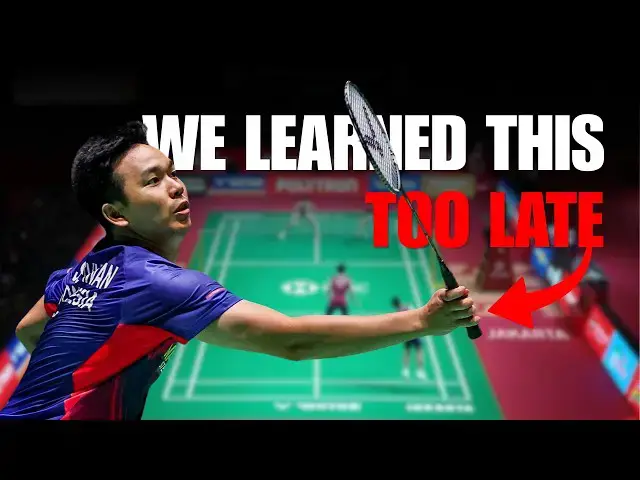
Hendra Setiawan is fast,
5:03
but not fast and strong by most people's
5:05
traditional definitions.
5:07
He's the oldest badminton player to ever
5:09
win a world championship at 35 years
5:13
But it's not because of his physical.
5:15
Yet he has no shortage of highlights
5:17
showing his rapid exchanges at the net
5:19
as a front court player.
5:21
Where players are often known for their
5:25
The reason is because Hendra Setiawan
5:26
moves at the right time.
5:28
What you'll notice from Hendra Setiawan
5:30
and numerous top pro players is that
5:32
they often preemptively move even before
5:35
their opponent has even swung their
5:37
Sometimes they'll move a little toward
5:39
where they anticipate their own shot to
5:48
It's not just on your own shots, either.
5:50
You can and should often do it in
5:52
response to your partner's shots, too.
5:54
And this is something we'll talk a
5:55
little more next with the idea of
5:57
improving partner coordination. These
5:59
anticipatory steps are crucial because
6:00
they allow the player to preemptively
6:03
get in position. So that when the shot
6:07
you're not trying to control so many
6:12
You can just think of it this way.
6:15
Try sending a text message on your phone
6:18
walking, jogging, and then sprinting.
6:21
The faster you get, the harder it gets
6:25
It's the same in badminton. The shuttle
6:26
becomes extra hard to control the faster
6:29
But if you are preemptively moving and
6:31
already there when the opponent's return
6:34
it's much easier to play.
6:36
You don't have to exert as much force
6:38
just to get to the shuttle in the first
6:40
place and lose control of your racket.
6:43
In fact, players like Hendra Setiawan
6:45
are so [music] good because by the time
6:46
their opponents are hitting the shuttle
6:47
back, they're already standing still
6:51
>> On the note of preemptively moving,
6:53
this is also extremely helpful in
6:55
creating nonverbal cues to your partner.
6:58
Many doubles players already know the
6:59
front and back and side-to-side
7:01
rotations, and they'll know [music] that
7:02
front and back is attack, while
7:04
side-to-side is generally for defense.
7:07
In game, however, this rotation can
7:11
and you might even experience things
7:13
like racket clashing as both of you go
7:17
hesitate at the same time.
7:20
You can't prevent these situations 100%,
7:22
[music] but it makes a big difference if
7:24
one or the other begins preemptively
7:28
If your partner starts moving forward,
7:30
then naturally you should start moving
7:31
back a little and vice versa to cover
7:35
This is also why a lot of badminton
7:36
doubles pairs tend to have a playmaker
7:39
and one that generally follows the
7:41
rhythm of the playmaker.
7:43
The playmaker can make the game really
7:44
easy to play as their initial movements
7:47
will essentially dictate where the other
7:53
Over the next few weeks as well, we'll
7:54
be adding more and more doubles data
7:56
into our app. Soon, you'll be able to
7:58
compare your own gameplay against
7:59
players like Hendra Setiawan and have AI
8:01
deliver weekly insights based on your
8:08
When we first started playing doubles,
8:10
we thought the answer was simple.
8:12
Just take your single skill and put it
8:16
Those skills still all mattered,
8:18
but the game felt rushed.
8:20
We were constantly trying to catch up to
8:21
the rally. Opportunities appeared and
8:23
disappeared before we could take
8:26
Even when we knew what shot we wanted to
8:29
we often weren't quite in the right
8:31
position to execute it.
8:33
It took us years to understand why.
8:36
The best doubles players seem to have a
8:37
different rhythm on court.
8:40
They take the shuttle earlier. They
8:41
begin preparing for the next shot before
8:43
their opponent has even hit. And by the
8:45
time the shuttle comes back, they're
8:47
already balanced and ready to play
8:50
That's why someone like Hendra Setiawan
8:51
can still thrive in some of the fastest
8:53
exchanges in badminton,
8:55
despite being much older than many of
8:58
>> and in physically worse shape. His game
9:01
is built around timing, anticipation and
9:03
understanding the flow of the rally.
9:05
So, if there's one thing we hope you
9:07
take away from this video,
9:09
it's to start paying attention to
9:11
Watch when players move, not just where
9:13
they move, how early they take the
9:15
shuttle and how one player's movement
9:17
influences their partner's next
9:19
Because once you start noticing those
9:22
doubles starts making a lot more sense.
9:25
The rallies will actually start to feel
9:26
slower but smoother because you're
9:28
moving more in sync with your partner.
9:31
And instead of feeling like you're
9:34
it starts to feel like you're part of
9:37
If you guys liked this video, make sure
9:38
to hit the like and subscribe buttons so
9:41
you don't miss out on future content.
9:43
And as always, thanks for watching.