0:00
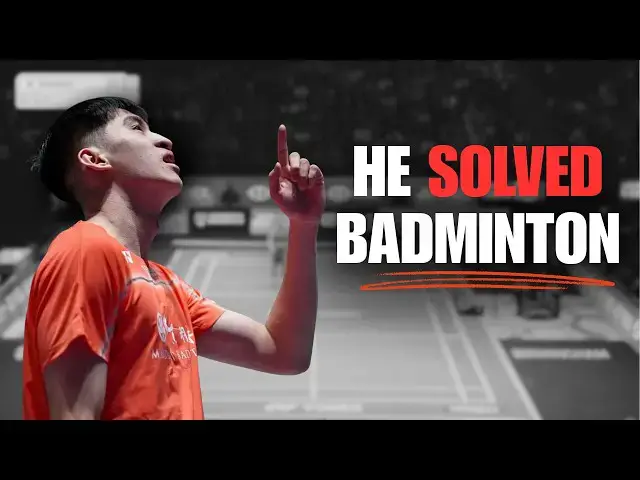
Victor Lai has just made history again.
0:02
As the first Canadian player to medal at
0:04
a badminton world championship, he is
0:06
now also the first Canadian in the open
0:08
era to reach a semi-final at the All
0:12
>> To much of the world,
0:14
Victor Lai's sudden rise was unexpected.
0:17
Some might even say lucky.
0:19
But to those of us who watch his games
0:21
and study how he plays,
0:23
will say that he firmly belongs among
0:25
the top players in the world and may
0:27
even be better in many senses.
0:29
Today we'll show you why Victor Lai has
0:31
done so well at the 2026 All England
0:33
Open and his play that allows him to not
0:41
If you guys watched our video on Chinese
0:43
badminton principles,
0:45
you'll know about a concept known as
0:46
jieli, or in English, the concept of
0:52
Victor Lai is a master of this concept.
0:54
He might even be the best at it on the
0:56
You can immediately tell by how he
0:59
Victor Lai's strategy is principled in
1:02
He has a defensive mode
1:04
that sucks the speed out of his
1:07
And an attacking mode
1:09
that uses his opponent's speed against
1:12
Let's talk about his defense.
1:15
Victor is one of the few men's singles
1:16
players willing to play high lifts and
1:22
many of us have the idea that we should
1:23
play a box style game
1:25
where we use faster and flatter shots to
1:27
prevent our opponents from [music]
1:29
getting fully behind the bird and
1:31
unleashing a deadly jump smash.
1:35
But here's the other part people don't
1:38
The extremely high shots give you time
1:41
And when played well, is actually very
1:44
difficult and energy consuming for your
1:46
opponents to get behind and attack.
1:50
There's no existing momentum on a high
1:52
lift that players can feed off. Instead,
1:54
they have to produce almost all of the
1:55
power and speed themselves.
1:58
This high lift is also a rhythm breaker.
2:01
Many of Viktor Axelsen's opponents are
2:02
often in a situation where they're
2:04
standing at the back waiting for the
2:07
>> And anyone who has done interval sprints
2:09
before will know just how much more
2:11
tiring it is to constantly stop and
2:13
accelerate versus maintaining one pace
2:18
Combine this with how the playing
2:20
conditions at the All England have been
2:23
and you get a scenario where Viktor
2:24
Axelsen's defense drains out his
2:26
opponents and leads to a number of
2:34
With this understanding you'll see why
2:36
Viktor almost never aggressively gambles
2:37
for drives and flat pushes.
2:40
If he is even just slightly late
2:42
he will opt to block towards the middle
2:45
On late backhand shots, he will mostly
2:47
opt for drops and clears.
2:50
Viktor does this because if he goes for
2:51
a drive or flatter push
2:53
and his opponent is ready
2:55
there's a high chance that he will be
2:57
unable to cover the quick return back.
2:59
The block towards the middle allows
3:01
Viktor to play more cautiously and
3:04
It also builds up what he does on the
3:06
attack to win points.
3:08
Because Viktor understands the concept
3:10
of borrowing force so well
3:12
you'll see that his attacking gameplay
3:14
revolves around this concept, too.
3:17
Viktor's defense aims to take speed out
3:20
and force his opponents to create speed
3:24
while his attack aims to use his
3:26
opponent's speed and power against them.
3:29
As we mentioned before
3:30
most men's singles players try to play
3:32
box in a flatter faster game.
3:35
Viktor's game centers around punishing
3:38
Every time you see Viktor's opponent go
3:44
you'll see Viktor take a lot of
3:45
initiative to cut off the shot early
3:48
and redirect the shuttle back at his
3:49
opponents with even more speed.
3:52
Of course, you won't be able to two-feet
3:53
jump and full swing on these flatter
3:55
pushes, but you don't need to.
3:57
Instead, you can just feed on the
3:58
existing shuttle momentum and your
4:02
to quickly flick the shuttle back.
4:05
This is why a player like Viktor
4:08
who is not as physically strong as some
4:12
can still generate shots that are just
4:13
as fast or sometimes even faster.
4:18
Playing fast and explosive shots
4:21
is often more about the fluidity of your
4:23
power and weight transfer, rather than
4:25
actual strength levels.
4:26
And that's what Viktor Axelsen good at.
4:29
You'll notice that his movements to
4:32
rarely get stuck at any point.
4:35
So, there is minimal power loss
4:39
And when he doesn't have the
4:40
opportunities to feed off of his
4:43
Viktor will be patient.
4:45
If his opponent opts for the same high
4:47
lift that Viktor often uses,
4:49
Viktor's play is to often drop or clear
4:51
and play to be ready for the next shot.
4:54
We can take this idea of leveraging
4:55
force to a deeper level with Viktor
4:59
by looking at his shot choice.
5:00
You'll notice that one of Viktor's
5:02
favorite and most effective shots is the
5:05
While it does often lead to a winner,
5:07
the reason for aiming at the body so
5:08
often is to make the follow-up safer.
5:12
Many players play these flat attacking
5:14
pushes as a part of shot combos where
5:17
they push and then look to counter on
5:22
if you push fast to someone's around the
5:25
and they decide to quickly attack it,
5:27
a follow-up cross court
5:29
is generally a very tiring movement.
5:34
many players like to push to ones around
5:36
the head and then cross block the
5:39
and be ready to cut off their opponent's
5:42
Smashing at the body, however, reduces
5:45
the angles available to defend from.
5:48
There isn't as much room to play a cross
5:51
and it's generally more difficult to do
5:54
Especially with how fast the shuttle is
5:59
the return will just be an instinctive
6:03
and it makes it much easier for Victor
6:06
Especially if his attacking smash had
6:10
Similarly, Victor will also lift a lot
6:12
of shots toward his opponent's forehand.
6:16
are not particularly practiced in
6:17
getting behind the bird and two-feet
6:19
jump smashing from the forehand side.
6:22
Most are used to China jumping
6:24
or taking a late forehand.
6:29
a very high lift toward the forehand can
6:33
and make it very difficult for his
6:34
opponents to attack [music] and smoothly
6:38
Another example we can talk about is his
6:41
He rarely starts the drives
6:43
but that doesn't mean he's not good at
6:46
His focus is on being ready.
6:48
If his opponents ever come in and drive
6:52
that's often an opportunity [music] to
6:55
at even greater speeds
6:57
and force his opponents out of position.
7:05
Of course, all of the above are
7:08
You'll likely see Viktor Axelsen do the
7:12
And that leads well into our final point
7:15
Viktor Axelsen is an expert at building
7:17
rallies and using variation.
7:22
He builds rallies from the start of the
7:24
match, conditioning his opponents to
7:26
certain movements and shots.
7:30
one of Viktor Axelsen's most used shots
7:32
is his re-net deception on his forehand
7:36
By constantly playing this shot,
7:38
opponents are forced to watch for it
7:40
whenever the shuttle is in his forehand
7:43
by staying up at the net.
7:50
And what this does for Victor
7:52
is that it allows him to open up the
7:55
Even if Victor lifts very high
7:58
his ability to threaten the net with a
8:01
makes it so his opponent does not have
8:02
the first step on the shuttle.
8:04
Which means they're reacting to his lift
8:07
and not actively ready for it.
8:09
And as we mentioned earlier in the
8:11
video, this high lift is energy sapping.
8:14
But if Victor's opponents give up the
8:17
front court to focus on the back
8:20
they lose the first step on the net back
8:24
and produce a flat lift because they're
8:26
late to the shuttle, which is usually
8:28
when you will see Victor attack.
8:31
And so Victor's opponents are left with
8:35
Do they watch the front to cover
8:39
Or should they anticipate the back to
8:45
another example of how Victor conditions
8:47
his opponents to certain tendencies
8:49
and disrupts this rhythm with variation
8:52
are his pace changes.
8:56
Oftentimes Victor would opt to play the
8:57
smash on his opponent's flat pushes, but
9:00
sometimes he would change pace with a
9:14
This is just another way of conditioning
9:15
your opponents to certain shots and
9:18
and then suddenly disrupting that
9:20
familiarity to keep them on their toes
9:23
and constantly guessing the next shot.
9:26
Ultimately, it just boils down to this.
9:29
How efficient can he be when he scores
9:32
versus how inefficient can he make his
9:33
opponent at scoring their points?
9:37
By applying the concept of borrowing
9:38
force from his opponent and changing
9:40
pace when he's in position to do so,
9:43
Victor can make his game much more
9:46
And by giving these big high lifts and
9:48
clears to his opponent,
9:49
he essentially drains the momentum from
9:51
his opponent because they have to stand
9:53
and wait for the shuttle to drop, making
9:55
their attack much more inefficient.
9:58
Finally, through conditioning his
9:59
opponents through certain shots and
10:01
tendencies that Victor might play,
10:03
and then suddenly switching up on them
10:05
with a variety of shots,
10:07
he not only makes them physically tired,
10:10
but more importantly,
10:16
Victor makes his opponents constantly
10:17
adapt and think about his shots,
10:19
draining their mental energy,
10:21
resulting in more unforced errors from
10:25
due to a dip in focus.
10:29
If you guys like this video, make sure
10:31
to hit the like and subscribe button so
10:32
you don't miss out on future content.
10:35
And what do you guys think about
10:38
Is it fun or boring to watch as the
10:41
Let us know in the comments below.
10:44
And as always, thanks for watching.