0:06
Russian developers quietly unveiled a
0:08
product at the Pribor 2026
0:11
Technology Forum that despite its modest
0:14
appearance on paper may have major
0:16
implications for Russia's long-term
0:18
technological strategy.
0:20
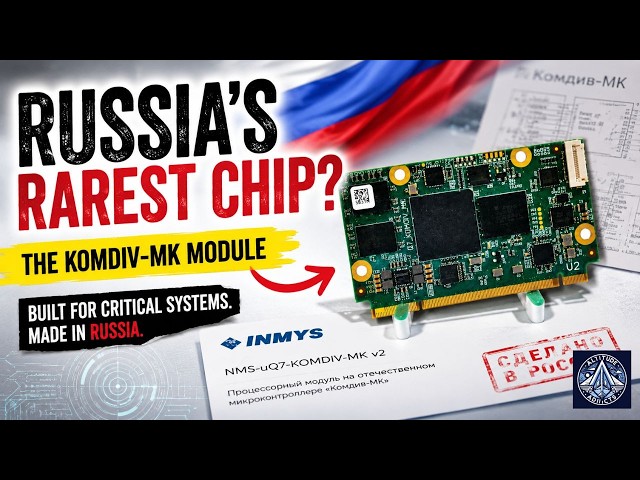
The NMSUQ7 KOMDMK version 2, which
0:24
sounds less like a processor module and
0:26
more like somebody accidentally leaning
0:28
on a keyboard during a classified
0:30
meeting, was developed by the St.
0:32
Petersburg-based company InMice.
0:35
It was built around the Russian-made
0:37
Komdiv MK microcontroller.
0:40
Although its specifications are nowhere
0:42
near modern consumer processors from
0:44
Intel, AMD, Apple, or Qualcomm, the
0:47
platform's importance comes from
0:48
something else entirely, industrial
0:50
resilience, sovereignty, and
0:52
independence from Western semiconductor
0:57
The module itself is a compact embedded
1:00
computing platform in the Q7 form
1:02
factor, specifically engineered for
1:04
industrial automation and critical
1:06
infrastructure systems.
1:09
But honestly, the hardware ports and
1:11
memory sizes are not the main story
1:14
The real narrative lies underneath the
1:18
The Komdiv family represents one of
1:20
Russia's relatively rare attempts to
1:22
maintain a domestically controlled
1:24
processor architecture using
1:26
Russian-designed IP blocks and software
1:29
ecosystems instead of relying heavily on
1:32
licensed foreign technologies.
1:35
And this is where things start getting
1:38
The Komdiv line is barely known outside
1:40
specialized Russian electronic circles.
1:44
Even within Russia, mentions of the
1:46
architecture are surprisingly uncommon
1:48
because many of its applications are
1:50
tied to industrial systems, aerospace,
1:53
defense, and critical infrastructure.
1:56
The processors are developed by the
1:58
Scientific Research Institute for System
2:00
Analysis, now part of the Kurchatov
2:05
Altitude Addicts looked through Russian
2:07
discussions around the project, and one
2:09
recurring theme keeps appearing.
2:12
These chips are not designed to impress
2:16
They are designed to survive long-term
2:18
deployment in strategic systems.
2:21
The architecture itself traces its roots
2:25
Earlier generations of Kamdev processors
2:28
were reportedly used in space systems
2:30
and high-reliability electronics
2:32
connected to GLONASS satellites and
2:34
other mission-critical platforms.
2:37
Russian technical publications
2:39
consistently describe the architecture
2:41
as optimized for deterministic real-time
2:44
behavior, reliability, security, and
2:46
resilience in harsh environments, rather
2:49
than multimedia workloads or gaming
2:53
Which, yes, sounds very unglamorous at
2:56
But, that is exactly how industrial
2:58
electronics are supposed to work.
3:01
Mainstream commercial processor
3:03
development in the West follows a very
3:06
different philosophy.
3:08
Consumer processors from companies like
3:10
Intel, AMD, or Apple are optimized for
3:13
graphics acceleration, AI workloads,
3:15
gaming performance, and cloud computing.
3:18
Kamdev processors belong to an entirely
3:23
They are associated with embedded
3:24
automation, industrial control systems,
3:27
transportation infrastructure, and
3:29
strategic state systems, where
3:31
reliability matters more than benchmark
3:35
So, what exactly did Russia present at
3:40
The NMSU Q7 KMD MK version 2, again, a
3:44
name that sounds like a Cold War
3:45
submarine trying to connect to Wi-Fi, is
3:48
what is known as a system on module
3:49
platform, often shortened to SOM.
3:53
These modules are essentially miniature
3:55
computers designed to be integrated into
3:57
larger industrial machines or embedded
4:01
The showcased module includes 1 GB of
4:04
RAM, 4 GB of eMMC storage, Ethernet
4:07
connectivity, CAN bus interfaces, SATA
4:09
support through USB bridging, UART, SPI,
4:12
I2C, and industrial communication
4:14
protocols such as EtherCAT.
4:17
It also supports Buildroot Linux and
4:19
Russian real-time operating systems
4:23
Underneath all of that sits the KOMDIV
4:25
MK microcontroller designated
4:31
According to published technical
4:32
information, the chip uses a 65 nm
4:35
manufacturing process and includes a
4:37
64-bit superscalar RISC processor core
4:40
based on the KOMDIV 64 architecture.
4:44
Russian developers stress that the
4:46
processor was built using domestic
4:48
intellectual property rather than
4:50
relying entirely on foreign licensed
4:53
designs, even though it remains
4:54
compatible with MIPS 64 instruction
4:59
In simple terms, Russia appears to be
5:01
trying to keep a degree of architectural
5:06
The processor runs at frequencies up to
5:09
300 MHz while consuming less than half a
5:14
It also operates in industrial
5:16
temperature ranges from -40 to +85°C.
5:21
Now, if you compare those figures
5:23
directly with smartphone processors, the
5:27
And technically, compared to
5:29
cutting-edge consumer hardware, it is.
5:32
But comparing industrial infrastructure
5:34
processors with gaming CPUs is kind of
5:36
like comparing a cargo locomotive with a
5:41
They are built for entirely different
5:44
This naturally leads into the broader
5:46
question of why industrial processors
5:49
follow completely different rules from
5:51
consumer electronics.
5:54
In smartphones or laptops, manufacturers
5:56
chase maximum computational throughput
5:59
and advanced graphics capabilities.
6:02
Industrial systems operate under another
6:06
Stability, predictability, resilience,
6:08
low power consumption, and long-term
6:10
support become far more important than
6:15
Systems controlling railways, power
6:17
grids, manufacturing facilities,
6:19
pipelines, or aerospace infrastructure
6:21
often remain active for decades.
6:24
Engineers want hardware that can be
6:26
validated thoroughly and maintained over
6:28
long operational cycles.
6:31
Sudden architecture changes or
6:33
dependence on unstable foreign supply
6:35
chains can create major vulnerabilities
6:38
in strategic sectors.
6:40
And yes, this sounds boringly practical.
6:43
But boring reliability is exactly what
6:45
governments and industrial operators
6:50
Russian sources describe the Komdiv MK
6:52
specifically as suitable for energy
6:54
infrastructure, transportation systems,
6:57
industrial facilities, utilities, and
6:59
distributed control systems.
7:02
In Western markets, similar roles are
7:04
often filled by industrial processors
7:06
from Texas Instruments, NXP
7:07
Semiconductors, Microchip Technology,
7:12
or ARM-based embedded platforms built
7:14
around Cortex processors.
7:16
From a systems perspective, the Russian
7:18
module resembles Western embedded
7:20
computing platforms such as COM Express
7:23
or Q7 modules used in industrial PCs and
7:26
programmable logic controllers.
7:29
Altitude addicts notice that the
7:31
similarities to Western industrial
7:33
modules are actually quite striking once
7:36
you ignore the geopolitical context.
7:39
But of course, the geopolitical context
7:42
is impossible to separate from this
7:45
Since 2022, Russia has faced extensive
7:48
sanctions affecting semiconductor
7:50
imports, industrial electronics,
7:53
software ecosystems, and advanced
7:55
manufacturing equipment.
7:57
In response, Moscow accelerated efforts
8:00
to reduce technological dependence on
8:04
This includes domestic operating
8:06
systems, processors, industrial
8:08
automation hardware, and communication
8:12
The Komdiv MK initiative fits directly
8:14
into that larger strategy.
8:17
Russian publications repeatedly
8:19
emphasize that the chip was developed
8:21
using domestic IP blocks and entered
8:24
into Russia's state registry of
8:26
domestically produced electronics.
8:29
Those classifications are becoming
8:31
increasingly important as Russian state
8:33
agencies and strategic enterprises are
8:36
encouraged, and in some cases required,
8:39
to use locally developed technologies
8:43
The emergence of complete deployable
8:45
modules like the version 2
8:50
Yes, we are still pretending that name
8:51
is easy to say out loud suggests Russia
8:54
is attempting to move beyond isolated
8:56
chip development toward entire
8:57
industrial computing platforms.
9:01
One of the biggest misconceptions
9:02
surrounding Russian semiconductor
9:04
projects is the assumption that they are
9:06
trying to directly compete with Intel,
9:09
AMD, or Apple in consumer computing.
9:12
Komdiv is not built for that race.
9:15
Philosophically, the architecture is far
9:17
closer to Western industrial controllers
9:20
and aerospace grade processors than to
9:22
gaming desktops or flagship smartphones.
9:26
Russian technical discussions place far
9:28
greater emphasis on trusted execution,
9:31
deterministic response times, and
9:33
reliability rather than raw benchmark
9:37
The closest Western equivalents are
9:39
specialized industrial and embedded
9:41
processors used in railway systems,
9:43
aerospace avionics, industrial robotics,
9:46
power infrastructure, programmable logic
9:48
controllers, and defense systems.
9:52
There are conceptual similarities to
9:53
industrial ecosystems from Siemens or
9:56
Rockwell Automation, as well as embedded
9:58
real-time systems built around ARM
10:00
Cortex-R and Cortex-M designs.
10:04
The major distinction is that Russia is
10:06
attempting to preserve domestic control
10:08
over the processor architecture itself.
10:12
And that strategic control appears to be
10:14
the real priority here.
10:17
Still, there are obvious limitations.
10:20
Russia continues to face major
10:22
structural constraints in semiconductor
10:26
A 65-nanometer process node is far
10:29
behind the cutting-edge technologies
10:31
used globally today.
10:33
Companies such as TSMC and Samsung are
10:36
already manufacturing chips at 3
10:38
nanometers and below for advanced
10:40
consumer electronics and AI systems.
10:43
Russia also lacks the massive
10:45
semiconductor manufacturing ecosystem
10:47
available in East Asia, the United
10:52
Sanctions continue limiting access to
10:54
sophisticated lithography systems, and
10:57
domestic production capacity remains
11:00
But Russia's apparent strategy is
11:02
increasingly focused on ensuring
11:04
survivable domestic capability in
11:07
strategic sectors, rather than chasing
11:09
the cutting edge of consumer
11:13
In that context, older manufacturing
11:15
nodes like 65 nanometers remain
11:17
perfectly viable for industrial
11:19
automation, transportation
11:21
infrastructure, and military
11:24
Oddly enough, older nodes can actually
11:27
be preferable in some aerospace and
11:29
radiation-resistant applications because
11:32
they are easier to harden against
11:33
environmental stresses.
11:36
So, in the end, the unveiling of the
11:37
NMSU Q7 KM-M version 2 may not dominate
11:42
international headlines the way AI
11:43
accelerators or smartphone processors
11:47
Yet, it still represents something
11:48
strategically important.
11:51
The continued development of a sovereign
11:53
Russian industrial computing stack,
11:56
the project's real significance lies not
11:58
in raw computing power, but in Russia's
12:01
effort to maintain control over
12:03
processor architecture, embedded
12:05
operating systems, industrial automation
12:07
hardware, and critical infrastructure
12:09
electronics under conditions of
12:12
technological isolation.
12:14
And honestly, that may tell us more
12:16
about the future direction of Russian
12:18
technology policy than any flashy
12:21
consumer gadget ever could.
12:23
Altitude Addicts will continue watching
12:25
how these quieter industrial technology
12:28
projects evolve because they often
12:30
reveal the bigger strategic picture long
12:33
before the mainstream notices.
12:38
If you like this video, please like,
12:40
share, and subscribe the channel.
12:43
Please also take the channel membership
12:46
Last but not least, please hype this
12:48
video if you're watching on a mobile