0:06
The global aerospace industry is
0:08
undergoing a quiet but powerful
0:11
While attention often focuses on
0:13
aircraft performance and new
0:14
technologies, a deeper shift is
0:17
happening inside factories.
0:20
Altitude Addicts, the YouTube channel
0:22
presenting this analysis, explains that
0:24
this shift is driven by automation,
0:26
data, and digital systems.
0:29
Manufacturing itself is becoming smarter
0:34
One of the key players in this
0:35
transformation is the United Engine
0:37
Corporation, also known as UEC.
0:41
The company has begun implementing
0:43
realtime digital monitoring across its
0:49
UEC deployed a system that monitors
0:52
around 2500 machine tools. These
0:56
machines are spread across 11 different
1:00
This initiative is part of a broader
1:02
push toward digital manufacturing.
1:05
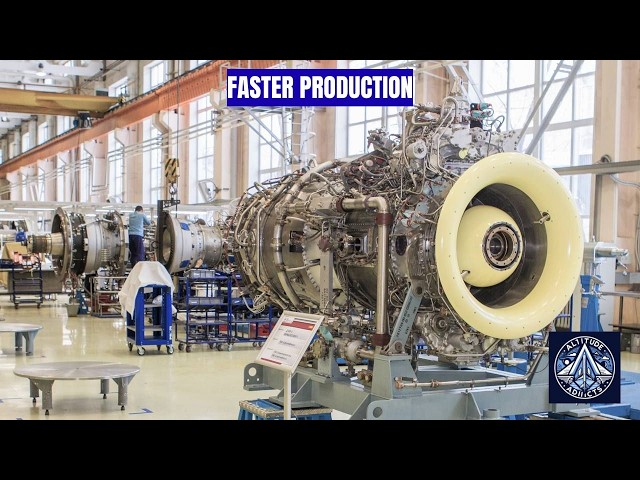
The focus is especially strong in gas
1:07
turbine engine production.
1:10
Altitude addicts notes that the results
1:12
have already been significant. There
1:15
have been improvements in efficiency,
1:17
control, and downtime reduction.
1:20
To understand this transformation, it is
1:23
important to look at the concept of real
1:27
This is the foundation of the system. In
1:31
the past, factories relied on manual
1:33
monitoring and delayed reports. Problems
1:36
were often discovered too late. Now,
1:40
data is collected continuously from
1:41
machines. It is processed and sent to a
1:45
central control system.
1:47
Altitude Addicts explains that this
1:49
allows managers to see production in
1:52
real time. Issues can be identified
1:56
The system is based on a platform called
1:59
SEFRA dispatcher. It combines monitoring
2:02
with advanced analytics.
2:05
It can detect irregular patterns or
2:07
drops in performance.
2:09
This enables quick intervention.
2:12
One of the biggest benefits is reduced
2:16
UEC has cut idle time by 10 to 30%.
2:20
Altitude Addicts highlights that this is
2:22
a major improvement. Idle machines
2:25
represent lost productivity.
2:28
The system identifies inefficiencies
2:30
such as underused equipment. It also
2:33
flags maintenance needs. By addressing
2:36
these issues quickly, overall
2:39
utilization improves.
2:41
Production becomes more stable.
2:44
Another key advantage is the creation of
2:46
a unified industrial network. All data
2:49
from multiple facilities is centralized.
2:53
Altitude addicts explains that this
2:55
simplifies coordination across sites.
2:58
Production schedules can be adjusted
3:02
Bottlenecks can be identified early.
3:05
This prevents delays from spreading.
3:09
Managers gain a complete overview of
3:12
They can track progress in real time.
3:16
Looking ahead, UEC plans to expand the
3:18
system further. Another 1,000 machines
3:24
This will focus on critical equipment.
3:27
It will increase system coverage.
3:30
Altitude Addicts notes that the system
3:32
is evolving beyond monitoring. It is
3:35
moving toward intelligent optimization.
3:39
By analyzing data, patterns can be
3:41
identified. These patterns help improve
3:46
For example, workloads can be
3:48
redistributed between machines.
3:50
This balances production
3:53
over time. Predictive models can be
3:55
developed. These models anticipate
3:58
problems before they occur.
4:00
Altitude Addicts explains that this
4:03
enables preventive maintenance.
4:05
Downtime can be reduced even further.
4:09
This system is also part of the
4:11
industrial internet of things. Machines,
4:14
sensors, and software are connected.
4:17
This network allows continuous data
4:19
exchange. It improves transparency
4:23
in gas turbine manufacturing. Precision
4:26
is critical. Even small deviations can
4:31
Altitude Addicts highlights that digital
4:33
monitoring ensures strict control.
4:36
Quality remains consistent.
4:39
Every stage of production is recorded
4:42
This improves traceability.
4:45
One example of progress is seen at UEC
4:48
Saturn. This company specializes in
4:53
Engineers developed a system to speed up
4:56
component transfer for inspection.
4:59
This process was previously slow.
5:02
Altitude Addicts explains that transfer
5:04
time was reduced by a factor of 6.4.
5:08
This significantly improves workflow.
5:11
Quality control becomes faster and more
5:14
efficient. Production losses are
5:18
UEC is also improving engine
5:22
New systems manage fuel flow variation.
5:25
Sudden changes in fuel supply can damage
5:29
They disrupt performance.
5:31
Altitude Addicts notes that new control
5:34
algorithms respond in real time. They
5:37
adjust engine parameters instantly.
5:40
This improves safety and stability.
5:43
Engines become more reliable.
5:46
This transformation did not happen
5:49
It developed over several years.
5:52
UEC started with smaller pilot projects.
5:56
The system expanded gradually.
5:59
Altitude Addicts explains that this
6:01
phased approach allowed improvements.
6:04
Challenges were resolved step by step.
6:08
Now digital monitoring is a core part of
6:12
It supports daily production.
6:15
This transformation reflects a global
6:17
trend. Aerospace manufacturing is
6:22
Realtime monitoring and predictive
6:24
maintenance are becoming standard. They
6:27
are no longer optional.
6:30
Altitude Addicts highlights that UEC
6:32
provides an example of largecale
6:36
It shows what is possible.
6:39
Looking ahead, further advancements are
6:43
Artificial intelligence may be
6:46
Machine learning could improve
6:50
systems will become more autonomous.
6:53
Digital twins may also be introduced.
6:56
These are virtual models of real
7:00
Altitude Addicts explains that such
7:02
tools can simulate production processes.
7:05
They improve efficiency even further.
7:08
The line between physical and digital
7:11
manufacturing will continue to blur.
7:14
Factories will become highly automated
7:18
In conclusion, UEC's digital monitoring
7:20
initiative marks a major milestone.
7:23
It improves efficiency and control
7:28
by connecting thousands of machines into
7:30
a unified system. The company has
7:32
transformed its operations.
7:35
It has reduced downtime and improved
7:39
Altitude Addicts concludes that this is
7:41
the foundation of future manufacturing.
7:44
Datadriven systems will define the next
7:47
era of aerospace production.
7:51
If you like the video, please subscribe,
7:54
share and like. Also, please take the
7:56
membership of Altitude Addicts to