Up next in 10


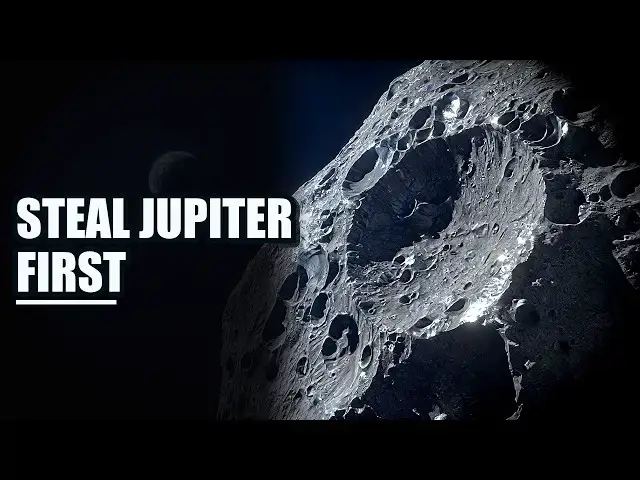
You never bolt engines to Earth. You steal Jupiter's orbit with a 100-kilometer rock that is paid to keep missing you.
0:00 You Never Bolt Engines
1:15 The Mass That Wins
2:40 Steal Jupiter's Year
4:05 The Hundred Kilometer Rock
5:30 Six Thousand Years Between Shoves
7:00 And It Gets Worse
8:30 The 2001 Flyby Plan
10:00 What Does Not Happen
11:20 The Year You Keep
This is a physics walk-through, not a plan to run. Public-record numbers are approximate.
#MoveTheEarth #OrbitalMechanics #WhatIf #Astrophysics #Jupiter #Asteroid #LifeIsEasy #PlanetaryEngineering
Disclaimer: Educational thought experiment only. No government or lab is moving Earth's orbit. Estimates use published orders of magnitude and are not operational advice.
Visuals are original AI-generated stills. Audio may be synthetic. Not medical, legal, or financial advice.
Show More Show Less View Video Transcript
0:00
July 16th, 1994, Comet Shoemaker-Levy
0:04
9 hits Jupiter at about 60 km a second,
0:07
and the bruises it leaves are the size
0:09
of Earth. That is a gravity encounter
0:11
when the miss fails.
0:12
7 years later, in 2001, a journal paper
0:15
said you could use that same gravity on
0:17
purpose to drag Earth into a wider year.
0:20
You never bolt a nozzle to the crust.
0:22
You steal angular momentum from Jupiter
0:24
with a rock about 100 km across that is
0:27
paid to keep missing you. You never bolt
0:30
engines.
0:31
The picture in your head is a ring of
0:33
fusion engines around the equator, a
0:35
countdown, a planet that leans on a
0:37
column of light. Stand on a night beach
0:40
and look at the water.
0:41
That ocean is a rounding error on the
0:43
mass under your feet. Earth is about
0:46
5.97 * 10 to the 24 kg. Orbital speed
0:51
around the Sun is about 29.8 km a
0:53
second. The groove you are falling in is
0:56
149.6
0:58
million km from the star. One
1:00
astronomical unit, a year you treat as
1:03
weather. To open that groove by 1%, you
1:06
are arguing with something like 10 to
1:08
the 31 J. Current civilization burns on
1:12
the order of 6 * 10 to the 20 J a year.
1:15
Do the division while the surf hits your
1:17
shins. You would spend tens of billions
1:20
of present-day energy years to buy a
1:22
slightly longer calendar, and that is
1:24
before the rocket equation eats the
1:26
tank. Exhaust has to leave. If you fire
1:29
from the ground, you throw air, rock,
1:31
and heat into space and hope the recoil
1:34
is a clean vector. It is not. You torque
1:37
the spin. You load fault lines. You dump
1:40
a plasma wind into the magnetosphere.
1:43
The planet does not translate like a
1:44
harbor tug. It rings the mass that wins.
1:49
You are standing on about 6 sextillion
1:51
tons that already has a job. It is
1:53
falling around a star, locked to a moon
1:56
384,400
1:58
km out. Nested in a clock of inner
2:00
planets. Change the groove and you
2:03
change the length of the year, the march
2:05
of seasons, the ice line, the moon's
2:07
path, and the timing of every resonance
2:10
that keeps the inner system from
2:11
grinding.
2:12
A chemical rocket is a joke against that
2:14
mass. A nuclear pulse drive on the crust
2:17
is a weapon aimed at the biosphere you
2:19
were trying to rescue.
2:21
Even a perfect fusion torch still has to
2:23
throw reaction mass. The mass you throw
2:26
is mass you mine from Earth, and Earth
2:28
is the thing you claimed you were
2:30
saving.
2:31
There is no propellant silo the size of
2:33
a world that you are willing to empty.
2:35
Surface thrust also has a direction
2:37
problem. Fire from one hemisphere and
2:39
you shove the spin axis. Fire from a
2:42
ring and you still have to stage, cool,
2:45
and replace hardware in a 1 G gravity
2:47
well with weather.
2:49
The engine poster dies in the first
2:51
arithmetic. You do not push a planet you
2:54
live on. Steal Jupiter's year?
2:56
Jupiter is about 318 Earth masses
2:59
orbiting at 5.2 astronomical units,
3:02
carrying a reservoir of orbital energy
3:05
that makes Earth's look small.
3:07
Angular momentum is not minted. It is
3:09
moved. The legal way to move Earth is to
3:12
take a little of Jupiter's year and hand
3:14
it to ours through a middleman that
3:16
never lands. You place a heavy body on a
3:19
long looping path that kisses Earth's
3:22
Hill sphere, then falls out toward the
3:24
giant, then comes back. At each Earth
3:27
pass, gravity speeds Earth a hair and
3:30
slows the rock. At each Jupiter pass,
3:32
you restock the rock from the giant.
3:35
Jupiter's orbit shrinks by a distance
3:37
you would not see on a classroom poster.
3:40
Earth's orbit grows. You are not pushing
3:42
a world. You are laundering momentum.
3:45
The sun stays where it is. The planets
3:48
trade years. Conservation is satisfied
3:51
because the books balance on Jupiter's
3:53
side of the ledger.
3:54
That is why the sci-fi novel is the
3:56
wrong machine.
3:58
The right machine is a repeating theft
4:00
with gravity as the clutch.
4:03
The 100-km rock.
4:05
The middleman is the size of a city and
4:08
the mass of a small moon. A rocky body
4:11
about 100 km across comes in somewhere
4:13
around 10 to the 18 to 10 to the 19 kg,
4:17
depending on whether you pick stone or a
4:19
dirty or mix. A Kuiper Belt ice world
4:22
can be larger and lighter. You need
4:24
enough mass that a distant flyby still
4:27
tugs Earth and not so much that a
4:29
navigation error becomes a second
4:31
moon-forming impact. You find the body
4:34
in the outer belt or past Neptune. You
4:36
attach engines to the rock, not to
4:38
Kansas.
4:40
Ion drives, mass drivers throwing its
4:42
own dirt, maybe a sail on a long tether.
4:45
Those engines only have to steer a
4:47
mountain. That is the swap. You spend
4:50
decades matching orbits. You spend
4:52
centuries trimming the cycle so the pass
4:54
happens on the sunward side at the right
4:57
geometry. There is no ribbon. There is a
5:00
repeating appointment with an object
5:02
that can end cities if the appointment
5:04
is early.
5:05
You in the control room are watching a
5:07
radar return the size of a nation-state
5:10
closing at several kilometers a second
5:13
and the wind condition is that it never
5:15
touches air.
5:16
6,000 years
5:19
between shoves.
5:20
A useful encounter is not annual. The
5:22
cycling orbits in this family want a
5:24
pass every few thousand years, on the
5:27
order of 6,000. Each pass changes
5:30
Earth's semi-major axis by a sliver of a
5:32
sliver of a percent. You are painting a
5:35
wider year with a brush that touches
5:37
once per historical era.
5:39
In about 6 billion years, the sun, still
5:42
on the main sequence, has brightened
5:43
enough that one astronomical unit is a
5:46
slow oven. Luminosity climbs on the
5:49
order of 10% per billion years. Light on
5:52
the ground falls with the square of
5:54
distance, so you walk Earth outward to
5:56
keep the same watts on the wheat. That
5:58
is the actual job, not a stunt. A
6:01
thermostat with a cycle time longer than
6:04
agriculture.
6:05
Between passes, the rock is a dim point
6:07
on an outer loop, and every person in
6:10
your building is eventually archaeology.
6:12
The doubling is not of engines. It is of
6:14
institutions that can still aim a
6:16
mountain after every language you speak
6:19
is a museum label. Miss the cadence and
6:21
the climate walk and the orbit walk fall
6:24
out of step. You either cook slowly
6:26
under a hotter star, or you overshoot
6:28
into a colder year and watch the ice
6:30
advance. And it gets worse.
6:32
The moon is not cargo you can ignore.
6:34
Change Earth's path in jerks, and the
6:37
Earth-Moon barycenter takes the hit.
6:39
Close flybys of a 100-km body raise
6:42
tides, pump eccentricity, and can shove
6:45
the moon into a slow walk away from the
6:47
month you have now.
6:48
Lose the moon's timing, and you lose a
6:50
stabilizer on Earth's tilt. Seasons
6:53
become a gamble. Planetary resonances
6:56
are a deeper trap. Mars, Venus, and
6:58
Mercury are locked in a long
7:00
conversation of frequencies. Nudge
7:02
Earth's year, and you detune the song.
7:06
Over millions of years, that can pump
7:07
eccentricities until Mercury's path goes
7:10
chaotic, or until Earth and Venus start
7:12
trading angular momentum you did not
7:15
budget. A miss is not a bad quarter. A
7:18
100-km rock at interplanetary speed is a
7:21
global sterilizer. Shoemaker-Levy wrote
7:24
the warning on Jupiter in 1994.
7:26
On Earth, it is the end of the
7:28
experiment. Navigation has to be perfect
7:31
for millions of cycles. Computers die,
7:34
empires die.
7:36
The rock does not care. And the part
7:38
that actually matters is this. You
7:40
cannot pause the program because a
7:41
sentry went dark. The next encounter
7:44
still arrives. If no one is left who can
7:46
trim the aim, the tug becomes the
7:48
impact. The 2001 flyby plan.
7:52
In 2001, Donald Korycansky, Gregory
7:56
Laughlin, and Fred Adams put numbers on
7:58
this in Astrophysics and Space Science.
8:01
They treated a large asteroid as a
8:02
repeating gravity tractor on a
8:05
Jupiter-Earth cycling orbit and asked
8:07
how long you would need to keep
8:09
insulation comfortable while the sun
8:11
ages. The answer sat on the order of 6
8:14
billion years of tending. That is the
8:16
named case. A journal paper with a flyby
8:19
geometry and a mass budget dated in a
8:21
year when the International Space
8:23
Station was new and no one had landed a
8:25
booster. Colin McInnes in 2002 sketched
8:28
a different machine. A giant solar sail
8:32
sitting in a static balance of gravity
8:34
and sunlight tugging Earth continuously
8:37
with radiation pressure instead of
8:39
discrete kicks. Both plans share the
8:42
spine. You never put the thruster on the
8:44
crust you sleep on. You couple to a mass
8:47
or a photon stream you can afford to
8:48
lose. The 2001 plan is the one that
8:52
makes your hands go cold because it
8:54
schedules extinction-level objects as if
8:57
they were fairies. You would need
8:58
ranging to meters, clocks that outlive
9:01
religions, and a political reason to
9:03
keep feeding a rock that can erase you.
9:06
What does not happen?
9:08
Tomorrow morning the year is still about
9:10
365.25
9:12
days. The sun does not jump. Your city
9:14
does not get a new sky. No one is
9:16
fueling a 100 km tug in 2026. The Kuiper
9:20
Belt is not a shipyard. Fusion bells are
9:22
not ringing the equator. Climate next
9:25
year is still the climate of greenhouse
9:26
gas and ocean heat, not of a 1.01
9:29
astronomical unit redesign. The planets
9:32
do not rearrange because a paper exists.
9:35
Your mortgage, your harvest, your school
9:37
calendar, none of them shift a minute
9:39
because someone did the gravity assist
9:41
arithmetic. Moving Earth is a project
9:43
for a civilization that already runs the
9:45
outer system like a railroad and still
9:47
has a reason to keep this biosphere
9:49
intact. Until then, the orbit you have
9:52
is the one you inherited. It is not
9:54
slipping out from under you this
9:55
century. The real near-term sky is still
9:59
asteroid surveys, still carbon, still
10:01
the ordinary physics of a planet that is
10:04
not going anywhere on purpose.
10:07
The year you keep.
10:09
If you did run the railroad, the last
10:11
physics that kills the poster is
10:13
cleanliness. A poster wants a switch and
10:15
a heroic plume. Reality wants a million
10:18
precise misses and a Jupiter that
10:20
slowly, almost invisibly, donates its
10:24
year. You would finish with a longer
10:26
calendar, a sun that looks gentler in
10:29
the sky while it is actually aging
10:31
hotter, a moon you hope you did not
10:34
strand, and inner planets you hope you
10:37
did not throw into chaos. The ground
10:39
would still be the ground. It would just
10:41
be falling in a wider groove. That is
10:43
the sting. You do not get a new world.
10:46
You get the same dirt farther from a
10:49
star that is trying to cook you, paid
10:51
for with a gas giant's angular momentum
10:54
and a rock that had to be perfect every
10:56
time.
10:57
The year you were born in is a local
10:59
habit of one astronomical unit.
News