Up next in 10


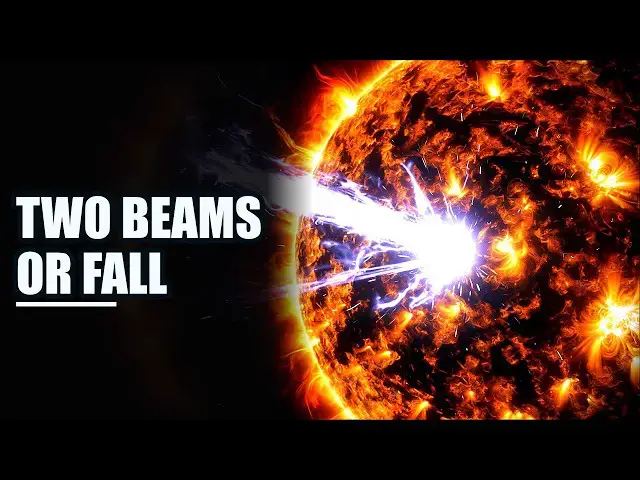
The giant mirror is the wrong machine. A Caplan thruster mines the Sun, fuses hydrogen, and fires two beams, because one beam means the engine falls into the star.
0:00 The hook: November 2019
0:48 The Mirror That Barely Moves
2:00 Strip Mercury First
3:12 Forty Doublings
4:28 Stellar Lifting
5:42 Two Jets
6:55 And It Gets Worse
8:10 The Million Year Push
9:28 What Earth Still Does
10:42 The Fuel Tank Called The Sun
This is a physics thought experiment, not an engineering proposal or a call to dismantle a planet. Numbers are public-record estimates; treat large rates as about.
#CaplanThruster #StellarEngine #DysonSwarm #Megastructures #Astrophysics #WhatIf #SpaceEngine #Mercury
Visuals are original AI-generated stills. Audio may be synthetic. Not medical, legal, or financial advice.
Show More Show Less View Video Transcript
0:00
In November 2019, Illinois State
0:02
physicist Matthew Caplan put a number on
0:05
moving the solar system, about 10 to the
0:07
minus 9 m/s squared, using the Sun as
0:11
both engine and fuel. The giant mirror
0:14
you have seen in every stellar engine
0:15
animation is the wrong machine.
0:18
A Shkadov thruster, proposed in 1987,
0:21
reflects sunlight. In a million years,
0:23
that mirror changes the Sun's speed by
0:26
about 2 m/s. The galaxy is moving at 230
0:30
km/s.
0:31
You have not steered. You have fidgeted.
0:34
Caplan's version does not reflect light.
0:36
It mines the photosphere, fuses
0:38
hydrogen, and fires two beams, because
0:41
one beam means the engine falls into the
0:43
star. You are standing on the night side
0:46
of Mercury at T high equals zero. The
0:48
clock is not a launch clock. It is a
0:51
mining clock. The popular picture is a
0:53
nozzle the size of Jupiter bolted to a
0:56
yellow star. That object cannot exist.
0:59
Gravity at the photosphere would swallow
1:01
it. The plasma would eat it. And a
1:03
single exhaust plume would push the
1:05
engine into the Sun as hard as it pushed
1:07
the Sun the other way. The real build
1:09
order starts with a planet you are
1:12
willing to destroy.
1:14
The mirror that barely moves.
1:16
The Shkadov thruster is a statite. A
1:19
mirror that sits against sunlight the
1:21
way a kite sits against wind.
1:24
Leonid Shkadov published it in 1987. You
1:27
unfurl a curved reflector across a chunk
1:30
of the inner system and bounce a
1:32
fraction of the Sun's light one way.
1:35
Photon thrust has a hard ceiling. Solar
1:37
luminosity over the speed of light is
1:39
about 1.3 * 10 to the 17 N
1:43
if you could grab every photon and send
1:45
it the same direction.
1:47
Divide by the mass of the Sun, about 2 *
1:50
10 to the 30 kg, and the whole solar
1:52
system accelerates at roughly 10 to the
1:55
minus 14 m/s squared. In a million
1:58
years, you have added a walking pace to
2:00
a star.
2:01
Light is a terrible propellant when the
2:03
vehicle mass is as much as a sun. That
2:06
ceiling is why the 2019 paper exists. If
2:09
you want a steering input that a galaxy
2:11
can feel, you have to throw mass, not
2:13
bounce photons.
2:15
Strip Mercury first, a Kaplan thruster
2:18
is a Dyson swarm with a fusion engine
2:20
attached, and the swarm is the first
2:22
machine you can actually start.
2:25
Mercury is about 3.3 * 10 to the 23 kg
2:29
of iron, silicate, and leftover heat.
2:32
At one astronomical unit, a full
2:35
spherical shell has an area of about 2.8
2:38
* 10 to the 23 square meters. If your
2:42
collectors mass about a kilogram per
2:44
square meter, Mercury is enough metal to
2:46
wrap the sun. You do not pour that metal
2:49
into a rigid shell. A rigid shell shears
2:51
itself apart. You build a swarm of
2:54
independent collectors, each one a thin
2:57
sail with a power converter,
2:58
station-keeping thrusters, and a laser
3:01
or microwave link. You land a seed
3:03
factory on the night side. It mines. It
3:06
smelts. It copies itself. The planet is
3:09
the feedstock. When you are done,
3:11
Mercury is gone. That is the first real
3:14
cost, and it happens before any jet
3:16
fires. From Earth, the first sign is not
3:19
a starship. It is a planet that stops
3:22
being a point of light.
3:24
40 doublings. Self-replicating industry
3:27
is a doubling clock. Start with one
3:29
factory the size of a warehouse. If it
3:31
copies itself every two months, 40
3:34
doublings give you about a trillion
3:35
copies in a little under 7 years. 30
3:38
doublings is a billion.
3:40
At T equals 1 year, the curve is still
3:42
quiet. A scar on Mercury, a few thousand
3:45
platforms, a dust ring you can see from
3:48
Earth as a faint extra glow near the
3:50
sun. At TR equals 5 years, the night
3:53
side of Mercury looks like a city that
3:55
never sleeps, and the first collectors
3:57
are already parked in tight solar
3:59
orbits, dumping waste heat as infrared.
4:02
The sky from Earth does not go black. A
4:05
partial swarm at 5% coverage is a
4:07
brighter zodiacal light and a small dip
4:10
in the solar constant. Your crops notice
4:13
before your eyes do. The logistics
4:15
problem is heat, slag, and collision
4:18
avoidance for millions of independent
4:20
stations sharing the same crowded
4:22
orbits.
4:23
The physics problem is still waiting.
4:25
You have only built the power plant. The
4:27
star has not moved a millimeter.
4:30
Stellar lifting.
4:32
Now you steal hydrogen. The sun already
4:34
throws off about a billion kilograms per
4:36
second as solar wind. A Kaplan thruster
4:39
wants something like 10 to the 15 kg per
4:42
second, about a million times the
4:44
natural leak, lifted off a patch of
4:46
photosphere and piped to the engine.
4:49
David Criswell described stellar lifting
4:52
in the 1980s. Concentrate energy on a
4:55
region of the surface, heat the plasma,
4:57
and use magnetic nozzles to funnel the
4:59
boil off into space. You are not
5:02
drilling a star, you are giving it a
5:04
fever on purpose. The photosphere sits
5:06
at about 5,800 Kelvin. Raise a column,
5:09
ionize it, grab it with magnetic fields,
5:12
and fling it outward along a corridor
5:14
the swarm keeps open. The mass you lift
5:17
is the reaction mass and the fusion
5:19
fuel.
5:20
The sun mass is 2 * 10 to the 30 kg. At
5:23
10 to the 15 kg per second, you could
5:26
run for tens of millions of years before
5:28
the star noticeably shrinks. You are
5:30
siphoning a fuel tank, not emptying it
5:33
overnight. From a probe above the pole,
5:35
you would see a bright wound on the
5:36
surface and a thread of plasma rising
5:39
into the dark.
5:41
Two jets.
5:42
Here is the part the animation skipped.
5:45
The engine cannot sit on the sun. It
5:47
hangs in space, a fusion complex the
5:49
size of a small planet, fed by the
5:51
swarm's power and by the hydrogen
5:54
pipeline.
5:55
Fusion of hydrogen yields about 0.7% of
5:58
rest mass as energy. You convert a
6:00
stream of lifted protons into helium ash
6:03
and fire that ash out the back at a few
6:05
percent of light speed. That jet is the
6:08
thrust that moves the solar system.
6:10
The second jet is hydrogen, not fused,
6:13
aimed straight at the sun. It does two
6:15
jobs. It dumps momentum into the star so
6:18
the star accelerates with you, and the
6:19
recoil holds the engine up against solar
6:22
gravity so the whole machine does not
6:24
fall in. One jet is a rocket. Two jets
6:27
is a tractor that pushes the star and
6:29
holds itself off the fire. Without the
6:32
inward beam, an engine in the 10 to the
6:34
21 Newton class becomes a meteor with a
6:37
power plant. That is the turn inside the
6:40
turn. The Kaplan thruster is a pair of
6:42
fire hoses, and the quiet hose, the one
6:45
aimed at the photosphere, is the one
6:47
that keeps you alive. And it gets worse,
6:49
and it gets worse. The sun is not a
6:52
billiard ball, it is a 1.4 million
6:54
kilometer sphere of plasma with a
6:56
surface you can push and a core that
6:58
does not know you exist for a long time.
7:01
Pressure waves cross the envelope on a
7:03
time scale of hours. The deep interior
7:06
takes far longer. Your hydrogen beam is
7:08
a blowtorch on a fog bank. You deposit
7:11
momentum in the outer layers. Those
7:13
layers can slosh, brighten, and throw
7:15
flares. A sustained load on the order of
7:18
10 to the 21 Newtons on one hemisphere
7:20
is a climate event for a star. Magnetic
7:23
fields twist. The solar wind you were
7:25
counting on as a gentle breeze becomes a
7:27
weather system you built on purpose.
7:29
Waste heat from the swarm has to go
7:31
somewhere. Infrared dumped to the sky,
7:34
aimed away from Earth if you are
7:35
careful, into the oceans if you are not.
7:38
The Oort Cloud is bound by a trickle of
7:40
gravity. Accelerate the sun by tens of
7:43
kilometers per second over a million
7:45
years and the loosely bound comets do
7:47
not all come along. Some lag, some fall
7:49
inward. You wanted a steering wheel, you
7:52
bought a new comet season, and a star
7:53
with a sunburn you have to keep managing
7:55
for as long as the jets stay on. The
7:58
million-year push, Kaplan's November
8:00
2019 paper in Acta Astronautica, treated
8:03
this as an engineering bound, not a
8:05
travel brochure. At about 10 to the
8:07
minus 9 m/s squared, a million years of
8:11
burn changes the Sun's velocity by about
8:13
30 km/s.
8:15
That is a real steering input on a 230
8:18
km/s galactic orbit. Distance covered is
8:21
tens of light-years, enough to walk the
8:23
solar system out of a bad star-forming
8:25
region, off the line of a future
8:27
supernova, or toward a younger
8:29
neighborhood before our own star bloats
8:31
and cooks the inner planets in about 5
8:33
billion years. You do not park at Alpha
8:35
Centauri for the weekend. Alpha Centauri
8:38
sits 4.3 light-years away. At this
8:41
acceleration, you close that gap in a
8:43
few hundred thousand years, and you
8:45
arrive with the whole system still
8:46
attached, which is the only reason to
8:48
build the thing. A probe could have gone
8:50
in decades. This machine exists because
8:53
you refuse to leave the planets behind.
8:55
The part that actually matters is that
8:57
time. A million years is longer than
8:59
Homo sapiens has been a species. The
9:01
engine is a civilizational object, not a
9:04
spacecraft you paint and cheer for, what
9:06
Earth still does.
9:08
What does not happen tomorrow morning?
9:10
Mercury is still there. The Sun still
9:12
rises over water. Earth does not get a
9:14
new orbit overnight. Your gravity well
9:16
is deep. Earth's orbital acceleration
9:18
around the Sun is about 6 mm/s squared.
9:22
The Kaplan push is millions of times
9:24
smaller. The planets follow the Sun the
9:27
way cargo follows a tug that leans into
9:29
the hawser over centuries. No world is
9:32
left behind in the first year or the
9:34
first thousand. The sky does not go dark
9:36
because you have not finished the swarm.
9:38
Fusion at the engine does not ignite the
9:40
photosphere into a nova. You are lifting
9:43
mass from the surface, not compressing
9:45
the core. Andromeda is still about 2.5
9:48
million light-years away and still
9:50
arriving in about 4.5 billion years,
9:53
whether you build this or not.
9:55
A million-year burn can change a local
9:57
orbit around the galaxy. It does not
10:00
evacuate the local group, and it does
10:02
not turn next Tuesday into a poster. The
10:05
disaster this engine is for is a slow
10:07
disaster. A dying star, a bad patch of
10:10
space, a need to move house with the
10:12
house still on the lot, the fuel tank
10:15
called the sun.
10:17
You now own a star that is a fuel depot
10:19
with a weather problem. Every second the
10:21
engine runs, about a quadrillion
10:23
kilograms of the sun leave as beam or
10:26
ash. The swarm has to retune as
10:29
luminosity shifts by fractions of a
10:31
percent. Earth's climate, already
10:33
balanced on about 1,360
10:36
W
10:36
per square meter at the top of the
10:38
atmosphere, lives under a machine that
10:41
can shade or dump heat by accident. The
10:44
bill is not a launch day with a
10:45
countdown. The bill is a planet named
10:48
Mercury, a million years of operations,
10:51
and a sun
News