Up next in 10


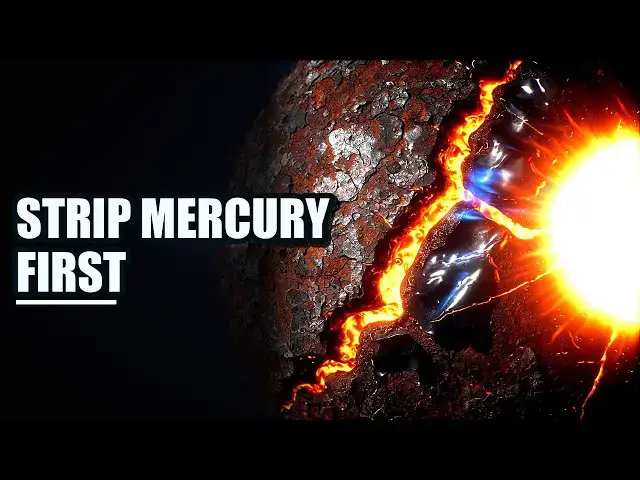
How you'd actually build a Matrioshka brain. Freeman Dyson's 1960 paper was never a chrome ball around the Sun. The real build order strips Mercury first, doubles the miners, flies a swarm, then nests more swarms on waste heat until a star is a computer.
0:00 The cartoon is a shell
0:48 Strip Mercury First
2:10 Swarm Not Shell
3:30 The Doubling Clock
4:55 First Layer Goes Live
6:15 Waste Heat Is the Fuel
7:45 And It Gets Worse
9:00 Tabby's False Alarm
10:15 The Physics That Kills
11:25 What Does Not Happen
This is a physics thought experiment using public-record numbers, rounded with "about." It is not a construction plan, a prediction, or a claim that anyone is building this.
#MatrioshkaBrain #DysonSwarm #Mercury #Megastructure #KardashevScale #SpaceEngineering #WhatIf #Astroengineering
Visuals are original AI-generated stills. Audio may be synthetic. Not medical, legal, or financial advice.
Show More Show Less View Video Transcript
0:00
On June 3rd, 1960, Science magazine
0:02
prints a three-page paper by Freeman
0:05
Dyson. He is hunting a star that dumps
0:08
about 3.8 * 10 to the 26 W into infrared
0:12
because something around that star is
0:14
catching every photon.
0:16
He never asked anyone to weld a hollow
0:18
ball around the sun.
0:20
The ball is the cartoon that showed up
0:21
later. The real machine starts by
0:24
stripping Mercury, and a Matryoshka
0:26
brain is not one sphere. It is nested
0:28
swarms, each layer living off the waste
0:31
heat of the layer inside it, strip
0:33
Mercury.
0:35
First,
0:37
you're standing on Mercury at local
0:38
noon. There is no air in your ears. The
0:41
silence is total.
0:43
Sunlight on your visor hits about nine
0:45
times harder than a clear noon on Earth,
0:47
and nothing in the sky smears it. Under
0:49
your boots sits about 3.3 * 10 to the 23
0:53
kg of rock and metal. That is the
0:56
opening inventory.
0:58
Mercury is the first mine for three dull
1:01
reasons. It is close, so solar power is
1:04
cheap. It has no atmosphere to fight,
1:06
and most of its mass is iron and nickel,
1:09
a giant core under a thin silicate
1:11
crust. Collectors and computers are
1:13
metal. This planet is a metal brick
1:16
parked in a furnace. The first machines
1:19
are solar-powered strip miners the size
1:21
of shipping containers dropped on the
1:23
day side. They melt regolith, pull iron,
1:26
silicon, oxygen, and pour that metal
1:29
into mirrors, frames, and the next
1:31
miner.
1:32
Night side sits near minus 180° C.
1:36
Day side can hit about 430° C,
1:39
the same world as a freezer and an oven
1:41
across a solar day of about 176 Earth
1:44
days. So, every miner has to survive
1:47
both.
1:47
Escape velocity here is about 4.2 km per
1:50
second, so launching a plate is a real
1:53
energy bill. You lay electromagnetic
1:55
drivers along the equator and fire
1:58
finished collectors into solar orbit.
2:00
Every kilogram that leaves is a mountain
2:02
that will not be here later. Swarm. Not
2:05
shell. The popular picture is a rigid
2:07
shell, a metal egg around a star, cities
2:10
on the inner wall. That object does not
2:13
stay put. A rigid shell around a point
2:15
mass sits in unstable equilibrium. Nudge
2:18
it once, and the near side falls in
2:21
while the far side flies out. You do not
2:24
fix that with thicker beams. You abandon
2:26
the shell. What Dyson described is a
2:28
swarm. Millions, then billions of
2:31
independent collectors, each in its own
2:33
orbit, each leaving gaps. From far away,
2:36
the star still looks like a star, dimmer
2:39
in visible light, brighter in infrared.
2:42
The gaps keep you from a Kessler
2:43
catastrophe on day one. A Matryoshka
2:46
brain uses that same swarm trick,
2:48
stacked. Inner orbits run hot computers.
2:51
Outer orbits catch the infrared those
2:54
computers dump. You are not building a
2:56
doll you can hold. You are building
2:57
nested traffic, the doubling clock.
3:00
One miner is a joke. A million miners is
3:03
a planet eater, and the only path is
3:05
doubling. Give each factory 6 months to
3:08
copy itself. After 1 year, you have
3:10
four. After 5 years, about a thousand.
3:13
After 10 years, about a million. After
3:16
20 years, about a trillion. The curve
3:19
feels like nothing until year eight.
3:21
Then the surface of Mercury looks
3:23
chewed. Power is not the first
3:25
bottleneck. At Mercury, the sun delivers
3:27
about 6 to 14 kilowatts per square
3:30
meter, depending on the oval orbit. A
3:33
factory roof is a power plant. The
3:35
bottlenecks are heat rejection, dust,
3:38
and cutting a world apart while you
3:39
stand on it. When the miners reach the
3:42
core, they are carving a metal ball
3:44
about 4,000 km across. Gravity falls as
3:47
mass leaves. Launch driver orbits shift.
3:50
The work gets easier and more chaotic in
3:52
the same season.
3:54
First layer goes live.
3:57
The first useful product is not a mind.
4:00
It is a belt of thin collectors a few
4:02
tenths of an AU out, turning photons
4:04
into current. Human civilization now
4:07
runs on about 20 terawatts. The sun puts
4:10
out about 380 septillion watts. That gap
4:13
is about 13 orders of magnitude. The
4:16
first belt does not close it. The first
4:18
belt proves you can catch a slice of a
4:20
star without melting the wiring.
4:23
Computing substrate rides the shadow
4:25
side of each collector behind radiators.
4:27
Electronics want to be cool.
4:29
The inner swarm sits in a glare that
4:32
would ignite wood in a second if wood
4:34
were here. So, layer one is a
4:35
compromise. Hot, dense, close, fast
4:39
clocks, and radiators the size of lakes
4:42
dumping infrared outward. That infrared
4:44
is not pollution. That infrared is the
4:47
power line for layer two.
4:50
Waste heat is the fuel.
4:52
Robert Bradbury named the Matrioshka
4:54
brain in the late 1990s after the
4:56
Russian nesting doll.
4:58
The idea is thermodynamics with no
5:00
manners. Every computation dumps heat.
5:03
Landauer's limit says erasing one bit
5:05
costs at least k T ln 2. So, a colder
5:09
computer can, in principle, think more
5:11
per watt. The inner swarm runs warm and
5:14
brutally powerful. Its waste glow
5:16
becomes a new sun for the next swarm.
5:19
Collectors tune to infrared instead of
5:21
visible light. That second swarm
5:23
computes and dumps a longer wavelength
5:25
glow.
5:26
You keep stacking until the outermost
5:28
layer is a huge cold radiator throwing
5:31
leftover heat into the dark at tens of
5:33
Kelvin. Each layer must be larger than
5:35
the one inside it. Same power at a lower
5:38
temperature needs more area.
5:40
Stefan-Boltzmann is blunt. Radiated
5:42
power goes as temperature to the fourth.
5:45
Cut temperature by a factor of 10 and
5:47
you need about 10,000 times the
5:49
radiating area for the same watts. The
5:51
finished object is puffed out. Outer
5:53
layers are gossamer, sails and radiators
5:56
and thin computers, not armor. And it
5:58
gets worse. And it gets worse because a
6:01
brain this big is not one mind. Light
6:04
from the inner swarm to Earth's old
6:06
orbit takes about 8 minutes. Out at 5
6:08
AU, you wait the better part of an hour.
6:11
You cannot have a single thought that
6:12
uses the whole structure. You have
6:14
provinces. Inner hot nodes do frantic
6:17
work. Outer cold nodes do slow,
6:19
efficient work. Any self that lives here
6:22
is a federation paying a speed of light
6:24
tax on every meeting. The star does not
6:26
sit still. A coronal mass ejection is a
6:29
wall of plasma. Thin collectors are
6:32
giant sails. Radiation pressure,
6:34
Poynting-Robertson drag, and
6:36
micrometeoroids tug the traffic. You
6:39
burn a slice of that incredible power
6:41
budget just to miss yourself. One
6:43
collision at orbital speed is a spray of
6:46
shrapnel through the next 10,000 plates.
6:49
The debris problem people fear in low
6:51
Earth orbit becomes a solar system job.
6:53
Tabby's false alarm.
6:56
In September 2015, Tabitha Boyajian and
6:59
her co-authors publish Kepler photometry
7:02
of a star tagged KIC 8462852.
7:06
The light drops by up to about 22% in
7:09
uneven dips.
7:10
For a few months, the internet decides
7:12
it has caught a Dyson swarm under
7:13
construction. Follow-up through 2016 and
7:17
2017 points at dust. The infrared excess
7:21
a Matrioshka brain would dump is not
7:23
sitting there like a beacon. That
7:24
episode is the closest thing we have to
7:26
a field test. If someone had already
7:28
wrapped a star in nested computers, the
7:31
waste heat would glow in infrared in a
7:33
way astronomers already know how to
7:34
hunt. We have looked at a lot of stars.
7:37
We have not found a heat dump the size
7:39
of a sun. The physics that kills a solid
7:41
shell fails on gravity. It also fails on
7:44
strength. Hoop stress in a rigid sphere
7:47
at planetary radius is a fantasy number.
7:49
You build with iron, silicon, carbon,
7:51
whatever, mercury, then Venus, then the
7:54
asteroids will give you. Venus is about
7:56
4.9 * 10 ^ 24 kg, roughly 15 mercuries,
8:02
wrapped in an atmosphere about 90 times
8:04
Earth's pressure at about 460° C.
8:07
You do not land a picnic, you skim the
8:10
upper clouds, or you spend energy
8:12
tearing the air off. The asteroid belt
8:14
is poor next to a planet, but it is
8:16
already in pieces, which saves the
8:18
launch bill.
8:19
Even with all that mass, you do not get
8:21
a hollow Earth with a sun in the middle.
8:23
You get a fog of hardware. Latency kills
8:26
the hive mind. Heat kills tight packing.
8:28
Collisions kill the dense shell. What
8:31
remains is nested swarms, built from the
8:33
inside out, fed by a star you never
8:35
touch, radiating a bigger, colder
8:38
infrared signature as you add layers.
8:41
That is the build. It is slower than a
8:44
movie and rude to the inner planets.
8:46
What does not happen?
8:48
What does not happen tomorrow keeps this
8:51
from being an ending. The sun does not
8:53
go out. Earth does not freeze on a
8:55
Tuesday. Your power bill does not
8:57
notice. NASA does not have a mercury
8:59
stripper in the budget. A doubling
9:01
factory that eats a planet in 20 years
9:04
does not sit in a hangar in Texas.
9:06
If a matryoshka brain ever rises in the
9:08
system, it is after a civilization
9:11
already ships megatons a day through
9:13
space industry, not after a video. You
9:16
would see it coming the honest way.
9:17
Mercury spectrum changes. An infrared
9:20
leak grows. Inner planets go missing as
9:23
mass. That is decades to centuries of
9:25
obvious, stupidly bright engineering. It
9:28
is the loudest machine a solar system
9:30
can make. The popular picture is a
9:32
chrome ball. The actual job is strip
9:35
mercury, double the miners,
News
Astronomy
Engineering & Technology
Physics