Up next in 10


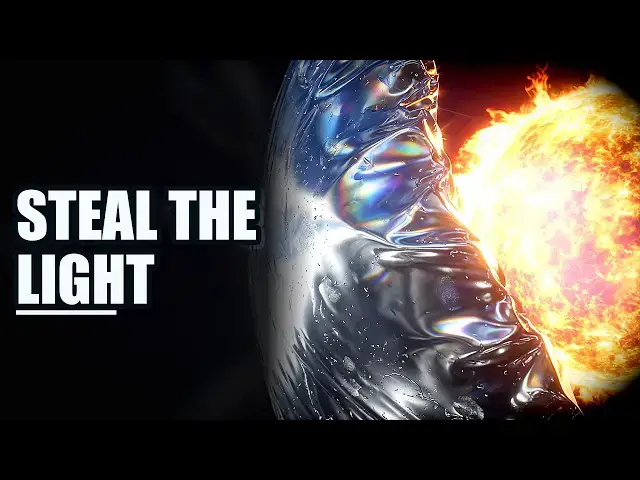
A stellar engine is not a rocket bolted to the Sun. You steal its light, throw it one way, and the whole solar system drifts the other way. Here is the real build order, the numbers, and the physics that kills the sci-fi version.
0:00 The 1987 Paper
1:20 You Don't Wrap the Sun
2:40 Steal the Light First
4:00 Mercury Is the Mine
5:20 Doubling Time
6:50 The Thrust Is Pathetic
8:20 And It Gets Worse
10:00 Caplan's Jet
11:30 What Does Not Happen
This is a thought experiment about megastructures, not a construction plan.
#StellarEngine #ShkadovThruster #DysonSphere #Megastructures #Space #Astronomy #Physics #WhatIf
Visuals are original AI-generated stills. Audio may be synthetic. Not medical, legal, or financial advice.
Show More Show Less View Video Transcript
0:00
In 1987, a Soviet engineer named Leonid
0:03
Skotnikov put a number on moving the
0:05
Sun, about 1.3 * 10 ^ 18 N of thrust
0:09
from a mirror the size of a planetary
0:11
orbit, and the whole solar system still
0:14
takes about 50 million years to pick up
0:16
1 km per second. You do not bolt a
0:19
rocket to a star. You steal its light,
0:22
throw that light one way, and the star
0:24
drifts the other way so slowly that a
0:27
human lifetime is a rounding error. The
0:29
1987 paper Skotnikov published the idea
0:32
as a class A stellar engine. A giant
0:35
curved mirror sits on one side of the
0:37
Sun, held up by the same radiation it is
0:40
reflecting. Photons leave the
0:41
photosphere at the speed of light. Half
0:44
of them hit the mirror and bounce.
0:46
Momentum is 2 * energy over C when a
0:48
photon reverses, and the leftover half
0:51
streams out the open side. The net
0:53
result is a photon rocket whose fuel is
0:55
the Sun itself. The luminosity of the
0:57
Sun is about 3.8 * 10 ^ 26 W.
1:01
Divide by the speed of light and you get
1:03
about 1.3 * 10 ^ 18 N.
1:07
That is the whole engine. No combustion
1:09
chamber, no nozzle, no place to stand.
1:12
At T = 0, the mirror is not even there.
1:15
At T = 1 year, you have a paper and a
1:17
sketch. At T = 5 years, you still have a
1:21
paper because the first kilogram of
1:23
structure has not been mined. You don't
1:25
wrap the Sun.
1:27
The picture people carry is a Dyson
1:29
shell with a steering wheel. A rigid
1:31
shell around a star is mechanically dead
1:34
on arrival. The Sun is not a ball you
1:36
can clamp. It is a plasma with a surface
1:39
gravity of about 274 m/s ^ 2
1:43
and a radiation field that would
1:45
vaporize anything you parked at one
1:47
solar radius. A closed shell has no net
1:50
thrust anyway because light leaves in
1:52
every direction and cancels. The working
1:55
engine is an open hemisphere, a statite,
1:57
a thing that hovers on light the way a
1:59
kite hovers on wind. It never orbits.
2:02
Radiation pressure balances the sun's
2:04
gravity at a distance you choose by how
2:07
reflective and how light the sheet is.
2:10
You are not wrapping the star. You are
2:11
putting a lid on half the sky, steal the
2:14
light.
2:15
First build order starts with photons,
2:18
not iron. Every second the sun throws
2:20
about 4 million tons of mass energy into
2:23
space as light. You do not need to
2:25
invent a new energy source. You need a
2:27
surface that can sit in that wind
2:29
without melting and without falling in.
2:32
A Shkadov mirror is a parabolic or
2:34
spherical reflector, tens of millions of
2:36
kilometers across, parked at a fraction
2:39
of an astronomical unit on the side of
2:41
the sun you want to push away from.
2:43
The reflected beam goes out the open
2:45
hemisphere. The star plus the planets,
2:48
locked by gravity, feel a tiny residual
2:51
acceleration toward the dark side of the
2:52
mirror.
2:53
Earth does not get a separate engine.
2:56
Earth is cargo. If the sun moves, the
2:58
gravitational well moves, and you come
3:01
with it the way a moth comes with a
3:02
porch light if you pick up the porch.
3:05
Mercury is the mine.
3:07
You do not start at the sun. You start
3:09
at Mercury. Mercury is about 330 billion
3:13
billion tons of silicate and metal
3:15
sitting at 0.4 astronomical units,
3:18
already baked, already metal rich,
3:21
already deep in the gravity well you
3:22
have to work in.
3:24
The popular stellar engine drawing skips
3:26
this. It shows a finished mirror. The
3:29
finished mirror is the last object.
3:31
First, you disassemble a planet. Solar
3:34
powered smelters on the day face of
3:36
Mercury, night side radiators dumping
3:38
waste heat into black sky, mass drivers
3:41
throwing refined sheet into a halo. You
3:44
are not building a cathedral. You are
3:46
peeling a world into foil. If you need
3:48
more area than Mercury can give, you go
3:50
to the asteroids next. Then you start
3:52
skimming the sun's own outer layers, and
3:54
that is a different machine. For a class
3:57
A engine, Mercury is the mine because it
3:59
is close. It is metal, and nobody lives
4:02
there. Doubling time.
4:04
A single factory on Mercury does not
4:06
finish this. You need a doubling time.
4:09
One smelter builds two. Two build four.
4:12
If your replicators double every two
4:14
years, 30 doublings is about a
4:16
billion-fold in 60 years, and that is
4:18
still only the seed. The mirror's area
4:21
is measured in square astronomical
4:23
units. A hemisphere at half an
4:25
astronomical unit is on the order of 1 *
4:28
10 to the 16 square meters. Even a
4:30
gossamer film a few micrometers thick is
4:32
a planetary mass of material. The
4:35
doubling clock is the real schedule.
4:37
Miss a doubling and you add years. Break
4:40
the chain with a dust storm, a coronal
4:42
mass ejection, a software fault that
4:45
turns your replicators into scrap, and
4:47
the clock resets. At TR = 0, you have a
4:51
lander. At TR = 1 doubling, you have a
4:54
camp. At TR = 5 doublings, you have a
4:58
city of robots and still no mirror that
5:00
could move a star. The engine is not a
5:02
construction project you finish in a
5:04
presidency. It is an industrial species
5:07
that has to keep its hands on the same
5:08
job for longer than writing has existed.
5:11
The thrust is pathetic.
5:14
Here is the number that kills the movie
5:16
version. 1.3 * 10 to the 18th Newton
5:20
sounds like a god. Divide by the mass of
5:22
the sun, about 2 * 10 to the 30 kg, and
5:26
the acceleration is about 6 * 10 to the
5:29
minus 13 m/s squared. In 1 year, the
5:32
sun's speed changes by about 2 cm per
5:35
second. In 1,000 years, 20 m per second.
5:39
To add 1 km per second takes on the
5:41
order of 50 million years. The galaxy is
5:44
about 100,000 light years across. At
5:46
Kardashev acceleration, you are not
5:48
touring it. You are leaning. After a
5:51
billion years, you have a respectable
5:52
velocity, and the planets have been
5:54
riding in the same gravitational well
5:56
the whole time, as long as you pointed
5:58
the thrust so the orbits did not shear
6:00
apart. The engine works. It works the
6:03
way continental drift works. True and
6:05
useless if you needed to dodge something
6:07
this century. And it gets worse, and it
6:09
gets worse, because the mirror has to
6:11
live there while it does this. A statite
6:14
in the inner solar system eats a weather
6:15
system that would shame a bomb range.
6:18
The solar wind is about 400 km per
6:20
second of protons. Coronal mass
6:22
ejections throw on the order of a
6:24
billion tons of plasma in a few hours.
6:27
Micrometeoroids sandblast any film you
6:29
stretch across millions of kilometers.
6:32
The mirror has to stay on station, stay
6:34
reflective, and stay in one piece while
6:36
the sun it is leaning on goes through
6:38
11-year cycles, flares, and the slow
6:41
brightening that comes with age.
6:43
If a sector tears, the thrust vector
6:45
tilts, and the solar system is no longer
6:48
a rigid crate. Earth's orbit is a
6:50
delicate clock. A fractional G error
6:53
that lasts a million years is not a
6:55
fractional G error. It is a climate, a
6:57
season, a day length. You are not only
7:00
building an engine, you are volunteering
7:02
to be the sun's flight control for
7:04
geological time with no off switch that
7:06
does not strand you. Kaplan's jet.
7:10
In 2019, the physicist Matthew Kaplan
7:12
published a different engine, a class C.
7:15
And this is the named case that changes
7:17
the clock. Instead of a passive mirror,
7:19
you build a Dyson swarm of collectors
7:21
and use that power to run particle
7:23
accelerators. You lift hydrogen off the
7:25
sun, fuse or accelerate it, and fire a
7:28
relativistic jet one way while a smaller
7:31
balancing jet holds the engine off the
7:33
photosphere.
7:34
Kaplan's estimate is brutal in the other
7:36
direction. A Kaplan thruster can, on
7:39
paper, dump enough momentum to shove the
7:41
solar system 50 light years in about 1
7:44
million years. Fast enough to walk away
7:47
from a nearby supernova or a passing
7:49
star that would otherwise stir the Oort
7:51
cloud. The fuel is the sun. You are
7:54
mining the star you live around. Every
7:56
kilogram you throw out the back is a
7:58
kilogram the sun will never fuse. Do
8:01
this hard enough, long enough, and you
8:03
shorten the main sequence on purpose.
8:05
The Shkadov engine is a kite. The Kaplan
8:07
engine is a blowtorch that eats the
8:09
boat. That is the part that actually
8:11
matters. Speed is available.
8:14
The price is the star's remaining
8:15
lifetime, paid in mass you will not get
8:18
back. What does not happen?
8:20
What does not happen tomorrow is the sun
8:22
lurching. Your sunrise does not shift.
8:25
Mercury is not under construction. No
8:28
government has a stellar engine office.
8:30
The 1987 paper is still a paper. The
8:33
2019 paper is still a paper. Voyager 1
8:36
after nearly 50 years has gone about 25
8:39
billion kilometers, which is a rounding
8:41
error on the distance a Shkadov sun
8:43
would crawl in a million years. And
8:45
Voyager had a launch vehicle. A stellar
8:47
engine does not make Earth a spaceship
8:49
next winter. It does not empty the sky
8:52
of stars. It does not give you a
8:54
steering wheel. If a civilization ever
8:56
built one, the first century would look
8:58
like mining and heat and failed foil,
9:00
and the first useful change in the sun's
9:02
velocity would belong to people who had
9:04
not been born when the first smelter
9:06
lit.
9:07
The popular
News