Up next in 10


The poster is a golden dish over the Pacific. The real machine is a microwave net in GEO and a 10 km wire farm on the ground. Here is the build order, the mass bill, and the physics that kills the sci-fi version.
0:00 The Beam You Cannot See
1:12 The Picture Is Wrong
2:28 Start In Low Orbit
4:05 The Mass Bill
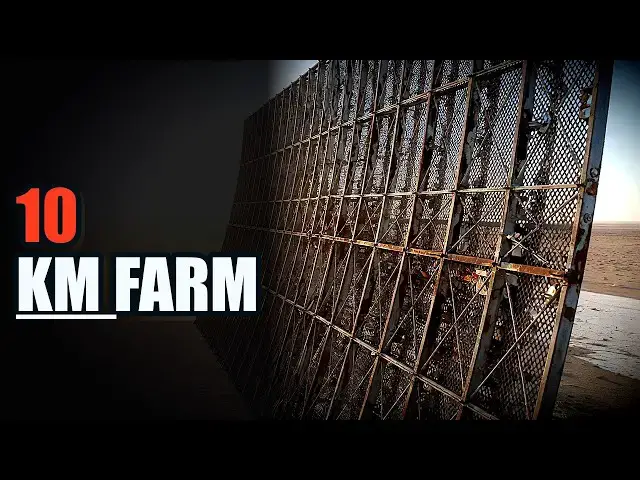
5:32 The Farm On The Ground
7:08 And It Gets Worse
8:42 A Box In 2023
10:10 What Does Not Happen
11:18 The Real Plug
This is a public-record explainer. Launch masses, costs, and timelines are about-numbers from published studies, not a construction schedule.
#spacesolar #spacebasedsolarpower #energy #geostationary #rectenna #starship #caltech #infrastructure
Visuals are original AI-generated stills. Audio may be synthetic. Not medical, legal, or financial advice.
Show More Show Less View Video Transcript
0:00
On January 3rd, 2023, a crate the size
0:03
of a mini fridge left Vandenberg on a
0:05
Falcon 9. By June, that crate had thrown
0:08
a microwave beam through vacuum, and a
0:10
detector on Earth registered the hit.
0:13
You feel that in your ribs if you have
0:14
ever been sold a poster. The sun is free
0:17
up there, so Earth should be a wall
0:18
socket. It is not a socket. Sunlight at
0:21
geostationary altitude is about 1/360 W
0:25
on every square meter every hour, no
0:27
night, no cloud. A 1 GW space station,
0:31
even on the light modern paper designs,
0:33
still means about 2,000 tons of hardware
0:36
you have to lift, assemble, and aim at a
0:38
patch of dirt the size of an airport.
0:41
The beam.
0:42
You cannot see you are standing on a dry
0:44
lake bed at noon, and the sky is the
0:46
wrong color. There is no fireball. There
0:49
is a faint warmth on the back of your
0:51
hand, like walking past a brick wall
0:53
that held the sun. That warmth is the
0:55
product. A space power satellite does
0:58
not drop lightning. It sends a microwave
1:00
beam at about 2.45 GHz, the same
1:03
neighborhood as a kitchen magnetron,
1:05
spread so the intensity at the ground
1:08
sits around 230 W per square meter. That
1:11
is less than a quarter of noon sunlight.
1:13
Your skin does not blister. A bird
1:16
crossing the center of the beam picks up
1:17
a mild heating and keeps flying. The
1:20
energy is real. It is also invisible,
1:22
which is why every painting of a golden
1:24
death ray is a lie you have already paid
1:27
for with your attention.
1:28
The picture is wrong. The poster is one
1:31
giant dish parked over the Pacific, a
1:34
city-sized gold flower, a cable of light
1:37
into California.
1:38
That picture dies in three places.
1:40
First, a solid dish that big would tear
1:43
itself apart under thermal stress, and
1:45
would cost more than the grid it claims
1:47
to feed. The working designs are sparse.
1:50
Picture a fishing net made of thin-film
1:52
solar and small microwave tiles,
1:54
kilometers across, mostly empty space.
1:57
Second, you do not plug Earth into one
1:59
satellite. You need a constellation if
2:01
you want more than a regional plant.
2:04
Third, the power plant you actually live
2:06
with is on the ground. The satellite is
2:08
a transmitter. The farm of wire mesh
2:10
that catches the beam is the thing that
2:12
ties into substations, transformers, and
2:15
the night load. If you came here for a
2:17
floating city that replaces every coal
2:19
stack on contact, you have the wrong
2:22
machine.
2:23
Start in low orbit.
2:25
You do not begin in geostationary orbit.
2:27
Geostationary is 35,786
2:31
km up, a multi-burn hall with a full
2:33
refuel dance, and a graveyard of dead
2:36
comsats fighting for slots.
2:38
You begin in low Earth orbit a few
2:40
hundred kilometers up, where a ride
2:42
share can drop a box for a few million
2:44
dollars, and you can prove the beam
2:45
before you bet a nation on it. You fly a
2:48
small microwave array. You steer the
2:50
beam by shifting the phase on each tile.
2:52
No gimbals, no huge dish. You hit a
2:55
receiver a few meters away on the same
2:56
spacecraft, then you try to tickle a
2:58
detector on Earth. Only after that works
3:01
do you talk about a megawatt-class bird,
3:03
then a gigawatt-class one.
3:05
The doubling is slow on purpose. Each
3:08
jump in power is a jump in aperture. The
3:10
transmitter and the receiver have to
3:12
grow together because of diffraction.
3:15
At 245 GHz over a 36,000 km throw, the
3:20
product of the two antenna diameters
3:22
sits around 10 km squared. Shrink the
3:24
space antenna and the ground farm
3:26
explodes. Shrink the ground farm and the
3:28
satellite has to become a kilometer-wide
3:31
clock that never misses a beat. The mass
3:33
bill here is the bill you pay in metal.
3:36
A classic 1970s NASA study put a
3:38
5-gigawatt station at about 50,000 tons
3:42
with a transmitting antenna about a
3:44
kilometer across. Modern British and
3:46
American paper designs claim you can get
3:48
near 2 gigawatts for something like
3:50
2,000 tons if the structure is a
3:52
gossamer truss and the solar is thin
3:54
film. Treat those as about numbers. Even
3:57
the optimistic 2,000 tons is almost five
4:00
international space stations. Starship
4:02
on a good advertised day is around 100
4:05
to 150 tons to low Earth orbit. GEO is
4:09
not low Earth orbit. You refuel in
4:11
orbit. You fly many times. You
4:13
robotically dock trusses that have never
4:15
been to a factory floor in one piece. A
4:17
launch cadence that puts 2,000 tons into
4:19
GEO is years of stacking and every
4:22
kilogram you save in solar mass, you
4:24
spend again in extra area or in the
4:27
motors that keep the net from folding or
4:29
in the spare tiles you will need when
4:31
micrometeoroids punch the first holes.
4:33
Sunlight is free. Aluminum is not.
4:36
Krypton for ion thrusters is not.
4:39
The crew that sets rectenna posts in a
4:41
Nevada valley is not free either. The
4:44
farm on the ground walk the perimeter.
4:48
For about 1 GW at a safe 230 W/m², you
4:52
are looking at a collecting area on the
4:55
order of 4 square kilometers. Stretch
4:57
that for the old 5 GW design and the
5:00
rectenna is about 10 kilometers across.
5:03
It is not a solar farm of glass. It is a
5:06
mesh of dipoles on poles like a radio
5:09
telescope laid on its back with enough
5:11
open sky that rain and grass still
5:14
happen underneath.
5:15
The sales slide says cattle can graze in
5:18
the gaps.
5:19
What you cannot do is drop this inside a
5:22
city. You put it on a dry lake, a
5:24
stretch of scrub, a desert with a
5:26
transmission corridor already nearby.
5:29
You still need substations. You still
5:31
need high-voltage lines. You still need
5:34
a grid that can swallow a gigawatt when
5:36
a cloud does not even matter. The beam
5:39
is weather blind in a way rooftop
5:41
photovoltaic is not. Rain and thin cloud
5:44
pass 2.45 GHz with modest loss.
5:49
Heavy rain eats more. You site for dry.
5:52
You also site for people.
5:55
A keep out zone around the peak
5:56
intensity is a political object.
5:59
Somebody owns that dirt. Somebody has to
6:01
sell the right of way. The satellite can
6:03
be owned by a consortium in orbit. The
6:06
farm is county politics, water law, and
6:09
a fence. And it gets worse and it gets
6:12
worse because orbit is not a parking
6:14
space with view.
6:15
Geostationary satellites still see
6:18
eclipse around the equinoxes.
6:20
For about 70 minutes on the worst nights
6:22
in March and September, Earth parks
6:24
itself between the station and the sun.
6:27
Your 24-hour solar plan is not 24-hour
6:31
unless you carry batteries or fly a
6:33
second bird. Station keeping eats
6:35
propellant for the life of the vehicle.
6:38
Micrometeoroids keep punching thin film
6:41
every year of the mission.
6:43
The beam has to stay inside the farm. A
6:45
steering error of a fraction of a degree
6:48
at 36,000 km is kilometers on the
6:51
ground. The safety case is a fail-safe.
6:54
If lock is lost, the phases decohere and
6:57
the beam blooms into a smear too weak to
7:00
matter. That is the brochure. The
7:03
regulator still asks what happens if it
7:05
does not.
7:06
Frequency coordination is a fight. 2.45
7:10
GHz is crowded. 5.8 GHz lets you shrink
7:14
antennas and then weather loss gets
7:16
uglier. China, the United States,
7:19
Europe, and Japan are all filing paper
7:21
for the same idea. And GEO slots and
7:24
spectrum do not multiply because a slide
7:27
deck is pretty. The part that actually
7:29
matters is not the sunlight. It is
7:31
whether a nation will zone 10 km of
7:33
land, hold a frequency for 30 years, and
7:36
keep writing checks while the first
7:38
gigawatt is still a drawing.
7:41
A box.
7:43
In 2023, on January 3rd, 2023, Caltech's
7:47
space solar power demonstrator rode
7:50
SpaceX Transporter 6. The microwave
7:53
piece was called Maple, a small array of
7:56
flexible antennas.
7:58
In June 2023, the team reported that
8:01
Maple had transferred power in space to
8:04
receivers on the same package, and that
8:06
a detector at Caltech had seen a whisper
8:08
of the beam. The power was tiny. Think
8:12
of a nightlight, not a city. That is the
8:14
point of a named first step. You do not
8:18
skip from a nightlight to a gigawatt.
8:20
China has been running ground tests from
8:23
a facility in Bishan, Chongqing, with
8:26
public plans that talk about a megawatt
8:28
class system in the 2030s and something
8:31
gigawatt class toward mid-century.
8:35
The United Kingdom's space energy
8:36
initiative has pushed the design called
8:39
Cassiopeia,
8:40
a helical arrangement of panels that
8:42
tries to cut the steering hardware. NASA
8:45
published a cost assessment in the early
8:47
2020s that was cold. Even with cheaper
8:51
launch, space solar had a hard time
8:53
beating terrestrial solar plus storage
8:56
on price. None of those programs is a
8:58
secret super weapon. They are
9:00
spreadsheets, anechoic chambers, and one
9:02
crate that already flew.
9:05
What does not happen?
9:08
What does not happen tomorrow morning?
9:10
Your breaker panel does not grow a new
9:12
feed labeled orbit. Coal plants do not
9:15
go cold next winter because a microwave
9:17
kissed the desert. Gasoline does not
9:19
move because a university array blinked.
9:22
Birds do not fall out of the sky. Your
9:25
phone does not start charging from a
9:26
satellite. The first commercial
9:28
gigawatt, if it happens, is a regional
9:31
plant with a long wire, a lot of
9:33
concrete on the ground, and a
9:35
construction schedule measured in years
9:37
after the last successful demo.
9:40
Launch prices can fall and the physics
9:42
of the beam stay the same.
9:44
Diffraction does not care that you are
9:46
excited. The land still has to be
9:48
bought. The grid still has to agree to
9:51
take a firm block of power at 2:00 in
9:53
the morning when the beam is still on
9:55
and demand is asleep. The real plug.
9:58
You wanted a sun hook in the sky. What
10:00
you can actually build is a transmitter
10:02
the size of a city block of netting, a
10:04
ground farm the size of an airport, and
10:06
a launch campaign that treats 2,000 tons
10:09
as a rounding error you have not earned
10:11
yet.
10:12
The sunlight was never the scarce thing.
10:15
The scarce things are mass to GEO,
10:17
kilometers of quiet dirt, a clean slice
10:20
of spectrum, and a buyer who will sign
10:22
for power that only exists at
News