Up next in 10


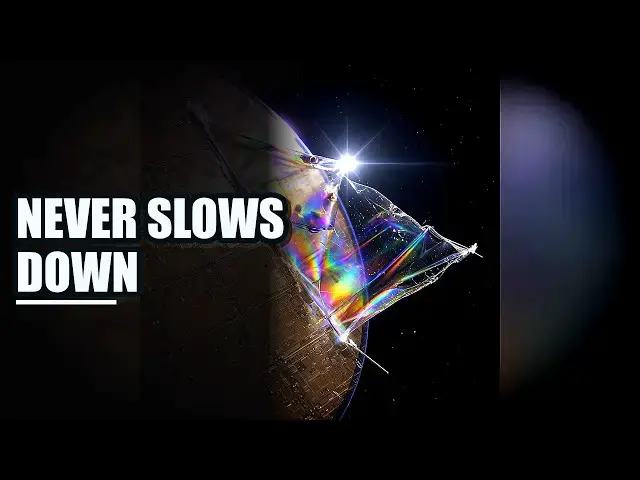
April 12, 2016: $100 million for another star. The craft is about one gram, it has no engine, and it never slows down.
This is how Breakthrough Starshot would actually work: a city-sized laser, a tablecloth sail, a 20-year coast at 0.2 c, and a flyby you cannot stop for.
0:00 Not A Starship
1:25 One Gram On A Sail
3:05 A Hundred Gigawatts
4:40 Four Minutes Then Coast
6:10 Aiming A City At A Stamp
7:35 Dust At Two Tenths C
9:05 The Flyby Window
10:35 A Whisper Across 4 Light Years
12:00 What Does Not Happen
Public-record program numbers, with about on cost and power estimates. This is an explainer, not a launch announcement.
#BreakthroughStarshot #AlphaCentauri #Lightsail #Interstellar #ProximaB #Nanocraft #DirectedEnergy #SpaceExplainer
Life is Easy. Mechanism, not slogan.
Visuals are original AI-generated stills. Audio may be synthetic. Not medical, legal, or financial advice.
Show More Show Less View Video Transcript
0:00
April 12th, 2016, One World Observatory,
0:03
New York. A hundred million dollars is
0:05
pledged to send hardware to another
0:07
star. The distance on the slide is 4.37
0:10
light years. The craft that would
0:12
actually fly is about 1 g. It has no
0:15
engine, and once the laser lets go, it
0:18
never slows down. That is Breakthrough
0:20
Starshot. Not a ship, a postage stamp
0:23
with a camera flung by light. At T = 0,
0:27
a ground laser the size of a city
0:29
ignites. At T or equals 1 minute, the
0:32
wafer is already outrunning every probe
0:34
humanity has ever launched. At T = 5
0:37
minutes, the beam cuts off. You are now
0:39
a bullet at about 20% of light speed,
0:42
about 60,000 km a second, and you will
0:45
stay that fast for 20 years until Alpha
0:48
Centauri is a smear you cannot stop for.
0:51
Not a starship.
0:53
The picture in your head is a metal can
0:55
with a crew, or at least a Voyager-class
0:58
box with a dish and a plutonium
1:00
plutonium heart. Starshot throws that
1:02
picture out on purpose. A chemical
1:05
rocket to Alpha Centauri on a human
1:07
lifetime is a fantasy of fuel. Even a
1:10
nuclear-electric tug spends centuries.
1:13
The energy you need sits in the exhaust,
1:16
and the exhaust has mass, and mass eats
1:19
the budget before you leave the solar
1:21
system. So, you strip the vehicle down
1:23
until it is not a vehicle. You keep a
1:26
wafer, processors, a camera, a tiny
1:29
laser, a radio, maybe a few sensors
1:32
massed like a paperclip. You glue that
1:34
wafer to a light sail a few meters
1:36
across, thinner than a soap film. You
1:39
leave the engine on Earth. The engine is
1:41
a laser. Photons have no rest mass, they
1:44
still carry momentum. You spend the
1:46
gigawatts on the ground where you can
1:48
plug into a grid, and you spend almost
1:50
nothing on the craft. You do not
1:52
colonize. You do not orbit. You do not
1:55
land.
1:56
You photograph a star system in a flyby
1:58
that lasts hours and then you are gone
2:01
into the dark on the far side, still at
2:03
0.2c forever. 1 g on a sail, hold a gram
2:09
in your palm, that is the spacecraft. At
2:12
a sail of a few grams, about 4 m across
2:15
in the baseline sketches, a sheet of
2:17
metamaterial maybe 100 nm thick. It has
2:21
to be light enough that a photon storm
2:23
can throw it, stiff enough that it does
2:24
not crumple, reflective enough that it
2:26
does not cook, and cheap enough that you
2:29
can throw a thousand of them because
2:30
many will die.
2:32
In June 2017, Breakthrough flew Sprite
2:35
chip sats, about 4 g circuit boards, 3.5
2:39
cm on a side, toward low Earth orbit as
2:42
a proof that a wafer can talk from
2:44
space. That is the mini case. It is not
2:47
Alpha Centauri, it is a breadcrumb. It
2:50
tells you the computer can be small. It
2:52
does not tell you the sail can survive a
2:54
100 GW slap. The sail is the whole
2:57
propulsion system. There is no tank.
3:00
There is no nozzle. If a wrinkle forms,
3:03
the beam punches a hole. If the coating
3:05
absorbs a fraction of a percent too
3:07
much, the film heats and fails in
3:09
seconds.
3:11
You are building a mirror that must take
3:12
the energy of a small power stations on
3:15
a surface the size of a tablecloth and
3:17
then you must not look at it again for
3:19
20 years.
3:21
100 GW.
3:24
The named energy source is a phased
3:26
array of ground lasers, about a square
3:29
kilometer. Peak power, about 100 GW.
3:33
For scale, that is in the neighborhood
3:35
of a large country's peak electricity
3:37
fired in a pulse that lasts minutes, not
3:40
hours.
3:41
You do not run that off a wall socket.
3:44
You store energy in a farm of capacitors
3:47
or a dedicated plant, then dump it into
3:49
the optics.
3:50
Each emitter is a laser element.
3:53
Thousands, then millions of them have to
3:55
lock phase so the beam acts like one
3:57
optic.
3:59
That is the same problem a huge
4:00
telescope has with atmospheric twinkle,
4:03
except you are pushing a sail instead of
4:05
collecting starlight. Adaptive optics,
4:08
guide beacons, fast mirrors.
4:10
The atmosphere is a river of turbulence.
4:13
You tax that river with light and the
4:15
sail feels a shove. If the phases drift,
4:19
the spot blooms and the stamp is no
4:21
longer in the hot core of the beam. Cost
4:24
on public estimates sits in the tens of
4:26
billions of dollars for the array with
4:28
the original program seed at 100 million
4:31
for research, not construction.
4:33
Lasers get cheaper. Aperture does not
4:36
get free. Land, cooling water, permits,
4:39
and a beam that could blind a satellite
4:41
if you miss. Those are the logistics
4:44
that hit first. You are building a power
4:46
station whose only job is to shout at a
4:49
blanket until the blanket is gone. 4
4:52
minutes. Then, coast.
4:54
Here is the clock again. The
4:56
acceleration window is a few minutes. In
4:58
that window, the sail rides the beam
5:00
from a high-altitude release out through
5:03
cis-lunar space already moving at tens
5:05
of thousands of kilometers per second.
5:08
Then the array cannot keep a tight spot
5:10
on a 4-m target that is receding at a
5:12
huge fraction of light speed. The beam
5:14
lets go. After that, there is no
5:16
throttle. No mid-course burn. No gravity
5:20
assist that matters at 0.2c.
5:23
You are in vacuum with a dead sail and a
5:25
computer on a timer. 20 years of cruise,
5:29
4.37 light-years. The sun becomes a
5:32
bright star. The target becomes a disk
5:35
only at the end.
5:37
Relativity is a rounding error at 20% of
5:40
c for the clock on the wafer. A few
5:42
months of time dilation over two
5:44
decades, not a drama. The drama is
5:47
pointing. A milliradian of error at
5:50
launch becomes a miss measured in
5:52
billions of kilometers. You fire a
5:54
shotgun of wafers so that statistics,
5:57
not heroics, put one of them through the
5:59
system. One craft is a press release, a
6:02
thousand crafts is an engineering plan.
6:05
Aiming a city
6:07
at a stamp stand on the array, you are
6:09
trying to keep a kilometer of lasers
6:12
pointed at a 4-m sail as it climbs away.
6:15
Diffraction wants the beam to spread.
6:17
The atmosphere wants to sparkle. The
6:20
Earth is rotating. Satellites and
6:22
aircraft have to be out of the lane. A
6:25
missed pulse is not a polite failure. It
6:27
is a weapon-grade beam that went
6:30
somewhere else. This is the logistics
6:32
problem before the physics problem. You
6:34
need clear air, a high dry site, a legal
6:37
corridor through near-Earth space, and a
6:40
phasing system that holds lock while the
6:42
target's light travel time from the
6:44
array starts to grow. When the craft is
6:47
a million kilometers out, even light is
6:49
already a few seconds late. Your control
6:52
loop is fighting a delay.
6:53
At 10 million kilometers, the sail is a
6:56
rumor of photons, and the array is still
6:58
trying to treat it like a bull's-eye,
7:00
and it gets worse.
7:01
Dust at 2/10.
7:04
The part that actually matters is not
7:06
the poster of the sail glowing against
7:09
the Milky Way. It is a grain of
7:11
interstellar dust. At 20% of light
7:13
speed, a particle you would not feel on
7:16
Earth hits like a sandblaster loaded
7:18
with explosives.
7:19
Kinetic energy scales with velocity
7:21
squared. 0.2c is about 60 million meters
7:25
per second. A micron-scale grain can
7:28
puncture the sail, kill a pixel, or
7:30
shatter the wafer. The interstellar
7:33
medium is thin. Thin is not empty. Over
7:36
4.37 light-years, you sweep a long
7:39
column of gas and dust. Hydrogen is a
7:42
drag and an erosion. Bigger grains are
7:45
Russian roulette. The program's answer
7:48
is the swarm. Launch hundreds or
7:50
thousands. Accept losses. Design the
7:53
sail to take hits at the edge. None of
7:56
that is a shield in the comic book
7:58
sense. It is an admission that the
8:00
galaxy is not a clean tunnel. There is
8:02
also the heating from the laser itself
8:04
at T high equals zero to T equals five
8:07
minutes, which can destroy the craft
8:10
before dust ever gets a vote. And the
8:13
charging of the hull in plasma. And the
8:15
fact that your camera at encounter is
8:18
moving so fast that a planet is a streak
8:20
unless the exposure is timed like a
8:22
rifle shot.
8:23
Survival is a stack of small bets, not
8:26
one clever coating.
8:28
The flyby window.
8:30
You do not insert into orbit.
8:32
Deceleration is the add-on people keep
8:34
grafting on later. Magnetic sails, extra
8:37
lasers at a destination you do not have.
8:40
Baseline Starshot is a flyby. The
8:43
physics that kills the movie version is
8:45
sitting right here. To break, you need
8:47
either mass you did not pack or
8:49
infrastructure that is already at Alpha
8:51
Centauri. You packed a gram. Nobody is
8:53
there. Alpha Centauri is a triple. Two
8:57
sun-like stars, A and B, and Proxima. A
9:01
red dwarf with at least one planet
9:03
announced in August 2016, Proxima b. You
9:06
cross that system in hours. The useful
9:09
imaging window on a single world is
9:11
minutes. Relative speed is 0.2c.
9:15
A planet 12,000 km across is in your
9:18
face and then it is a memory. The camera
9:21
has to slew, expose, compress, and queue
9:24
a laser pulse home.
9:26
There is no second pass. There is no
9:28
orbit circularization. There is no
9:30
rover. You, as the operator on Earth,
9:33
will not see the pictures until more
9:34
than four years after the encounter
9:36
because light itself is the downlink.
9:39
The craft that took them is already
9:41
leaving the system. Still not slowing
9:43
down, and there is no way to call it
9:45
back. The encounter is a photograph
9:47
taken by a bullet.
9:49
A whisper.
9:51
Across 4 light-years.
9:53
The wafer must talk. From 437
9:56
light-years, a milliwatt radio is a
9:58
joke.
9:59
You need a laser downlink, probably
10:02
using the sail as a transmitter optic,
10:04
aimed back at the solar system with a
10:05
beam so narrow that a pointing error,
10:08
the width of a hair, misses Earth
10:10
entirely. Earth has to listen with a big
10:13
telescope, maybe the same class of optic
10:15
that shot the craft. The bit rate is
10:17
low. The signal is buried in starlight.
10:20
Error correcting codes eat half your
10:22
photons. A single image might crawl home
10:25
over weeks. Many probes might send at
10:27
once and jam each other. The swarm that
10:30
saved you from dust now becomes a
10:32
traffic problem in the sky. Power on the
10:34
wafer is a postage stamp of
10:37
photovoltaics or a tiny battery. At
10:40
Alpha Centauri, the starlight is still
10:42
bright, but your encounter is fast, and
10:44
then you are in the black again. Thermal
10:46
control at 0.2c through dust is a prayer
10:49
with a heat sink. If the transmitter is
10:52
a degree off, the message is a poem
10:54
recited into an empty room. If it holds,
10:57
you get a handful of photons and a map
10:59
of a world you will never walk. What
11:01
does not happen? What does not happen
11:04
tomorrow morning? Alpha Centauri does
11:06
not get a flag. No crew launches. Your
11:09
night sky does not fill with a 100
11:11
gigawatt beam. The array is not funded,
11:14
permitted, and phased by next quarter.
11:17
Proxima b does not send a postcard.
11:20
Voyager does not get arrival on the pad.
11:22
Earth does not become an interstellar
11:24
civilization because a press conference
11:26
happened in 2016. The physics that kills
11:29
the movie version is simple. You cannot
11:32
carry the fuel. You cannot break without
11:34
a second infrastructure at the other
11:36
star. You cannot armor a gram against
11:39
the galaxy and still be a gram.
11:41
So, you do the thing the 2016
11:44
announcement actually described. You
11:46
build the engine on Earth. You throw a
11:48
flock of wafer
News