Up next in 10


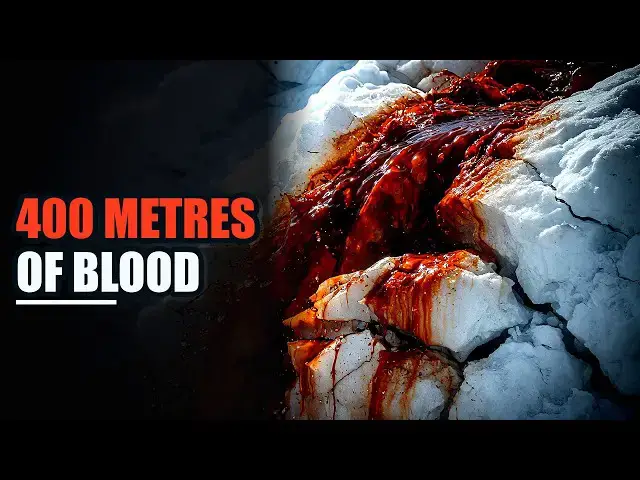
Antarctica has a waterfall of blood. It is not blood. It is a trapped sea, squeezed out of Taylor Glacier for something like a million and a half years.
0:00 The Wound In The Ice
1:20 Taylor's Algae Mistake
2:30 A Fjord Under Four Hundred Metres
4:00 Salt Is Not Enough
5:00 The Ice That Melts Itself
6:20 And It Gets Worse
7:40 The September Pulse
9:00 Life That Breathes Iron
10:20 What Does Not Happen
#BloodFalls #Antarctica #TaylorGlacier #ScienceExplained #Glaciers #Astrobiology #McMurdoDryValleys #EarthScience
This is an educational science explainer. Depths, salinities, ages, and temperatures are from published measurements and are given as about where they are estimates. Not medical, travel, or expedition advice.
Visuals are original AI-generated stills. Audio may be synthetic. Not medical, legal, or financial advice.
Show More Show Less View Video Transcript
0:00
In the Austrial summer of 1911,
0:02
Australian geologist Thomas Griffith
0:04
Taylor rounded the snout of a glacier at
0:07
77 degrees south and found a waterfall
0:10
the color of a fresh wound. Liquid, the
0:13
shade of arterial blood, was pouring out
0:15
of white ice onto a frozen lake. He
0:18
thought it was red algae. He was off by
0:21
about a million and a half years, 400
0:23
meters of ice and an entire trapped
0:25
ocean.
0:27
The wound
0:29
in the ice. You are standing on the ice
0:32
of West Lake Bonnie in Taylor Valley,
0:34
East Antarctica. Behind you, the Trans
0:37
Antarctic Mountains Wall off the inland
0:39
ice sheet. In front of you, Taylor
0:42
Glacier, about 35 mi long, noses into
0:45
the valley, and dies against the lake.
0:47
Mean air temperature here sits around
0:49
minus7 C. Annual precipitation is about
0:53
100 millimeters of water equivalent.
0:56
almost all of its snow that catabatic
0:58
winds strip before it can settle. This
1:00
is a polar desert. From a crack in the
1:03
glacier snout, a fan of rust red brine
1:06
is staining the ice. A field tent parked
1:09
nearby is about 4 meters long. The red
1:11
apron is bigger than the tent. The
1:13
liquid is not gushing like a garden
1:15
hose. It seeps, then pulses, then
1:18
freezes into a crust, the color of dried
1:21
blood, then it seeps again. Taylor's
1:24
algae mistake.
1:26
Griffith Taylor was on Robert Scott's
1:28
Teranova expedition. His western party
1:31
was mapping this valley while Scott's
1:33
polar party walked toward the South
1:35
Pole. The maps later put Taylor's name
1:38
on the glacier. He named the stain as he
1:40
saw it. Something living, something
1:42
alume
1:44
ice. That guess lasted for decades. Red
1:48
snow algae are real. They were the
1:50
obvious answer. They were the wrong
1:53
answer. By the 1960s, chemists had the
1:56
iron. The red was oxide. Ferrris iron
1:59
dissolved in salt water that had never
2:01
seen the sun, hitting oxygen at the
2:03
surface and rusting in real time. You
2:06
are watching a chemical reaction, not a
2:08
bloom. Reduced iron stays invisible as
2:11
long as the brine is sealed. The second
2:13
it meets air, the color arrives.
2:17
A fjord under 400 m. Here is the
2:21
logistics problem. First, the water you
2:23
are looking at did not melt from the
2:25
glacier. Taylor Glacier is a cold
2:27
glacier. Most of it is frozen to its
2:30
bed. Ice at the base sits near minus17
2:33
C. Fresh melt water should not exist
2:36
here as a flowing system. Getting a
2:38
sample is a logistics problem before it
2:41
is a science problem. You fly to
2:43
Mcmeroto station. You traverse the dry
2:45
valleys. You camp on a lake that never
2:47
fully thaws. The brine is old seawater.
2:51
About 2 million years ago, give or take,
2:53
marine water flooded Taylor Valley when
2:56
it was a fjorded maybe 600 to 900 meters
2:59
deep. Then the glacier advanced, the sea
3:02
receded, and a pocket of that water was
3:04
sealed under ice. As pure ice froze out
3:08
of the trapped seawater, salt was
3:10
expelled into the remaining liquid. The
3:12
brine now holds about 8% sodium
3:14
chloride. Total dissolved solids sit
3:17
around 126 gram per liter, roughly 3 and
3:20
a half times ocean water. The reservoir
3:23
sits under about 400 meters of ice,
3:26
about 1,300 ft, several kilometers from
3:29
the tiny outlet you can photograph.
3:31
Airborne surveys have traced hypersalin
3:34
groundwater at least about 5.75 km up
3:37
glacier from the snout. The size of the
3:39
pool itself is still unknown. Salt is
3:42
not enough. Salt drops the freezing
3:45
point. That is the road salt trick. 8%
3:49
sodium chloride buys you roughly 7
3:51
degrees of depression. The brine sampled
3:53
inside the ice in December 2014 sat at
3:56
about -7 C, about 19 Fahrenheit. Air and
4:01
ice around it sit nearus 17. You still
4:04
have a gap of about 10°. Salt alone
4:06
cannot keep this liquid. If salt were
4:09
the whole story, blood falls would be a
4:11
frozen red stain, not a waterfall. The
4:14
ice that melts itself. This is the
4:16
physics problem. When a fraction of the
4:19
brine starts to freeze, it releases
4:21
latent heat. That heat warms the ice
4:24
around the remaining liquid. The glacier
4:26
is carving channels in itself with the
4:29
heat of its own freezing. In 2017,
4:32
glaciologist Aaron Pettit and colleagues
4:35
mapped this with radio echo sounding,
4:37
bouncing pulses through the ice the way
4:39
a bat maps a cave. They found a network
4:42
of basil creasses injecting pressurized
4:45
brine into the glacier and a path about
4:47
90 m 300 ft from a reservoir toward the
4:51
falls. Taylor Glacier is the coldest
4:53
known glacier on Earth with persistently
4:56
flowing water. The brine is not a single
4:59
pipe. It is a braided system of
5:01
englacial conduits. Near the central
5:04
axis of one zone, volutric brine content
5:07
exceeds 13% within 2 meters. Pressure
5:11
under the ice routes the fluid toward
5:13
the northern snout where blood falls
5:15
lives. And it gets worse. And it gets
5:18
worse because the red is not even rust
5:20
the way you think of rust. In 2022,
5:24
material scientist Ken Libby at John's
5:27
Hopkins put solids from the discharge
5:29
under a transmission electron
5:31
microscope. He did not find neat
5:33
crystals of iron oxide. He found
5:36
nanospheres about 1/100th the diameter
5:39
of a human red blood cell. Ironrich
5:42
globes loaded with silicon, calcium,
5:45
aluminum, and sodium. The color is
5:48
amorphous mixed veent iron hitting air.
5:52
The stain on the glacier is a cloud of
5:54
those spheres oxidizing as you watch.
5:56
The part that actually matters is
5:58
pressure. The glacier is not a static
6:01
lid. It is a moving weight. As Taylor
6:04
Glacier slides downstream, ice
6:06
compresses the subglacial channels.
6:09
Pressure builds. The brine has nowhere
6:11
to go except up through those basil
6:14
creasses toward the only low pressure
6:16
vent at the snout. You are not looking
6:19
at a leak. You are looking at a squeeze.
6:22
The September pulse on about the 23rd of
6:25
September 2018, three instruments caught
6:28
the same hidden event. A GPS station
6:32
installed on Taylor Glacier in 2017
6:35
recorded the glacier surface dropping
6:37
about 15 mm. A time-lapse camera pointed
6:40
at Bloodfalls one frame a day showed
6:43
fresh discharge. A thermister string in
6:46
West Lake Bonnie about 150 meters from
6:49
the glacier terminus recorded cold
6:52
anomalies of up to about 1.5 Celsius
6:55
below the seasonal mean at a depth of
6:57
about 17.9
7:00
m. The largest hits were on the 23rd of
7:03
September and the 16th of October. Brine
7:07
was pulsing out for about a month. As it
7:09
escaped, pressure under the ice fell.
7:11
The surface lowered. Ice velocity
7:14
slowed. Then the system reloaded. That
7:17
is the mechanism caught in the act. Not
7:19
a constant drip, an episodic squeeze,
7:22
glacier as piston, brine as blood. In
7:25
December 2014, Jill Makuki's team and a
7:28
German engineering group melted into the
7:31
conduit with a probe called Ice Mole, a
7:34
steerable box with a heated copper head
7:36
and an ice screw. It melted about 17 m
7:39
on an oblique path and tapped the brine
7:42
before the air could touch it.
7:43
Temperature minus 7.1 C. Iron about 3.4
7:50
millmer. Salt about 8%. Almost no
7:54
oxygen. That is the blood before it
7:56
rusts. Life that breathes iron. You
8:00
would expect that pocket to be dead. No
8:02
light. No oxygen. Cold enough to freeze
8:05
flesh. Salt high enough to pickle it. In
8:09
2009, Makuki and colleagues published in
8:12
science that water from bloodfalls held
8:14
at least 17 types of microbes, and she
8:17
said the real number was probably closer
8:20
to 30. Later work isolated
8:22
marinobacttor, a salt-loving, coldloving
8:25
heterotroof. They do not breathe air.
8:28
They use iron. Sulfate, a leftover
8:30
marine fingerprint, acts like a
8:32
catalyst. Feric iron is the terminal
8:36
electron acceptor. Trace organic carbon
8:39
trapped with the ancient seawater is the
8:41
food. The strange part is there is
8:43
almost no sulfide. The waste product you
8:46
would expect if they were simply
8:48
reducing sulfate. The sulfur and iron
8:51
cycles are locked together recycling the
8:53
reactants instead of running them down.
8:56
This metabolism had not been seen in
8:58
nature before that paper. In 2026,
9:02
Angela Zumplas and colleagues analyzed
9:06
167 samples from Bloodfalls and the
9:08
surrounding dry valleys. Using
9:11
environmental RNA, which flags organisms
9:13
that are actually active, they found
9:16
ukarotes centered on the falls, datoms,
9:19
dinoflagelates, haptytes, siliates,
9:23
marine lineages, not the freshwater
9:25
types from nearby sites. The simplest
9:28
reading is that some of this life is
9:30
left over from the lost fjord still
9:32
hanging on in the pulse of brine.
9:36
What does not happen? What does not
9:38
happen tomorrow? Taylor Glacier does not
9:41
collapse. Lake Bonnie does not turn into
9:44
a red sea. The dry valleys do not flood.
9:47
Blood falls does not run like Niagara.
9:50
Most days it is a stain. Some weeks it
9:53
is a seep. Some months like that stretch
9:56
in 2018. It is a pulse you can measure
9:59
in millimeters of ice drop and fractions
10:01
of a degree in a lake. The reservoir is
10:04
not an infinite tank. Finding
10:06
Marinobacttor here does not put life on
10:08
Mars. It puts a lower bound on how
10:11
little a cell needs. No sun, no air,
10:14
salt, iron, and time. What it does is
10:17
this. 400 m of ice is not a tomb. Liquid
10:21
can move at minus17 if salt and latent
10:24
heat and pressure line
News