Up next in 10


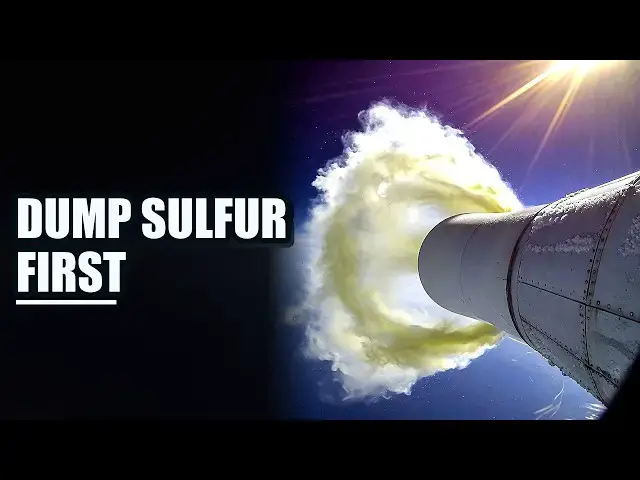
You don't shade Earth with one giant umbrella. You spray the stratosphere the way Pinatubo already did, or you station-keep a swarm of trillions of films at L1 forever.
June 15, 1991: about 20 million tons of sulfur dioxide. Global temperature dropped about 0.5°C. The space parasol is the drawing. The real kit is a tanker at 20 km or a 20-million-ton swarm.
0:00 The light goes brown
0:34 The Wrong Umbrella
1:35 How Much Light You Cut
2:47 Why A Disk Dies
3:54 The Pinatubo Shortcut
4:54 The Spray Fleet
6:13 And It Gets Worse
7:32 The Swarm At L1
9:03 What Does Not Happen
10:06 The Bill You Still Pay
This is a physics and logistics explainer using public-record events and published engineering estimates. Numbers marked "about" are rounded. Not a policy endorsement.
#geoengineering #solargeoengineering #Pinatubo #climate #spacesunshade #L1 #scienceexplainer #whatif
Visuals are original AI-generated stills. Audio may be synthetic. Not medical, legal, or financial advice.
Show More Show Less View Video Transcript
0:00
June 15th, 1991. Mount Penatubo punches
0:04
about 20 million tons of sulfur dioxide
0:06
into the stratosphere. The noon light
0:08
over Luzon goes brown. And for more than
0:10
a year, the whole planet runs about half
0:12
a degree cooler. You do not shade Earth
0:14
with one giant umbrella. You either
0:17
spray the sky the way that volcano
0:18
already did, or you park a swarm of
0:21
trillions of thin films a million and a
0:23
half kilometers sunward of us, and you
0:25
keep them there forever. The wrong
0:28
umbrella. The picture in your head is a
0:30
dinner plate the size of a continent
0:32
hanging at the sun earth lrangee point
0:34
cutting a clean shadow across the globe.
0:37
Stand under noon in Arizona and wait for
0:39
the lights to dim. That object does not
0:42
get built. A rigid disc that big has no
0:45
way to hold its shape against tides,
0:47
micromedorites, and sunlight that hits
0:49
it like a continuous wind. The point in
0:52
space people point at, L1, sits about
0:55
1.5 million km closer to the sun than
0:58
Earth. It is not a hook. It is a saddle.
1:01
Drift a few thousand kilometers and the
1:03
gravity gradient and the solar pressure
1:05
both start shoving you. A single
1:08
umbrella would have to thrust, flex, and
1:10
repair itself across an area measured in
1:13
millions of square kilometers. Nobody
1:15
has a factory for that. The popular
1:17
picture dies on the first engineering
1:19
drawing. How much light you cut. You are
1:23
not switching the sun off. Incoming
1:25
sunlight at the top of the atmosphere
1:27
averages about 340 watts per square
1:29
meter. A doubling of carbon dioxide adds
1:33
about 3.7 watts of extra heat. To cancel
1:36
that, you need to knock down the
1:38
incoming beam by about 1 to 2%. Earth's
1:41
cross-section is about 127 million
1:44
square kilm. 1 and a half% of that is
1:47
about 2 million square kilmters of
1:49
shade. a patch the size of Mexico if you
1:52
could hang it right against the planet.
1:54
At L1, the geometry is worse. The sun is
1:57
not a point. It is a disc half a degree
2:00
wide. Your shade throws a fuzzy
2:02
penumbra, so the swarm has to be larger
2:05
than the simple disc math. You feel it
2:07
as a slightly paler noon, not night.
2:10
Crops still get light. The sky still
2:12
looks blue. The number that matters is a
2:15
few watts per square meter, which is a
2:17
rounding error on a summer afternoon. in
2:19
the whole climate on a century.
2:22
Y a disc
2:25
dyes. Now put your hands on the object.
2:27
A solid sheet two million square
2:30
kilometers across even a millimeter
2:32
thick is billions of tons. Launch that
2:35
from Earth and you are flying the annual
2:37
output of the world's mines one rocket
2:40
at a time for decades. Make it thinner.
2:42
a micron of plastic or glass and
2:45
sunlight still hits it with about nine
2:47
newtons of pressure per square kilometer
2:49
across the whole shade. That is a
2:52
continuous shove of thousands of tons
2:54
force, always sunward to planetward. At
2:57
L1, that shove is the same order as the
2:59
restoring gravity. The disc wants to
3:01
fall toward Earth. You can park it a
3:03
little closer to the sun, so gravity and
3:06
radiation pressure cancel, but only if
3:08
the mass, the reflectivity, and the
3:10
attitude stay perfect. A rip, a wrinkle,
3:13
a micromedoroid swarm and the thing
3:16
starts to tumble. A rigid parasol is not
3:18
a structure. It is a failure mode with a
3:21
pretty silhouette. The pinatubo shortcut
3:24
here is the version that already ran in
3:27
the stratosphere. That sulfur becomes a
3:29
haze of sulfate droplets a fraction of a
3:31
micron across. Those droplets scatter
3:34
sunlight. Global average temperature
3:36
dropped about 0.5° C. Harvests shifted.
3:41
Sunsets went red for months. You could
3:43
have stood on a rooftop in 1992 and felt
3:46
a slightly weaker sun on your face. The
3:48
droplets fell out in about two years.
3:51
That is the cheap shade. You do not need
3:53
L1. You need the altitude band around 20
3:56
km where a particle can loiter for a
3:59
year or two. Paper studies put the
4:01
maintenance dose at about 5 to 10
4:03
million tons of sulfur per year to
4:05
offset a large slice of present warming.
4:08
That is a mining and flying problem, not
4:10
a space program. It is also the reason
4:12
every serious geoengineering meeting
4:15
starts with airplanes, not parasols. The
4:18
spray fleet walk the logistics. Your
4:20
ears pop as the tanker climbs. At about
4:23
20 km, the air is thin. The sky is black
4:26
and the wing sits above most of the
4:29
commercial lanes. You carry high sulfur
4:31
fuel or a tank of sulfur dioxide. A
4:33
handful of modified tankers flying daily
4:36
can loft millions of tons a year. Cost
4:39
estimates sit in the low billions of
4:41
dollars per year. Cheap in the way a
4:43
fire extinguisher is cheap compared with
4:45
rebuilding the house. You spray in the
4:47
tropics, so the Brewer Dobson
4:49
circulation lifts and spreads the haze
4:52
pullward. Within months, the optical
4:54
depth creeps up by a percent or two.
4:57
Noon gets a hair wider. Direct sunlight
4:59
falls. Diffuse light rises, which some
5:02
crops like. and some hate. You on the
5:05
ground do not hear it. There is no bang.
5:08
There is a flight schedule and a mass
5:10
budget. In 2022, a startup called Make
5:13
Sunsets lofted sulfur on balloons from
5:16
Mexico and sold cooling credits by the
5:18
Graham. The mass was a rounding error.
5:21
The fight was not. That is how close the
5:24
cheap path already is. Not a treaty, a
5:27
balloon. And it gets worse. And it gets
5:29
worse. Shade is not the opposite of
5:31
carbon dioxide. Carbon dioxide heats the
5:34
planet and acidifies the ocean. Sulfate
5:37
haze only knocks down the heat. The
5:40
ocean keeps drinking CO2. Coral keeps
5:43
dissolving. A haze thick enough to hold
5:45
temperature also changes the monsoon.
5:48
The South Asian monsoon feeds about two
5:50
billion people. Pinatubo was followed by
5:53
a weaker wet season in some regions and
5:55
drought stress in others. Ozone
5:58
chemistry at the poles gets uglier
6:00
because sulfate particles are surfaces
6:03
for chlorine. If you load the
6:04
stratosphere for 30 years and then stop,
6:07
the haze falls out in two. The heat that
6:09
was being held back arrives in a rush.
6:12
That is the termination shock. A few ten
6:14
of a degree per year instead of a few
6:17
tenths per decade. You do not get to
6:19
spray once, you buy a subscription. Miss
6:22
a decade of flights after you have
6:24
depended on them. And the climate
6:25
whiplash is faster than the warming you
6:28
were trying to cancel. That is the part
6:30
that actually matters. The cheap shade
6:32
is cheap because it is a drug with a
6:35
short half-life.
6:37
The swarm at L1. If you still want the
6:40
space version, you stop drawing a disc
6:42
and you start drawing a cloud. In 2006,
6:45
the astronomer Roger Angel published a
6:47
design about 16 trillion autonomous
6:50
flyers, each a disc about 60 cm across.
6:54
a few grams of thin silicon hovering in
6:56
a cloud around L1. Total mass about 20
7:00
million tons. The films are not black.
7:02
They are transparent with a hole pattern
7:04
that defracts sunlight just off Earth,
7:07
which cuts the heat load and tames
7:09
radiation pressure. You do not launch 20
7:12
million tons on chemical rockets.
7:14
Angel's build order was electromagnetic
7:16
guns on Earth throwing one-ton stacks.
7:19
Or if you are being honest about scale,
7:22
you mine the moon or a near-Earth
7:24
asteroid and you manufacture the film in
7:26
sunlight. Aluminum and silicon are
7:29
sitting in lunar dirt. Doubling time is
7:31
the factory question. One small plant on
7:34
the moon that copies itself every 2
7:36
years is how you get from a test swarm
7:39
to 2 million square kilometers without
7:41
eating Earth's launch pads. Station
7:43
keeping never ends. Each flyer nudges
7:46
itself with light or a tiny ion trickle.
7:49
Lose the swarm to a solar storm or a
7:52
software fault and the shade sags. You
7:55
have not built a monument. You have
7:57
built a fleet that has to fly until the
8:00
carbon comes down. What does not happen?
8:03
What does not happen tomorrow? The sun
8:06
does not go out. Your street does not
8:08
fall into twilight. Weed in Kansas does
8:11
not die in a week. Pinatubo cooled the
8:15
world by half a degree and civilization
8:17
kept its appointments. A 1% dimming is a
8:20
thin filter, not an eclipse. Polar night
8:23
still happens because of tilt, not
8:25
because of a parasol. Rain does not stop
8:28
globally. Some regions get drier, some
8:30
wetter, and the map of winners and
8:32
losers is the fight. Rockets do not
8:35
start flying moon dirt next Tuesday. The
8:37
make sunsets balloons did not move the
8:39
thermometer. No government has
8:41
authorized a full-scale spray fleet. The
8:44
ocean does not heal because you dim the
8:46
sky. Your house does not get a new
8:48
climate sticker in the morning. The
8:50
physics is slow in the way ice is slow
8:52
and fast in the way a stopped spray
8:54
fleet is fast. The bill you still pay.
8:59
You can shade the earth. Volcanoes
9:01
already proved the optical half.
9:03
Airplanes can prove the industrial half
9:05
in a decade if a major power decides to.
9:08
The swarm at L1 is a centuryclass mining
9:11
project with a mass budget of tens of
9:14
millions of tons and a control problem
9:16
that never clocks out. Carbon in the air
9:18
sits near about 420 parts per million
9:21
and the ocean has already taken up
9:23
enough of it to drop surface pH by about
9:26
0.1. None of those shade moves pull that
9:30
carbon
News