Up next in 10



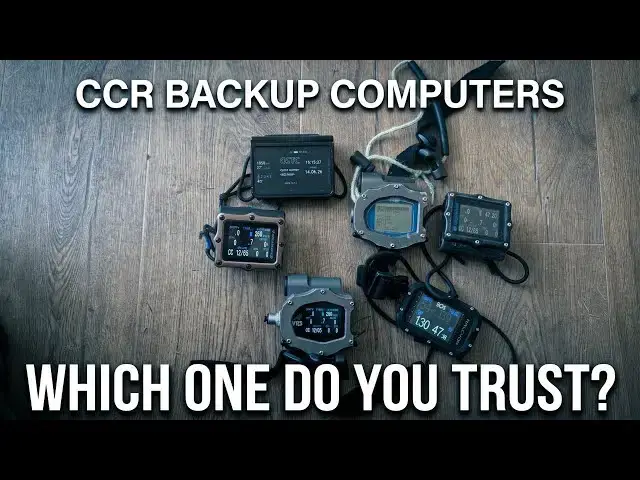
My primary CCR handset has flooded twice. Both times at depth, with no warning. In that moment, everything falls to one device — the backup computer you barely think about when you clip it on.
That experience is why this investigation exists.I've been loaned CCR backup computers from VR Technology, Shearwater, and Halcyon for a long-term real-dive test. Suunto and OSTC are on their way.
━━━━━━━━━━━━━━━━━━━━━━
*ABOUT THIS CHANNEL*
Deep Wreck Diver explores shipwrecks, submarines, and sunken aircraft from around the world - combining technical diving with detailed wreck identification and historical storytelling. Every dive uncovers a piece of history lost to the depths.
━━━━━━━━━━━━━━━━━━━━━━
*Kit I Use*
Note, some of these are affiliate links so help support making my videos:
- Gloves are Ansell Alphatec 87-063 - https://amzn.to/4jDHhX4
- Main torch is an Orcatorch D630 - https://amzn.to/4jlT4tA
- Backup torch is an Orcatorch D710 - https://amzn.to/4jhddRk
- Drysuit is an O-Three Ri200 - https://www.othree.co.uk/drysuit-range/ri-2-100-drysuit/
- CCR is an AP Diving Inspiration (XPD) - https://www.apdiving.com/
- Backup computer is a Shearwater Perdix v2 - https://amzn.to/42FXZOW
- Reels are by Kent Tooling - https://www.divingproducts.co.uk/
- Cameras are Paralenz Vaquita
- Video light is NiteScuba NSV60 - NiteScuba NSV60 - https://s.click.aliexpress.com/e/_onHEKQZ
Show More Show Less View Video Transcript
0:00
I've had two failures of the handset on
0:02
my rebreather.
0:04
One of them was at 55 m, one of them was
0:07
about 72 73 m.
0:10
Both of them I had roughly an hour of
0:13
decompression to do. That's not a great
0:15
place to be, needless to say. And when
0:17
it happens, if it happens, maybe one of
0:20
the things that suddenly becomes really
0:22
important is this.
0:24
This is my secondary computer, my backup
0:27
computer, not connected to my
0:29
rebreather, so it works on a fixed set
0:31
point PO2.
0:33
But when that happens, this is what
0:35
controls my decompression.
0:38
For those of you who don't recognize it,
0:39
and I'm sure most of you will, this is a
0:42
Shearwater Perdix 2. I've had other
0:45
versions of Shearwater computers, so
0:47
before this I had a Perdix, and before
0:49
that I had a Petrel.
0:51
I think I had a Petrel 1 and a Petrel 2.
0:53
So I've dived Shearwater computers for a
0:55
very long time. And I'll be honest, I
0:58
love them to bits. In both of those
1:01
scenarios, the Shearwater sorted me out.
1:04
I was able to do my decompression,
1:07
get safely to the surface. In one
1:09
incident, I managed to stay on the
1:10
rebreather loop. In the other incident,
1:13
I actually had to bail out. But on both
1:15
occasions, the Shearwater sorted me out.
1:18
I love them. I've used them for a long
1:20
time. I'm really happy with them. But
1:22
one of the things that struck me a few
1:24
weeks ago was actually I don't know very
1:27
much about other dive computers.
1:29
Whenever anybody asks me, I always say,
1:32
you know, Shearwater.
1:33
I kind of thought, you know what, I
1:35
should really find out a bit more about
1:36
other dive computers, see what they've
1:38
got to offer, and see how they compare.
1:41
So you probably saw I did that on my
1:43
Facebook page and my Instagram, and I
1:46
said, look, I'm looking to use some
1:47
other dive computers and see how they
1:50
perform. And a lot of people got in
1:52
touch with me, which was which was
1:54
really nice. And I've had the
1:55
opportunity to dive with a few of them
1:57
and I've got some more, you know, I'm
2:00
going to dive with some more in the
2:01
future. And I'm also going to do some
2:03
kind of long-term testing on some of
2:05
them as well to kind of see how they
2:06
perform on more than one dive. Now, the
2:09
first computers that I got,
2:12
quite amusingly,
2:13
were VR3s. So, for those of you don't
2:16
know, the VR3, that was kind of the
2:19
computer that started it all off. And in
2:21
fact, here we go. I've I've Here it is.
2:24
VR3. This is This is the granddaddy,
2:27
really, of CCR diving computers.
2:30
Released in 1997, it was the one
2:33
everybody wanted and everybody used. So,
2:36
I've taken this on a dive. I've had it
2:39
to
2:40
68 m on the East Point. Absolutely
2:43
fascinating.
2:45
One of the big problems with it, though,
2:46
is it's LCD monochrome. So, I really
2:49
struggled to see the screen. For those
2:51
of you don't know, I normally need
2:53
reading glasses. And I don't have lenses
2:56
or anything. I'm kind of in that
2:57
midpoint where I'm probably going to
2:58
need them fairly soon. But anyway, I
3:00
couldn't see really see the monochrome
3:02
handset even with the, you know, the
3:04
backlight, which is pretty rubbish. So,
3:06
fortunately, somebody sent me this,
3:08
which is the the color version of the
3:11
VR3. And that was uh much better. So,
3:13
I've dived with that and used that down
3:16
to, I think it was on a 70-m dive on the
3:19
Silver Laurel. And I actually did all my
3:22
deco on that one. The The other one, I
3:26
VR3 makes you do deep stops. I missed
3:29
the deep stops on the monochrome one, so
3:31
it kind of kicked me out and said, "Use
3:33
tables." The color handset, I did all my
3:35
stops on it, cleared the stops, got to
3:37
the surface. So, absolutely interesting.
3:39
And I'm going to do a
3:40
more a more detailed video on those,
3:43
like I'm going to do for all the
3:44
computers I'm going to talk about. So,
3:46
what I'm really doing here is just kind
3:47
of introducing you to of kind of
3:51
You could call it a test mainly kind of
3:53
review. I guess it's there's no real
3:55
science to it. It's just my impressions
3:57
of all these computers. So, that was
4:00
fantastic. Really enjoyed diving with
4:02
the VR3. Really interesting to dive with
4:04
them.
4:05
Um for those of you who've never picked
4:07
up one of these things, they are
4:07
massively heavy. So, I need I could take
4:09
a kilo of lead off as well, which is
4:11
which is quite nice.
4:13
The other thing that I I've got and I
4:15
you've probably seen my review on it
4:16
already is the Perdix 2 bronze journey
4:20
edition. So, I I've dived with that
4:22
quite a bit as well and um you may have
4:24
seen my video. So, that's that's really
4:26
good.
4:28
Better screen, vibration alerts, that's
4:31
the kind of
4:32
the upgrades on my Perdix 2. I'm also
4:34
hoping to get the Perdix 3 at some point
4:37
as well. So, Shearwater have said
4:39
they're going to send me one. So, it'll
4:40
be interesting to compare that kind of
4:41
evolution.
4:43
And the other thing that I've had, which
4:47
I was kind of surprised by actually, is
4:49
I've had the two Symbios computers from
4:53
Halcyon.
4:54
Which is really nice because I guess
4:56
they're probably pretty close to the
4:58
upper end of the market. So, this is the
5:00
Symbios handset.
5:03
Um
5:03
it's designed really for use in their
5:05
kind of Symbios ecosystem, but it does
5:07
have a fixed set point mode. Which was
5:10
really interesting. I've done three or
5:13
four dives with this. Really really
5:15
interesting computer and I'm going to
5:17
talk about all of these computers
5:18
individually when I feel I've I'm in a
5:21
position to do so. But, that was really
5:22
good. And this one here, which I guess
5:24
is is in some ways the odd one out
5:26
because it's not a
5:28
a wrist-mounted computer. This is the
5:30
Symbios HUD. As you can see there, it is
5:33
mask-mounted with that little yellow
5:35
leash to to make sure I I don't lose it.
5:38
Actually, it hasn't come off. The the
5:40
mount is is really impressive in itself
5:43
and the fact it's mask-mounted is is
5:45
really interesting. I've used a NERD,
5:47
not very much, but I have used a nerd,
5:49
and I've used the AP um
5:53
Huss, which is their own kind of um
5:55
head-up display. They don't They don't
5:57
make it anymore, but but I had one of
5:58
the older ones and used it a bit. One of
6:00
the things I always found with
6:01
loop-mounted displays is that I tend to
6:04
move my head around a bit, even though
6:05
I've got the loop in my mouth, and so I
6:07
was always trying to adjust it to get it
6:10
in my eyeline. This, because it's
6:11
mask-mounted, obviously don't have that
6:13
problem. The The buttons and the utility
6:18
and everything are exactly the same as
6:20
the Symbios uh handset. There's just a
6:23
few more things uh you can see on the
6:25
main screen of this one, but really
6:28
interesting development, and um I'll be
6:30
honest, I love this thing to bits. Um
6:33
but I'm going to do some more diving
6:34
with it, see if there's any kind of
6:35
niggles or quirks or whatever that I
6:37
haven't spotted so far, but yeah, uh
6:39
absolutely fascinating.
6:41
And the last one that I've currently
6:43
got, uh which is uh just arrived today,
6:47
and a lot of people ask me about this,
6:49
is uh the OTS C.
6:52
Uh this is their latest version,
6:54
and um I'm just trying to turn it on.
6:56
There we go. It's kind of powering up.
6:58
So, this is
7:00
uh very popular, I believe, on the
7:01
continent. I've seen a few people dive
7:04
with them, but that they're not so
7:05
popular here in the UK. So, I haven't
7:08
had time to read the manual, haven't had
7:09
time to go diving with it yet, but I'm
7:11
off to Dover in about 10 days' time, um
7:14
where I do, I'm going to be using the
7:17
OTS C, because
7:19
when I put out that post on social
7:20
media, a lot of people said to me, "You
7:22
need to look at this one." So, it's
7:24
going to be really interesting to kind
7:26
of see what it's like and to get my uh
7:29
to get my opinion on it. So, as you can
7:31
see there, I've got a I've got a whole
7:32
load of uh different dive computers from
7:35
different manufacturers.
7:37
The
7:39
one that I haven't got yet, although
7:41
once again, it's I've been promised it,
7:43
is the Suunto Nautic.
7:46
Suunto have reached out to me. They
7:47
said, "We're going to send you one of
7:48
these things." Um
7:50
I haven't got it. I suspect it's because
7:53
the firmware isn't there for CCR mode,
7:55
and there's no point really sending me
7:57
an open-circuit dive computer. I'll just
8:00
put it into gauge mode, and that doesn't
8:02
really give you very much of anything.
8:05
That is my
8:07
um
8:08
kind of introduction, I guess, to the
8:11
what I'm going to be doing with some
8:12
different dive computers.
8:15
If you have a computer that you think I
8:18
should be looking at, if you've got
8:20
particularly strong views on any of
8:21
those ones that I've mentioned already,
8:23
I would I'd love to hear them in the
8:25
comments or on my Facebook page or
8:27
whatever else it is. But for now, I'm
8:30
Dom Robinson, deep wreck diver, and I
8:33
will look forward to telling you in more
8:35
detail about all of these dive
8:36
computers.
#Sports