Up next in 10

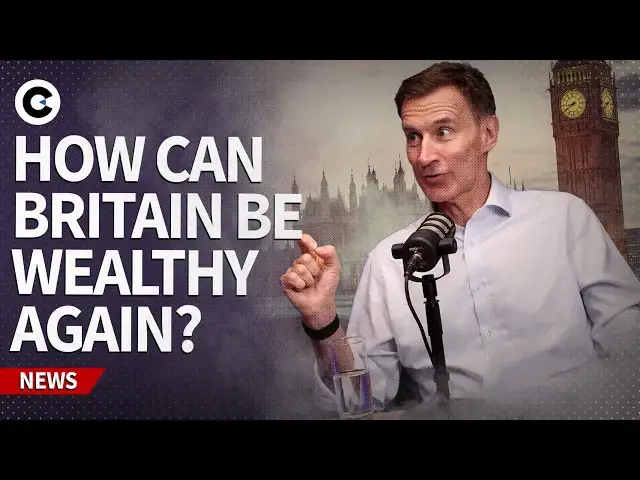
How can Britain be wealthy again? Jeremy Hunt on growth, poverty, and the pension triple lock
Jun 8, 2026

In Sir Jeremy Hunt's new book, 'Can We Be Rich Again?' the former Chancellor gives a detailed explanation of how Brits can be wealthy again.
He came in to City AM's studio to speak to Editor in Chief, Christian May, about his prescription for growth, ranging from the pensions triple lock to welfare spending.
Sir Jeremy's book is out now.
Get more of City AM 👇
🌐 http://www.cityam.com
X(formerly Twitter): http://twitter.com/CityAM
Facebook: http://www.facebook.com/cityam
Instagram: http://www.instagram.com/city_am
LinkedIn: http://www.linkedin.com/company/cityam
Show More Show Less View Video Transcript
0:00
When we talk about poverty now, uh we
0:03
always talk about relative poverty. We
0:05
talk about the number of people below
0:07
twothirds of median income, which is the
0:09
way we do that. That is actually not a
0:11
measure of poverty. It's a measure of
0:12
inequality.
0:14
But because we measure it that way,
0:16
every welfare reform affects people on
0:18
low income. And so therefore, everything
0:21
you do, you're able to produce a figure
0:24
saying these reforms will push 200,000
0:26
more people.
0:27
>> The Resolution Foundation will produce a
0:29
figure. Yeah. Saying they'll push
0:30
200,000 more people into poverty and of
0:32
course that makes it impossible for
0:34
Labor MPs to vote for. We had a real
0:36
issue with pensioners living in very
0:39
very tough conditions. Now pensioners
0:41
are less likely to be in poverty than
0:44
any other population group. And let's be
0:46
clear, I don't want to cut the state
0:47
pension. In fact, I would like to have a
0:50
rockolid guarantee that it will always
0:52
go up with inflation so that pensioners
0:55
never have to worry that the value of
0:57
their pension will be eroded. joined in
0:59
the City AM studio now by Jeremy Hunt
1:02
who has served in a wide variety of
1:05
cabinet positions and has been at the
1:07
heart of British politics for quite a
1:09
long time. The longest serving health
1:11
secretary, he's been culture secretary,
1:13
foreign secretary, and of course
1:15
chancellor. Now still in parliament, but
1:17
on the backbenches, he's writing books.
1:20
The latest of which asks the important
1:22
question, can we ever be rich again as a
1:27
country or just the two of us? I'm not
1:29
sure. But uh
1:30
>> well, let's let's hope for everyone.
1:32
>> They're related, [clears throat]
1:32
>> including both of us.
1:33
>> Yeah, they're related. Can we be rich
1:35
again is the name of the book. Um we're
1:38
going to get on to that and we're going
1:40
to try and find an answer. Um you've
1:43
been writing books uh since since
1:46
leaving government on on the theme
1:47
really of how to fix Britain.
1:50
So, I think it probably makes sense for
1:53
me to start by asking how is it broken
1:56
and who broke it?
1:59
>> Well, um, if that's a sort of oblique
2:01
way of saying, didn't you conservatives
2:03
screw it all up in your 14 years? Um,
2:05
>> I'm I'm prepared to go back further than
2:08
14 years if need be.
2:09
>> Thank you. But, um, but for sure we
2:11
didn't get everything right. But what
2:13
has been particularly difficult in the
2:15
last 20 years is that something's
2:17
happened that never happened before in
2:19
our lifetimes, which is that we didn't
2:21
have one global crisis, but we had three
2:25
in quick succession. We had the global
2:26
financial crisis, then COVID, then the
2:29
Ukraine energy shock. Now we've got a
2:31
bit of an Iran energy shock. And um and
2:35
during that period um I mean the irony
2:38
of my title is that actually we have got
2:41
richer over that period. Um you know
2:43
since 2010 our GDP perhead's gone up by
2:46
about 15%.
2:48
But we don't feel it and when the
2:51
economy was growing at 2 and a half% a
2:53
year as it was for most of the time that
2:55
you and I were growing up um the truth
2:58
is the economy was doubling in size
3:00
every 28 years. and we had this rockolid
3:02
confidence that we would be richer than
3:04
our parents and a lot richer than our
3:06
grandparents. Now that confidence has
3:09
evaporated and um this book is actually
3:13
an optimistic book to say actually we've
3:15
got a lot going for us. Um and you know
3:19
we've got in the century of AI the third
3:23
largest AI sector in the world after the
3:25
United States and China. Uh p during the
3:29
pandemic medicines and vaccines
3:30
discovered here save more lives than
3:32
those from any other country. We've got
3:35
lots of very big problems to fix. Um but
3:38
we sometimes forget that other countries
3:40
have problems as well. And uh we should
3:42
get our mojo back.
3:43
>> Well, we're all in favor of getting our
3:45
mojo back. But you've you've painted a
3:48
picture there of a period quite a long
3:51
period during which a number of
3:53
fundamental things have gone wrong and I
3:56
know that you pick up on a lot of
3:57
different themes in your book from
3:58
welfare to education.
4:00
A a broad question that I'm interested
4:02
in, particularly given your experience
4:05
at the top table, is whether over the
4:08
last 15 years or so, Britain has got
4:12
harder to govern and whether that's a
4:15
consequence or a symptom of the sort of
4:17
economic problems that you're
4:19
identifying.
4:20
>> Um, it's become a little bit harder to
4:22
govern because we've passed laws that
4:24
with the benefit of hindsight we can see
4:27
are wrong. such as
4:29
>> such as the way judicial reviews work.
4:31
You know, if parliament decides it wants
4:33
a nuclear power station and the Treasury
4:35
allocates the money for it, it still
4:37
takes 20 years, 20 years before it
4:40
generates any electricity. And if it's
4:42
built by EDF, it will generate
4:45
electricity that costs double the amount
4:48
that EDF would charge for that
4:50
electricity if they built exactly the
4:52
same nuclear power station in France.
4:54
because our planning and regulatory
4:56
requirements have become ridiculously
4:58
goldplated. So we have made life harder
5:01
for ourselves but and I think we should
5:03
change those laws. By the way, that's
5:04
one of the things that I argue in in the
5:06
book.
5:06
>> This is what people refer to as the
5:08
stakeholder economy.
5:09
>> Yes. And the fact that we you know we
5:12
have the ECR which makes it very very
5:16
difficult to solve problems like small
5:18
boats crossings. But you know, I don't
5:20
think we should be just saying that this
5:23
is all the fault of uh these things.
5:25
Actually, leaders who know what they
5:27
want to do are able to change things.
5:30
And you know, I'll give you examples.
5:32
They're politically contentious. But
5:34
putting aside the rights and wrongs of
5:35
the decisions, you know, George Osborne
5:38
put in place a very tough austerity
5:40
program that got the deficit down from
5:43
10% of GDP to 2% of GDP. Very difficult
5:48
decisions. Michael Gove did some very
5:50
controversial schools reforms that
5:52
massively raised standards in in state
5:54
schools. I had to take some eye watering
5:58
decisions that involved increasing tax
5:59
and cutting spending to make sure that
6:02
we were balancing the books after the
6:03
COVID debt uh the fur scheme and so on.
6:06
So it's perfectly possible to take very
6:08
big decisions Ian Duncan Smith's
6:10
introduction of universal credit and so
6:12
on. So um I think if you know what you
6:14
want to do um the civil service do their
6:17
level best. Um but yes we probably have
6:20
made the the plumbing of government a
6:22
bit more uh complex than it needs to be.
6:25
>> So let's talk a bit about the role of
6:27
and you could call it a plan you could
6:29
call it ideology. Um I remember the
6:33
years leading up to the 2010 general
6:36
election and it was well understood what
6:40
uh the conservatives I pick on that
6:42
particular party were proposing to do.
6:44
Um and indeed um you know as it happened
6:48
it did so alongside Liberal Democrats
6:50
but it was quite well understood and one
6:52
of the criticisms that we hear of the
6:54
current government is the lack of a
6:57
plan. Uh some people have been perhaps
6:59
pointing out claiming there's been a
7:00
lack of plan for a long time. We now
7:02
know thanks to the Mandlesson files that
7:05
people right at the heart of number 10,
7:07
including some of the senior ministers
7:09
at the cabinet table around which you
7:11
used to sit were were feeling exactly
7:13
the same and that have been
7:14
communicating in private messages which
7:16
have now become public that they also
7:18
felt that there was no plan, there was
7:19
no grip. Um, and does that go to suggest
7:24
that
7:26
if you try to govern by reaction or by
7:30
responding to situations, you're not
7:32
going to be able to do it as effectively
7:35
uh as if you had come in and said,
7:37
"These are the things we're going to
7:38
do." And you set out an argument and you
7:40
and you'd almost won the argument and
7:42
the right to then set about doing some
7:44
difficult things.
7:45
>> Absolutely. And I say this as as a
7:48
conservative politician who on the night
7:50
of the election publicly wished Kier
7:52
Stala and Rachel Reeves well because I
7:55
wanted them to succeed because you know
7:57
they are going to be uh they were going
7:59
to be running the the government for
8:01
five years and uh you know we need every
8:03
government to succeed. Um but um I think
8:07
in retrospect and these things you only
8:09
understand uh with the benefit of
8:11
hindsight
8:13
uh they had one fundamental
8:14
misunderstanding. So I think they
8:16
thought that economic growth mattered
8:19
but there were other priorities you know
8:21
whether it's the NHS or education or
8:24
inequality and they were all priorities
8:27
and we're going to balance them all off
8:29
against each other and that's not how it
8:31
works. Uh Angela Merkel famously said,
8:35
"Growth isn't everything. It's true. But
8:37
without growth, everything is nothing."
8:40
You have to do the fundamentals on
8:42
economic growth for anything else to
8:44
work. And that's why they made the wrong
8:47
call when they buckled on welfare
8:49
reform. um which I think actually has
8:51
done them far more damage than the the
8:53
Mandlesson stuff because they thought
8:56
well this is just one of those tradeoffs
8:57
and and we've got some angry backbenches
9:00
here and so we'll uh we'll live to fight
9:03
another day. But actually welfare reform
9:06
was fundamentally important for growth
9:08
because without it you have to put up
9:10
taxes on business and that stops the
9:13
economy growing and that is the thing
9:16
which who whoever takes over from Karma
9:19
um as it looks like Andy Bernham might
9:23
they have to understand that economic
9:25
growth is the non-negotiable and look I
9:29
would disagree if you've got the economy
9:31
growing if it grows by 1% the Chancellor
9:34
has 10 to 12 billion pounds more to
9:36
spend every year and I would have the
9:38
argument that we should use some of that
9:40
for tax cuts to fuel even more economic
9:42
growth and labor people will say no uh
9:45
we want it for public services or
9:47
whatever. You can't even have that
9:49
argument unless you have the economic
9:51
growth and that's what I think they've
9:52
got wrong.
9:54
>> Let's dig into some of the specifics
9:56
your prescription if you like. Um
9:58
because you you mentioned welfare.
10:01
I I did actually funny enough did a fair
10:04
bit of work with Ian Duncan Smith in the
10:07
immediate runup to the 2010 general
10:09
elections. Was quite familiar with the
10:11
work that he was doing in preparation
10:13
for welfare reform. And I don't think
10:15
I've heard a Labor case for welfare
10:18
reform since Frank Field.
10:21
Are you surprised by that? What what do
10:23
you attribute that to? You would have
10:25
thought that it shouldn't be unusual to
10:27
hear tub thumping
10:30
uh you know moral arguments for welfare
10:33
reform from Labor MPs. Where have they
10:36
gone a drift on this?
10:37
>> It's because uh we've made a profound
10:41
mistake, Conservative and Labor
10:43
governments alike, in the way we measure
10:46
poverty. And so when we talk about
10:48
poverty now, uh we always talk about
10:52
relative poverty. We talk about the
10:54
number of people below twothirds of
10:56
median income, which is the way we do
10:58
that. That is actually not a measure of
10:59
poverty. It's a measure of inequality.
11:02
But because we measure it that way,
11:04
every welfare reform affects people on
11:06
low income. And so therefore, everything
11:09
you do, you're able to produce a figure
11:11
saying these reforms will push 200,000
11:14
more people.
11:15
>> The Resolution Foundation will produce a
11:17
figure.
11:17
>> Yeah. Saying they'll push 200,000 more
11:19
people into poverty. And of course that
11:21
makes it impossible for Labor MPs to
11:23
vote for. The reality is that um you
11:27
know welfare reform uh should help
11:30
people get on the ladder to independence
11:34
um to standing on their own two feet to
11:37
selfrespect
11:39
and um that will mean that there is a
11:43
less generous welfare system or a
11:45
welfare system that has more strings
11:48
attached. you know, Denmark, which is,
11:51
you know, considered a kind of soggy
11:54
liberal Scandinavian country, their
11:56
welfare system is far tougher than ours.
11:58
It's virtually impossible to get money
12:00
out of the state unless you can show
12:02
that you are actively looking for work
12:04
or working. They get four or five% more
12:07
of their population in work. Uh that
12:10
means less pressure on national finances
12:13
and more prosperity, higher GDP per
12:16
head. So, you know, I'm not saying that
12:18
we want a system like America where you
12:20
have people in in real poverty, but just
12:22
look at the Scandinavian countries, look
12:23
at Switzerland, look at look at the way
12:26
they do things in uh in Norway. And if
12:30
we did it like that, we would actually
12:31
have a more compassionate system
12:33
because, you know, if you've got anxiety
12:35
or depression, every doctor that I met
12:38
when I was health secretary said, "What
12:40
you need if you've got mental illness is
12:42
you need social contact. You need people
12:44
around you. Parking those people on on
12:47
welfare is going to make their mental
12:50
illness worse, not better, because it's
12:51
going to mean they lead a more isolated
12:54
lifestyle. Uh we should be saying if you
12:56
got anxiety or depression, we're going
12:58
to treat it. We should expand NHS mental
13:01
health treatment. It will be a fraction
13:03
of the cost of the benefits bill and
13:06
massively better for the individuals
13:07
involved. And uh and that's the way you
13:10
win the argument for welfare reform. Of
13:12
course, these different policy
13:14
priorities are all related and you had a
13:16
good example of that today uh at Prime
13:19
Minister's questions as we sit here and
13:21
conduct this interview on a Wednesday.
13:23
Your party leader Kimmy Baden now went
13:25
quite hard on on the welfare reform
13:27
argument. Of course, she was armed with
13:28
embarrassing quotes from the welfare
13:31
secretary having said that he only ever
13:33
has conversations with Labour MPs about
13:35
who to tax more in order to spend more
13:38
on welfare. And in response, the prime
13:40
minister K star said that they are
13:43
pursuing welfare reform and that
13:45
everything they're doing is about trying
13:46
to get people back into work. And uh
13:50
there's quite tight scripted exchanges,
13:52
I suppose, if it was allowed to run on
13:54
to a full half hour head-to-head. At
13:57
some point, somebody would have said,
13:58
"But what about the situation with
14:00
employment and employment taxes and
14:02
entry- level jobs?" And we can take AI
14:05
out of it for a moment. We might come
14:06
back to that. But there has been a
14:08
problem, has there not with the erosion,
14:11
I'm talking just really in the last 18
14:13
months or so um of employers confidence
14:16
to hire and particularly in sectors that
14:18
tend to act as the route into other jobs
14:21
or more permanent jobs in hospitality or
14:23
retail etc. There's a contradiction
14:25
there between a government that says it
14:27
wants to get people back into work as a
14:29
way of lowering the welfare bill.
14:31
they're not prepared to cut it
14:32
financially and actually what they're
14:34
doing to employers in this country.
14:36
>> I mean the increase in employers
14:39
national insurance was a catastrophic
14:42
mistake um which has led to many fewer
14:45
jobs being offered to young people and a
14:48
big increase in the number of so-called
14:50
needs people not in education employment
14:52
and training but you know not reforming
14:56
welfare and the government's got no
14:57
plans to reform welfare. hearing
14:59
virtually nothing uh in terms of
15:02
concrete actions is is a double whammy
15:05
because if we got if you look at what's
15:08
actually happened the welfare role was
15:10
basically going down until 2019 and then
15:13
the pandemic happened and it made a lot
15:16
of people ill but also in parallel to
15:19
that and not entirely because of the
15:21
pandemic we had an explosion in people
15:23
claiming welfare for mental illness
15:26
which we hadn't had before um and that's
15:30
when it really started to go wrong. Now,
15:31
if we got the welfare bill back just to
15:34
the level it was in 2019, so pre-
15:37
pandemic, that's not that long ago, uh
15:40
it would save 56 billion pounds a year.
15:44
And you wouldn't have needed to have
15:45
that increase in employers national
15:48
insurance um or indeed most of Rachel
15:51
Ree's tax increases. So the opportunity
15:55
cost that you lose from ducking welfare
15:59
reform is higher taxes on business. And
16:02
that's why it's so bad. This is not just
16:04
about
16:06
parking people on welfare and um and and
16:10
damaging their life chances. It's also
16:13
about the consequence of that which is
16:16
higher taxes on business, lower growth.
16:19
So there's another large part of the
16:20
welfare agenda which you've been
16:23
recently quite candid about which is the
16:25
triple lock on the state pension which
16:27
was of course a conservative policy. Um
16:31
and it was hailed as being terribly
16:32
clever and absolute vote winner at the
16:34
time. You're now saying that that it's
16:36
unaffordable and and and and if I may,
16:38
you're just saying out loud what I'm
16:40
sure almost everybody you speak to in
16:42
the House of Commons. Um perhaps not not
16:44
everybody but an awful lot of them would
16:45
would concede. um and that would include
16:48
people in government that it's it's an
16:50
unaffordable proposition and it's it's
16:52
it's it's one of one of the most um
16:56
obvious areas of future state
16:58
expenditure which you look at and you
17:00
just think this is just it's not going
17:01
to happen. Um and yet everybody claims
17:03
that it that it will because we're
17:05
committed to it. I think all parties at
17:07
present are committed to it. Um do you
17:10
regret the introduction of it? Was it a
17:13
political weise that was too clever by
17:14
half? I don't think that is the case. Um
17:17
when it was introduced, pensioners were
17:20
more likely to be below the poverty line
17:22
than any other group in the population.
17:25
Um and we had a real issue with
17:27
pensioners living in very very tough
17:30
conditions. Now pensioners are less
17:32
likely to be in poverty than any other
17:35
population group. And let's be clear, I
17:37
don't want to cut the state pension. In
17:38
fact, I would like to have a rockolid
17:40
guarantee that it will always go up with
17:42
inflation so that pensioners never have
17:46
to worry that the value of their pension
17:48
will be eroded by price increases. Why
17:50
don't we hear that argument more?
17:51
Because that that doesn't sound like
17:54
it's a bit like the conversation around
17:55
the future of the NHS. You know, you
17:58
either support the NHS as it is and
18:00
don't want to touch it or you're somehow
18:02
in favor of the worst of the US
18:03
healthare system. And when it comes to
18:05
the triple lock again, it seems like
18:06
people are are too afraid to say, "I
18:10
still think pension should increase at
18:11
the rate of inflation. I just don't
18:12
think we need the other mechanisms that
18:14
sometimes raise it by, you know, silly
18:16
amounts. Why don't we have that sensible
18:17
conversation?"
18:18
>> Well, that's what I'm trying to do. And
18:19
obviously,
18:19
>> well, you and I are having a sensible
18:21
conversation. Where is it in
18:23
Westminster?
18:23
>> Well, I have some freedom on the
18:24
backbenches. And my hope is, look, I
18:26
recognize that both Labour and the
18:28
Conservatives promised in their
18:30
manifestos to keep the triple lock. So,
18:33
we're probably going to have it for this
18:34
parliament and I I would respect the
18:36
decision to keep it for this parliament
18:38
given that it was in that those
18:39
manifestos. The question is what happens
18:41
in the next parliament because the
18:43
savings this parliament would actually
18:44
be relatively low and I hope all the
18:48
parties will agree not to put it in
18:50
their manifestos going forward because
18:51
and this is the the clinching argument
18:54
for me. Um every year that we've had the
18:56
triple lock we've had a deficit.
18:59
So the cost of above inflation rises in
19:03
the state pension uh as opposed to just
19:06
inflation rises is partly being funded
19:08
by debt. Now how many people
19:11
would think that it was fair for them to
19:14
have an above above inflation increase
19:17
in their pension if that was being paid
19:18
for by more debt on their children and
19:21
grandchildren. I think most people would
19:23
recognize that actually isn't fair on
19:26
future generations. But it's also very
19:28
bad for economic growth because we have
19:30
to pay for that debt through uh 110
19:35
billion pounds a year that the excheer
19:37
pays for debt interest. That's more than
19:39
we spend on the police, more than we
19:41
spend on schools, more than we spend on
19:43
the entire defense budget. And so
19:46
there's a cost to it. It's a kind of um
19:49
what is it? It's an anchor drag on
19:51
economic growth. Now if we want to look
19:53
after pensioners well that's not just a
19:56
generous state pension it's also having
19:59
good NHS good social care system that
20:02
needs economic growth and at the moment
20:04
if we keep racking up our debt we aren't
20:07
going to have that economic growth so on
20:08
this triple lock point
20:11
why don't you use your status as a
20:13
grandy you're wellliked you're respected
20:15
you served in different departments I
20:17
know you're still on you're on good
20:19
terms with with Rachel Reeves I don't
20:21
know how long she's going to be the
20:22
Chancellor for but my point is
20:24
you have some standing in Westminster
20:27
and in this debate perhaps to be able to
20:29
coordinate some sort of formal cross
20:32
party consensus that could in fact take
20:35
the sting out of this. This might be
20:37
well beyond the the realms of what's
20:39
possible in party politics today. But
20:41
can you imagine a scenario in which the
20:44
main parties ahead of the next election
20:47
agreed to a pretty standardized approach
20:49
to the future of the triple lock and
20:51
then it's taken out of the debate in
20:53
that regard. Is that something that you
20:55
would look to explore or advocate?
20:57
Because without unanimous agreement,
20:59
you're not going to find someone going
21:01
into the next election saying vote for
21:03
us. We're the only party who doesn't
21:04
support triple law.
21:05
>> Yes. It's a kind of prisoners dilemma
21:07
for um politicians. Well, I hope I can
21:10
uh provoke those kind of discussions and
21:14
you know, if it isn't that, you know,
21:17
could we perhaps set up a royal
21:19
commission to look into uh the entire
21:23
affordability of our pension system, not
21:25
just the state pension, but what we can
21:27
do to encourage people to save more for
21:29
themselves over their working life. You
21:31
know, another reform that would make a
21:32
big difference is if we just have one
21:34
pension pot that followed us from job to
21:36
job instead of this crazy system where
21:38
we have a different pension pot for
21:41
every employer we go to. That that
21:43
doesn't make sense. The Aussies give you
21:45
one pension pot. And of course, what
21:47
that means is you can see the value of
21:49
your pension pot on your phone anytime
21:52
and then if you get a bonus or an
21:54
inheritance or whatever it is, you have
21:55
an incentive to top it up.
21:57
>> Things have improved a little bit,
21:58
haven't they? But I am still in the
21:59
process of trying to get a pension from
22:01
an employer in 2013 to transfer what
22:04
modest sum I collected there into my new
22:07
pot at the moment because there've been
22:08
some improvements there. But I I take
22:10
your point. I'd like to end by asking if
22:13
you can just give us your thoughts on
22:16
what you think
22:18
the next parliament might look like. Um,
22:21
and I'm not asking you to put numbers to
22:24
parties as such, but do you anticipate
22:27
uh having served in a coalition
22:29
government that we might have another
22:31
form of coalition government?
22:33
>> Um, it's difficult obviously to predict
22:36
because politics is so volatile. I I
22:40
will say in defense of my own party, you
22:43
know, the share price is very low at the
22:45
moment, having had our worst ever defeat
22:47
two years ago, but I do think people are
22:51
increasingly worried about the economy
22:53
and I think they do trust for all our
22:56
many failings. I think they recognize
22:58
Conservative governments do take the
23:00
tough and difficult decisions to get the
23:01
economy back on its feet. That's one of
23:03
the most important reasons that people
23:05
support us. But I think the biggest
23:08
lesson that I hope everyone absorbs
23:11
after what we've had in this parliament
23:14
is that you need to think about economic
23:18
growth and if you're going to take
23:20
difficult decisions. You know, if Andy
23:22
Bernham becomes prime minister, there
23:24
will be a period immediately after he
23:27
becomes prime minister when he can do a
23:29
lot of things. And if for example one of
23:32
his ideas I mean a lot of things I
23:34
wouldn't agree with his approach but one
23:35
thing I would agree with is devolving
23:37
real power to the regions to regional
23:39
mayors so they can actually sort out
23:41
their own problems without having to
23:42
bang on the door of white. If he's going
23:45
to do it, do it quickly. And you know, I
23:48
hope it's Kimmy Bnock as prime minister
23:49
after the next election. And if it is
23:52
her, what she does in the first three to
23:54
six months are the most important things
23:56
of all because that's when you have the
23:57
political capital to get stuff done. But
24:01
political capital is like an egg t. The
24:04
sand is draining away. Um, you know,
24:06
when you wake up on day two, you've got
24:09
less sand than you had in the first day.
24:13
And so if you don't do things quickly,
24:15
um, you lose the chance to be bold and
24:17
radical. And that I think is the real
24:20
lesson.
24:20
>> Well, look, I'm the gloomster journalist
24:22
and I know that I've been focusing this
24:24
conversation on a lot of the problems
24:25
that we face, but I also know that your
24:27
book is um a more of an optimistic take
24:30
on where we could be. So, um, I think
24:32
it's well worth people getting hold of.
24:34
Uh, can we be rich again? Well, come
24:37
back and tell us in a few years time.
24:39
Jeremy Hunt, thanks for coming into
24:40
city.
24:41
>> Pleasure. Thank you.
News