Up next in 10


New data suggests British brands are lagging behind the rest of the world as more value than ever is placed on a company's perception.
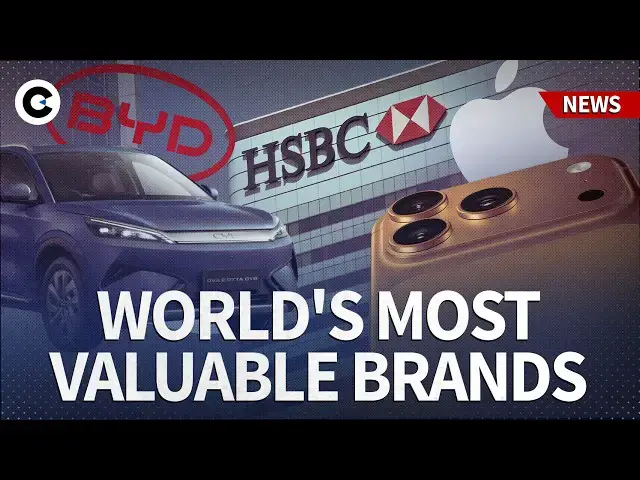
A study by Kantar and the University of Oxford has placed HSBC on its power list of brands, the only UK name. With China and the US outperforming, see what names, Kantar say, are so strong they could outperform the S&P 500 stockmarket index.
Get more of City AM 👇
🌐 http://www.cityam.com
X(formerly Twitter): http://twitter.com/CityAM
Facebook: http://www.facebook.com/cityam
Instagram: http://www.instagram.com/city_am
LinkedIn: http://www.linkedin.com/company/cityam
Show More Show Less View Video Transcript
0:00
Now, here's one for all the marketing
0:01
geeks out there because British brands
0:04
might be falling behind the rest of the
0:06
world according to data out this very
0:08
morning from Kantar and the University
0:10
of Oxford. British businesses will need
0:12
to work harder and faster to make sure
0:14
they keep pace with those from overseas
0:17
to maintain their standing with
0:18
consumers and clients. The findings also
0:20
show that companies with particularly
0:22
strong brand equity deliver abnormally
0:25
high share price returns even
0:27
outperforming the S&P 500 and have a
0:29
greater resilience to crisis and
0:31
uncertainty. Well, joining us now is
0:33
Peter Aitken, a senior director at
0:35
Kantar who conducted the research. Why
0:37
don't you start by explaining why you
0:40
conduct this research and why Britain
0:42
seems to be falling behind? Thank you.
0:44
Well, thank you for having me first of
0:45
all.
0:46
So, we've been doing this research for
0:47
over 20 years um and it helps us to
0:49
understand the brands that are
0:50
performing in the market but also the
0:51
ones that are most likely to grow. And
0:52
as you said in the intro there, uh by
0:54
understanding the perceptions that
0:55
people have of companies, that's a very
0:57
strong predictor of their likelihood to
0:59
grow over time. And we found that over
1:01
over the period that we've running,
1:02
these uh stronger brands have
1:05
outperformed the S&P 500 and MSCI World
1:07
Index. So, brand strength is a is an
1:09
irrefutable predictor of of growth.
1:12
Um
1:13
but your question here around around
1:15
British brands and the the makeup of
1:17
this, you know, we've certainly seen an
1:18
increased dominance of the US brands
1:20
from the US and from China making up
1:22
this. So, now uh the US brands uh make
1:25
up over just over 80% of the total value
1:29
of the of the 100 and we've seen a huge
1:31
growth of of Chinese brands uh in there
1:34
as well. They've grown 31%. So, we're
1:36
certainly seeing that the the uh the
1:39
volume of of
1:40
of scale that's that's created and the
1:42
value that's created is is increasingly
1:44
dominated by by US and and Chinese
1:46
brands. I'm really intrigued by some of
1:48
the data about particularly Chinese
1:49
automotive firms cuz back in the day if
1:51
you were a company like Geely when it
1:53
first wanted to enter the British
1:54
market, you'd buy a brand like MG and
1:56
you'd use that because you build on the
1:58
the familiarity that it already has. But
2:00
now BYD, I mean it's on your list. I
2:03
don't know we had some reporting out
2:04
this morning about how there are more
2:05
BYD cars now than there are Land Rovers
2:08
in the UK. I suppose what's been the
2:09
shift that's sort of made that cultural
2:12
uptake more more kind of acceptable to
2:14
the public.
2:14
>> So BYD is now the fifth most valuable
2:16
car brand in the list. So you know there
2:18
there are still a lot of other big
2:19
brands ahead of them, Toyota for
2:20
example. Um but what we've seen in the
2:22
UK is the growth of Chinese brands and
2:25
their increasing market share. They've
2:26
gone from sort of single digits, 1 or 2%
2:28
a few years ago about in 2020, up to
2:30
about 10% of market share right right
2:32
now. Just new new registrations. What is
2:34
the quantitative process you go through
2:36
to quantify exactly the value of a
2:39
brand? Like how would you for example
2:40
try and quantify the brand of Businesses
2:42
as Usual Partners in partnership with
2:44
Octa by City AM? How would you go about
2:46
figuring that out? I I can't see it on
2:48
the top 10, but
2:49
>> [laughter]
2:50
>> but I might have an out-of-date list. I
2:51
don't I I won't put that against you. So
2:53
firstly you want to understand the the
2:55
total value of the company and that is
2:57
everything including its tangible
2:58
assets, its intangible assets. It's
3:00
that's everything. It's not just market
3:01
cap, but it's the future growth
3:02
projections based on that analyst
3:04
>> Matt and I are the only assets really in
3:05
this. That's
3:07
what what are the how do you measure
3:08
intangible assets? Well, so what we're
3:10
doing with so what the brand value will
3:13
will look at is it will take out it will
3:16
take out the all of the all the tangible
3:18
assets. It will also take out things
3:19
like IP as well and it will just look at
3:20
the consumer perceptions of the of the
3:22
brand and the extent that that
3:24
contributes to the total So do you poll
3:26
people? You ask people have you ever
3:28
heard of Exactly. So we've been running
3:30
the same standardized study over the
3:32
last 20 years. So it gives a really
3:33
strong base for for understanding that
3:35
growth over time. And and the only
3:37
British name that you said is sort of
3:39
still on this sort of power list is
3:40
HSBC. Why is that?
3:44
HSBC are a huge brand globally.
3:46
Huge in the UK.
3:48
Um and so brands that make the top 100
3:52
they they do a number of things.
3:53
Firstly, they they appeal to a huge
3:54
range of people. We call that being very
3:55
meaningful. They also stand out as
3:57
offering something unique, seen as
3:59
different, but they have to do that on a
4:00
global scale. And that's what HSBC have
4:02
done incredibly well over the over the
4:04
last number of years, and that's kept
4:05
them in kept them in the ranking. Um
4:07
what sort of advice would you give CEOs
4:09
and CMOs listening to this
4:11
uh about how to elevate their brand
4:13
equity?
4:16
Brand equity is formed on three
4:18
characteristics. Firstly, um the the
4:20
perception that the brand did gives you
4:21
something that you want. We call that
4:22
being meaningful. Second, that it stands
4:24
out and offers something that's seen as
4:25
unique in the category. Um
4:27
offers something that others don't. We
4:28
call that being different. And also, it
4:29
comes to mind quickly when you want to
4:30
buy something in that category. We call
4:32
that being salient. And so, being to
4:34
growing, you need to deliver on those
4:35
things. You need to recognize what's
4:37
important for customers, but you also
4:39
need to do that in a way that seems
4:40
unlike any others in the category. And
4:41
that's what BYD have done really well.
4:43
They recognize that the British buyers
4:46
want low low prices, but they also want
4:48
quality. They want good engineering. And
4:49
that's why they've managed to to grow,
4:51
you know, grow growing at a strong rate
4:53
in the UK at the moment. Um but equally,
4:55
that's what, you know, British brands
4:56
have been doing doing for a long time.
4:57
They they they recognize what customers
4:59
want, and they do it often in a way that
5:01
feels feels different, but just not
5:02
necessarily at the same scale as we're
5:04
seeing likes of Claude and Google and
5:06
Apple.
5:07
We've spoken quite a lot about the
5:08
companies at the top of the list. But I
5:10
suppose sort of lower down the rankings,
5:11
are there any particularly promising
5:13
British brands that you're seeing rising
5:14
up at the moment that you think actually
5:16
could be in the upper reaches given a
5:18
few years? Yeah, I mean, it's about
5:20
creating the conditions for scale. So,
5:21
Britain is not short of great
5:23
innovation, great creativity,
5:25
engineering, entertainment. So, we see,
5:27
you know, F1 and all the F1 teams. We
5:28
see the Premier League. We see Burberry,
5:30
the BBC, Dyson. So, Britain is not short
5:33
of talent, innovation, engineering
5:35
capability. The challenge for Britain is
5:37
is scaling that. Um what we see in the
5:40
US and the conditions that exist in the
5:41
US, Silicon Valley and Shenzhen in in
5:44
China, they create the the conditions to
5:46
have a a much greater ecosystem for
5:48
these brands to grow. The challenge for
5:50
the for Britain is taking these local
5:53
heroes and and allowing allowing them to
5:55
grow. And we're seeing in the UK greater
5:57
investment, for example, in the OxCam
5:59
Corridor.
6:01
We're also seeing that the Rachel Reeves
6:03
trying to push for greater retail
6:05
investment in UK equities. And so what
6:07
these businesses need is
6:09
they need the conditions for scale and
6:11
that's increasingly what what Britain
6:13
needs to get right to enable these
6:14
things to happen. Well, Peter Aicken
6:15
from uh Cantor, thank you very much for
6:17
coming in. We look forward to seeing
6:18
Business as Usual sponsored by Octa on
6:21
your list next year in at least the top
6:24
20. Can we get it to the top 20? Okay.
6:26
Challenge Challenge for 2030. Let's go.
6:29
>> [laughter]
6:29
>> 2050 maybe.
6:30
Thank you for coming in.
News