
China: Chinese researcher recalls pleasant surprise of discovering new lunar mineral.
May 6, 2026
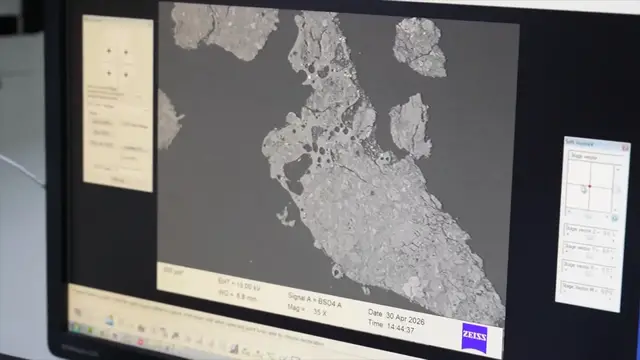
Shotlist Beijing, China - Recent (CCTV - No access Chinese mainland) 1. Various of lunar samples; researchers at work; screen showing images of samples 2. SOUNDBITE (Chinese) Qu Kai, member, Committee on New Mineral Naming and Classification, Chinese Society for Mineralogy, Petrology and Geochemistry (ending with shot 3): "We scanned the samples on the first day and discovered that there were abundant merrillites of multiple varieties. Under the electron microscope, we could see that they contain thousands upon thousands of tiny granules." 3. Various of screen showing images of samples 4. Various of researchers at work 5. SOUNDBITE (Chinese) Qu Kai, member, Committee on New Mineral Naming and Classification, Chinese Society for Mineralogy, Petrology and Geochemistry (starting with shot 4/ending with shot 6): "Dr. Wang Yanjuan quickly realized this could be a new mineral. The study of new minerals is often described as the 'Olympics of mineralogy' -- whoever submits a proposal to the International Mineralogical Association first gets the priority to name it. So we immediately shifted our research focus to fully proving that this is a new mineral." 6. Various of researchers at work; screen showing images of samples Storyline A Chinese researcher has recalled the pleasant surprise of discovering a new lunar mineral changesite-(Ce) from samples brought back to the Earth by China's Chang'e-5 mission. Along with magnesiochangesite-(Y) and magnesiochangesite-(Ce), changesite-(Ce) is one of three new lunar minerals recently identified from the samples. A research team from the Chinese Academy of Geological Sciences took the lead in discovering changesite-(Ce). The discovery came unexpectedly in September last year, when the team was examining lunar samples under a scanning electron microscope. Their original goal was to investigate why the merrillite mineral group, which has been found on asteroids, Mars and the moon, has disappeared from the Earth's surface. "We scanned the samples on the first day and discovered that there were abundant merrillites of multiple varieties. Under the electron microscope, we could see that they contain thousands upon thousands of tiny granules," said Qu Kai, a member of the Committee on New Mineral Naming and Classification of the Chinese Society for Mineralogy, Petrology and Geochemistry. But as they systematically screened the countless granules, something unusual caught their attention. Some granules have a different composition from changesite-(Y), a lunar mineral discovered in 2022 that is rich in heavy rare earth elements. The new granules were enriched in light rare earths -- a strong signal that they might represent a mineral never before identified in nature. "Dr. Wang Yanjuan quickly realized this could be a new mineral. The study of new minerals is often described as the 'Olympics of mineralogy' -- whoever submits a proposal to the International Mineralogical Association first gets the priority to name it. So we immediately shifted our research focus to fully proving that this is a new mineral," Qu said. Through systematic mineralogical study, the research team ultimately found changesite-(Ce), a phosphate mineral rich in the light rare earth element cerium.
Show More Show Less #news