Up next in 10


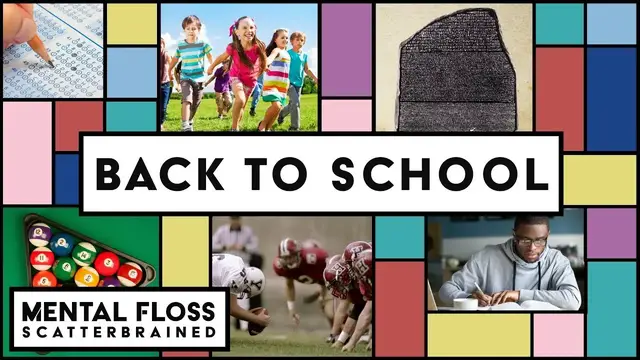
Today, we learn the history of school in the United States! Then, we get study tips straight from science. We take it back to the eighties to learn about a historic prank done by some MIT fraternity brothers at an Ivy League football game. We give you the scoop on why writing down your notes helps you retain the information. A few child prodigies are discussed. Finally, we answer the question: "Why do kids get summers off?" in this episode presented by the Paper & Packaging - How Life Unfolds.
Subscribe for new episodes of Scatterbrained every other Wednesday!
Follow our hosts on Twitter:
John Green: @johngreen
Amanda Suk: @sukiestyles
Becca Scott: @thebeccascott
Elliott Morgan: @elliottcmorgan
Dani Fernandez: @msdanifernandez
Mike Rugnetta: @mikerugnetta
----
Don't miss a video! Subscribe NOW: https://www.youtube.com/@MentalFloss?sub_confirmation=1
About Mental Floss:
Mental Floss is where curious people come for trivia-tastic information. Mental Floss produces lists of fun facts, debunks common misconceptions, and tells untold stories from history, science, culture and more.
Website: http://www.mentalfloss.com
Twitter: http://www.twitter.com/mental_floss
Facebook: http://www.facebook.com/mentalflossmagazine
Store: http://store.mentalfloss.com/ (enter promo code: "YoutubeFlossers" for 15% off!)
Copyright Notice: This video and YouTube channel contain dialog, music, and images that are property of Mental Floss. You are authorized to share the video link and channel, and embed this video in your website or others as long as a link back to this YouTube Channel is provided.
2025 Mental Floss
The Surprising History of School! - Mental Floss Scatterbrained | Mental Floss
https://www.youtube.com/@MentalFloss
Show More Show Less View Video Transcript
0:00
Hello and welcome to Mental Floss Video. From study tips to historic pranks to answering the question
0:05
why do kids get summers off? We're going to be talking about all things school in this episode
0:11
presented by Paper and Packaging, How Life Unfolds. Let's get started. Luckily for modern students, there are researchers working hard to figure out the best way
0:29
to learn information, and some of those studies might be useful for you
0:33
Like, according to one experiment from 1978, switching from location to location while studying might help you on tests
0:40
The researchers had 16 undergrads study a list of 40 nouns once
0:45
then study them again three hours later. But half of the students moved to a room that looked pretty different for the second study session
0:52
Then, three hours after that, both groups had to write down as many of the words they could in 10 minutes
0:58
The ones who only studied in one room had an average recall of 15.9 words
1:04
Participants who moved rooms got 24.4 words. There has also been a lot of research on whether taking time between study sessions is beneficial
1:12
In one experiment, participants were asked to study Swahili words. The researchers varied how much time there was between study intervals, from 5 minutes to 14 days
1:22
And then they were tested 10 days after they studied last. The researchers concluded that one day was the ideal time to wait between study sessions
1:30
They also did a second experiment where they had participants memorize the names of weird items
1:35
which they'd be tested on in six months. This time, they experimented with wait times of five minutes to six months between study sessions
1:44
In this variation, they found the best test results occurred with one month between study sessions
1:49
A lot of information on the internet will tell you to not use a highlighter to learn
1:53
But at least one study suggests the opposite. 184 UCLA undergraduate students read a paragraph about groundwater
2:01
Some were told to use a highlighter while reading. Another group didn't get a highlighter
2:06
Then they were asked to study the passage again. But some participants had no time between reading and studying
2:12
Some spent half an hour doing another activity. Then one week later, both groups took a 12-question quiz about the paragraph
2:19
The participants that used a highlighter did remember the paragraph better. The ones who benefited most were people who didn't take a break between highlighting and restudying
2:27
and students in the highlighter group who claimed to value highlighters as a study tool
2:31
didn't benefit as much as those who didn't value them. School isn't all homework and scientific studies
2:42
Every once in a while you have to throw some football games and pranks in the mix Sometimes both which is exactly what happened during a November 1982 Harvard football game Get some ideas class of 2019 this one for you
2:55
In a prank that might have resulted in an arrest today, a giant balloon inflated near the 45-yard line during the second quarter of the game
3:02
And the pranksters wanted credit, as all pranksters do. They had printed MIT all over the balloon
3:09
Eventually, it popped. Balloons. It's probably worth noting that all the players were further down the field and no one was too close to the balloon itself
3:18
This was the work of a few MIT fraternity brothers of Delta Kappa Epsilon
3:22
The idea started a few years earlier in the late 70s. Some of the brothers put tubes under the Harvard field with the hopes of spelling out MIT in yellow paint
3:30
But they got caught! So the balloon idea was attempt number two
3:34
Preparing for the prank took about eight trips to Harvard Stadium between 1.30am and 5am
3:40
Multiple fraternity brothers went so some could look out, while others laid wire
3:44
connecting the area to a circuit breaker by the Harvard locker room. I mean, yeah, every student can do that, right
3:50
The last night they went, they buried the device about 36 inches into the ground and covered it with sod
3:56
Surprisingly, they had no run-ins with any security during these trips. As one of the brothers explained, the hardest part of the whole project was trying to scalp tickets to get into the game
4:05
The Deke brothers were pretty proud of their work. they held a press conference after the game to explain everything they'd done
4:11
They told reporters that they'd created a harmless device made of a refrigerant called Freon
4:16
and they used the motor from a vacuum cleaner. They even made sure to leave an informative note on the balloon about how to clean it
4:23
Oh, good citizens of the world. As for the result of the game, Harvard beat Yale 45-7
4:29
Yikes, but who really cares about that? As Sports Illustrated put it
4:33
Free-wheeling minds like these developed the heat-seeking missile, polyester, computers, the neutron bomb, and other hallmarks of modern civilization
4:42
Harvard may have won the game, but hail to the MIT! If you're looking for a smart studying life hack to try this year, instead of taking your laptop to class, break out a notebook
4:55
In a 2014 study, two groups of students were asked to take notes on a lecture. Sure, one group used laptops to take notes, the other wrote their notes longhand on paper
5:04
The students with laptops took down a much larger volume of notes, nearly 50% more, but
5:09
when the researchers tested both groups of students on the material from the lecture
5:13
immediately afterwards, the students who had taken their notes on paper performed much better
5:19
The groups did equally well on questions about basic facts like names or dates, but the group
5:23
that had handwritten their notes performed much better on more complex, conceptual questions
5:28
So what made the pen and paper students perform better Well the researchers theorized that our brains may process information differently when we writing it down When you type notes into your laptop it may feel like you can record more of what your instructor is saying
5:41
but that might actually hurt your ability to retain what you're hearing
5:45
You may be less focused on engaging with the material itself and more on basically transcribing the lecture
5:52
A similar phenomenon is when you say to a friend, are you even listening to me?" and they repeat back the most recent thing that you said
5:58
which is not necessarily an indication that they were listening or indeed understood anything
6:02
that you just said. When you take notes by hand on paper, you can't possibly write everything down that your teacher is saying
6:08
so you have to pay attention to process the lecture and yze what's important before writing it down
6:14
You're synthesizing your own summaries and organizing the conclusions, and since your brain is being forced to engage with the material more deeply, you're more likely to retain it
6:23
And the boost from handwriting notes is not just a short-term gain. In another part of this study, the researchers called the two groups of students back a week later for another round of questions
6:32
and this time students were allowed to study their notes for ten minutes before being tested
6:37
The students who had typed on a laptop had a much larger volume of notes to review, so you might think that they performed better
6:42
but no, the students who had handwritten their notes still came out on top
6:46
The researchers theorized that since they had processed the information on a deeper level during the initial lecture
6:52
their understanding and retention remained heightened down the road. So the lesson is add notebooks to your back-to-school shopping list
6:58
Oh, and write that shopping list down. You'll remember it better. Here are some child prodigies that might help inspire your schoolwork
7:09
Our first prodigy is Maria Agnese, who lived from 1718 through 1799
7:15
By the age of 12, she knew French, Italian, Greek, Hebrew, Spanish, German, and Latin
7:22
She went on to be a big deal in the field of mathematics, writing a two-volume book called ytical Institutions
7:29
It covered algebra and integral and differential calculus. No big deal. And she was appointed a professor at the University of Bologna thanks to a personal recommendation from Pope Benedict XIV
7:40
Right? Right? A more modern language expert was Kim Ung-yong, who was born around 1962 in Korea
7:48
At age four, he was able to read in Japanese, Korean, German, and English
7:53
He learned four more languages after that, but I mean, who really cares after the first four
7:57
But he got famous by doing math equations at a young age on TV
8:01
And he's reported to have come to America and started working for NASA before he was even a teenager
8:06
He quit a few years later and went on to have a low-profile life in Korea
8:10
working in management, then as a professor. Jean-Francois Champollion, who was born in 1790
8:16
was another language expert learning at least seven of them before he turned 20 I bet one of them was French He presented a paper on language to academics at Grenoble Academy when he was just 16 and his interest in language continued throughout his life He helped figure out that the hieroglyphics
8:31
on the Rosetta Stone weren't just alphabetic or pictographic. They included syllabic syllables
8:36
as well as ones that were determinative, which means they were shorthand for an entire idea
8:41
Sor Juana Inés de la Cruz was a prodigy in Mexico during the 17th century. She was reading
8:46
at three and writing poetry by eight. But no one said they were good poems, you know? At 17, she
8:52
impressed a panel of 40 professors who tested her on multiple subjects. She wrote on many pieces
8:57
throughout her life, everything from poems to plays to philosophical passages. She's now on the 200
9:03
peso note in Mexico. And finally, we have a very different kind of child prodigy, Willie Moscone
9:08
who lived from 1913 through 1993. His dad owned a pool hall, but he locked up everything except
9:15
for the tables. Luckily, Willie was resourceful and taught himself to play the game with potatoes
9:20
and a broomstick. He started playing real exhibition games at age six and went pro at 19
9:27
He went on to break all kinds of billiard records and was a consultant on the movie The Hustler
9:36
If you're going back to school soon, you're probably not questioning why you got summer
9:40
off in the first place, but you might be, so we're going to answer it. Let's take you back
9:43
to the 1840s when school years in American cities lasted for about 240
9:47
to 260 days. Things were done a little differently in the countryside where kids were
9:51
also expected to help out with household farming. They actually got spring and fall
9:55
off from school when they were needed to plant and harvest crops. Cities started to grow
9:59
and as that happened, they got hotter. So the middle and upper classes would head to the country during
10:03
the summer. Classes began losing a bunch of their kids for big chunks of the year
10:07
So even though there were technically more school days than today's 180 in America
10:12
kids were pretty much going to school the same amount. It was just unofficial. Also around this time, some people and legislators began to claim
10:18
that a summer vacation would be beneficial. They believed that kids needed a break to let their brains rest
10:23
Plus, it couldn't be good for them to be baking in those hot classrooms with no AC. In the early 20th century, city officials started giving kids summers off
10:31
and the rest of the schools followed. Thanks for watching Mental Floss Video, which is made by all of these nice people
10:36
And thanks again to our sponsor for today, Paper and Packaging How Life Unfolds
10:40
I am unusually dependent upon paper, specifically people buying paper books, so thank you
10:46
If you'd like to see upcoming episodes of Scatterbrained, please don't forget to subscribe, thank you for watching, and DFTBA
#education