0:00
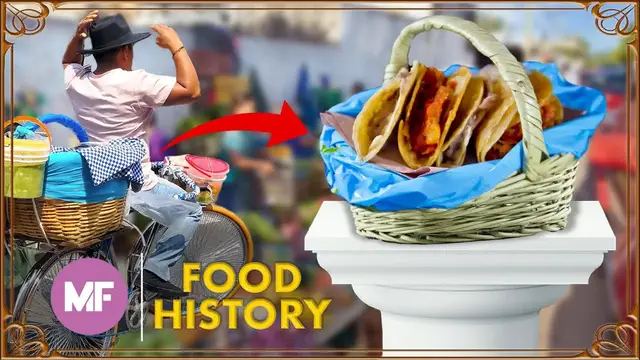
Tacos de Canasta are a mainstay on the streets of Mexico City today
0:04
but their history goes back thousands of years. Even if you've never had a basket taco, which
0:09
spoiler alert, do not contain stewed wicker, you've probably enjoyed the street food explosion
0:14
they helped set off in the Western Hemisphere. Hi, I'm Justin Dodd. Welcome to Food History
0:20
Who were the first people to come up with the clever storage method that gave Tacos de Canasta
0:24
their name? And what role did they play in the birth of the taco? How do you define a taco anyway
0:30
Let's pull back the blue plastic bag of history and find out
0:39
In 1948, Marcial Balderas left his home in the small farming village of San Vicente, Zilo
0:45
Chochitla, Mexico. He was only 14, but his timing was fortuitous. Mexico City, then known as the
0:51
Distrito Federal, or Federal District, was poised to explode in population, largely due to immigration
0:58
from rural areas of the country. The capital city was also becoming one of the world's premier street food destinations
1:04
a movement Balderas would soon help accelerate. In Mexico City, Balderas met a woman named Cristina Mendoza
1:10
who taught him a clever method for making and transporting tacos. By stuffing tortillas with hot fillings
1:16
and then meticulously layering them into a napkin-lined basket, he could keep the tacos warm for hours
1:23
That let him haul his wares all over town, seeking out customers instead of waiting for them
1:27
to find him. The tortillas absorbed steam and oil without falling apart, earning them the name
1:33
tacos sudados, which literally translates to sweated tacos. Today, they're more commonly
1:38
known by the name tacos de canasta, or basket tacos. Balderas did more than sell the street
1:44
snack. He took Mendoza's method and shared it with other young entrepreneurs from his hometown
1:49
moving to Mexico's capital. Some of these transplants took their recipes back to San Vicente
1:54
in the sleepy agricultural village underwent a transformation. Seven years later, both Mexico
1:59
City and San Vicente are famous for their hot, juicy tacos and the bike-riding vendors who
2:05
commonly sell them. Balderas was instrumental in shaping the taco de canasta business that
2:10
serves Mexico City today but the tradition of piling steamy tacos into baskets predates him by decades Versions of tacos de canasta were served as far back as the late 19th and early 20th centuries which according to some historians places them among the earliest tacos But not
2:27
everyone agrees on tacos' origin story. As I covered in our nachos episode, people in Mexico
2:32
have been making tortillas for thousands of years. Corn was first domesticated there around 7,000 BCE
2:39
and around 1500 BCE, Mesoamericans developed the process of soaking it in alkaline water known
2:45
as nixtamalization. In addition to becoming more nutritious and easier to digest, corn
2:51
soaked in a caustic solution, can be ground into masa. This corn-based dough is used to make a
2:56
number of Mexican staples, perhaps the most famous being the tortilla. According to Merriam-Webster
3:02
a taco consists of a tortilla that's been folded or rolled and stuffed with a mixture
3:07
Based on this definition, the first tacos likely appeared shortly after the first tortilla
3:11
Around Aztec tables, tortillas were used like spoons to scoop up ingredients such as squash, meat, and beans
3:18
Hot chili sauce may have been added to the bundle, but it would have lacked alliums like onions and garlic
3:24
which only grew across the Atlantic Ocean prior to the Colombian exchange
3:28
Folded tortillas stuffed with the mixture have a long history, but that doesn't satisfy everyone's definition of a taco
3:35
Is it still a taco if you use the tortilla to pick up ingredients one bite at a time
3:39
or do the components need to be assembled on a plate? Is there a minimum tortilla to filling
3:44
ratio requirement? Does eating chana masala inside a piece of naan make it a taco? What about a piece
3:50
of breakfast sausage in a corn pancake? Is a Pop-Tart technically a calzone? I can see we're
3:55
rapidly approaching is-a-hot-dog-a-sandwich territory, so let's save this discussion for our future episode on culinary ontology in a post-modern multiverse. Yeah, I know, sometimes
4:05
we can't resist a little clickbait. The origins of the word taco are a bit easier to pin down
4:11
The term originally meant plug or wad in Spanish, and it was used by miners to describe the gunpowder
4:16
filled parcels they would stuff into rock faces to excavate precious ores. Silver was Mexico's top
4:23
export for most of the 19th century, and the workers who mined it needed quick, satisfying
4:27
meals they could eat on the job. A hearty stewed filling, or guisado, tucked into a tortilla
4:34
tick these boxes It easy to see why these snacks reminded miners of their own explosive tacos Especially they had a spicy kick to them Instead of paper wrapped around gunpowder these edible tacos consisted of tortillas wrapped around savory
4:47
fillings. There's evidence that the term taco was already in use as a generic name for any kind of
4:53
snack, which may have expedited its adoption as a label for this more specific dish. Tacos minados
4:59
as they're now known, had to travel well, so miners stacked them and wrapped them tightly
5:03
with napkins to keep them warm. That means the first tacos to bear the name taco likely bore a
5:09
strong resemblance to Tacos de Canasta, even if they were consumed in fields and mines instead of
5:14
on city street corners. It didn't take long for basket tacos to infiltrate urban environments
5:20
The decades after independence were difficult times for Mexico's mining industry, and when miners moved to the capital seeking jobs, they likely introduced Tacos Mineros to
5:29
their new home. Like the original version of the dish, Mexico City's first tacos would have been
5:34
pre-assembled and served out of baskets, appealing to working-class citizens on the go. One of the
5:40
earliest known photos featuring tacos proves that Tacos de Canasta have a long history in the city
5:46
Taken around 1920, it shows a female street vendor standing next to a basket of tacos
5:51
wrapped in napkins as hungry paperboys from the area gather to dig in. Street tacos were present
5:57
in Mexico City throughout the early 20th century, but the young businessman Marcial Balderas changed
6:02
the scene. His hometown of San Vicente, Zilo, Chochitla, is known as La Cuna, or the Cradle
6:09
of Tacos de Canasta. By sharing his trade secrets with other San Vicente natives, he helped establish
6:14
a long tradition of taqueros, assembling their tacos in the village every morning, transporting
6:19
them to Mexico City, and selling them to the city's hungry working folks. Though some vendors
6:25
have made their permanent homes in the city, many are willing to commute up to two hours
6:29
even if it means wrangling their bikes and taco baskets onto buses. It's estimated that 80% of
6:34
the town's population works in the basket taco business today, whether they're selling the
6:40
finished dish, cooking the savory stews that fill them, or producing the tortillas themselves
6:45
The guisados used to make tacos de canasta vary, but customers usually have their choice of four
6:50
classic fillings adobo chicharron beans and potatoes with or without meat we got a chance
6:56
to sit down with a taquero in mexico city to hear about this delicious piece of history firsthand
7:09
Just as important as what goes inside the tacos is how they're packaged
7:13
When a layer of tacos is added to the basket, they're ladled with the hot oil that's left over
7:18
from making the adobo stew. This keeps them warm and moist even through hours of travel
7:23
Mobile taqueros know how to pack a container with as much food as possible while leaving channels
7:27
for the fat to drain. After some complex arranging, they'll have a basket filled with 200 to 500 tacos
7:35
Baskets are lined with plastic bags and covered with cloth or paper to keep the heat locked inside
7:41
The liners tend to be blue, and they're often the first thing customers spot from across the street
7:46
It's unclear why that color was originally chosen. According to one theory, cooks like the color blue
7:51
because it kept flies away. The thinking went that because blue so rarely appears in nature
7:56
here, pests aren't interested in it. Unfortunately for street food vendors, this assumption may
8:01
be backwards. Researchers at the University of Florida found that flies are actually three
8:06
times more attracted to blue objects than they are to yellow ones. A less fanciful explanation
8:11
is that the blue plastic may have just been affordable and readily available. Either way
8:16
the color has become part of the taco's brand today. With no need for on-the-spot cooking
8:21
equipment, many taqueros are able to sell their products from the backs of bicycles
8:25
In addition to a hefty basket, bikes are typically equipped with jars of condiments like pickled
8:30
chilies and salsa. The low overhead also allows vendors to sell their goods at an affordable price
8:35
It's easy to find a taco de canasta in Mexico City for 10 pesos, or around 50 cents in US
8:41
dollars, sometimes even cheaper. Nowadays, tacos de canasta can be found not just on the street, but in brick-and-mortar establishments
8:55
and then sometimes outside, and the people are out there. Basket tacos may have moved out of the mine shafts, but their role as a cheap, fast, satisfying
9:04
meal for working-class people hasn't changed very much over the years. Drop your favorite taco in the comments below
9:10
Maybe we'll make a future episode of Food History about it, or at the minimum, order
9:14
some for dinner tonight. Please, I am constantly plagued by decision paralysis and I could really use some suggestions
9:21
I am so hungry. Thanks for watchin'