0:00
In 1864, a man in Nevada lost a bet
0:03
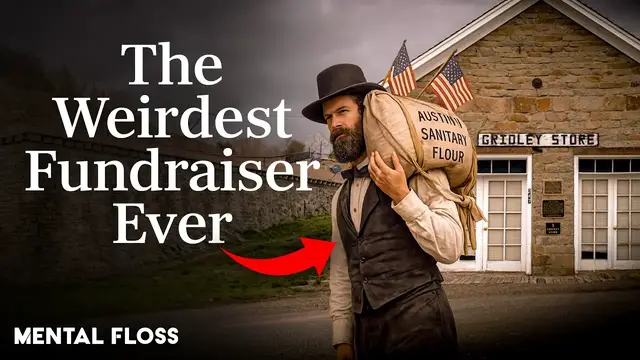
That part isn't unusual. What is unusual is what happened next. His punishment, carrying a 50-pound sack of flour
0:10
through town, somehow turned into a cross-country fundraising tour that raised the modern equivalent of $4 million
0:18
made national headlines, and turned one very ordinary bag of flour into one of the most successful fundraising
0:24
objects in American history. This is the story of the bag of flour that went viral
0:28
before the internet, before radio, and before most of Nevada had reliable plumbing
0:33
Hi, I'm Cara and welcome to Mental Floss, where we answer questions you didn't know you had
0:38
Like, how did a grocery item become a Civil War celebrity? To explain that
0:42
we need to go to a mining town in Nevada, a heated local election, and a grocer named
0:47
Ruel C. Gridley, who had no idea he was about to become the star of one of the most wholesome
0:53
fundraising stories of the 19th century. Our story begins in Austin, Nevada in 1864
1:03
a town that existed because silver did. Austin sprang up almost overnight after a major silver
1:09
discovery in 1862. Within two years, it had thousands of residents, dozens of saloons
1:15
and the kind of chaotic civic energy that happens when everyone is new in town and half the
1:20
population works underground. Mining towns were famous for two things. One, boom and bust economics
1:26
and two, people who loved a good spectacle. So when the 1864 mayoral election rolled around
1:32
the town was ready for drama. Two friends, Ruel C. Gridley, a grocer and Mexican-American war
1:38
veteran, and Dr. H.S. Herrick, a local physician, supported opposing candidates. They made a friendly
1:44
wager. The person with the losing candidate had to carry a 50-pound sack of flour from Gridley's
1:50
store to the center of town while a band played him along, to the tune of John Brown's body
1:55
This wasn't meant to be humiliating, more like a goofy civic stunt, but it was enough to draw a
2:00
crowd Gridley candidate lost and Gridley being a man of his word hoisted the bag of flour onto his shoulder and started walking The town turned out to watch A brass band played People followed along It was part parade
2:14
part comedy routine, and part, we don't have Netflix yet, so this is the best entertainment
2:19
we've got. When Gridley reached the end of his route, he handed the sack of flour to
2:23
Betwinner Herrick, while suggesting that it be auctioned off to the Sanitary Commission
2:27
the civilian organization that provided medical supplies, food, water, shelter, and relief to
2:33
Union soldiers. This wasn't a random choice. Despite being far from the battlefields
2:38
Nevada carried a lot of pro-Union sentiment. Many residents were new arrivals from other states or
2:43
countries. Supporting the Sanitary Commission was a way to participate in the national cause from
2:47
far away. So the auction began. And immediately, it became clear that people weren't bidding on
2:53
flour. They were bidding on the moment. The bag sold for $350, a huge sum for a mining town. But
3:00
the winning bidder didn't take it home. They donated it back. So the auctioneer said, let's do that
3:06
again. And they did, over and over. Surrounding towns joined in, and soon the bag of flour had
3:12
raised over $8,000, more than many miners would see in their entire lifetime. As word spread about
3:19
the Austin Auction, and the surprisingly large sum it generated for the Sanitary Commission
3:24
Gridley's sack of flour quickly became a symbol of support for Nevada's Union troops
3:29
Mining towns were competitive by nature, and nothing motivated them quite like the chance
3:34
to out-donate their neighbors. So when Virginia City heard what Austin had raised, they invited
3:39
Gridley and his sack of flour up north to repeat the event. But the first Virginia City auction
3:45
flopped. Despite the town's wealth and size, the initial showing of the sack of flour brought in
3:51
less than $500, nowhere near Austin's total. So the sack moved on to Gold Hill, a smaller town
3:58
just down the road. And that's where everything changed. Reporter Samuel Clemens, who would later
4:03
become famous under the pen name Mark Twain, traveled with the sack and described the scene
4:08
We descended into Gold Hill with drums beating and colors flying and enveloped in imposing clouds of dust The whole population were massed in the main street all the flags in town were at the masthead and the blare of
4:22
the bands was drowned in cheers." When Gridley asked for the first bid, General John B. Winters shouted
4:28
A thousand dollars! Coin! That opening bid set the tone. Little Gold Hill, the underdog, raised more than six thousand dollars in a single event
4:37
Virginia City was mortified. Shamed by its smaller neighbor, they asked Gridley and his sack of flour back for a second round
4:45
This time, they were determined not to be outdone. On its return to Virginia City, the auction became a civic spectacle
4:52
Two well-known orators, Thomas Fitch and Charles DeLong, presided over the event
4:57
and the town poured money into the cause. The second Virginia City auction raised almost $13,000 in cash and gold
5:05
Plus donated stocks and even a shotgun, all of which were sold with proceeds added to the
5:10
Sanitary Commission Fund. By now, the sack had been embellished with a painted label
5:15
reading Austin Sanitary Flower. And the competition wasn't over. Other Nevada towns wanted their turn
5:22
Silver City raised more than $1,500. Dayton raised almost $1,900. Mining companies and
5:28
local politicians competed for the honor of presiding over the auctions. By the time Gridley
5:34
had finished the Nevada circuit, the SAC had raised over $30,000. And that's when Nevada's
5:39
spectacle turned into something much bigger. By now, the Sanitary Commission realized they had
5:45
stumbled upon something extraordinary. Fundraising was difficult during the Civil War. The need was
5:50
enormous and people were exhausted by years of grim news. But Gridley's flower bag was different
5:57
It was fun. It was wholesome. It was a way for people to feel connected to the war effort without
6:03
confronting the horrors of battle. So the commission invited Gridley to take the bag of flour
6:08
on a national fundraising tour. He agreed. The Nevada circuit had already raised tens of thousands
6:14
of dollars. Now Gridley took the same formula, the parade, the band
6:18
the repeat auctioning and brought it to the rest of the country He visited California first visiting towns where miners and merchants were eager to contribute Then he headed east stopping in major cities like St Louis
6:30
Cincinnati, and even New York. Everywhere he went, the pattern repeated. A crowd gathered
6:35
a band played, the bag was auctioned, the winning bidder donated it back, and the auction started
6:40
again. Newspapers covered the event, turning the bag of flour into a national curiosity
6:46
People who had never heard of Austin, Nevada now knew about its most famous grocery item
6:51
By the end of the tour, the bag had raised over $275,000, equivalent to roughly $4 million today
7:00
That made it one of the most successful grassroots fundraising objects in American history
7:05
Grigley wasn't a showman by nature. He was a grocer and a veteran of the Mexican-American War
7:10
The tour was physically demanding. He traveled thousands of miles, often at his own expense, and his health suffered
7:18
After the war, he returned to Nevada and later moved to California
7:22
He died in 1870, only a few years after the fundraising tour had ended
7:26
But veterans' groups remembered him. They raised money to support his family and erected monuments in his honor
7:32
To them, Gridley represented the best of civilian support. Someone who used humor, community spirit, and a single bag of flour to make a real difference
7:42
After years of being lifted, carried, auctioned, and displayed, the bag of flour finally reached retirement
7:49
It was preserved by the Nevada Historical Society, where it remains today
7:53
Patched, worn, and still one of the most successful fundraising objects ever created
7:58
It's a reminder that history isn't just shaped by generals and politicians
8:02
So the next time you see a viral fundraiser, a charity livestream, a meme challenge, or
8:07
a GoFundMe that takes off, remember that one of the earliest examples of going viral for
8:12
a good cause didn't involve technology at all. It involved a mining town, a parade, a grocer with a sense of humor, and a 50-pound bag
8:21
of flour that somehow raised millions. History is full of big moments, but sometimes the ones that stick are the small, strange
8:29
human ones. Thanks for watching Mental Floss, and we'll see you next time. Thank you