0:00
So, basically this design which you are
0:02
seeing, this assembly is with the
0:05
Okay, so this is used to basically to
0:08
reduce the vibration.
0:10
I mean, which is created by the process
0:14
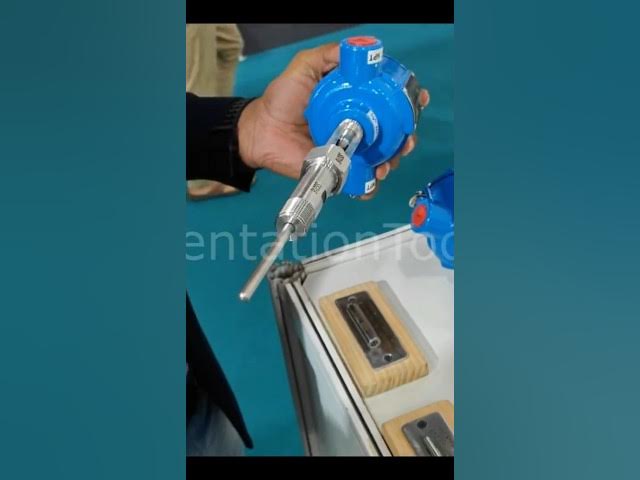
This thermocouple is the helical design
0:16
So, which you are saying this is a
0:18
venturi design thermal well. This is the
0:22
for the high pressure.
0:24
This thermal well is with the nickel
0:26
screen. So, basically for the harsh
0:28
environment and the corrosive
0:31
These are just the thermal wells.
0:33
Uh these are those thermal wells
0:35
actually. These are stainless.
0:37
Uh this design we actually give it to
0:44
>> So, this is also a sample of a one
0:46
thermal well. So, this is basically uh
0:50
You can see the cut section also. This
0:52
is basically a PT100 sensor, RTD.
0:55
So, in RTD we have a two types of sensor
0:58
like one is a thin sensor and one is a
1:01
So, you can see this is a wire one
1:03
sensor which we generally give it to
1:05
clients. So, I'll just explain with the
1:07
what's the difference between the RTD
1:09
and thermocouple. So, basically if you
1:12
measure the temperature like below 500°,
1:14
then we use RTD. And above 500° if you
1:17
have to measure, then we use a
1:18
thermocouple. So, basically it depends
1:20
on the application that what we are I
1:24
So, this which you are seeing is MI
1:26
cable sample. This we manufacture in
1:30
And this MI cable we take into this
1:32
assembly. This is a which you are saying
1:34
this is a MI cable. Okay. Okay. This is
1:37
a cut section part. This is a junction
1:43
Spring loaded mechanism basically.
1:49
Uh see, there is a part actually in this
1:53
There's a part actually here.
1:55
Okay. This is a part.
1:57
And this is a nipple. So, like uh
1:59
nipple. So like this is as per the pain
2:03
profile area IEC 60584.
2:05
So the OD of this part and the ID of
2:09
this nipple, the distance should be
2:11
maintained less than 0.39 mm.
2:13
So it is in conformance as per IEC