0:06
At the start of 2026, Russia's aviation
0:09
sector experienced a significant
0:11
leadership transition.
0:13
Alexander Bobev resigned from his
0:15
position as managing director of JSC
0:18
Tupalev and 37year-old Yuria Broimov was
0:22
appointed as the interim head of the
0:24
company. The transition took place in
0:26
mid January and quickly became a subject
0:29
of active discussion in industry and
0:33
The official statement on Bob Rashev's
0:35
departure referred to his age and the
0:38
successful completion of the tasks
0:40
assigned to him. He marked his 77th
0:43
birthday in January and according to the
0:46
state corporation Rosstec, he had
0:48
fulfilled all objectives placed before
0:51
Aviation analysts argue that his
0:53
resignation should neither significantly
0:56
delay nor accelerate the 2214 program,
0:59
which remains one of the most
1:01
anticipated civilian aircraft projects
1:03
in modern Russian aviation.
1:06
At the same time, beyond the official
1:08
explanation, industry observers have
1:11
raised a reasonable question.
1:13
Was age truly the only factor behind the
1:16
decision? In 2025, Tupalev was expected
1:20
to deliver three new 2214 aircraft, a
1:23
target that was not met. In parallel,
1:27
the number of lawsuits filed against the
1:29
company reportedly reached a historic
1:31
maximum, adding to doubts surrounding
1:34
the narrative of a purely honorable
1:38
The situation is further complicated by
1:40
the fact that Tupalev has had seven
1:42
different directors over a period of
1:44
only 11 years. Within aviation circles,
1:48
such frequent leadership changes are
1:50
rarely seen as accidental.
1:53
They are more often interpreted as signs
1:55
of deeper organizational and structural
1:58
problems. Critics argue that constant
2:01
executive rotation can serve to obscure
2:03
systemic weaknesses rather than resolve
2:06
them. The new head of Tupalev, Yuri
2:09
Abrazimov, previously served as the
2:11
company's financial delegate under
2:15
If confirmed as permanent chief
2:17
executive, he would become the youngest
2:19
leader in Tupalev's history since its
2:21
founder, Andre Tupalev, who established
2:24
the design bureau at the age of 34.
2:28
Abrosov holds a degree in economics
2:30
rather than in aircraft engineering or
2:32
design. He began his career at Tupalev's
2:36
Kazan branch immediately after
2:37
graduation and advanced rapidly into
2:40
senior management roles.
2:42
Throughout his professional life, he has
2:44
worked exclusively within the Tupolev
2:47
system, gaining experience mainly in
2:50
financial and administrative management.
2:53
Industry sources generally describe
2:55
Abrosimoff in positive terms. He is
2:58
often characterized as sociable,
3:00
intelligent, and capable of building
3:02
rapport with a wide range of teams. He
3:05
is also reported to be the grandson of
3:07
Yuri Litvanov who headed the Kazan
3:10
aviation plant in the mid 1990s a time
3:13
marked by severe postsviet industrial
3:18
As interim director, Abraimoff is
3:20
responsible for overseeing both military
3:22
aviation programs and the troubled 2214
3:26
civilian aircraft project. Balancing
3:29
defense contracts with civilian
3:30
production remains a strategic
3:32
difficulty for Russia's aviation
3:36
Historically, factories and design
3:38
bureaus have been oriented primarily
3:40
toward military output.
3:43
To understand why this leadership change
3:45
has attracted so much attention, it is
3:48
necessary to examine the 2214 program
3:52
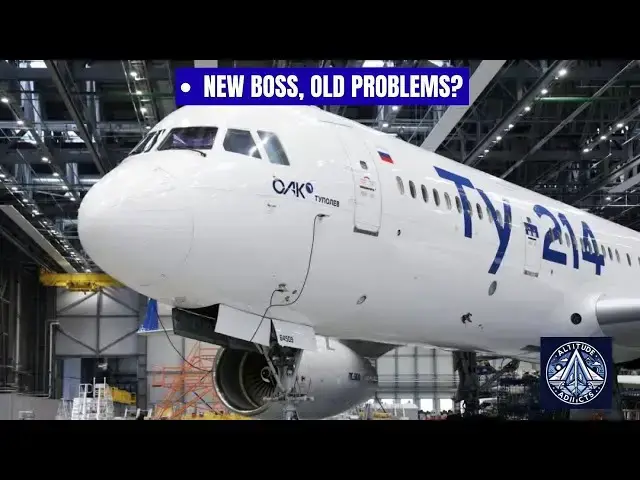
The aircraft is a medium-range passenger
3:54
jet developed as a derivative of the
3:59
It is intended for both commercial
4:01
airline service and government transport
4:05
Although the 2214 was designed in the
4:08
1990s and once held strategic
4:10
importance, its production remained
4:15
Economic constraints, shifting
4:16
priorities, and technological stagnation
4:19
prevented it from achieving true serial
4:22
production for civilian airlines.
4:25
Plans announced for the period from 2022
4:28
to 2025 envisioned a major increase in
4:35
Dozens of aircraft were expected for
4:37
Russian airlines and state operators.
4:40
In reality, only a small number were
4:42
built far below official targets.
4:45
The reasons for these delays are
4:48
Analysts point to difficulties at the
4:50
Kazan aviation plant, including outdated
4:53
production facilities, heavy reliance on
4:56
manual labor, and limited automation.
4:59
A shortage of skilled personnel further
5:02
constrained the plant's ability to scale
5:06
After 2022, the 2214 program underwent a
5:11
major transformation aimed at replacing
5:13
foreign components with domestically
5:17
While strategically necessary, this
5:20
process required extensive retesting and
5:24
These procedures inevitably delayed the
5:26
start of full serial production.
5:29
In December 2025, certification tests of
5:33
the fully import substituted TU214 were
5:36
completed. Russia's aviation authorities
5:39
approved major amendments to the
5:41
aircraft's type design. This cleared the
5:44
formal path for serial production to
5:50
Officials have reiterated a long-term
5:52
objective of reaching up to 20 aircraft
5:57
although a precise production schedule
6:00
has not yet been disclosed.
6:04
must also be viewed within the broader
6:06
strategy to revive Russia's civil
6:08
aviation sector amid restricted access
6:11
to Western aircraft and components.
6:14
Alongside the 2214, Russia is advancing
6:17
other programs such as the MC21, the
6:20
Superjet 100, and the IL114.
6:24
Experts emphasize that the TU214 and the
6:27
MC21 serve different strategic purposes.
6:31
The TU214 is seen as a proven and robust
6:34
platform that can be produced using
6:36
existing industrial capabilities.
6:39
By contrast, the MC21 represents a more
6:42
technologically advanced but higher risk
6:47
At the same time, the difficulties
6:49
surrounding the 2214 reflect broader
6:52
systemic problems within the industry.
6:55
These include the need for stable
6:57
supplier chains, modern manufacturing
7:00
infrastructure, reliable financing, and
7:02
continuous workforce development.
7:05
Certification alone does not guarantee
7:08
the ability to produce aircraft in large
7:12
The arrival of a younger financeoriented
7:14
leader could influence the 2214 program
7:17
in different ways. On the positive side,
7:20
Abrosmov may be able to impose stricter
7:23
financial discipline, streamline
7:25
internal processes, and improve
7:27
coordination between Tupolev, the Kazen
7:30
plant, and government authorities.
7:32
In some cases, leadership renewal
7:34
signals that a stalled project is
7:37
entering a new phase.
7:39
On the other hand, critics point to
7:41
Abroimov's limited background in
7:43
engineering and production.
7:46
This could be a disadvantage given the
7:48
technical complexity of scaling aircraft
7:52
Managing a design bureau and production
7:54
ecosystem under intense political and
7:57
economic pressure is a formidable task
7:59
even for seasoned aviation executives.
8:03
Frequent leadership changes are not
8:07
Similar restructurings have occurred at
8:09
other Russian aircraft manufacturers in
8:14
This underlines the intense pressure on
8:16
the industry to rapidly achieve import
8:18
substitution and modernize airline
8:22
The story of the 2214 is therefore about
8:26
more than missed deadlines or a change
8:28
at the top. It exposes the structural
8:31
strains within Russia's aviation sector
8:34
where ambitious state goals collide with
8:36
limited industrial capacity, aging
8:39
infrastructure, and shortages of skilled
8:43
The future of the 22 214 will depend on
8:46
whether the new leadership can transform
8:48
recent certification success into real
8:51
production growth during 2026 and 2027.
8:56
A firm contract with a major airline
8:59
expected in early 2026 could serve as an
9:03
important signal of confidence.
9:05
If such a deal is signed, it may
9:08
indicate that Tupalev has finally
9:09
crossed a critical threshold.
9:12
If it collapses at the last moment,
9:14
doubts about the aircraft's prospects
9:19
For now, the industry is watching
9:21
closely. The leadership transition has
9:24
taken place. Whether the aircraft itself
9:27
will ultimately enter service in
9:29
meaningful numbers remains an open
9:35
If you like the video, please subscribe,
9:37
share, and like. Also, please take the
9:40
memberships to encourage us.