0:06
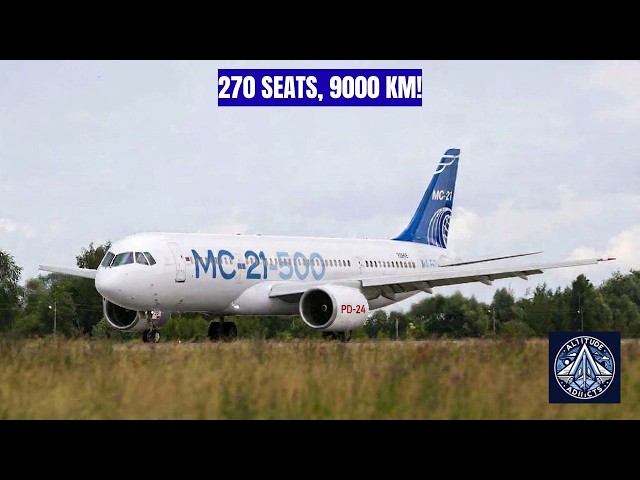
The recent display of the MC-21-500,
0:09
an advanced variant of its
0:10
next-generation narrow-body airliner
0:13
family, has signaled a new phase of
0:15
strategic expansion in Russia's aviation
0:19
This aircraft is more than just an
0:21
incremental improvement. It was
0:23
introduced at the Russian Venture Forum
0:27
It reflects a broader vision, expanding
0:29
the operational envelope of the MC-21
0:32
platform into long-haul territory while
0:35
reinforcing technological independence
0:37
through domestic systems.
0:41
challenges conventional classifications
0:44
with a projected capacity of up to 270
0:47
passengers and a range of approximately
0:52
It occupies a hybrid space between
0:54
traditional narrow-body and wide-body
0:58
For viewers of Altitude Addicts, this
1:00
signals a clear shift in how Russia aims
1:03
to compete in the global aviation
1:07
As we move into the development story
1:08
behind this aircraft, the origins of the
1:11
MC-21 platform reveal how this
1:14
transformation began.
1:16
Yakovlev's MC-21 was initially designed
1:19
as a modern alternative to Western
1:21
single-isle aircraft, especially the
1:23
Airbus A320neo and Boeing 737 Max
1:28
Developed under the United Aircraft
1:30
Corporation, the aircraft integrates
1:32
advanced aerodynamics, modern avionics,
1:35
and extensive composite materials.
1:40
represents a significant evolution of
1:44
Engineers extended the fuselage to
1:46
increase seating capacity well beyond
1:50
This change is not only about size, it
1:53
reflects a repositioning of the aircraft
1:55
for new mission profiles.
1:58
The aircraft can now operate on routes
2:00
that were previously reserved for larger
2:04
This transition highlights a broader
2:06
shift in airline economics.
2:09
Efficiency and flexibility are now
2:11
prioritized over sheer capacity, a trend
2:14
closely followed by Altitude Addicts and
2:16
aviation observers worldwide.
2:19
Turning towards structural innovation,
2:21
the MC-21 family is defined by its
2:24
extensive use of composite materials,
2:27
especially in the wing.
2:31
continues this approach using
2:33
domestically produced composites.
2:36
These materials offer multiple
2:39
They reduce structural weight, improve
2:41
aerodynamic efficiency, and lower fuel
2:45
In long-haul operations, where fuel
2:47
costs dominate, these gains are
2:51
The aircraft's high aspect ratio
2:53
composite wing plays a critical role.
2:56
It improves lift-to-drag performance,
2:58
enabling longer flights without
3:00
proportional increases in fuel use.
3:04
This is a key factor behind the
3:05
aircraft's estimated 9,000 km range.
3:09
Now shifting focus to propulsion, the
3:12
heart of the MC-21-500
3:14
lies in the PD-24 engine.
3:17
This engine is part of a broader family
3:19
of next-generation Russian turbofan
3:23
The PD-24 is designed to produce
3:25
approximately 24 tons of thrust.
3:29
This is a major increase compared to the
3:31
earlier PD-14 engine.
3:34
The added power supports the aircraft's
3:37
increased weight and extended range.
3:40
What makes the PD-24 particularly
3:42
important is its shared architecture
3:45
with the PD-35 program.
3:47
Both engines use a common gas generator,
3:50
the core where fuel combustion produces
3:54
This modular design allows engineers to
3:56
scale performance across multiple thrust
3:58
classes without redesigning the entire
4:02
This approach mirrors global best
4:06
It reduces development costs, simplifies
4:08
maintenance, and accelerates the rollout
4:13
Alongside this development, attention
4:15
shifts to another intriguing reveal. The
4:17
Tu-454 concept equipped with PD-26
4:22
This model highlights a parallel path in
4:25
Russian civil aviation development.
4:28
The Tu-454 represents an alternative
4:33
While less prominent than the MC-21
4:35
program, it underscores the continued
4:37
relevance of the Tupolev Design Bureau.
4:41
The PD-26 engine, producing around 26
4:44
tons of thrust, sits between the PD-24
4:49
It offers another option within the
4:51
unified engine family.
4:53
Its potential use in aircraft like the
4:55
Tu-454 suggests a diversified strategy
4:59
built around a shared propulsion
5:02
This parallel development raises a
5:06
Will Russia consolidate around a single
5:08
dominant platform, or will multiple
5:11
design philosophies coexist?
5:14
This brings us naturally to a deeper
5:16
historical context, the rivalry between
5:18
Yakovlev and Tupolev.
5:21
The emergence of both MC-21-500 and
5:25
brings this competition back into focus.
5:29
Historically, Tupolev dominated Soviet
5:31
and Russian civil aviation.
5:33
It produced iconic aircraft like the
5:39
Yakovlev, in contrast, was known more
5:41
for military trainers and smaller
5:45
However, post-Soviet restructuring
5:47
reshaped these roles.
5:49
The MC-21 program represents Yakovlev's
5:52
shift toward modern, globally
5:53
competitive airliner design.
5:56
Tupolev, meanwhile, brings deep
5:58
experience in long-range aviation.
6:01
The Tu-454 can be seen as an attempt to
6:04
reassert its position in the modern
6:08
This internal competition may ultimately
6:10
benefit the industry.
6:12
Competing design bureaus can drive
6:14
innovation, challenge assumptions, and
6:19
Moving forward, the MC-21-500
6:22
occupies a unique position in the
6:25
It bridges the gap between narrow-body
6:27
and wide-body aircraft.
6:30
This segment, often called the middle of
6:32
the market, is gaining global attention.
6:35
Airlines seek aircraft capable of long
6:38
routes without the complexity of
6:39
wide-body operations.
6:42
Russia is positioning the MC-21-500
6:45
as a flexible solution.
6:48
It could serve both domestic and
6:50
international routes efficiently.
6:52
For long distances with moderate demand,
6:55
this aircraft could be highly effective.
6:58
This development is closely tied to
7:01
Russia's broader industrial strategy.
7:04
The country has accelerated efforts to
7:06
localize production across engines,
7:08
avionics, and materials.
7:11
While this transition is complex, it
7:13
offers long-term resilience.
7:16
The PD engine family plays a central
7:18
role in enabling scalable aircraft
7:22
Looking at the global picture, the
7:26
could influence the aviation market.
7:28
Airbus and Boeing remain dominant, but
7:31
alternatives are gaining attention.
7:34
Airlines seeking diversification or cost
7:36
advantages may consider this aircraft.
7:40
However, certification, production
7:42
capacity, and support infrastructure
7:44
will be critical factors.
7:47
As Altitude Addicts continues to track
7:49
these developments, one thing is clear.
7:52
The unveiling of the MC-21-500
7:55
alongside the Tu-454 marks a pivotal
7:59
Rather than a single path, Russia's
8:01
aviation industry is exploring multiple
8:05
The MC-21 represents a modern global
8:09
The Tu-454 reflects legacy expertise
8:12
adapting to new realities.
8:15
At the center of both lies the unified
8:19
This shared foundation strengthens the
8:21
feasibility of multiple aircraft
8:25
Ultimately, the interplay between
8:27
Yakovlev and Tupolev may define the
8:30
future of Russian aviation.
8:32
Whether through competition or
8:34
collaboration, their combined efforts
8:37
will shape Russia's position in the
8:38
global aerospace industry.
8:43
If you like the video, please subscribe,
8:47
Also, please take the membership of the
8:49
channel to encourage us.