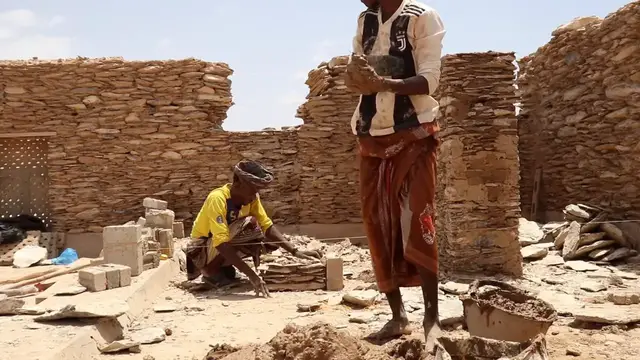

Yemen: Yemen's Hadhramaut Valley preserves centuries-old limestone architecture.
Jun 18, 2026
SHOTLIST: HADHRAMAUT, YEMEN (JUNE 14, 2026) 1. VARIOUS DRONE SHOTS OF AREA WITH TRADITIONALLY BUILT LIMESTONE STRUCTURES 2. VARIOUS OF TRADITIONALLY BUILT LIMESTONE STRUCTURES 3. VARIOUS OF YEMENI BUILDING CRAFTSMAN AHMED HAMIS WORKING 4. YEMENI BUILDING CRAFTSMAN AHMED HAMIS SPEAKING TO REPORTER (Arabic) 5. VARIOUS OF CONSTRUCTION WORKERS WORKING AT CONSTRUCTION SITE 6. COMMUNITY VOLUNTEER MOHAMMED OMAR SPEAKING TO REPORTER (Arabic) 5. EXTERIOR SHOT OF TRADITIONAL BUILDING 7. COMMUNITY VOLUNTEER MOHAMMED OMAR SPEAKING TO REPORTER (Arabic) 8. VARIOUS EXTERIOR SHOTS OF TRADITIONAL BUILDING 9. DRONE SHOT OF TRADITIONAL BUILDING HADHRAMAUT, YEMEN - JUNE 14, 2026: Yemen’s Hadhramaut Valley continues to preserve its centuries-old limestone architecture, showcasing a unique building tradition that has endured for generations despite the country's ongoing economic hardships. Across the region, local builders still construct homes using the same traditional materials and techniques employed by their ancestors, alongside historic forts and archaeological structures that have stood for centuries. The buildings are constructed by stacking locally sourced limestone and binding it with mud mortar mixed with dried agricultural residue, a technique that has helped the structures withstand the region's harsh, arid climate. In the Yebus district, craftsmen are keeping these ancient construction methods alive by passing their technical knowledge down to younger apprentices, ensuring the survival of a distinctive architectural heritage. Ahmed Hamis, a Yemeni master craftsman with 20 years of experience, said traditional structures owe their longevity to techniques like double-wall construction, which provides natural thermal insulation and structural stability. According to Hamis, these methods continue to be used in modern construction and has enabled many buildings to remain standing for centuries. Community volunteer Mohammed Omar described the area as an open-air museum, pointing to dozens of historic villages, forts and castles scattered across the landscape, some of them more than 300 years old. Omar called for greater international and local efforts to preserve the sites, saying they represent a critical pillar of Yemen's cultural and architectural legacy.
Show More Show Less