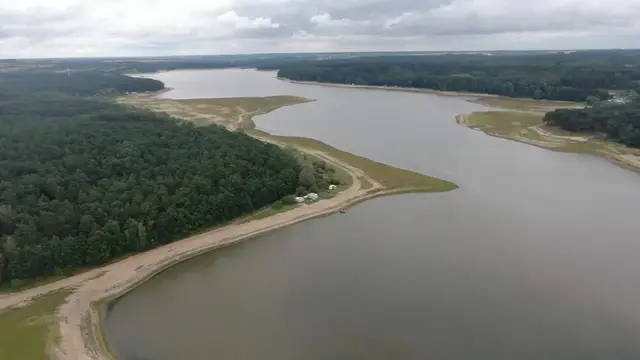

Poland: DRONE - Drought lowers water levels across Poland as dry conditions worsen.
Jul 24, 2026
SHOTLIST: RAKOW, POLAND (JULY 24, 2026) 1. VARIOUS DRONE SHOTS OF LOW WATER LEVELS AT CHANCZA RESERVOIR 2. VARIOUS OF PEOPLE ENJOYING RECREATIONAL ACTIVITIES ALONG SHORE OF CHANCZA RESERVOIRRAKOW, POLAND - JULY 24, 2026: Drone captured on Friday, July 24, low water levels at the Chancza reservoir in Rakow, Swietokrzyskie province, southern Poland, as drought conditions continued to worsen across the country. Poland's national weather agency said hydrological drought has spread across much of the country, with low water levels recorded at around two-thirds of its monitoring stations. Officials also reported falling river levels, declining groundwater supplies and an increasing number of rivers dropping below long-term minimum flow thresholds. Europe's drought crisis is no longer a seasonal phenomenon limited mainly to the Mediterranean, but has evolved into a continent-wide climate challenge, experts told Anadolu. Increasingly frequent dry periods, declining river flows, depleted soils and rising temperatures are exposing Europe's growing vulnerability to water stress. Laura Iozzelli, a policy advisor at climate change think tank E3G, said drought in Europe has undergone a fundamental shift in recent years. "Drought in Europe is no longer an occasional shock that is mainly confined to the Mediterranean. It has become a recurring threat," Iozzelli told Anadolu. She pointed to data from the European Environment Agency (EEA), noting that in May 2025 nearly 39% of the 38-nation EEA area was affected by drought conditions. "Several parts of Europe are experiencing dry conditions, with low rainfall, dry soils, and reduced river flows," she said. The most severe impacts are emerging where prolonged heat combines with a lack of precipitation, intensifying pressure on farming, ecosystems and water supplies. "Southern Europe remains the most hit region," Iozzelli said, adding that around 30% of the population in southern Europe lives under permanent water stress, while this rises to around 70% during seasonal summer stress. She said agriculture, tourism and public water supply are increasingly competing for the same shrinking resources. "Cyprus and Greece are the most acute cases, but the EU's drought observatory shows alert-level conditions this summer extending well beyond the south, into France, Germany, Austria, Hungary, Romania, Poland, Ukraine and the Baltic states. Eastern and central Europe are also increasingly affected," Iozzelli said.
Show More Show Less #news