Up next in 10



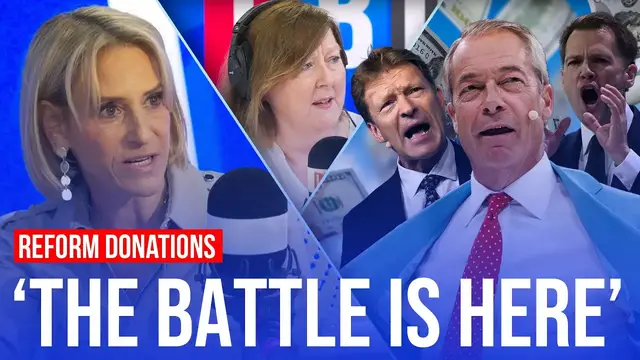
Reform UK has hit out after it was suggested that Labour could apply proposed donations laws retrospectively and force Nigel Farage to hand back two £36m donations given to the party by crypto-billionaire backers.
Angela Rayner suggested on LBC's Sunday with Lewis Goodall that the laws contained within the Representation of the People Bill could apply a retrospective cap on foreign donations at £100,000.
This could force Reform to hand back two matching £36 million donations by cryptocurrency billionaires Ben Delo and Christopher Harborne, announced last week.
Emily Maitlis joins Shelagh Fogarty to discuss the news.
00:00 | Shelagh breaks down the latest news
03:07 | Emily Maitlis joins the show
#shelaghfogarty #emilymaitlis #nigelfarage #reform #labour #ukpolitics #lbc
Show More Show Less View Video Transcript
0:00
Hello, good afternoon to you. I noticed just before I came on air the comments of the Trade
0:05
Union Congress boss about these reform donations. Paul Novak, head of the TUC, says, and I think he
0:13
says, I think he's right, and I think it's a good comparison to make for our discussion about how
0:17
political parties are, can and should be funded. He says there is no similarity between the £72
0:25
million pounds donated to reform by two billionaires neither of whom at the moment are
0:30
resident in the UK as I understand it. Richard Tyce sort of prevaricated on that a bit this
0:35
morning I think and no comparison between those two men and their combined donation of 72 million
0:43
pounds to one political party in this instance reform and individual union members paying their
0:48
subs and giving money donating money to the Labour Party. I think that's a good comparison to keep in
0:54
our minds. And the Housing Secretary, Angela Rayner, spoke over the weekend with Lewis Goodall
0:58
about a possible funding cap on political donations. We want to see our democracy safeguarded
1:04
against foreign interference. And we can't have a situation where one or two individuals in a
1:09
particular sector with billions of pounds seem to be able to buy our democracy. And I think people
1:15
are genuinely concerned about that. And we're taking forward the recommendations from Rykoff
1:20
They are retrospective from when the Rycroft Review was published in March
1:25
That was already announced before any of these donations. And also we've wrote to the Electoral Commission to look at what they think in terms of spending caps, etc
1:35
Are you confident that the proposed donations are legal? Well, again, I'm not going to go on about these particular individuals because I don't know these particular individual circumstances
1:45
And that's not fair and right to do that. But there is a broader question that was already being asked about who influences our democracy and making sure we safeguard it into the future
1:55
Would you take the money if they came to you, if Mr D'Lo and Mr Harbourn had said, actually, we think you're fantastic, this Labour government, we've got £36 million for you, would you have taken it
2:03
Well, look, we have really strict rules in place for donations and the Labour Party go through that
2:09
And we've refused donations before from potential donors. we have a strict rules going forward and I say this Lewis in the context of you know where there
2:21
is a police investigation into allegations of trying to get around the rules that are already
2:27
in place around donations is we all have an obligation to safeguard and protect our democracy
2:34
because the British people will rightly get concerned if they think one or two individuals
2:40
can interfere or look like they buy our democracy. Labour Party has taken money from big donor individuals in the past Well the Labour Party has a number of donors We often also get a lot of grief because of our trade union links
2:54
which, in fact, the Labour Party was born out of the trade union. Indeed so. And millions of trade union members contribute to their unions
3:02
and that's the cleanest form of money that comes into our party
3:07
The size of this donation, I think, is the key question, and the fact that the money comes only from two people
3:14
Emily Maitlis joins me to talk about this co-host of Global's podcast, The News Agents
3:18
I mean, it is a stark figure from just two people, neither of whom I think at the moment are resident in the UK
3:24
But the other parties, they also have to look at how they get their money, don't they
3:31
It's not a complete slam dunk for them, I don't think. I mean, there is an argument that 72 million in today's money is, you know
3:39
how shocking a sort of million pound donation was sort of two decades ago
3:43
when we first heard sums like that. I think what would presumably be uncomfortable
3:47
for a form I'm imagining is just the stark truth that two crypto billionaires
3:55
are happy to hand over this amount of money when they can't seem to raise money
4:00
from ordinary party members. And Fraser Nelson's actually been doing really interesting work on this
4:06
If you look at gifts of under £10,000 as a share of all donations
4:10
from January to June of this year, What you see is the Lib Dems are on about 36%
4:17
So 36% of all their donations are smaller than 10,000. Reform, 0.3
4:24
In other words, the party that sees itself or wants to portray itself as this people's party
4:30
is not getting any money, very, very little money from everyday donations
4:37
And that's one. Fundraises at the local party level or subs to a union, for example, or whatever
4:42
You know, what was memorable about Trump in that first term, what was memorable about Bernie Sanders was that they managed to get this grassroots movement of people who genuinely sort of handed over their 20 quid or whatever it was to say, I'm proud to be part of it
4:57
And I'm going to part with money to sort of show my dedication. It's really interesting that, I mean, a gift of under 10,000 includes, you know, 20 quid, 10 quid, 50 quid
5:07
and they are not making their money from people like that. So it doesn't sit very comfortably with this party that's trying to be anti-elite
5:18
trying to be the grassroots party, trying to be the sort of, you know, oh, we hate the elite and the establishment
5:23
And yet they can't actually seem to motivate their own members to donate at all
5:27
And is it fair to say as well that if you're looking at crypto
5:34
we don or is it just that I don fully understand crypto yet We don really know fully where this money comes from do we That is the point I mean sorry to be sort of blunt about this
5:46
So there is an argument going on in the financial world between basically bankers and crypto
5:51
And the bankers think that crypto is terrible because it is not transparent
5:55
It has very few consumer rights on it. You can't really see what it's carrying
6:00
And it tends to attract some extraordinarily nefarious, dodgy characters because it sort of allows you to do things on the dark web that nobody ever finds out about
6:08
The crypto people say, well, they would say that, wouldn't they? The old school bankers, the monopoly, you know, they don't want us to succeed
6:16
They don't want us to liberalise. And they see essentially what they're doing is like the sort of mid 80s Big Bang, you know
6:23
And the point about crypto, they would argue, is you get rid of the sort of the market trading times, you know
6:29
the little bell rings in the stock market at the beginning and then it rings at the end and all your
6:32
trading is done between then and a trade might take five days. With crypto, it could take five
6:37
minutes and you could go through the clock and it would speed up things enormously. So there is an
6:42
argument which is, you know, if you are kind of, if you want to break things, if you want to kind
6:47
of explode the system and get more growth and get more money sort of traveling around more quickly
6:51
then crypto is an extraordinarily sort of electric way of doing it
6:57
But we just, we don't know the origin of it. We don't know it
7:01
You know, we don't really know. Which actually really matters in political money, doesn't it
7:05
Of course, because, you know, if those donations, there's a reason why they say you can't donate more than
7:11
I think they're talking about, 100,000 for overseas. We don't know if that's money laundering
7:16
We don't know if it's child trafficking. We don't know if it's drugs. We don't know if they're clearing up arms money
7:21
We just don't know what kind of money is going into that. And you would have thought that it's not a great look to be sort of sitting there taking £72 million from two guys where you can't actually see the origin of the money
7:35
And if the government brings in this £100,000 limit on individuals who are non-resident or is it expats
7:46
I mean, it might be. This is the whole question, isn't it? could it also apply to people who are resident here
7:51
And the two donors that we're talking about now, I think, have established that they are resident
7:57
We're talking not geography, but tax, you know. And then there's a question of how long have they been here
8:02
Because one of the, I think, parts of the legislation would say you have to be resident here for 12 months before you donate
8:09
And this is why Richard Tice was being asked to... I thought you were going to say something like 10 years. I don't think 12 months is enough at all
8:13
No, but it might actually get in the way of this particular donation. And it was interesting, Richard Tice
8:18
this morning couldn say how long either donor had been a UK resident for So I don know whether that going to scupper it or whether it starts to look like I mean as Lewis was talking to Angela Rayner what would Labour do if they were given that amount You know would they want to give it back And then do we really want that many millions
8:36
knocking around our politics? I mean, I sort of think, Jesus, we don't want to go down the
8:41
American route. No, and I was going to ask you to make a kind of American comparison for me here
8:45
because we really don't want that, do we? Because it just literally turns into only the wealthy can
8:51
become powerful. I mean, look, luckily, there is no comparison yet with America. They wouldn't be
8:56
talking about 72 million dollars with a sort of job draw. They'd be like, yeah, next, you know
9:02
because the money is ridiculous. And I think it was Obama, funnily enough, in 2008, who was the
9:06
first online donations. Well, no, no, I was going to say he's the first person to bust through
9:11
I think it was a billion, the billion dollars. So, I mean, it goes both ways. It goes both parties
9:17
I mean, I'm sure he got a lot of it not from this way, but didn't he also get really small
9:20
online donations of people. Of course, he got a lot of grassroots donations. But what I mean
9:25
this wasn't about donations, but it was big. No, it was a billion dollars spend on his campaign
9:31
Right. Do we really want to be doing that? I can think of so many more things I'd like to spend a
9:36
billion dollars on than sort of following, you know, ads and politicians around the country
9:41
And this attempt, well, alleged attempt to retrofit the rules to avoid reform benefits
9:49
from this money. Richard Tice said he's absolutely convinced they can't do that to them and therefore
9:54
at least one of the donations will be sound. So that's going to be the battle royal, I imagine
10:01
Look, I think it's sort of, I mean, I think it is genuinely uncomfortable for Labour as well
10:05
because if they do try and retrofit it and reform, then makes it look like, oh, you know
10:11
the establishment's against us. That's not great. It also begs the question, what happens if, you
10:16
know one of Labour's big donors you know comes along and says oh what about an 80 million from
10:22
me then they're not going to presumably be able to take that if it's from or I don't know you know
10:27
I think it's I think um I think it is going to be a battle I think Richard Tice has already said
10:34
he's pretty sure that the money came from two um UK residents but he can't actually give us
10:40
you know the diary or the dates or any of the facts to back it up but then as you said earlier
10:46
the question of what is the money and from where did it come? Yeah, as opposed to the person it belongs to
10:51
Thank you, Emily. Let's see. And what it means. You know, if you are taking a lot of money from crypto
10:58
are you then signing up to a world in which crypto dominates
11:02
and you have a 10% tax rate, which they've already promised for crypto, you know, millionaires and all the rest of it
11:08
It takes us into a whole different policy discussion. I'll send them 50 quid when I finish this afternoon
11:14
There you go. Thank you, Emily. co-host of Global's Podcast News Agents, which..
#news