Up next in 10


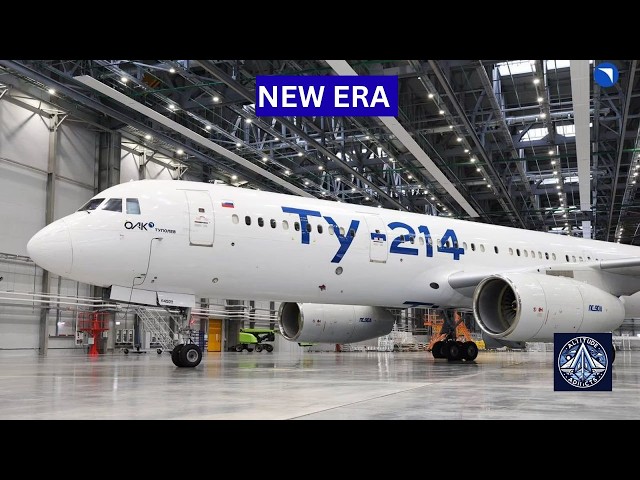
Russia's aviation industry has reached a major milestone as the United Aircraft Corporation begins delivering newly produced Tu-214 passenger aircraft to customers. After years of modernization, certification work, and factory upgrades, the long-awaited airliner is finally entering service.
In this video, we examine how Russia plans to increase Tu-214 production from four aircraft in 2026 to eight in 2027 and eventually up to twenty aircraft annually. We also look at the extensive modernization of the Kazan Aviation Plant, the role of domestic components in the aircraft's redesign, and why the Tu-214 has become one of the most important projects in Russia's aviation strategy.
The story becomes even more significant with reports of a potential 100-aircraft deal involving S7 Airlines, one of Russia's largest carriers. If completed, the agreement could become one of the largest orders ever placed for a Russian-built passenger jet in the modern era and provide a major boost to long-term production plans.
We'll also explore how the Tu-214 evolved from a relatively low-volume aircraft into a centerpiece of Russia's effort to strengthen domestic aircraft manufacturing. From new production lines and import substitution to airline demand and future expansion plans, this video covers the broader implications for Russia's commercial aviation sector.
Can the Tu-214 become the backbone of Russia's future airline fleet? And is this the beginning of a wider aviation revival? Watch until the end as we break down the latest developments surrounding one of Russia's most important civil aircraft programs.
#Tu214 #Russia #RussianAviation #AviationNews #AirlineNews #CommercialAviation #CivilAviation #Tupolev #UAC #Rostec #S7Airlines #AircraftProduction #PassengerJet #Aerospace #Airliner #KazanAviationPlant #RussiaNews #Geopolitics #AviationIndustry #AltitudeAddicts
Be a Member for exclusive privileges - https://www.youtube.com/channel/UCviEFTf1xIPKsjmyF_zvFug/join
Twitter : https://x.com/AltitudeAddicts
Website: https://www.altitudeaddicts.com
Show More Show Less View Video Transcript
0:05
In 2026, the United Aircraft Corporation
0:08
initiates the transfer of newly
0:10
constructed Tu-214 passenger aircraft to
0:13
customers, marking an important
0:15
achievement in the Russian aviation
0:18
industry.
0:19
Vadim Badyakov, the Chief Executive
0:21
Officer of the corporation, announced
0:23
the formal beginning of airliner
0:25
deliveries prior to the annual St.
0:28
Petersburg International Economic Forum.
0:31
The development is an important event in
0:33
Russia's quest to restructure its
0:35
domestic civil aviation sector around
0:38
locally manufactured aircraft and
0:40
decrease its reliance on foreign
0:42
aerospace suppliers.
0:45
The Tu-214 program has been a critical
0:48
component of Russia's aviation
0:49
self-sufficiency strategy for a long
0:52
time.
0:53
Although the aircraft is not a new
0:55
design, its modernization and revival
0:58
raised it to one of the most important
1:00
initiatives in the nation's
1:01
post-sanctions aviation landscape.
1:05
The start of deliveries signifies that
1:07
the program has transitioned from
1:08
planning and certification to actual
1:11
serial production.
1:13
With production growth plans already
1:15
underway, the corporation intends to
1:17
produce four Tu-214 aircraft in 2026, as
1:22
per Vadim Badyakov.
1:24
Production is anticipated to double to
1:26
eight aircraft in 2027,
1:28
with the ultimate goal of producing up
1:31
to 20 aircraft annually.
1:34
He underscored that the Kazan Aviation
1:36
Plant has undergone a significant amount
1:38
of modernization and is now nearly
1:41
prepared for mass production.
1:44
So, let's look at who gets these planes
1:46
first.
1:47
Special government customers will
1:48
receive the first aircraft manufactured
1:51
this year.
1:53
Commercial deliveries to airlines will
1:55
take place at a later date, with Red
1:57
Wings expecting the official delivery of
1:59
aircraft from the production line in
2:02
2027.
2:04
The industry's cautious approach as it
2:06
transitions from low-rate manufacturing
2:08
to full-scale serial production is
2:10
reflected in this gradual dissemination.
2:14
The production targets are especially
2:16
noteworthy due to the fact that the
2:18
Tu-214
2:19
was built in extremely limited
2:21
quantities only a few years ago,
2:24
primarily for government and special
2:25
purpose operators.
2:28
The expansion of Russian commercial
2:30
aircraft manufacturing to a rate of 20
2:33
aircraft per year would be one of the
2:35
most significant since the Soviet era.
2:39
Driven by massive investments at the
2:41
Kazan Aviation Plant, the facility
2:43
responsible for the production of the
2:45
Tu-214
2:47
has undergone a significant amount of
2:49
modernization, which is a significant
2:51
factor in the program's increasing
2:53
momentum.
2:55
In recent years, substantial investments
2:57
have been made to enhance the
2:58
capabilities of manufacturing
3:00
infrastructure, assembly facilities,
3:03
fabrication centers, logistic systems,
3:05
and production lines.
3:07
To facilitate increased production
3:09
rates, the plant has implemented new
3:12
mechanical processing equipment,
3:14
enhanced fuselage assembly capabilities,
3:16
and established supplementary logistics
3:19
facilities.
3:21
Now, what this modernization initiative
3:23
is really intended to do is improve
3:25
manufacturing efficiency and quality
3:27
control, in addition to just increasing
3:30
output.
3:32
The purpose of these investments is to
3:34
guarantee that the facility can maintain
3:36
annual production levels of
3:38
approximately 20 aircraft, while
3:40
simultaneously satisfying the
3:42
increasingly stringent requirements of
3:44
airlines.
3:46
The assurance conveyed by leadership
3:48
implies that the infrastructure
3:50
bottlenecks that had previously
3:52
restricted production are being
3:54
progressively resolved.
3:57
Because the S7 Airlines order changes
3:59
everything, the emergence of S7 Airlines
4:02
as an important prospective customer is
4:04
likely the most major breakthrough for
4:07
the Tu-214 program.
4:10
A memorandum was signed earlier this
4:12
year by S7 Group, the manufacturer, and
4:15
the State Transport Leasing Company to
4:17
outline the delivery of up to 100 Tu-214
4:21
aircraft.
4:22
Despite the ongoing negotiation of final
4:25
commercial agreements, the memorandum is
4:27
one of the most significant commitments
4:29
ever made to a Russian-built passenger
4:32
aircraft in the modern era.
4:34
The agreement did not materialize
4:36
overnight.
4:38
The discussions between S7 and the
4:40
manufacturer started years ago and have
4:42
progressed through various phases.
4:45
The technical configuration, cabin
4:47
layout, maintenance requirements, and
4:50
operational procedures of the aircraft
4:52
were determined by engineers from both
4:54
organizations who collaborated.
4:57
The version that emerges is customized
4:59
to meet the operational model and
5:01
passenger service expectations of S7.
5:05
To give you a breakdown, according to
5:07
reports, the aircraft designed for S7
5:09
have the capacity to transport up to 213
5:13
passengers,
5:15
rendering them suitable for high-density
5:17
domestic routes throughout Russia.
5:20
The State Transport Leasing Company will
5:22
act as the financial collaborator and
5:24
leasing organization that facilitates
5:27
the acquisition process.
5:29
The significance of the S7 contract for
5:31
the Tu-214 program is not limited to the
5:34
order volume.
5:36
Large airline commitments provide the
5:38
long-term production visibility that
5:40
manufacturers need to justify
5:42
investments in tooling, personnel
5:44
expansion, supplier development, and
5:47
industrial modernization.
5:49
Paving the way for a more realistic
5:51
aviation development program, the Tu-214
5:55
program's future appears to be
5:57
increasingly secure, as evidenced by
6:00
recent statements from leasing
6:01
leadership.
6:03
The large order pipeline has risen
6:05
significantly. The feasibility of
6:07
Russia's civil aviation development
6:09
plans, according to Altitude Addicts.
6:12
A second production line has already
6:14
been initiated at the Kazan Aviation
6:16
Plant, and a third is currently in the
6:19
process of being prepared.
6:21
The confidence that demand for the
6:23
aircraft will continue to increase over
6:25
the next decade is evident in this
6:28
expansion.
6:29
The manufacturer's ability to meet
6:31
ambitious delivery schedules should be
6:33
boosted by the presence of multiple
6:36
assembly lines, which should also
6:38
enhance production resilience.
6:41
Additionally, Altitude Addicts have
6:43
disclosed that the first 10 aircraft
6:46
designated for S7 will include a flight
6:48
engineer station.
6:51
Subsequent aircraft will transition to a
6:53
more modern two-person cockpit
6:55
configuration, which consists of a
6:57
commander and first officer.
7:00
This method enables airlines to start
7:02
aircraft operations sooner, while
7:04
certification and adaptation work for
7:06
newer configurations are on.
7:09
Now,
7:10
what this means is that a critical
7:12
milestone is achieved in import
7:14
substitution.
7:16
The modernized aircraft effectively
7:18
completed certification activities
7:20
related to import substitution at the
7:22
end of 2025, which was one of the most
7:25
significant achievements for the Tu-214
7:27
program.
7:29
The aircraft's standard design was
7:31
modified by Russian regulators following
7:33
the confirmation of the performance of
7:36
domestically produced systems and
7:38
components through testing.
7:40
Russian alternatives were substituted
7:42
for imported equipment, materials,
7:44
avionics, and other critical systems
7:47
during the modernization initiative.
7:50
This success is considered by Altitude
7:53
Addicts to be one of the main elements
7:55
that has enabled the development of
7:57
large-scale production.
7:59
In an environment where international
8:01
supply chains remain uncertain, the
8:03
program achieves greater predictability
8:06
and stability by decreasing its
8:08
dependence on foreign suppliers.
8:11
The approval effectively paved the way
8:13
for full serial production and bolstered
8:16
confidence in the aircraft's future
8:18
availability.
8:21
To answer what is the significance of
8:22
the Tu-214,
8:24
the Tu-214 is a twin-engine narrow-body
8:27
airliner that was conceived by the
8:29
Tupolev Design Bureau and manufactured
8:32
in Kazan.
8:33
Despite its post-Soviet origins, the
8:36
aircraft has continued to develop and is
8:38
currently one of Russia's most
8:40
proficient domestically produced
8:42
passenger jet.
8:44
Let's look at the basic specs of this
8:45
plane.
8:46
It is capable of accommodating
8:48
approximately 210 passengers contingent
8:51
upon the configuration of the fuselage
8:53
and is powered by PS-90A turbofan
8:56
engines.
8:58
It is capable of operating on
8:59
medium-range routes and can transport a
9:02
large number of passengers for
9:04
approximately 4,500 km.
9:08
The aircraft's capacity to operate
9:10
across the vast geography of Russia is
9:12
one of its assets.
9:15
The domestic network of the country
9:16
encompasses routes that connect remote
9:19
regions with major cities, necessitating
9:21
aircraft that can operate consistently
9:24
in a diverse range of conditions.
9:27
The Tu-214 is well suited for missions
9:29
of this nature due to its operational
9:32
flexibility and robust design.
9:35
However, the aircraft's most significant
9:37
value to policy makers and industry
9:39
planners is its ability to ensure
9:42
industrial independence.
9:44
The modernized Tu-214 is a pillar of
9:47
Russia's endeavor to sustain a
9:49
self-sufficient aviation industry as it
9:52
is increasingly reliant on domestically
9:54
produced systems and components.
9:57
By building a domestic aviation
9:59
ecosystem, the Tu-214's revival is not
10:02
merely about the production of aircraft.
10:05
It is also about the reconstruction of a
10:07
comprehensive industrial ecosystem that
10:09
encompasses suppliers, maintenance
10:11
organizations, training centers,
10:14
engineering teams, and leasing
10:16
companies.
10:17
The demand for thousands of components
10:19
and services is generated by each
10:22
aircraft that is delivered.
10:24
Suppliers throughout Russia are afforded
10:26
the opportunity to augment their output,
10:29
implement new technologies, and recruit
10:31
additional personnel as production
10:33
increases.
10:35
This multiplier effect is not limited to
10:38
the aerospace sector. It also promotes
10:40
the expansion of industrial development.
10:44
Additionally, it is anticipated that the
10:46
program's expansion will facilitate
10:48
workforce development.
10:51
Highly experienced engineers,
10:52
technicians, machinists, and assembly
10:55
specialists are necessary for aircraft
10:57
manufacturing.
10:59
In this way, the expansion of production
11:01
serves to preserve critical industrial
11:04
knowledge and creates opportunities for
11:06
a new generation of aerospace
11:08
professionals.
11:10
But let's be real for a second because
11:12
major challenges remain.
11:14
Nevertheless, substantial obstacles
11:16
persist despite the constructive
11:18
momentum.
11:20
The manufacturer must exhibit the
11:21
ability to consistently increase
11:23
production while maintaining quality
11:26
standards.
11:28
Delivering a small number of aircraft
11:29
annually is vastly different from
11:32
maintaining production rates that
11:33
approach 20 aircraft annually.
11:37
As output increases, supply chains,
11:39
workforce availability, and
11:41
manufacturing efficiency will all be
11:43
evaluated.
11:45
Additionally, airlines will conduct an
11:47
exhaustive assessment of the aircraft's
11:49
operational economics.
11:52
Future purchasing decisions will be
11:54
influenced by fuel efficiency,
11:56
maintenance costs, reliability,
11:58
passenger convenience, and support
12:00
infrastructure.
12:02
The program's long-term success will be
12:04
contingent upon the aircraft's
12:06
performance in commercial service, in
12:08
addition to production targets.
12:11
Fleet integration is another key
12:13
challenge.
12:14
In order to transition to the Tu-214,
12:17
airlines must develop maintenance
12:19
procedures, stock spare parts, train
12:22
personnel, and integrate the aircraft
12:24
into their existing operational systems.
12:27
These procedures necessitate work and
12:30
investment.
12:31
With an eye on the future, the beginning
12:33
of client deliveries in 2026 signifies
12:37
more than the mere arrival of another
12:39
passenger aircraft.
12:41
It represents the opening of a new era
12:44
in the development of Russian civil
12:45
aviation.
12:47
The Tu-214 program has finally reached
12:50
the stage where aircraft are being
12:52
delivered to clients following years of
12:54
planning, modernization, certification,
12:57
and industrial investment.
13:00
Major airlines are expressing interest
13:01
in large-scale acquisitions, domestic
13:04
systems have been certified, and
13:06
production lines are expanding.
13:09
The program is poised to enter its most
13:11
ambitious phase yet, with plans to
13:13
increase annual production from four
13:15
aircraft this year to eight next year,
13:18
and ultimately up to 20 aircraft
13:21
annually.
13:22
S7 Airlines' potential to operate a
13:24
fleet of up to 100 aircraft adds an
13:27
extra layer of assurance that the
13:29
manufacturing capacity investment will
13:31
be put to good use.
13:34
It remains to be determined whether the
13:35
Tu-214
13:37
will ultimately serve as the foundation
13:39
of Russia's domestic airline fleet.
13:43
Nevertheless, the program's momentum is
13:45
more robust than it has been in recent
13:47
decades.
13:49
2026 may be remembered as the year the
13:52
Tu-214
13:54
transitioned from a niche production
13:55
program to one of the central pillars of
13:58
Russia's commercial aviation revival as
14:00
new aircraft depart the assembly line
14:02
and enter service.
14:07
We thank the people who have subscribed
14:09
the channel, liked, and shared the
14:10
videos.
14:12
We also thank the channel members for
14:13
encouraging us.
14:15
Last but not least, we also thank the
14:18
viewers who have hyped our videos.
#Science