0:05
One of the most important industrial
0:07
programs in Russia's aviation sector
0:09
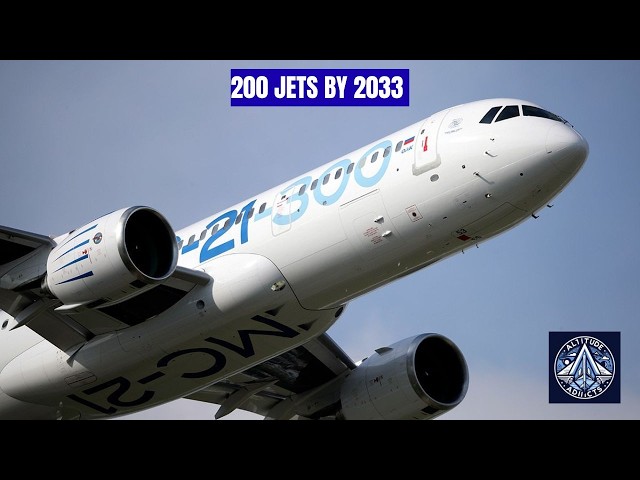
today is the MC21 airliner.
0:13
This next generation narrowbody aircraft
0:15
is designed to gradually replace
0:17
westernbuilt jets in Russian airline
0:21
The aircraft was developed as Russia's
0:23
response to modern jets like the Airbus
0:25
A320 Neo and the Boeing 737 family.
0:30
However, the scale of production
0:32
required to meet domestic demand is
0:36
Altitude Addicts, the YouTube channel
0:38
bringing you this aviation analysis,
0:41
explains that the program is now
0:43
entering a decisive phase. Russia must
0:46
soon transition from development and
0:48
testing to sustained industrial
0:52
During a recent meeting of Russia's
0:54
aviation regulator Rosa Viatzia, Deputy
0:57
Prime Minister Vitali Sevelv revealed a
0:59
major development. The national airline
1:02
Aeroflot plans to acquire up to 200 MC21
1:06
aircraft by the year 2033.
1:10
This announcement highlights both the
1:12
strategic importance of the aircraft and
1:15
the scale of the manufacturing challenge
1:17
ahead. The aircraft is produced by the
1:20
Russian manufacturer Yakovv.
1:23
Altitude Addicts notes that meeting
1:25
Aeroflot's acquisition timeline will
1:28
require extremely rapid production. If
1:31
large-scale production begins soon,
1:33
Yakovv may need to deliver roughly one
1:36
aircraft every 2 weeks.
1:38
That pace reflects the urgency of
1:41
Russia's effort to rebuild a fully
1:43
domestic commercial aviation industry.
1:46
It also shows how central the MC21 has
1:49
become to the country's aviation
1:52
To better understand the scale of this
1:54
challenge, it helps to examine the
1:56
aircraft itself. The MC21 is designed as
2:00
a modern medium-range narrowbody
2:04
In a typical twoclass configuration, the
2:07
aircraft can carry roughly 165 to 175
2:13
Its design aims to compete directly with
2:15
aircraft such as the Boeing 737 Max and
2:22
Altitude Addicts explains that the
2:24
aircraft incorporates several modern
2:26
engineering features. One of the most
2:29
notable is its advanced composite wing.
2:33
Composite materials reduce weight and
2:35
improve aerodynamic efficiency.
2:38
This helps lower fuel consumption and
2:42
The fuselage of the MC21 is also
2:45
slightly wider than that of many
2:47
competing narrow body aircraft.
2:50
This allows for a larger cabin and
2:52
improved passenger comfort.
2:55
However, the aircraft's development has
2:57
been far from straightforward.
3:00
Early prototypes relied heavily on
3:04
These included engines, avionic systems,
3:06
and specialized composite materials.
3:09
Geopolitical tensions and sanctions
3:12
forced Russia to redesign the aircraft.
3:15
Altitude Addicts explains that the
3:17
program shifted toward a fully import
3:20
substituted version. In other words, the
3:23
aircraft now relies almost entirely on
3:26
domestically produced components.
3:29
Developing these replacements required
3:31
major technological efforts across
3:33
Russia's aerospace sector. New avionic
3:37
systems, composite materials, and
3:39
engines had to be created locally.
3:42
As this redesign progressed, another
3:44
challenge emerged. The fully domestic
3:47
version of the aircraft still requires
3:52
Current plans suggest that certification
3:54
could be completed by the end of the
3:59
Large-scale deliveries to airlines will
4:02
likely begin afterward.
4:04
Altitude Addicts explains why this
4:07
timeline creates pressure for the
4:10
Aeroflot still expects to receive around
4:13
200 aircraft by 2033.
4:17
If full-scale deliveries begin around
4:19
2026 or 2027, the production window
4:23
becomes relatively short. Only 6 or 7
4:27
years would remain to complete the
4:31
When the numbers are examined, the
4:33
challenge becomes clear. Delivering 200
4:36
aircraft in roughly 7 years requires
4:39
about 28 to 30 aircraft per year.
4:43
Altitude Addicts calculates that this
4:45
equals roughly one aircraft every 13 to
4:50
Such a pace would require a highly
4:52
efficient production system.
4:54
Aeroflot itself plays a central role in
4:57
this plan. The airline is expected to
5:00
become the launch customer and the
5:02
largest operator of the MC21.
5:06
The airline group is currently
5:07
undergoing a major fleet modernization
5:11
This program emphasizes aircraft built
5:16
Altitude Addicts notes that the airline
5:18
plans to significantly increase the
5:20
proportion of domestic aircraft in its
5:23
fleet. This includes the Superjet
5:26
regional aircraft and the T214
5:31
However, the MC21 is the centerpiece of
5:34
the strategy. It is intended to replace
5:37
many Airbus A320 and Boeing 737 aircraft
5:41
currently operated by Aeroflot.
5:44
According to current plans, the airline
5:46
expects to receive more than 100 MC21
5:50
aircraft by the end of the decade. Total
5:53
deliveries could approach 200 aircraft
6:01
Such a large order guarantees strong
6:05
But it also places enormous pressure on
6:07
the production system.
6:10
Altitude Addicts explains that the
6:12
aircraft is assembled at the Kutsk
6:14
aviation plant in eastern Siberia.
6:17
This facility is one of Russia's largest
6:20
aerospace manufacturing centers.
6:23
In recent years, the plant has undergone
6:25
extensive modernization.
6:28
New composite manufacturing facilities
6:30
and assembly lines have been built.
6:33
Automation technologies have also been
6:36
introduced to improve efficiency.
6:38
The goal is to create a production
6:40
system capable of manufacturing dozens
6:43
of aircraft each year.
6:46
However, increasing production rates is
6:50
Aircraft manufacturing relies on highly
6:52
specialized supply chains.
6:55
Altitude Addicts explains that dozens of
6:58
suppliers provide essential components.
7:01
These include avionics systems, landing
7:04
gear, composite materials, and cabin
7:07
Any disruption in this network could
7:11
That risk becomes greater when the
7:13
aircraft relies almost entirely on
7:18
One particularly critical component is
7:20
the engine. The MC21 is powered by the
7:27
The engine is produced by the Perm
7:29
Motors facility of United Engine
7:33
It was specifically developed to replace
7:35
Western engines originally planned for
7:39
Altitude Addicts explains that engine
7:42
production must expand dramatically.
7:45
Two engines are required for each
7:48
Aeroflot's planned order of 200 aircraft
7:51
alone would therefore require at least
7:56
Additional spare engines would also be
7:58
needed. If engine production cannot keep
8:02
pace, aircraft assembly could quickly
8:04
slow down. In modern aviation programs,
8:08
engine supply is often the most
8:10
sensitive bottleneck.
8:12
Beyond engines, the entire aerospace
8:14
supply chain must operate smoothly.
8:17
Suppliers across Russia produce
8:19
avionics, landing gear, structural
8:21
components, and interior system.
8:24
Altitude Addicts points out another
8:28
Many of these suppliers are also
8:30
involved in military production.
8:33
Balancing civil aviation manufacturing
8:35
with defense priorities can create
8:37
logistical challenges.
8:40
This makes supply chain coordination
8:44
If certification proceeds according to
8:46
plan, deliveries could begin gradually
8:52
Initial deliveries may occur in limited
8:54
numbers around 2026 or 2027.
9:00
As production stabilizes, the annual
9:02
output could rise significantly by the
9:04
end of the decade. Aeroflot could
9:07
eventually receive dozens of aircraft
9:09
each year. Altitude Addicts notes that
9:13
by around 2030, the airline may operate
9:16
more than 100 MC21 aircraft. Remaining
9:21
deliveries would then follow in the
9:25
Although domestic demand will dominate
9:27
early production, Russia has long hoped
9:30
the aircraft could succeed in export
9:34
Before sanctions, several international
9:36
customers expressed interest.
9:39
However, exporting the aircraft now
9:42
presents additional challenges.
9:44
Certification from international
9:46
aviation regulators is normally
9:50
Altitude Addicts explains that such
9:52
certification could be difficult under
9:54
current geopolitical conditions.
9:57
Some international airlines may also
9:59
hesitate to rely on supply chains
10:04
For this reason, the MC21 will likely
10:07
focus on the domestic market during its
10:09
early years. Future export efforts may
10:13
target airlines in Asia, Africa, and the
10:16
Ultimately, the success of the MC21 will
10:20
serve as a major test for Russia's
10:24
Producing a modern passenger aircraft at
10:26
scale requires advanced engineering and
10:28
a reliable industrial ecosystem.
10:32
Altitude Addicts concludes that Yakovv
10:35
may need to deliver one aircraft roughly
10:37
every 2 weeks to satisfy Aeroflot's
10:40
order. Achieving that pace would
10:43
represent a remarkable industrial
10:46
If production ramps up successfully, the
10:49
MC21 could become the backbone of
10:51
Russian airline fleets for decades.
10:54
It would also demonstrate Russia's
10:56
ability to sustain largecale civil
10:59
aircraft manufacturing.
11:01
But if delays occur, airlines could face
11:04
shortages of modern aircraft during a
11:06
period when Western jets remain
11:09
For this reason, the MC21 program is
11:12
widely seen as a defining project for
11:14
Russia's aviation sector.
11:17
With certification expected by the end
11:19
of 2026 and hundreds of aircraft already
11:23
planned, the coming decade will be
11:27
The aircraft represents not only a
11:29
technological milestone, but also a
11:31
crucial test of Russia's industrial
11:33
resilience in global aviation.
11:38
If you like the video, please subscribe,
11:41
share and like. Also, please take the
11:44
membership of Altitude Addicts to