0:08
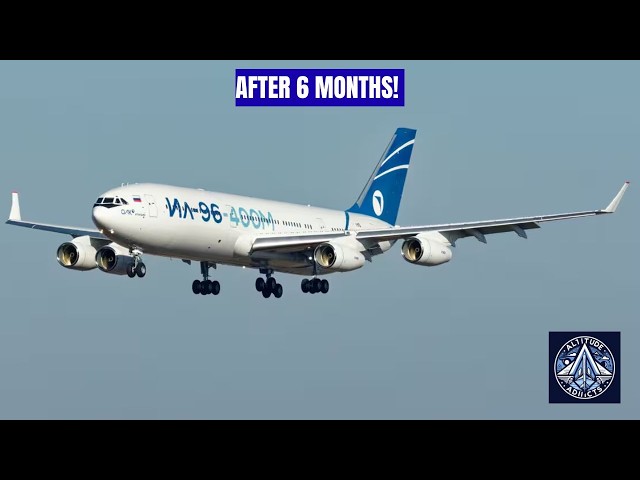
a wide-body long-haul aircraft, has
0:11
officially resumed flight testing in
0:14
This project has become increasingly
0:16
important to the country's strategy for
0:18
rebuilding its domestic aviation
0:22
The prototype aircraft, tail number
0:26
returned to the skies after a 6-month
0:28
pause and successfully completed a
0:30
9-hour nonstop flight along the
0:32
Zhukovsky to Novosibirsk and back route.
0:36
This flight was not only a technical
0:37
milestone, but also a powerful signal
0:40
that the program remains active despite
0:42
the many challenges it faces.
0:45
The aircraft's return after such a long
0:47
gap carries both practical and symbolic
0:52
It reflects the resilience of the
0:53
project and confirms that the Il-96-400M
0:57
continues to play a role in Russia's
0:59
long-term push for aviation
1:03
In a world where access to western
1:05
aircraft and technologies is
1:06
increasingly restricted, programs like
1:09
this are gaining strategic weight.
1:12
To understand why this aircraft matters
1:14
today, it is important to look at where
1:17
it all began and how the program evolved
1:23
is not an entirely new aircraft, but
1:25
rather a continuation of the Soviet-era
1:28
one of the last wide-body jets developed
1:32
When it first flew in the late 1980s, it
1:35
was considered a modern competitor to
1:40
However, the collapse of the Soviet
1:42
Union and the economic instability of
1:44
the 1990s severely limited its growth.
1:48
Production slowed, airline demand
1:50
remained weak, and the aircraft never
1:52
achieved large-scale commercial success.
1:58
represents an attempt to revive that
1:59
legacy by modernizing the platform with
2:02
a longer fuselage, higher passenger
2:04
capacity, and updated onboard systems.
2:08
The goal is simple but ambitious. Keep a
2:10
proven airframe, but adapt it for
2:12
today's aviation needs.
2:15
Building on that legacy, the aircraft's
2:17
design and capabilities reveal what it
2:20
aims to achieve in the modern era.
2:25
is designed as a long-haul wide-body jet
2:27
capable of carrying between 350 and 370
2:31
passengers, depending on cabin
2:35
Its extended fuselage makes it suitable
2:38
for high-density routes across vast
2:42
Power comes from four PS-90A1 engines,
2:45
enabling long-range operations with a
2:48
cruising speed of around 870 km/h.
2:52
Under optimal conditions, the aircraft
2:55
can travel more than 10,000 km.
2:58
These capabilities allow it to operate
3:00
on both long domestic routes and
3:02
potential international sectors.
3:05
One defining feature is its reliance on
3:08
domestically produced components.
3:11
This independence is especially valuable
3:13
in the current geopolitical climate,
3:15
ensuring that production and maintenance
3:18
can continue without reliance on foreign
3:22
With that context in mind, the recent
3:24
9-hour test flight becomes even more
3:29
Extended flights like this are critical
3:31
for evaluating how the aircraft performs
3:33
under real-world conditions.
3:36
Engineers assess engine reliability,
3:38
avionics, onboard systems, and overall
3:41
stability during such missions.
3:44
The fact that this flight occurred after
3:46
a long pause makes it even more
3:50
It shows that the program has regained
3:52
momentum and is moving forward towards
3:54
certification milestones.
3:57
As the team at Altitude Addicts would
3:59
note, long-duration flights are
4:01
essential for proving whether a
4:03
wide-body aircraft can truly handle
4:05
sustained operations without compromise.
4:09
Successfully completing this mission
4:11
strengthens confidence in the aircraft's
4:14
readiness and reliability.
4:17
Looking beyond testing, the Il-96-400M
4:20
plays a broader role in Russia's
4:24
The country has been working to build a
4:26
complete lineup of domestically produced
4:31
Within this ecosystem, the Il-96-400M
4:34
serves as the primary long-haul
4:38
Alongside aircraft like the MC-21 and
4:41
SSJ100, it is intended to ensure that
4:44
Russia can operate long-distance routes
4:48
This is particularly important given the
4:50
country's vast geography, where reliable
4:53
long-haul connectivity is essential.
4:58
could become a key link connecting major
5:00
cities with remote regions.
5:03
However, moving from strategy to reality
5:06
reveals significant production
5:09
The manufacturing rate remains extremely
5:11
slow, with output limited to very low
5:15
This is a major constraint for any
5:17
aircraft program aiming for relevance.
5:21
One of the main reasons is the heavy
5:23
reliance on manual labor.
5:25
Unlike modern aircraft production, which
5:27
uses automation and digital systems,
5:30
much of the Il-96-400M assembly process
5:36
This increases both production time and
5:39
Another issue is the lack of full
5:43
Modern programs rely on digital twins
5:46
and integrated systems, while this
5:48
aircraft still depends on older
5:51
As highlighted in discussions within
5:53
Altitude Addicts, this gap makes scaling
5:56
production far more difficult than in
6:00
These production realities tie directly
6:03
into the aircraft's economic challenges.
6:06
One of the biggest concerns is its
6:10
While reliable, it is less efficient
6:12
than modern twin-engine aircraft.
6:16
This results in higher fuel consumption,
6:18
increased maintenance, and overall
6:20
higher operating costs.
6:22
In a highly competitive aviation market,
6:25
these factors significantly reduce its
6:30
Most modern wide-body aircraft now use
6:32
two engines, offering better efficiency
6:34
and lower life-cycle costs.
6:37
This places the Il-96-400M
6:40
at a disadvantage in commercial
6:43
There are ongoing discussions about
6:45
developing a twin-engine version with
6:48
next-generation engines.
6:50
Such a move could dramatically improve
6:54
but it would require significant time
6:58
Despite these challenges, the aircraft
7:00
still holds value beyond passenger
7:06
can be adapted for multiple roles,
7:08
including cargo operations, government
7:10
transport, and airborne command centers.
7:14
These alternative uses could help
7:16
sustain the program, even if commercial
7:18
demand remains limited.
7:21
In fact, Altitude Addicts often
7:23
emphasizes that versatility is one of
7:25
the aircraft's strongest strategic
7:29
In this sense, the Il-96-400M
7:32
is not just an airliner, but a flexible
7:34
platform with broader applications.
7:38
Looking ahead, the future of the program
7:40
depends on several key factors.
7:43
Modernizing production facilities and
7:45
adopting advanced manufacturing
7:47
technologies will be crucial.
7:50
Without these changes, scaling
7:52
production will remain difficult.
7:55
Engine development is another critical
7:59
More efficient engines could
8:00
significantly improve competitiveness
8:02
and reduce operating costs.
8:05
Government support will also play a
8:09
With limited interest from commercial
8:11
airlines, state orders are likely to
8:13
remain the backbone of the program.
8:17
In the end, the Il-96-400M
8:20
stands at the intersection of symbolism
8:22
and practical reality.
8:24
Its return to flight highlights Russia's
8:26
ability to sustain complex aviation
8:29
projects under challenging conditions.
8:32
At the same time, it faces real-world
8:34
limitations, including production
8:36
constraints, high operating costs, and
8:39
the need for modernization.
8:41
The aircraft reflects both the strengths
8:43
of legacy engineering
8:45
and the challenges of adapting to modern
8:50
If it becomes a stepping stone toward
8:52
more advanced aircraft, its role will be
8:54
strategically significant.
8:57
If not, it may remain a niche solution,
8:59
important for state use, but limited in
9:06
If you like the video, please subscribe,
9:10
Also, please take the membership of the
9:12
channel to encourage us.