Up next in 10


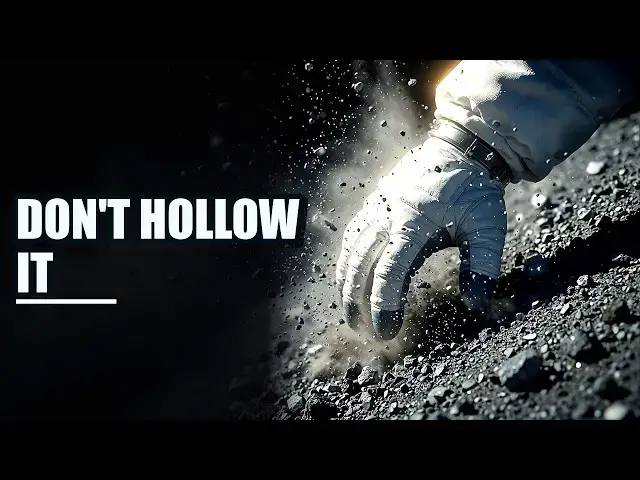
The popular picture of a mining town inside a hollow asteroid dies on contact. One atmosphere of air would blow a rubble pile into a cloud. This is the actual build order: hull, dirt, then spin.
0:00 The ball pit at Bennu
1:15 It Is a Ball Pit
2:40 You Do Not Walk
3:55 Pick the Rock
5:20 Do Not Hollow It
6:45 How Fast You Spin
8:10 And It Gets Worse
9:40 Air Water Steel
11:05 The 1975 Plan
12:20 What Does Not Happen
#asteroid #spacehabitat #OSIRISREx #Bennu #space #Ceres #Psyche #LifeIsEasy
Public-record numbers are approximate. This is a science explainer, not a mission plan. No affiliation with NASA.
Visuals are original AI-generated stills. Audio may be synthetic. Not medical, legal, or financial advice.
Show More Show Less View Video Transcript
0:00
October 20th, 2020, a NASA spacecraft
0:02
named OSIRIS-REx kisses asteroid Bennu
0:06
for 5 seconds and the ground swallows
0:08
the arm.
0:09
The sampling head sinks about 50 cm into
0:11
what looked like a cliff. Thrusters
0:13
fire. The vehicle is about to drown in
0:16
gravel 300 million kilometers from
0:18
Earth. Bennu is about 490 m across. You
0:22
could walk it in 10 minutes if walking
0:24
worked. Walking does not work. The
0:26
popular picture is a mining town inside
0:29
a hollow rock. Mag boots, tunnels, a
0:31
window on the stars. That picture is
0:34
dead on contact. You do not live in a
0:37
cave in an asteroid. One atmosphere of
0:40
air would blow a rubble pile into a
0:42
cloud. The rock is not the house. The
0:45
rock is the sandbag you pile on the
0:47
house after you build a hull that can
0:50
actually hold breath.
0:52
It is a ball pit.
0:54
You are standing on Bennu in a suit.
0:56
Surface gravity is about 8 millionths of
0:58
a G. Escape velocity is about 20 cm a
1:01
second. A hard jump puts you in solar
1:04
orbit. The ground under your boots is
1:06
not bedrock. It is a pile of boulders,
1:09
pebbles, and dust held together by their
1:12
own tiny gravity and a whisper of
1:14
electrostatic stick.
1:16
Density is about 1.2 g per cubic
1:20
centimeter, which means the rock is half
1:22
empty.
1:23
In 2020, the spacecraft proved it. The
1:26
arm went in like a beach ball into dry
1:28
beans.
1:30
Ryugu did the same thing to Japan's
1:31
Hayabusa 2 in 2019. Dimorphos, the
1:35
moonlet NASA hit on September 26th,
1:38
2022, recoiled like a sandbag, not a
1:42
billiard ball.
1:43
The DART strike shortened its orbit by
1:45
about 33 minutes. A solid metal potato
1:49
would not have done that.
1:51
Most of the near-Earth rocks we actually
1:53
know how to reach are dumps, not
1:55
cathedrals. You could bag the whole pile
1:57
in a net, and the net would be doing
1:59
more structural work than the rock. That
2:01
is the object you are being asked to
2:03
move into. You do not walk forget mag
2:06
boots. There is nothing under you worth
2:08
magnetizing. Bennu is a carbonaceous
2:11
pile, not a steel hull.
2:13
You translate. You fire a cold gas puff,
2:17
and you drift. You clip a tether because
2:19
a sneeze at 20 cm a second is a lost
2:22
crew. Your inner ear has nothing to work
2:25
with.
2:26
Dust does not settle. It hangs, then
2:29
migrates on sunlight like a slow fog.
2:32
Thermal swing on a bare near-Earth
2:35
surface can run from well below freezing
2:37
on the night side to hotter than boiling
2:40
water on the day side, depending on
2:42
distance from the Sun.
2:44
You live in a can, or you cook and
2:46
freeze on a 6-hour clock.
2:48
The first hour on station is not a flag
2:51
and a footprint. It is a tether, a
2:53
handrail, and a rule. Do not push off
2:56
hard. If you drop a wrench, it does not
2:58
fall. It waits. Then sunlight and your
3:01
own exhaust start it on a path you will
3:03
spend an hour chasing.
3:05
Every tool is on a lanyard. Every hatch
3:08
is a place a person can leave forever.
3:11
Pick the rock.
3:13
You do not start with Bennu as a house.
3:15
You start with mass you can cook. A
3:17
C-type carbonaceous chondrite is the
3:20
grocery store.
3:21
Those rocks carry water locked in clay
3:23
minerals, plus carbon, sulfur, and
3:26
ammonia salts. CI and CM meteorites on
3:29
Earth run about 10 to 20% water by
3:32
weight when you heat them. That water is
3:34
drinking, oxygen, and hydrogen-oxygen
3:37
propellant once you split it with
3:39
electricity.
3:40
Heat a ton of that clay in a solar
3:42
furnace, and you are looking at about
3:44
100 to 200 kg of water if the grade
3:48
holds.
3:49
A metal-rich body like 16 Psyche, about
3:52
220 km across, is the hardware store if
3:55
it is actually nickel-iron and not a
3:58
metal dump of its own.
4:00
NASA launched the Psyche spacecraft on
4:02
October 13th, 2023, to find out which.
4:06
Ceres, about 940 km across, is the ice
4:10
warehouse in the main belt. Surface
4:13
gravity there is still only about 3/100
4:15
of a G, so your gait is a long hop, but
4:18
you have a dwarf planet of feedstock and
4:21
a crust loaded with frozen water.
4:23
The named mass for a first habitat is
4:26
not a world. It is a few hundred million
4:29
tons of C-type material in a near-Earth
4:32
orbit you can reach with solar power,
4:34
sitting at about 1360 W per square
4:37
meter. That is the energy source, no
4:39
mystery plant. Mirrors, furnaces, and
4:42
years. Do not hollow.
4:44
And here is the physics that kills the
4:46
sci-fi version. One atmosphere is about
4:49
101,000
4:51
pascals. That is 14.7 lb on every square
4:55
inch of the inside of your cave.
4:57
Competent granite might hold that in a
4:59
thick enough vault.
5:00
A rubble pile has cohesion, measured in
5:03
tens of pascals, not tens of millions.
5:06
Pressurize a hollowed Bennu and you have
5:08
built a bomb. The air leaves. The rock
5:11
becomes a spreading cloud. Even a
5:14
competent nickel-iron monolith is a
5:15
terrible pressure vessel until you mill
5:18
it, weld it, inspect it, and give it a
5:20
geometry that carries hoop stress. So
5:23
you do not live in the hole. You center
5:25
or smelt a hole first. Nickel-iron
5:28
plates, basalt fiber, or sintered
5:30
regolith over a polymer bladder. Then
5:33
you pile 2 to 5 m of crushed rock on the
5:36
outside. The asteroid is feedstock and
5:38
shielding. The house is a tank. Build
5:41
order is hull, then dirt, then spin.
5:44
Hollow last and only as a quarry. If you
5:47
spin the raw pile to make fake gravity,
5:49
the same weakness shows up as tension.
5:52
Cohesion that cannot hold a cave also
5:54
cannot hold a spinning mountain
5:56
together. The pieces climb the equator
5:59
and leave. How fast you spin?
6:01
You need a floor that pushes. One G at
6:04
one revolution per minute wants a radius
6:07
of about 900 m. That is a cylinder
6:10
almost 2 km across. 2 RPM drops the
6:13
radius to about 220 m and your inner ear
6:16
starts to argue. Head turns become
6:18
nausea. Coriolis on a moving arm throws
6:21
your coffee sideways. Habitat studies
6:24
from the 1970s parked the comfort line
6:26
under 2 RPM and treated 1 RPM as the
6:29
civilized number. So, the first real
6:31
home is not a tunnel in a 400 m rock. It
6:34
is a spinning can hundreds of meters
6:36
across wrapped in slag using that rock
6:39
as the mine. You can run a smaller
6:41
centrifuge inside a parked hull for
6:43
sleep and bone. A wheel for the crew
6:45
while the workshop stays in
6:47
microgravity. Bone still lose mass in
6:50
weeks without load. After months, you do
6:52
not walk well when you finally need to.
6:54
The wheel is medicine. The big cylinder
6:56
is the town. Spin up is a slow crank
6:59
over days. So, fittings and people both
7:02
keep their lunch. Get the axis wrong by
7:04
a fraction and the whole stack wobbles
7:07
and a wobble in a million ton drum is a
7:09
tear waiting on a weld. And it gets
7:11
worse.
7:12
Radiation does not care about your hull
7:14
until the hull is thick. Galactic cosmic
7:17
rays in free space deliver on the order
7:19
of a few hundred millisieverts per year
7:22
to an unshielded body and a solar
7:24
particle event can spike that in hours.
7:26
Career limits for astronauts are
7:28
measured in hundreds of millisieverts,
7:30
not thousands. 2 to 3 m of packed
7:33
regolith or a few meters of water rich
7:35
slag knocks the dose into a range a crew
7:38
can live with for years. That shield is
7:40
heavy. A cylinder 2 km across and a few
7:43
kilometers long wrapped in 3 m of rock
7:46
is millions of tons of deadweight you
7:48
have to process, lift, and stick to a
7:50
spinning hull without tearing the seams.
7:52
Solar particle storms still demand a
7:54
storm shelter with extra water or
7:56
polyethylene around the bunks. And the
7:59
part that actually matters, every
8:01
kilogram you mine has to be contained.
8:03
Fine dust from carbonaceous rock is
8:06
toxic, electrically sticky, and happy to
8:08
wreck seals, lungs, and radiators. You
8:11
are not homesteading, you are running a
8:13
mill that never gets a breeze. A pinhole
8:16
in the bladder under that slag is a
8:18
silent leak you find by the hiss in a
8:19
headset and the frost on a camera. You
8:22
patch from the inside while the rock
8:24
blanket tries to stay put on a hole that
8:27
is trying to be a drum.
8:30
Air, water, steel.
8:32
A person burns about 800 g of oxygen a
8:34
day and drinks a few liters. Almost all
8:37
of that can cycle if the stills and the
8:39
filters work.
8:41
The International Space Station already
8:42
recovers the majority of its water from
8:44
urine and condensate. Food is the leak.
8:47
Calories have to come from somewhere and
8:49
a closed farm wants area, light, and a
8:52
nitrogen cycle that does not crash. At 1
8:54
AU, a square meter of sunlight is about
8:57
1360 W before you lose it in mirrors and
9:00
conversion. You do not glass the hull.
9:03
You run sunlight in through mirrors and
9:05
shutters or you run lamps off solar
9:07
because a window is a radiation hole and
9:10
a pressure hole.
9:11
Steel, or at least metal, comes from
9:13
reduced oxides and from nickel-iron
9:15
grains you magnetically rake out of the
9:17
grind. Water you bake from clay at a few
9:20
hundred degrees in a solar furnace.
9:22
Oxygen you electrolyze. The first year
9:24
is a refinery that happens to have
9:26
bunks. If the still stops, you have
9:28
days, not months. Spare parts are the
9:31
second life support system.
9:33
There is no hardware store on the next
9:35
rock unless you already put one there. A
9:37
failed pump is a countdown. A failed
9:40
crop is a ration chart. Doubling time
9:43
only starts after the mill, the furnace,
9:45
and the farm all run in the same week
9:48
without a crew living on cargo from
9:50
Earth.
9:52
The 1975 plan.
9:54
In the summer of 1975,
9:57
NASA Ames and Stanford ran a 10-week
9:59
study that put numbers on this. They did
10:02
not hollow a potato. They designed a
10:04
torus about 1.8 km across for about
10:08
10,000 people spun for Earth gravity,
10:11
shielded in slag, fed by lunar and
10:14
asteroid mass.
10:16
Gerard O'Neill had published the
10:17
cylinder version in Physics Today in
10:20
1974,
10:21
Island 3, 8 km across, 32 km long.
10:26
The mini case is that 1975 Ames study
10:30
dated, named, and still the skeleton
10:33
every later paper walks. Doubling time
10:36
was the quiet claim.
10:38
Use one habitat as the factory that
10:40
stamps the next hull. Solar
10:42
concentrators process ore.
10:44
Each cycle of metal and glass and slag
10:47
should, on paper, cut the time to the
10:49
next town, on paper. In metal, you still
10:53
have to keep a vacuum mill running, keep
10:55
people alive, and not let a single bad
10:58
weld open a kilometer of hull.
11:00
50 years later, we have sampled Bennu,
11:03
punched Dimorphos, and landed on Eros on
11:06
February 12th, 2001, when NEAR Shoemaker
11:09
became the first spacecraft to rest on
11:12
an asteroid. We have not centered a
11:14
pressure hull out of one. The plan is
11:16
older than the shuttle's first landing.
11:19
The feedstock is still sitting where it
11:21
was. The 1975 torus assumed a
11:24
construction rate and a mass driver that
11:26
we have still not parked against a
11:28
C-type rock. That gap is the real clock.
11:31
What does not happen? Tomorrow morning,
11:34
nobody moves into a hollow mountain in
11:36
the sky. Bennu does not get a subway.
11:39
Ceres does not open a hotel. Your city
11:41
does not empty. Launch costs fall and
11:44
surveys get better, and sample return
11:46
capsules keep dropping in Utah. And
11:48
still the first crew that stays for a
11:50
year will live in a tin can parked
11:53
against a pile, eating from a farm the
11:55
size of a warehouse, sleeping in a
11:57
centrifuge, watching a camera feed of
News