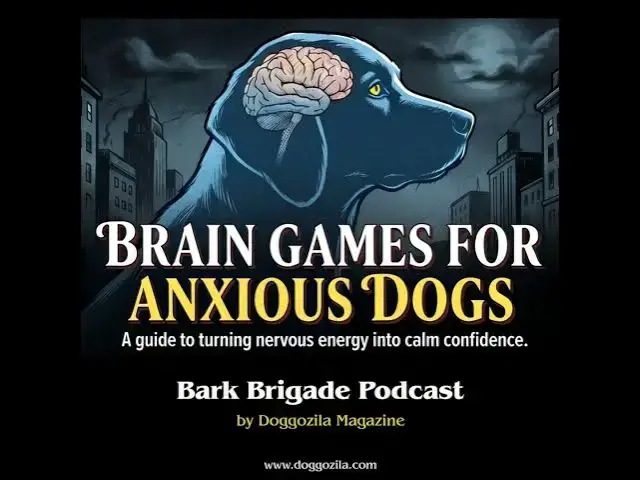
Up next in 10

Your dog trembles at loud noises. He chews the sofa when you grab your keys. That constant worry can leave you feeling helpless. But you can offer real relief through brain games for anxious dogs (https://doggozila.com/brain-games-for-anxious-dogs/) .
These simple, playful activities work with your pup’s natural instincts to melt stress away.
This episode walks you through the best brain games for anxious dogs (https://doggozila.com/brain-games-for-anxious-dogs/) that turn nervous energy into calm, confident tail wags.
You’ll find easy DIY puzzles, powerful scent work, and science-backed reasons why mental stimulation soothes a worried mind.For more information read the full article by Doggozila Magazine that is called:
Brain Games for Anxious Dogs That Melt Mind Panic Immediately (https://doggozila.com/brain-games-for-anxious-dogs/)
Show More Show Less View Video Transcript
0:00
Welcome to another episode of the Bark
0:02
Brigade podcast by Dogazilla magazine.
0:04
>> Glad to be here. I'm really excited to
0:06
get into this one.
0:07
>> Me, too, because um what if I told you
0:09
that like just 10 minutes of your dog
0:13
simply sniffing around a uh a baldup
0:16
towel in your living room could exhaust
0:19
them more profoundly than you know a 30
0:23
minute sprint through your neighborhood.
0:25
>> It sounds kind of unbelievable, right?
0:27
But it's true,
0:28
>> right? And if you're listening to this
0:29
right now, there's a very good chance
0:31
that you are well intimately familiar
0:34
with a really specific brand of
0:36
helplessness.
0:37
>> Oh, yeah. Every dog owner knows that
0:38
feeling.
0:39
>> Yeah. You know, you are staring at your
0:41
dog and they're uh they're trembling
0:43
under the coffee table because someone
0:45
dropped a book in the apartment upstairs
0:47
or like you've just walked through your
0:48
front door to discover that the armrest
0:50
of your sofa has been systematically
0:52
dismantled.
0:52
>> Completely shredded.
0:53
>> Exactly. just because you dared to, you
0:55
know, leave the house to buy groceries.
0:58
And dealing with an anxious pup is, I
1:00
mean, it's completely exhausting. It's
1:02
heartbreaking.
1:03
>> It really takes a toll on you.
1:04
>> It does. But today, we are going on a
1:07
mission in this deep dive. We are taking
1:09
the core principles from the article
1:11
mind games for calm canines and
1:13
exploring how incredibly simple playful
1:16
brain games for anxious dogs tap
1:19
directly into their hidden evolutionary
1:21
biology
1:22
>> which is just a fascinating area of
1:24
research.
1:24
>> Right. We are going to break down how to
1:27
literally melt that stress away turning
1:29
all of that destructive nervous energy
1:31
into you know calm confident rest. Okay,
1:35
let's unpack this because if you picture
1:37
an anxious dog, the goal isn't just to
1:39
stop them from chewing the furniture.
1:41
>> No, not at all.
1:42
>> The real magic, the ultimate goal is a
1:44
dog sprawled out on the floor, eyes
1:46
soft, breathing slow, and at total peace
1:49
with the world.
1:50
>> Yes. And getting to that image requires
1:52
us to completely redefine what anxiety
1:54
physically is inside your dog's body.
1:56
>> Because it's not just them being bad,
1:58
right?
1:58
>> Exactly. An anxious dog isn't just, you
2:00
know, acting out or being naughty. Their
2:02
brain is literally trapped in a
2:04
biological loop of fear. It is a
2:06
neurological cycle,
2:07
>> a cycle that they can't just snap out of
2:09
on their own, right? The amygdala, which
2:11
is basically the brain's alarm system,
2:14
is constantly scanning the environment
2:16
for threats.
2:17
>> So, it's always on high alert,
2:19
>> always. It's releasing stress chemicals
2:22
um like cortisol and adrenaline,
2:24
constantly preparing the cardiovascular
2:26
system in the muscles for a worst case
2:28
scenario,
2:29
>> which has to be exhausting. Oh, it is
2:30
exhausting just existing in that state.
2:32
So, brain games for anxious dogs are
2:34
fundamentally designed to actively break
2:36
that loop.
2:37
>> How do they do that exactly?
2:38
>> Well, they introduce a problem-solving
2:40
task that forces the canine brain to
2:43
physically reallocate its resources. You
2:46
are making them replace a state of panic
2:48
with a state of intense focus.
2:50
>> Okay, that makes biological sense on a
2:51
surface level, but let me pull devil's
2:53
advocate here for a second.
2:54
>> Sure, go for it. Think about what
2:56
happens to us as humans. If I am uh
2:59
spiraling over a major work
3:01
presentation, my heart is racing. My
3:03
thoughts are going a mile a minute. What
3:05
do I do?
3:06
>> You probably reach for your phone.
3:07
>> Exactly. I pick up my phone and I start
3:09
doomcrolling. I desperately look for an
3:12
engaging task to snap my brain out of
3:14
the spiral. But doom scrolling doesn't
3:16
actually stop the panic loop, you know.
3:18
>> No, it's just a distraction.
3:19
>> Yeah. It just temporarily masks it. The
3:21
second I put the phone down, the anxiety
3:23
is right there waiting for me. So, can a
3:26
simple game like uh hiding a piece of
3:29
kibble under a cup really break a
3:32
full-blown panic loop for a dog? Or are
3:34
we just, you know, canine doom
3:36
scrolling?
3:37
>> That's a great analogy, but it's crucial
3:39
to differentiate between passive
3:41
consumption and active problem solving.
3:44
>> Okay, how so? When you are doom
3:45
scrolling, you are passively consuming
3:47
stimuli that does not require
3:49
significant cognitive load.
3:51
>> Cognitive load being like brain power
3:54
>> essentially. Yes. Cognitive load is the
3:56
amount of working memory resources being
3:58
used by the brain at any given moment.
4:00
Think of it like RAM in a computer.
4:02
>> Oh, I like that.
4:03
>> Yeah. So, a dog's brain, much like a
4:05
computer, only has a finite amount of
4:07
processing power. Doom scrolling uses
4:09
very little RAM. But when you present a
4:12
dog with a tactile brain game, say, uh,
4:16
figuring out how to unroll a towel to
4:18
find a specific scent, they have to use
4:20
a lot of different systems at once.
4:22
>> Like what?
4:22
>> They have to use their old factory
4:24
senses, their motor skills, their
4:25
spatial awareness, and their problem
4:27
solving faculties simultaneously. That
4:29
demands massive cognitive load.
4:31
>> So it's literally a hardware limitation.
4:34
They cannot process the fear of allowed
4:36
noise because all of their mental RAM is
4:37
like occupied by the mechanics of the
4:39
puzzle. Exactly. You cannot hyperfixate
4:41
on the existential dread of a
4:42
thunderstorm and simultaneously solve a
4:45
complex multi-ensory puzzle.
4:47
>> You literally don't have the bandwidth.
4:49
>> Right. The cognitive load required to
4:51
solve the puzzle physically redirects
4:53
the brain's electrical and chemical
4:55
energy away from the amigdula
4:56
>> and sends it where?
4:57
>> It routes it into the prefrontal cortex,
4:59
the area responsible for complex problem
5:02
solving. You are hijacking their
5:03
processing power.
5:05
>> Wow. Okay. But if solving the puzzle
5:07
stops the panic in the moment by using
5:09
up that ram, what happens when the
5:11
puzzle is empty? Does the anxiety just
5:13
come rushing back?
5:15
>> Well, that naturally ties into the real
5:17
reason your pup acts out in the first
5:18
place,
5:19
>> which is what because we have a terrible
5:21
habit of personifying our dogs, right?
5:23
We walk in, we see the shredded pillows,
5:25
and we think, "Oh, he's mad at me for
5:27
leaving."
5:28
>> Yes. And that personification is one of
5:30
the biggest hurdles owners face. The dog
5:33
isn't holding a grudge.
5:34
>> They aren't trying to punish us. Not at
5:36
all. Shredding pillows or barking
5:38
non-stop at the window is a fight
5:40
orflight response. Their brain is
5:42
whispering, "Something scary is coming."
5:44
>> And that builds up energy.
5:46
>> Immense amount of bottled up energy.
5:48
Anxiety isn't just an emotion for them.
5:50
It is a physical substance. It is
5:53
adrenaline demanding physical action.
5:55
>> So, they have to do something with it.
5:56
>> Exactly.
5:57
>> If we don't provide a productive outlet
5:59
for that chemical cocktail, the dog will
6:01
find an unproductive one. Shredding a
6:03
pillow is a way to physically expel that
6:05
nervous energy.
6:06
>> So, how do brain games for anxious dogs
6:09
redirect that nervous energy long term?
6:11
I mean, if the puzzle ends, the ram
6:13
freeze up, right? Why doesn't the
6:15
amydala just take over again?
6:17
>> Because of what happens at the moment of
6:19
success.
6:19
>> Oh, when they actually solve it.
6:21
>> Yes. When the dog successfully navigates
6:23
the puzzle and extracts the treat, their
6:25
brain receives a massive surge of
6:27
dopamine.
6:28
>> The reward chemical.
6:30
>> Exactly. M
6:31
>> dopamine isn't just the feel-good
6:33
chemical though. It is the
6:34
neurotransmitter responsible for
6:36
motivation, reward, and learning.
6:38
>> So, it teaches them something.
6:39
>> Precisely. By giving them these games,
6:42
you aren't just distracting them. You
6:44
are actively rewarding their nervous
6:46
system for operating in a calm, focused
6:48
state.
6:49
>> You are literally building new habits in
6:51
the brain.
6:52
>> You are creating new neural pathways.
6:54
Every time they solve a puzzle, instead
6:56
of panicking, that calm and focused
6:58
pathway gets a little wider and the
7:00
panic pathway gets a little weaker.
7:02
>> That is fascinating. Which brings us
7:03
directly to the science of a tired
7:05
brain, not just a tired body. Because,
7:08
you know, we've all heard the golden
7:09
rule of dog ownership, right? A tired
7:11
dog is a good dog.
7:12
>> Oh, absolutely. It's repeated
7:14
everywhere,
7:14
>> right? And this assumption has always
7:16
been that if your dog is destroying the
7:18
house, you need to run them to the
7:19
ground, throw the ball for an hour, go
7:21
for a 5m run,
7:23
>> just exhaust them physically.
7:24
>> Yeah. But if a 10-minute sniffing game
7:27
exhausts them more than a 30 minute
7:29
sprint,
7:31
so what does this all mean? Are we
7:33
saying physical exercise doesn't matter?
7:35
Because that completely upends
7:37
traditional dog training advice. If we
7:39
connect this to the bigger picture,
7:41
cardiovascular exercise is still
7:44
absolutely vital for a dog's physical
7:46
health, joint mobility, and weight
7:48
management.
7:48
>> Okay? So, we aren't saying don't walk
7:50
your dog.
7:51
>> No. No. But physical exercise does
7:53
absolutely nothing to quiet a racing
7:55
mind.
7:56
>> Really nothing.
7:57
>> In fact, if you take a highly anxious
7:59
dog on a long, stimulating run through a
8:01
busy, chaotic neighborhood, you are
8:04
continuously exposing them to triggers
8:06
>> like cars, other dogs, loud noises.
8:08
Exactly. You might actually be pumping
8:10
them full of more adrenaline. They come
8:12
back to your house physically exhausted.
8:14
Their muscles are tired, but their
8:15
nervous system is completely wired.
8:18
>> Oh wow. So they are basically an elite
8:20
athlete with a panic disorder.
8:22
>> Precisely.
8:22
>> They just have more stamina to be
8:24
anxious.
8:24
>> That's exactly it. They have a larger
8:26
lung capacity for their panic.
8:28
>> Mental fatigue, on the other hand,
8:30
operates on a completely different axis.
8:32
>> Oh, so
8:33
>> mental fatigue drains the actual
8:35
chemical fuel that anxiety runs on.
8:37
Okay.
8:38
>> When a dog is mentally drained from
8:40
processing complex smells and solving
8:42
problems, their brain demands deep
8:44
restorative sleep to recover those
8:46
cognitive resources.
8:47
>> So, they actually sleep better.
8:49
>> Yes. They learn that being calm brings
8:51
pleasure and rest rather than viewing
8:54
the quiet house as a terrifying vacuum
8:56
where they just sit and wait for the
8:58
next scare.
8:59
>> Okay. I want to dig into what the latest
9:00
research tells us about soothing anxiety
9:03
because you know this shift from
9:04
physical exhaustion to mental enrichment
9:07
isn't just some trendy social media
9:09
aesthetic.
9:10
>> No, it's heavily backed by science,
9:11
>> right? It's grounded in hard science. We
9:14
are seeing veterinary behaviorists um
9:16
who are basically the absolute pinnacle
9:18
of animal psychology experts prescribing
9:21
these exact brain games
9:23
>> often in tandem with or even before
9:26
traditional medication.
9:27
>> Yeah. or obedience training. What
9:29
exactly are they seeing in the lab that
9:31
proves this works?
9:32
>> Well, researchers at leading animal
9:34
cognition labs have moved beyond just
9:37
observing behavior. They were measuring
9:39
internal chemistry
9:40
>> like taking blood work.
9:42
>> Exactly. They are taking saliva and
9:44
blood samples before, during, and after
9:46
problem-solving tasks. And they are
9:48
finding significant measurable drops in
9:51
cortisol.
9:51
>> And cortisol is the bad one, right? The
9:53
stress hormone. Cortisol is the primary
9:55
stress hormone. Unlike adrenaline, which
9:57
is a quick burst, cortisol lingers in
9:59
the bloodstream,
10:00
>> which causes long-term problems,
10:02
>> major problems. Chronic high cortisol
10:04
suppresses the immune system. It
10:06
destroys gut health and it keeps the dog
10:08
in a permanent state of hypervigilance.
10:10
>> So, they can never really relax,
10:12
>> right? But the fact that playing a
10:14
simple game physically lowers the
10:16
concentration of cortisol in a dog's
10:18
blood proves that we are actively
10:20
altering their internal chemistry.
10:22
Here's where it gets really interesting.
10:24
It's one thing to see cortisol drop in a
10:26
sterile, quiet laboratory, but there was
10:29
this groundbreaking project involving
10:31
shelter dogs, right?
10:32
>> Yes. And that study is incredibly
10:35
important
10:35
>> because if you have ever set foot in a
10:37
county animal shelter, you know, it is a
10:39
sensory nightmare.
10:40
>> It's overwhelming for humans, let alone
10:42
dogs.
10:42
>> Exactly. It's deafeningly loud. It
10:44
smells like bleach and hundreds of
10:46
terrified animals. It is the ultimate
10:48
high stress environment. And yet
10:51
researchers introduced daily puzzle
10:53
games to these dogs right in their
10:55
kennels.
10:56
>> And the results of that shelter project
10:57
are just astounding. By implementing
11:00
daily brain games, the researchers
11:02
observed a drastic reduction in subtle,
11:04
often missed stress signals.
11:06
>> Like what kind of signals?
11:08
>> We're talking about behaviors like
11:09
excessive lip licking, yawning when they
11:11
aren't tired, and whaley.
11:13
>> Whale eye. That's where you can see the
11:14
whites of their eyes. Right.
11:15
>> Exactly. These are the microp
11:17
expressions of canine panic. And by
11:19
giving them puzzles, those micro
11:21
expressions went down.
11:22
>> Yes. Significantly.
11:23
>> And their adoption rates skyrocketed as
11:26
a result because people walking through
11:27
the shelter saw dogs that were focused
11:31
and relaxed instead of, you know,
11:33
bouncing off the chain link fencing,
11:34
>> right? They looked like completely
11:36
different dogs.
11:36
>> So, if a puzzle can penetrate the chaos
11:38
of a municipal animal shelter, it
11:41
completely invalidates the excuse that
11:43
my house is too distracting for my dog
11:45
to focus.
11:46
>> Absolutely. What's fascinating here is
11:48
the specific biological trigger the
11:50
researchers leaned into. There's a
11:52
groundbreaking study on sniffing and
11:55
stress that perfectly illustrates this.
11:57
>> Tell me about that one.
11:58
>> They set up a scent hunt for dogs. The
12:01
researchers attached heart rate monitors
12:02
to the dogs and simply asked them to
12:04
find a hidden scent.
12:06
>> Just a basic game of hideand-seek with
12:07
smells.
12:08
>> Exactly. And almost immediately upon
12:11
beginning the active sniffing process,
12:13
the dog's heart rates plummeted.
12:15
>> Wait. Immediately. Yes, it wasn't a
12:17
gradual calming down. It was a rapid
12:19
physiological deceleration.
12:21
>> Why? I mean, I get that sniffing is
12:23
distracting, but why does the heart rate
12:25
literally drop like a stone?
12:26
>> Because of the parasympathetic nervous
12:28
system.
12:28
>> Okay, remind us what that is.
12:30
>> Every mammal has an autonomic nervous
12:32
system with two main branches. The
12:34
sympathetic nervous system is your gas
12:36
pedal. It drives the fight orflight
12:38
response,
12:38
>> right?
12:39
>> The parasympathetic nervous system is
12:40
the brake pedal. It is the rest and
12:42
digest biological switch. So sniffing
12:45
hits the brakes.
12:46
>> Yes. In dogs, the act of intense focused
12:50
sniffing physically stimulates the
12:52
olfactory bulb, which has direct neural
12:55
pathways to the areas of the brain that
12:57
govern emotion.
12:58
>> Oh wow.
12:59
>> Engaging the olfactory system
13:00
automatically engages the
13:02
parasympathetic brake pedal. It slows
13:04
the heart rate, lowers blood pressure,
13:06
and physically forces the body to calm
13:08
down. So, the biological off switch for
13:11
your dog's panic is literally attached
13:13
to their face. It's their nose.
13:15
>> It is their nose.
13:16
>> The nose is the brake pedal. That
13:18
completely changes how I view my dog
13:20
stopping to smell a bush on a walk. I
13:21
mean, I used to pull them away to keep
13:23
the pace up, but they are literally
13:24
self-medicating.
13:25
>> They're regulating their own nervous
13:26
system.
13:27
>> That is wild. This also explains why
13:29
short bursts of fun trumping sessions.
13:33
We've been taught that to fix a bad
13:35
behavior, we need to drill obedience.
13:37
you know, sit, stay, heel down, over and
13:40
over for 40 minutes.
13:42
>> And drilling obedience commands on a
13:44
highly anxious dog often backfires
13:46
spectacularly.
13:47
>> Why is that?
13:48
>> If you are standing over a nervous dog
13:50
demanding they hold a stay while their
13:52
brain is screaming about a loud noise
13:53
outside, you are just adding social
13:56
pressure and conflict to their existing
13:58
anxiety.
13:58
>> You are stepping on the gas pedal.
14:00
>> Exactly. The science shows that
14:02
voluntary positive experiences build
14:04
emotional resilience much faster. The
14:06
key word there is voluntary, right?
14:08
>> When you offer a brain game, the dog
14:10
chooses to engage. They are opting in.
14:12
>> Yes. There's no penalty for failing, no
14:15
harsh correction if they walk away.
14:16
>> It's entirely choice-based fun. So, if
14:19
we want to hit that biological brake
14:20
pedal, we have to look at the five brain
14:22
games for anxious dogs that use their
14:25
nose.
14:25
>> And there are some really great ones.
14:27
>> Yeah. Though, I have to point out if you
14:29
really dig into the mechanics of these
14:30
games from the source, there are three
14:33
that serve as the absolute foundation.
14:35
If you master these three, you are
14:37
fundamentally changing your dog's daily
14:39
life
14:40
>> because it is entirely about quality and
14:43
intentionality over sheer quantity. You
14:46
don't need a massive repertoire of
14:48
games,
14:48
>> right? You just need the good ones.
14:49
>> You need to understand how to leverage
14:51
the ones that most effectively engage
14:54
that old factory bulb.
14:55
>> Okay, let's start with the holy grail,
14:57
the magic of a simple snuffle mat.
15:00
>> Oh, I love snufflemats.
15:01
>> They are amazing. For anyone who hasn't
15:03
encountered one, imagine a small shaggy
15:06
rug made of densely packed strips of
15:08
fleece. You take their regular kibble or
15:11
some high value smelly treats and you
15:13
bury them deep down in the fabric so the
15:15
dog can't just see them.
15:16
>> You have to really work for it.
15:17
>> Exactly. They have to shove their snout
15:19
into the fleece to find the food. Why is
15:22
this specific action so potent?
15:25
>> Because it perfectly mimics foraging.
15:27
>> Like in the wild.
15:28
>> Yes. If you look at the evolutionary
15:30
ancestors of our domestic dogs, wolves
15:33
and wild canines spend a massive portion
15:36
of their waking hours tracking,
15:38
scavenging, and foraging for food. It is
15:41
their primary occupation,
15:42
>> right? They don't just get food handed
15:44
to them.
15:44
>> Exactly. The modern domestic dog is
15:47
essentially unemployed. We hand them
15:49
their food in a metal bowl and they
15:50
inhale it in 30 seconds,
15:52
>> which is pretty boring for them.
15:53
>> Very boring. The snuffle mat gives them
15:55
their job back. They are biologically
15:58
hardwired to work for their meals.
16:00
>> Yes. And that work requires the complex
16:03
nasal turbinets, which are the intricate
16:05
bony structures inside their snout, to
16:07
filter and process sense.
16:09
>> So, it's a real physical workout for
16:11
their mos.
16:12
>> When they are foraging in that mat,
16:13
they're engaging deeply ingrained
16:15
evolutionary behaviors. It slows down
16:17
their eating, which prevents gastric
16:19
distress, but primarily it provides a
16:22
steady, prolonged release of calming
16:24
neurotransmitters. Just like a drip feed
16:26
of calm.
16:27
>> Exactly. You will frequently see a dog
16:29
that was pacing frantically do a
16:31
10-minute snuffle mat session and
16:32
immediately collapse into a deep
16:34
restorative sleep.
16:35
>> And the best part is, you know, you
16:37
don't even need to buy a $50 branded
16:38
one. You can get a rubber sink mat with
16:41
holes in it, cut up an old fleece
16:42
blanket, and tie the strips through the
16:44
holes. It is literally a zerocost
16:47
intervention.
16:48
>> DIY options are fantastic. Okay, the
16:50
second foundational game is find the
16:52
treats, which are incredibly easy brain
16:55
games for anxious dogs. You show the dog
16:58
a treat, ask them to wait, and then you
17:00
hide it. Maybe behind a curtain, under a
17:02
chair, or just around the corner. Then
17:04
you give the release cue, find it.
17:06
>> This is a master class in sensory
17:08
redirection.
17:09
>> Sensory redirection.
17:10
>> Yes, an anxious dog is almost always
17:13
visually hypervigilant. They're staring
17:16
at the doorways, staring at the window,
17:17
their eyes darting around looking for
17:19
the monster they think is coming,
17:20
>> right? They are just waiting for the
17:21
scary thing.
17:22
>> When you initiate find the treats, you
17:25
are forcing them to switch sensory
17:27
modalities. You're asking them to stop
17:30
relying on their worried eyes and start
17:32
relying on their powerful nose.
17:34
>> Oh, that makes so much sense. It's like
17:35
a customized Easter egg hunt. When you
17:38
watch a kid on an Easter egg hunt, they
17:39
aren't worried about the weather or
17:41
what's happening tomorrow. They are
17:43
utterly consumed by the immediate
17:45
environment, scanning for the prize.
17:47
>> Exactly.
17:48
>> You are taking a brain that is actively
17:50
scanning the horizon for invisible
17:52
threats and rewiring it to seek joy in
17:55
the immediate vicinity.
17:56
>> And you are building incredible
17:58
confidence in the process. Every time
18:00
they find that hidden piece of kibble,
18:03
they have successfully solved a problem
18:04
in their environment.
18:05
>> Feel like a winner.
18:06
>> They learn that their environment is a
18:07
place of discovery, not a place of
18:09
danger. The third game takes that
18:12
problem solving up a notch, right? The
18:14
muffin tin puzzle. This is such a quick
18:17
brain game for anxious dogs.
18:18
>> It's a classic.
18:19
>> So, you take a standard metal muffin
18:21
tin, drop treats into a few of the cups,
18:23
and then cover every single cup with a
18:25
tennis ball. The dog has to use their
18:27
nose to figure out which cups have the
18:29
food, and then figure out how to
18:31
manipulate the tennis ball to get it.
18:33
This introduces a tactile obstacle to
18:36
the olfactory challenge.
18:37
>> Meaning they have to use their paws or
18:39
their nose to move something.
18:41
>> Exactly. They have to use their nose to
18:44
locate the scent, but then they have to
18:46
physically displace the ball. It
18:48
increases the cognitive load
18:50
significantly.
18:51
>> I love watching dogs figure this out
18:52
because their personalities really shine
18:54
through. I mean, some dogs are
18:56
incredibly surgical. They will
18:57
delicately grip the fuzz of the tennis
18:59
ball with their front incizers and lift
19:01
it straight up like they are playing
19:03
operation.
19:04
>> And others take a very different
19:05
approach.
19:05
>> Oh yeah. Other dogs are absolute
19:07
bulldozers. They just shove their snout
19:09
in and send the tennis balls flying
19:11
across the kitchen floor. But either
19:13
way, the frantic anxious edge completely
19:16
melts away.
19:16
>> The method of extraction doesn't matter.
19:19
Whether they are surgeons or bulldozers,
19:21
the biological result is identical.
19:23
>> A ram gets used up.
19:24
>> Exactly. The cognitive load occupies the
19:27
working memory. The olfactory bulb
19:29
engages the parasympathetic nervous
19:31
system and the physical interaction
19:33
provides an outlet for kinetic energy.
19:36
>> So, we have the tools. We know how to
19:38
engage the nose. But, you know, if I
19:40
throw a snuffle mat down in the middle
19:42
of a chaotic kitchen while the kids are
19:44
screaming and the TV is blasting, it's
19:45
not going to work, is it?
19:46
>> Probably not. No.
19:48
>> This brings us to how to set up a calm
19:50
space with brain games for anxious dogs.
19:53
The environment you play in dictates the
19:55
success of the game.
19:57
>> Environment provides context. If the
19:59
environment is chaotic, the dog's
20:01
baseline arousal is already elevated.
20:04
>> So, they are already starting from a
20:06
place of stress.
20:07
>> Exactly. Choosing the right spot for zen
20:10
play is about creating a physical
20:12
sanctuary that signals to the dog's
20:14
brain that it is safe to completely drop
20:16
its guard. You need a quiet corner,
20:19
ideally away from heavy foot traffic,
20:21
and crucially away from doorways and
20:24
windows.
20:24
>> Wait, why are doorways and windows such
20:26
a problem? If my dog likes looking out
20:27
the window, shouldn't I put the puzzle
20:29
there?
20:30
>> Absolutely not. Windows and doorways are
20:32
access points to the outside world.
20:33
>> Oh, right.
20:33
>> To an anxious dog, the outside world is
20:36
where the unpredictable threats live.
20:38
It's where the loud trucks are, where
20:40
the strange dogs walk by, where the mail
20:42
carrier approaches.
20:43
>> So, it's a patrol zone.
20:44
>> Exactly. If you place a puzzle next to
20:46
the front door, half of the dog's brain
20:49
is working on the puzzle, but the other
20:51
half is still actively listening for
20:53
footsteps on the porch.
20:54
>> They can't fully commit to the game.
20:56
>> You are preventing them from fully
20:58
immersing in the cognitive load. By
21:01
moving them to an interior room, putting
21:03
down a familiar blanket or mat, you are
21:05
removing the environmental triggers.
21:07
>> You are creating a spatial boundary that
21:09
says, "We do not patrol for threats in
21:12
this corner."
21:13
>> Precisely. a dedicated zen. If you use
21:16
the same corner, keep the lighting dim,
21:17
maybe have a specific soft bed there,
21:19
eventually just walking over to that
21:21
corner becomes a cue, right? It's like
21:23
how I feel when I walk into my bedroom
21:25
at night. I see the pillows and my body
21:27
physically exhales. The environment
21:29
triggers the relaxation before I even
21:31
lie down.
21:32
>> That is classical conditioning at its
21:33
finest. You want the physical space to
21:36
become synonymous with safety and
21:37
dopamine. And the best times to offer
21:40
brain games for anxious dogs are just as
21:42
important as the location, right? You
21:44
can't just wait until the dog is already
21:46
at a level 10 panic attack to throw a
21:47
puzzle at them.
21:48
>> No, it's about proactive timing.
21:50
Mornings are brilliant for burning off
21:52
the overnight jitters. Midday puzzles
21:55
break up the monotony.
21:56
>> And what about when we leave the house?
21:58
>> You must strategically deploy these
22:00
games around predictable triggers. If
22:03
your dog suffers from separation
22:04
anxiety, your departure is the ultimate
22:07
trigger. So you give them the puzzle.
22:08
Then
22:09
>> if you offer a high value complex puzzle
22:11
right before you grab your keys, you are
22:14
fundamentally altering the emotional
22:16
tone of your exit. You are giving them a
22:18
job to do that distracts from the
22:20
emotional pain of the separation.
22:22
>> Which leads perfectly into pairing
22:24
soothing sounds with enrichment toys. We
22:26
know dogs have incredible hearing and
22:29
outdoor bangs like construction,
22:31
fireworks, slamming car doors are
22:33
massive triggers. You can mask those
22:35
sounds with a white noise machine or
22:37
slow classical music while they work on
22:40
a puzzle. So, if we play classical music
22:42
during a fun puzzle, does the music
22:45
itself eventually become a trigger or
22:47
calm?
22:48
>> This raises an important question about
22:49
the limits of century pairing. Yes, it
22:52
does.
22:52
>> Oh, it really does.
22:53
>> What you are doing is deliberately
22:55
engineering a Pavlovian response.
22:58
Ivan Pavlov demonstrated that if you
23:00
ring a bell before feeding a dog, the
23:03
dog eventually salivates at the sound of
23:04
the bell alone.
23:05
>> Right? The classic experiment.
23:07
>> By consistently pairing a specific
23:09
classical music playlist with the
23:11
massive dopamine hit of a food puzzle,
23:13
you are physically wiring those two
23:15
experiences together in the dog's brain.
23:18
>> So the music isn't just masking the
23:19
scary sounds, it becomes a trigger for
23:22
chemical relaxation.
23:23
>> Exactly. Over months of consistency,
23:25
that sound profile acts as a multiensory
23:28
anchor. If a sudden thunderstorm rolls
23:30
in at midnight, you can turn on that
23:32
specific classical playlist,
23:33
>> and their body just knows what to do.
23:35
>> The dog's nervous system will
23:36
automatically begin to downregulate
23:38
because it associates those specific
23:40
frequencies and tempos with safety,
23:42
focus, and reward.
23:44
>> It's a multiensory hug. I love that
23:46
concept. And speaking of multiensory
23:48
experiences, we have to talk about the
23:50
textures involved in these games.
23:52
Section six explores DIY lick mats and
23:55
food puzzles that soothe. Because
23:57
sniffing is great, but licking and
23:59
chewing operate on a different
24:00
incredibly powerful biological level,
24:02
don't they?
24:03
>> They absolutely do. The mechanics of
24:05
licking are deeply rooted in canine
24:07
evolutionary biology. From the moment a
24:09
puppy is born, the mother relies on
24:11
licking to clean them, stimulate their
24:14
breathing, and comfort them.
24:15
>> So, it's their first experience of
24:17
feeling safe. It is the very first
24:19
tactile sensation of safety a dog
24:21
experiences. As they grow, the
24:24
repetitive motion of licking continues
24:26
to act as a self soothing mechanism. It
24:28
literally floods the dog's brain with
24:30
endorphins.
24:30
>> Endorphins being the body's natural
24:32
painkillers and stress relievers.
24:34
>> Correct. When a dog is highly aroused or
24:36
stressed, you will often see them
24:38
obsessively licking their own paws or
24:40
lips.
24:40
>> Oh, yeah. My dog does that when guests
24:42
come over.
24:42
>> They're trying to self-medicate. By
24:44
providing a lickmat, we are giving them
24:46
an appropriate, highly effective avenue
24:48
for that natural biological urge.
24:51
>> This explains why lickmats are the go-to
24:53
brain games for anxious dogs. For anyone
24:56
who hasn't seen one, you take a textured
24:57
silicone mat. It usually has all these
24:59
little grooves and nubs on it. You
25:01
spread a thin layer of plain yogurt or
25:03
mashed banana or wet dog food across it,
25:06
and you freeze it.
25:07
>> And freezing it is the secret weapon.
25:09
>> Why is that? because it extends the
25:11
activity from 2 minutes to 20 minutes.
25:14
The repetitive rhythmic motion over the
25:16
cold surface literally cools their core
25:19
temperature down while the endorphins
25:21
flood their brain.
25:22
>> Wow. So, it's a physical cooling effect,
25:24
too.
25:25
>> It is. It forces a steady rhythmic
25:27
breathing pattern as well. They cannot
25:29
pant frantically while actively engaged
25:31
in licking a frozen mat. It physically
25:33
regulates their respiration. So, if the
25:36
lickmat is the gentle yoga of brain
25:38
games, the frozen Kong is the heavy
25:40
weightlifting. The frozen Kong recipes
25:42
that keep paws busy are legendary for a
25:45
reason. You plug the small hole at the
25:47
bottom with peanut butter, fill the
25:49
inside with their kibble, maybe mix in
25:51
some pumpkin puree or plain chicken
25:53
broth, and freeze it solid like a brick.
25:56
>> A literal brick of food.
25:57
>> Yeah. Why is this so much more effective
26:00
for sudden anxiety spikes than just
26:01
handing them a standard bone from the
26:03
pet store? We return to the concept of
26:05
cognitive load and frustration
26:07
tolerance. Extracting frozen, tightly
26:10
packed food from an irregular cavity
26:12
requires intense sustained
26:14
concentration.
26:14
>> Right? It's not easy for them.
26:16
>> A bone is just chewing. It's passive
26:18
destruction. A frozen Kong is a puzzle.
26:20
The dog has to figure out the angles.
26:22
They have to use their tongue, their
26:23
teeth, their paws.
26:24
>> It's a full body workout. the cool hard
26:26
work of thawing and extracting every
26:28
single morsel, consumes so much mental
26:30
bandwidth that the amydala is
26:32
effectively starved of the energy it
26:34
needs to sustain a panic attack.
26:35
>> Now, I have to push back on the final
26:37
DIY puzzle, the toilet roll treat
26:40
dispenser, which is touted as a zerocost
26:43
brain game for anxious dogs. You take an
26:45
empty cardboard toilet paper tube, fold
26:47
one end shut, drop some smelly treats
26:49
inside, fold the other end shut, and
26:51
give it to your dog to destroy.
26:53
>> Yes, it's a great game.
26:54
>> Wait a minute. Aren't we basically
26:56
encouraging our dogs to destroy things
26:58
by giving them cardboard to shred? I
27:01
mean, if I am trying to stop my dog from
27:02
shredding my couch cushions, why on
27:04
earth would I hand them a piece of
27:06
cardboard and actively encourage them to
27:08
rip it up? Aren't I just validating
27:10
their destructive habits?
27:12
>> That is a very logical concern, but it
27:14
fundamentally misunderstands how dogs
27:16
categorize behavior and context.
27:18
>> Okay, correct me then. There is a vast
27:20
psychological chasm between a elicit
27:23
destruction born out of blind panic and
27:25
supervised permissible destruction born
27:27
out of curiosity.
27:28
>> So they feel different to the dog.
27:30
>> Completely different. When your dog
27:32
shreds the couch because you left the
27:33
house, that is a frantic panic-driven
27:36
displacement behavior. They are not
27:37
enjoying it. They are drowning in
27:39
adrenaline.
27:39
>> So what is happening when they shred the
27:42
toilet paper roll? You are offering a
27:44
sanctioned solvable puzzle that taps
27:47
into their innate prey drive. Tearing
27:50
into that cardboard mimics the natural,
27:53
satisfying sequence of dissecting prey.
27:55
>> Ah,
27:56
>> it fulfills a deep biological urge to
27:58
rip and tear, but in a completely safe,
28:01
controlled, and heavily rewarded
28:03
context. You're providing a massive
28:06
immediate tension release.
28:08
>> But do they actually know the
28:09
difference? Will they think, "Oh, the
28:10
toilet paper roll was fun. and let me go
28:11
try the drywall next.
28:12
>> Dogs are incredibly context specific
28:14
learners. They absolutely know the
28:16
difference between an item you
28:17
deliberately hand them infused with the
28:20
scent of high value treats and the
28:22
inanimate leg of your dining room table.
28:24
>> So, the permission makes it different.
28:26
>> By providing permissible outlets for
28:28
destruction, you drastically reduce the
28:30
likelihood of them seeking out elicit
28:32
outlets when they are stressed. You
28:33
could even escalate the challenge by
28:35
taking five of these stuffed toilet
28:37
paper rolls and hiding them inside a
28:39
larger taped up Amazon box. Oh, that
28:41
sounds like a mess to clean up.
28:42
>> It is a mess. But watching a dog
28:45
systematically dismantle a cardboard box
28:48
to find hidden treasure is watching a
28:50
dog completely purge their system of
28:52
stress.
28:53
>> Okay, that makes perfect sense. We are
28:55
channeling the destruction, not
28:57
encouraging chaos. So, we have all these
28:59
incredible tools. We have the snuffle
29:01
mats, the frozen Kongs, the sanctioned
29:03
shredding boxes.
29:05
>> Lots of options in the toolkit. But, you
29:07
know, doing this once on a random
29:09
Tuesday when a thunderstorm hits isn't
29:11
going to fix a chronically anxious dog.
29:13
To see real permanent behavioral change,
29:16
we have to look at building a daily
29:18
routine for a happier, braver pup.
29:21
>> Consistency is everything,
29:22
>> right? So, what does this all mean? We
29:24
aren't just distracting them. We're
29:25
architecting their entire day for
29:27
emotional success.
29:29
>> Architecting their day is the exact
29:30
right framework. A fearful mind is
29:33
constantly worried about the unknown,
29:35
>> always wondering what's next,
29:36
>> what is going to happen next, when is
29:38
the scary noise coming, when are they
29:40
leaving me?
29:41
>> A gentle, utterly predictable daily
29:43
rhythm rebuilds their trust in their
29:45
environment
29:46
>> because they know the schedule.
29:47
>> It creates a scaffold of safety because
29:50
they know exactly what good things are
29:51
coming and exactly when they are coming.
29:54
>> Let's walk through this daily
29:56
architecture. Let's start with quick
29:58
morning brain games for anxious dogs to
30:00
start the day right. A lot of people
30:02
wake up, leash the dog, and immediately
30:05
drag them out the front door for a
30:07
bathroom walk,
30:08
>> which is very common. But for a reactive
30:10
or anxious dog, that transition from a
30:13
quiet sleep straight into the chaotic
30:15
outside world is jarring.
30:17
>> It's like jumping into freezing water.
30:19
>> It is incredibly overstimulating. If you
30:21
swap that immediate rush out the door
30:23
for a 5-minute scent search first, you
30:25
change the entire trajectory of their
30:27
day.
30:27
>> So, what does that look like?
30:29
>> You can scatter their morning kibble
30:30
across the backyard grass or if you are
30:32
in an apartment, hide it in the folds of
30:34
a blanket on the floor.
30:35
>> Why do this before the walk?
30:37
>> Because you are purposefully draining a
30:39
layer of cognitive energy before they
30:41
ever encounter a trigger.
30:43
>> Oh, taking the edge off.
30:44
>> Exactly. if they step out the front door
30:46
with a full tank of mental energy. Every
30:50
passing car, every squirrel, every
30:52
neighbor is a potential threat that
30:54
requires high alert processing.
30:55
>> And if they sniff first,
30:56
>> if they step out the door after 10
30:58
minutes of intense sniffing, their
31:00
baseline arousal is significantly lower.
31:03
The world is less overwhelming because
31:05
their parasympathetic nervous system is
31:07
already engaged.
31:08
>> It's like doing a 10-minute meditation
31:09
before you read your morning emails. You
31:11
are just better equipped to handle the
31:13
stress. That's a perfect way to look at
31:15
it.
31:16
>> Then we move to midday calm down
31:18
activities. The sun is high. Maybe you
31:21
are working from home. The house is dead
31:23
quiet. This is when the restless pacing
31:25
usually starts, right?
31:26
>> Yes. Dogs are kpuscular by nature,
31:29
meaning their biological rhythms make
31:31
them most active at dawn and dusk.
31:33
>> So midday is naturally weird for them.
31:36
>> The long midday stretch goes against
31:38
their natural activity spikes, making it
31:40
incredibly boring and lonely. A quick
31:42
midday puzzle breaks up that monotony.
31:44
>> Like a twisted towel with treats rolled
31:46
inside or a puzzle ball they have to
31:48
roll around to dispense kibble.
31:50
>> Exactly. It gives them a mission. They
31:52
aren't just waiting for you to finish
31:53
work. They are actively employed in
31:56
extracting their lunch from a puzzle.
31:58
You are replacing anxious waiting with
32:00
active rewarding engagement.
32:03
>> And finally, the evening windown puzzles
32:05
for better sleep. The sun goes down and
32:07
a lot of anxious dogs get what we call
32:09
the witching hour. zooies. They are
32:12
frantic, pacing, whining.
32:14
>> It's a very real phenomenon.
32:15
>> Instead of trying to play tugofwar to
32:17
tire them out, which just spikes their
32:18
adrenaline, you dim the lights, turn on
32:20
that classical music, and pull out a
32:22
frozen lick mat.
32:24
>> You are sending clear, unmistakable
32:26
biological signals to the dog's nervous
32:28
system that it is time to power down.
32:30
The soft, repetitive licking drops the
32:32
heart rate
32:33
>> and brings that core temp down, like we
32:34
talked about.
32:35
>> It cools the body. It primes the brain
32:37
for deep REM sleep, which is when true
32:40
neurological healing and memory
32:41
consolidation occurs.
32:43
>> So they actually process the day's
32:44
learning while they sleep.
32:46
>> This consistent rhythm, you know, the
32:47
morning mental burn, the midday mission,
32:49
and the evening soothing ritual is the
32:52
architecture that ultimately cures the
32:53
anxiety.
32:54
>> As we lay out this perfect architecture,
32:56
I know listeners are mentally applying
32:58
this to their own homes, and that
32:59
naturally brings up friction points
33:01
because every dog's anxiety manifests
33:04
differently. Of course, every dog is
33:06
unique.
33:06
>> So, let's dive into the frequently asked
33:09
questions, the nuances, and the edge
33:10
cases. First up, what are the best brain
33:13
games for a dog with severe anxiety? I'm
33:17
talking about the dog who is so
33:18
terrified they won't even look at food.
33:20
>> That is a tough situation. Severe
33:22
anxiety completely suppresses the
33:24
appetite. If a dog is in full fight or
33:26
flight, the digestive system basically
33:29
shuts down.
33:29
>> So, how do you start? For these dogs,
33:31
you must avoid anything that requires
33:33
complex problem solving or could cause
33:35
frustration. Frustration will just stack
33:37
on top of the anxiety. You start with
33:39
the absolute lowest barrier to entry.
33:41
>> Like what?
33:42
>> A very easy snuffle mat or a lick mat
33:44
with ultra high value food like
33:46
brunchwiger or meat baby food. Something
33:48
they can't resist.
33:49
>> And crucially, you have to let them opt
33:51
out. If you put the snuffle mat down and
33:52
they take two sniffs and walk away to
33:54
hide, let them go, right?
33:56
>> Yes. If you force them back to the mat,
33:59
you're turning the game into a high
34:01
pressure obedience drill. The autonomy
34:03
of choice is what eventually brings them
34:05
out of their shell.
34:06
>> Okay, next scenario. How do mental
34:09
stimulation games help dogs with
34:11
separation anxiety? This is arguably the
34:14
most common and devastating issue owners
34:17
face.
34:18
>> We touched on this with the departure
34:19
timing earlier, but it bears repeating.
34:21
Separation anxiety is agonizing because
34:24
the dog anticipates the panic long
34:26
before you actually leave.
34:27
>> They watch you put on your shoes. They
34:29
hear the jingle of the keys and their
34:31
cortisol spikes immediately.
34:32
>> By introducing a highly complex frozen
34:34
puzzle, something that takes 20 minutes
34:36
to solve right as you begin those
34:38
triggers. You are doing two things.
34:40
>> Okay, what's the first?
34:41
>> First, you are occupying their working
34:43
memory so they cannot hyperfixate on
34:45
your departure.
34:46
>> And second, you are reframing the
34:48
departure itself.
34:49
>> Exactly. Over weeks of consistency, the
34:52
terrifying ritual of you grabbing your
34:54
keys transforms into a positive cue. The
34:56
dog hears the keys and their brain
34:58
thinks, "Excellent. The magic peanut
35:00
butter puzzle is about to appear."
35:01
>> You are classical conditioning them to
35:03
look forward to your absence.
35:05
>> Yes.
35:06
>> What about outside the house? Can I use
35:08
brain games for anxious dogs if my dog
35:10
is reactive on walks? We talked about
35:13
the pre-walk scent hunt lowering the
35:14
baseline, but what about during the walk
35:17
itself? Reactivity on a leash, you know,
35:20
lunging, barking at other dogs, is an
35:23
outward explosion of internal
35:24
hyperarousal.
35:26
If you see a trigger coming from a block
35:28
away, you can use a find it gab right
35:30
there on the sidewalk.
35:31
>> Just throw food on the ground.
35:32
>> Yes. Toss a handful of high-v value
35:34
treats into the grass and give the find
35:36
it cue.
35:37
>> Yeah,
35:37
>> you are forcing the dog to drop their
35:39
head, disengage visual contact with the
35:42
trigger, and engage their olfactory
35:44
system.
35:44
>> You are breaking the visual lock. I love
35:46
the idea of using this for leash
35:48
reactivity. It's almost like giving them
35:49
a mental warm-up to lower the stakes
35:51
before they face the neighborhood dogs.
35:53
Right.
35:53
>> Exactly. You are physically forcing the
35:54
parasympathetic brake pedal down while
35:56
the trigger passes.
35:57
>> Next question. How long should a brain
35:59
game session last for a nervous pup? If
36:01
10 minutes is good, is an hour better?
36:04
>> No. More is not better in this case.
36:06
Cognitive fatigue is very real. For a
36:09
highly nervous pup trying a game for the
36:11
first time, 3 to 5 minutes is the
36:14
absolute maximum.
36:15
>> Oh, that's short. You must watch their
36:16
body language closely. Look for signs of
36:19
mental exhaustion like looking away from
36:20
the puzzle, excessive yawning, or the
36:23
most obvious one, a full body wet dog
36:26
shake, even when they are completely
36:28
dry.
36:29
>> Wait, what does that full body shake
36:31
mean?
36:32
>> That shake is a literal physiological
36:34
attempt to shed muscular tension. It
36:36
means their cognitive load has peaked.
36:38
When you see that shake, the game is
36:40
over.
36:41
>> So, pick up the puzzle right then.
36:42
>> Pick it up. A single successful
36:44
threeinut session builds massive
36:46
confidence. Pushing them to 20 minutes
36:48
leaves them frustrated and mentally
36:50
depleted. Quality over quantity always.
36:52
>> And what about the cost? Do I need
36:54
expensive toys to start brain games for
36:56
anxious dogs? Because I mean, pet store
36:59
shelves are filled with $50 plastic
37:00
puzzles with sliders and hidden
37:02
compartments.
37:03
>> The dog has zero concept of retail
37:05
value. They do not care about the brand
37:06
name.
37:06
>> They just want the treats. The most
37:08
effective games we've discussed, the
37:10
towel roll, the toilet paper tube, the
37:12
muffin tin, the DIY snuffle mat, utilize
37:15
items you already have in your house.
37:17
The value to the dog comes from the
37:19
sensory experience and the challenge,
37:21
not the plastic housing.
37:22
>> Your creativity is the actual
37:24
enrichment.
37:25
>> Exactly.
37:26
>> Finally, what about our older
37:28
companions? Can old dogs with anxiety
37:30
benefit from these brain games?
37:33
Sometimes we think, "Oh, they're 14.
37:34
They just sleep all day. They don't need
37:36
puzzles." Senior dogs benefit immensely,
37:39
perhaps even more than puppies. As the
37:41
dog ages, their vision and hearing often
37:43
degrade, which can cause massive spikes
37:45
in anxiety because the world becomes
37:47
unpredictable.
37:48
>> They can't see or hear what's coming,
37:50
>> right? However, their sense of smell
37:52
remains incredibly robust late into
37:54
life. Scent-based games allow an
37:56
arthritic deaf dog to still engage in
37:58
deep, satisfying problem solving without
38:01
needing to run, jump, or strain their
38:03
joints.
38:03
>> It keeps their cognitive pathways sharp.
38:05
It staves off canine cognitive
38:07
dysfunction and maintains a high quality
38:09
of life.
38:10
>> No matter the dog's age, the severity of
38:13
their trauma or the budget you are
38:14
working with, the biological mechanisms
38:17
are identical. The oldactory bulb, the
38:19
cognitive load, the dopamine release,
38:21
these are universal tools.
38:22
>> We work for every dog.
38:24
>> We've explored the neuroscience of the
38:25
panic loop, the evolutionary history of
38:28
the canine nose, the profound impact of
38:30
structured environments, and the power
38:32
of a daily rhythm. And it all leads back
38:35
to that singular beautiful image. Your
38:38
dog sprawled out on the floor, breathing
38:41
slow, finally at peace.
38:43
>> It really is a beautiful thing. And when
38:44
you look at the sheer undeniable
38:47
effectiveness of this biological
38:48
approach, it leaves us with a rather
38:51
profound reflection.
38:52
>> Oh, what's that? Well, if just 5 to 10
38:54
minutes of intentional, focused, tactile
38:57
problem solving can completely rewire a
38:59
dog's nervous system, you know, shifting
39:01
them from a state of total blinding
39:03
panic to profound peace.
39:05
>> Yeah.
39:05
>> What might small daily moments of
39:08
offline focused tactile work do for our
39:11
own human anxieties in an increasingly
39:13
overstimulated doomscrolling world?
39:15
>> Oh wow. We could probably all use a
39:16
snuffle mat of our own, huh?
39:18
>> We really could.
39:19
>> Thank you for listening, dear brigaders.
39:20
And if you have any questions, visit the
39:22
source article on Dogazilla magazine at
39:24
dogazilla.com.
39:25
That was all for this episode and until
39:27
the next time, bye to all listeners of
39:29
the Bark Brigade
#Pets & Animals