Up next in 10

This episode is inspired by the expert guide article called:
The Etiquette Advice for Frantic Dog Barking when Doorbell Rings (https://doggozila.com/doorbell-dog-etiquette/)
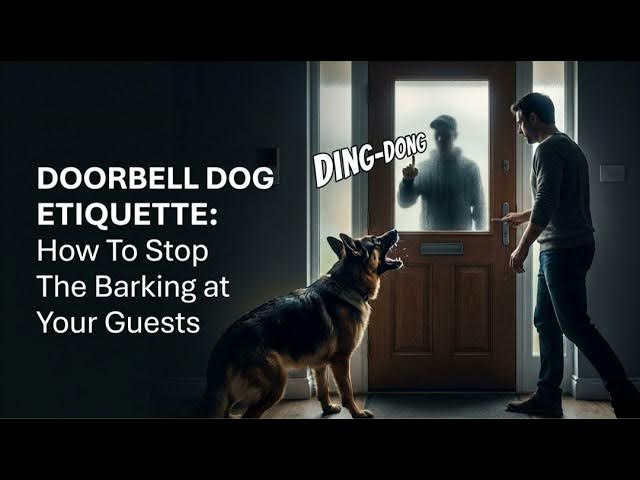
We have all experienced that sudden spike in blood pressure, the one that occurs the moment the doorbell rings. For many pet owners, that simple “ding-dong” is the starting gun for a frantic display of barking, lunging, and general chaos. Most dogs aren’t being “bad“; they are stuck in a cycle of alert-barking or anxiety-driven reactivity.
The goal of this post is to help you move beyond the frustration and provide a roadmap to transform “undesirable door-related behavior“ into graceful, composed greetings. By understanding the psychology behind the bark and implementing these expert strategies, we can embark on a transformative journey together, turning your foyer from a battleground into a welcoming haven.
1. Shifting the Emotional Association (Counter-Conditioning)
To change how your dog acts, you must first change how they feel. In the behavioral world, we call this Counter-Conditioning. Instead of viewing the doorbell as a high-stakes alarm that triggers alert or anxiety, we want your dog to perceive it as a dinner bell for something spectacular.
This requires a counter-intuitive approach: you must reward the dog immediately when the bell rings, even if they have already started barking. By consistently pairing the trigger with a high-value reward, you shift the dog from a state of reactive stress to one of positive anticipation.
Show More Show Less View Video Transcript
0:00
Welcome to another episode by the Dog
0:01
Mind Gears podcast. You know, usually
0:04
when you think about your home, you
0:05
picture a sanctuary. It is your safe
0:08
haven.
0:08
>> Right. A place to completely decompress.
0:10
>> Exactly. A place to unwind, kick your
0:12
shoes off, and relax after a long,
0:14
stressful day.
0:15
>> The house is quiet. But then, ding dong,
0:19
the doorbell rings, and in just a
0:21
fraction of a second, your peaceful
0:23
living room transforms into a literal
0:26
war zone.
0:27
>> Oh, it really does. It is pure chaos. I
0:29
mean, we are talking frantic barking,
0:31
jumping, claws slipping frantically on
0:33
the hardwood floors, the rug getting
0:35
bunched up against the wall. It's like a
0:37
switch flips in their brain, and your
0:40
sweet, cuddly best friend turns into a
0:42
panicked, furry tornado.
0:43
>> It is a phenomenal shift in energy to
0:45
witness, though obviously incredibly
0:47
stressful to live with. For anyone
0:49
listening who deals with this daily,
0:50
navigating that sudden frenzy isn't just
0:52
a matter of teaching a dog to be polite.
0:54
It's a quality of life issue. You are
0:56
trying to reclaim your own living space.
0:59
You want to remove that deep sinking
1:01
feeling of dread every time you, you
1:04
know, order a pizza or host a friend and
1:06
just take the baseline anxiety out of
1:09
answering your own front door.
1:11
>> Today's deep dive is taking us straight
1:13
into the heart of this everyday battle.
1:15
We are drawing from an incredibly
1:17
detailed and insightful piece published
1:19
in Dogazilla magazine by Simon Tracy.
1:22
It's titled Doorbell Dog Etiquette: How
1:24
to Stop the Barking at Your Guests.
1:26
>> It is such a great article.
1:29
>> Okay, let's unpack this. Why is a simple
1:31
electronic chime, a sound that lasts
1:33
maybe 2 seconds, such a massive,
1:36
overwhelming psychological trigger for
1:38
our dogs?
1:38
>> Well, we really have to step back and
1:40
look at the entire situation through the
1:41
lens of canine psychology and positive
1:43
reinforcement. If you just try to yell
1:44
at a dog for barking, I mean, you are
1:46
fighting a losing battle against a
1:48
natural instinct.
1:49
>> That never works anyway.
1:50
>> Exactly. The goal here is behavioral
1:52
modification.
1:53
>> We want to replace those unwanted
1:56
explosive behaviors with calm,
1:58
incompatible alternatives.
2:00
>> But more importantly, we are trying to
2:02
fundamentally change the internal
2:04
emotional response the dog experiences
2:07
the literal second they hear that chime.
2:10
>> Which means we need to stop thinking
2:11
like humans and start getting inside the
2:13
dog's head. Before we can demand that
2:15
they sit quietly, we have to understand
2:17
what that doorbell sound actually
2:19
translates to in their language. It's
2:21
not just a harmless ding, right?
2:23
>> Far from it. The very first step for
2:25
anyone dealing with this is to identify
2:27
the specific nature of the trigger. You
2:29
have to play detective with your own
2:30
dog. Are they reacting aggressively to
2:33
the physical acoustic pitch of the bell
2:35
itself?
2:36
>> Oh, like the actual noise hurts their
2:37
ears
2:38
>> sometimes. Yeah. Or are they reacting to
2:40
the anticipation of what that bell has
2:42
always predicted? Think about their
2:44
lived experience. Every single time that
2:46
sound happens, it has been paired with a
2:48
major environmental shift. Someone new
2:50
is invading their defined territory. Or
2:52
maybe a favorite human is finally
2:54
arriving. To a dog, that chime is a
2:57
highstakes alarm bell demanding
2:58
immediate action.
3:00
>> I mean, if an air raid siren went off in
3:02
my living room every time the mail
3:03
carrier dropped off a package, I'd
3:05
probably be pretty amped up in pacing
3:07
the floors, too.
3:08
So, if the sound equals incoming crisis
3:11
in their brain, the research suggests we
3:14
need to simplify the basics of building
3:16
positive doorbell associations,
3:18
especially for beginners.
3:19
>> Absolutely.
3:20
>> The article recommends introducing the
3:22
doorbell sound at a very, very low
3:24
volume. The objective is to help them
3:27
view the sound not as an alarm, but as a
3:30
cue that something wonderful is about to
3:32
happen to them.
3:33
>> That is the crucial first step. You need
3:34
a dedicated stash of high-value treats.
3:37
And when we say high value, we don't
3:38
mean their dry everyday kibble. We are
3:40
talking about the really good stuff,
3:41
>> like the stinky stuff.
3:42
>> Exactly. Tiny pieces of cheese, boiled
3:45
chicken, or whatever their absolute
3:46
favorite irresistible snack is. The
3:49
protocol is simple, but requires
3:51
precision. The very second that doorbell
3:53
rings, the dog gets a piece of that
3:55
high-value treat. You pair the delivery
3:57
of the food with immediate upbeat verbal
4:00
praise.
4:00
>> So, you're being super positive,
4:02
>> right? a bright yes or good job followed
4:06
by petting or even a quick focused game
4:08
of tug.
4:09
>> Okay, here's where it gets really
4:10
interesting. But wait, I have to stop
4:12
you there because if my dog is actively
4:14
barking their head off at the front door
4:16
just losing their absolute mind and I
4:19
walk over and shove a delicious piece of
4:21
cheddar cheese in their mouth, aren't I
4:24
just rewarding the bad behavior?
4:26
>> I hear that all the time. It feels
4:28
exactly like handing a screaming toddler
4:30
a lollipop in the middle of a grocery
4:32
store tantrum.
4:33
>> What's fascinating here is the
4:35
underlying psychology, specifically the
4:37
mechanics of classical conditioning. It
4:39
is completely counterintuitive to us as
4:41
humans. We think action equals reward.
4:44
But in these early stages of doorbell
4:46
training, you are not actually rewarding
4:48
the physical voluntary action of
4:50
barking.
4:50
>> Okay. So what are we doing then?
4:52
>> You are hacking their involuntary
4:54
nervous system. You are changing the
4:55
underlying emotional response to the
4:58
sound itself.
4:58
>> I'm trying to wrap my head around that.
5:00
So, we're targeting the emotion beneath
5:02
the bark, not the bark itself.
5:04
>> Think of it like Pavlov's dogs. Pavlov
5:06
didn't reward the dogs for salivating,
5:08
right? The dogs just started salivating
5:10
because they associated the bell with
5:11
dinner. Right now, your dog's brain
5:14
hears the doorbell and dumps a cocktail
5:16
of adrenaline and cortisol into their
5:18
system.
5:18
>> Oh, wow. So, it's a physiological
5:20
response.
5:20
>> Totally. They feel panic or intense
5:22
arousal and the barking is just the
5:24
symptom of that internal chemical dump.
5:27
When you consistently give them a piece
5:28
of chicken the exact millisecond the
5:30
bell rings, you are actively rewiring
5:33
their brain chemistry.
5:34
>> So the bell means chicken, not intruder.
5:36
>> Precisely. You are changing the
5:38
association so that the doorbell
5:40
triggers positive, calm, happy feelings
5:42
rather than anxiety or fear. Once their
5:45
internal emotional state shifts from
5:47
intruder alert to, "Oh, I hear a chime.
5:49
It's chicken time." The urge to bark
5:51
naturally vanishes. You cure the
5:53
disease, the anxiety, and the symptom.
5:55
The barking simply fades away.
5:57
>> That is a massive perspective shift. We
6:00
aren't bribing them to stop barking. We
6:02
are changing how they feel so they don't
6:04
even want to bark in the first place.
6:06
Yeah.
6:06
>> So, assuming we put in the reps and
6:08
shift that underlying emotion, they
6:10
still need to know what they're supposed
6:11
to do with their body when visitors
6:13
arrive,
6:13
>> right? They need a job.
6:15
>> Exactly.
6:15
>> Yeah. The source material outlines a
6:17
really clear three-step training process
6:20
for managing this initial doorbell
6:22
excitement and building up to polite
6:24
greetings. And step one is to identify
6:27
and redirect the excitement. Right.
6:29
>> Yeah. Breaking down that three-step
6:31
process is what takes you from a dog
6:33
that just sits there waiting for chicken
6:35
to a dog that actually exhibits polite
6:37
household manners. Even if they are
6:40
expecting a treat, their momentum is
6:42
going to pull them toward that front
6:43
door. You have to step in and
6:45
immediately interrupt that forward
6:47
motion.
6:47
>> You redirect their attention back to
6:49
you. And the research shares three fast,
6:51
highly effective ways to distract an
6:53
overexited dog immediately in this
6:55
scenario. First, you can intercept them
6:57
with a positional cue like sit or place
7:00
before they reach the entryway.
7:01
>> That's a great one.
7:02
>> Second, if they've already blown past
7:04
you and are running down the hallway,
7:06
you can use a highly reinforced come or
7:09
recall command to call them completely
7:11
away from the door. that physically
7:13
breaks their visual focus on the guest,
7:16
>> which is huge for breaking that
7:17
fixation.
7:18
>> And third, if they are a dog that gets
7:21
very mouthy or nippy when excited, you
7:23
can instantly provide them with a
7:24
special toy or a chew. It redirects all
7:27
that frantic, anxious jaw energy onto
7:29
something appropriate.
7:31
>> Those are fantastic circuit breakers.
7:33
They stop the physical momentum. But
7:35
once you've successfully interrupted
7:37
that initial rush, you have to move to
7:39
step two, which is building the actual
7:41
muscle of self-control.
7:42
>> Building the muscle. I like that.
7:44
>> Yeah. This involves gradually extending
7:46
the duration of their calm behavior. You
7:48
ask your dog to hold that sit or stay in
7:51
their designated area for slightly
7:52
longer periods each time, very slowly,
7:55
increasing the gap of time between the
7:56
doorbell ringing and when they finally
7:58
receive their reward.
7:59
>> So, what does this all mean? It's
8:01
exactly like building muscle memory at
8:02
the gym. You don't walk in on your first
8:05
day and try to bench press 200 lb. You
8:08
would fail and you might get hurt. You
8:10
start with just the empty bar.
8:12
>> Exactly. You practice the form before
8:14
adding weight.
8:14
>> Right. With a dog, you don't ask them to
8:16
hold a sit for 5 minutes while a
8:18
stranger walks in. You ask them to hold
8:20
it for 2 seconds, then 5 seconds. You
8:23
have to build the literal neurological
8:25
muscle of self-control second by second,
8:28
rep by rep.
8:29
>> That is the perfect way to visualize it.
8:31
We often assume self-control is an
8:33
innate trait in dogs, but especially
8:36
when faced with highly stimulating
8:37
situations like a stranger appearing in
8:39
their territory. It is purely a learned
8:42
skill.
8:42
>> It takes effort for them,
8:44
>> immense cognitive energy to hold a
8:46
position when their instincts are
8:48
screaming at them to investigate is
8:49
exhausting. It requires patience and
8:52
extreme consistency from the owner to
8:54
help them build up that tolerance. Which
8:56
brings us to step three, reinforcing the
8:59
calm behavior for the long haul.
9:01
>> Right? Because once they're actually
9:02
proficient at holding that calm sit or
9:04
staying on their mat while the door
9:06
opens, you reward the ultimate success.
9:10
Over time, that reward evolves. Maybe
9:12
you invite them over to finally greet
9:14
the guests politely, or they get to
9:15
enjoy that special chew toy on their bed
9:17
while the visitors are hanging out in
9:19
the living room.
9:19
>> Yes, you transition to real life
9:21
rewards. Slowly over weeks and months,
9:25
you phase out the highv value cheese and
9:27
chicken, relying on verbal praise and
9:30
those natural life rewards to maintain
9:31
those manners.
9:32
>> On paper, it sounds incredibly
9:34
straightforward, but taking that theory
9:36
and making it work in a chaotic
9:37
household is where most people hit a
9:39
wall.
9:39
>> I'm so glad you brought that up. That
9:41
three-step process sounds brilliant in a
9:43
controlled environment. But let's talk
9:44
about the reality of modern life. How do
9:47
you actually integrate this training
9:48
into a daily home routine? If I'm a busy
9:51
professional, I barely have time to make
9:53
my coffee in the morning, let alone run
9:55
a highly structured 45minute doggy boot
9:58
camp every afternoon.
10:00
>> Well, the secret is that you don't need
10:01
45 minutes. It all comes down to
10:03
proactively setting up the environment
10:05
so that the right choice is the easiest
10:07
choice for the dog. You begin by solidly
10:10
teaching the place command outside of
10:12
any doorbell context,
10:14
>> right before the trigger even happens.
10:15
You set up a specific mat or a
10:17
comfortable dog bed in a quiet area of
10:19
your home and you intentionally position
10:21
it away from the direct line of sight
10:23
and the chaos of the front door.
10:25
>> And the breakdown on how to teach this
10:27
is so practical. Use a consistent verbal
10:30
cue like place or bed. You literally
10:33
take a treat, hold it to their nose, and
10:36
guide them onto that spot. The second
10:38
all four paws are on the mat, you drop
10:40
the treat and praise them. Then you take
10:42
one step away. And if they stay, you
10:44
step back and reward.
10:46
>> You were basically creating a highly
10:47
rewarding magnetic target for them in
10:49
the house.
10:49
>> Once that place command is rock solid,
10:51
meaning you can say place from across
10:53
the room, they trot right over to it.
10:55
You finally incorporate the doorbell.
10:57
Ideally, you have a friend or family
10:58
member stand outside and physically ring
11:00
the bell. The bell rings, you say place.
11:03
>> And what if they actually do it?
11:04
>> If the dog goes to the mat and holds
11:06
position, you rain down generous
11:08
rewards. If they break position or run
11:10
to the door barking, you don't yell or
11:12
scold. you just calmly, silently take
11:15
their collar, lead them back to the mat,
11:17
reset the scenario, and try again.
11:19
>> I hear that, but I'm going to push back
11:21
on behalf of the listeners. What if you
11:23
live entirely alone? Or what if you
11:26
don't have a friend willing to stand on
11:28
your porch and ring the doorbell 50
11:30
times on a random Tuesday night just so
11:32
you can practice? If we want to offer
11:35
practical steps to weave training
11:37
exercises into your busy daily schedule,
11:39
we need a solo strategy. This raises an
11:42
important question about
11:43
resourcefulness. You absolutely do not
11:46
need an assistant if you set your
11:47
environment up cleverly. You can find
11:49
highquality doorbell sound recordings
11:51
right on your smartphone. Or if the
11:53
sound of the deadbull is the trigger,
11:54
you can just walk over and jiggle the
11:56
lock yourself. The key is simulating the
11:58
trigger consistently.
11:59
>> Playing the sound from a YouTube video
12:01
while you're just going about your
12:03
evening is such a low friction way to
12:05
train. If we were to provide a concrete
12:08
checklist for consistent daily practice
12:11
to build these calm behaviors, it would
12:13
be pretty streamlined.
12:14
>> What's on the checklist?
12:16
>> One, have that designated place mat
12:18
permanently set up in the living room.
12:20
Two, keep a small sealed jar of those
12:22
high-value treats sitting right next to
12:25
the training area so you aren't
12:26
scrambling to find them. Three, execute
12:28
incredibly short 2 to three minute micro
12:31
sessions using a recorded doorbell sound
12:34
during your standard home routines.
12:36
>> Those micro sessions are where the real
12:37
magic happens. You weave these steps
12:39
into standard home routines so it never
12:41
feels like a massive chore. You play the
12:44
doorbell sound on your phone right
12:45
before you put their dinner bowl down.
12:47
You play it while you wait for your
12:48
coffee to brew in the morning.
12:50
>> It's just a few minutes a day.
12:51
Integrating reward-based training into a
12:54
normal busy daily schedule doesn't
12:56
require clearing your calendar. It
12:58
requires consistency. Every single time
13:01
that specific bell rings, whether it's a
13:03
real person at the door or a simulation
13:05
from your phone, it has to result in the
13:07
exact same protocol for the dog.
13:09
>> Now, we do have to acknowledge that not
13:11
every listener has just one easily
13:13
distracted Labrador. Sometimes the
13:16
situation is vastly more complex.
13:18
Consider a multi-dog household. When
13:20
that doorbell rings, it's not just one
13:22
dog reacting, it's an entire stampede.
13:25
>> Oh, multi-dog dynamics change the
13:27
training landscape entirely because
13:28
arousal and excitement are highly
13:30
contagious among dogs. When offering
13:33
tips for managing several dogs at the
13:34
door during training, there is one
13:36
non-negotiable rule,
13:38
>> which is
13:38
>> separate training sessions are an
13:40
absolute must.
13:40
>> It's like trying to teach a chaotic
13:42
classroom of kids. If one kid starts
13:44
acting up and throwing paper airplanes,
13:46
the whole room descends into madness.
13:48
You can't teach the lesson. You have to
13:50
pull them aside and tutor them
13:51
one-on-one.
13:52
>> That's a great analogy. Individual
13:54
sessions are non-negotiable because they
13:57
prevent that frantic excitement from
13:58
spreading like a virus between your
14:00
dogs. If one dog barks at the door, the
14:03
second dog often starts barking purely
14:05
in response to their packmates energy.
14:07
>> They might not even care about the door.
14:09
>> Exactly. Each dog in your home has a
14:11
different learning speed, different
14:13
thresholds for excitement, and different
14:15
triggers. They require your undivided
14:17
attention to succeed without the intense
14:19
distraction of their siblings hyping
14:21
them up.
14:22
>> Let's pivot to something even more
14:24
critical. We need to outline key safety
14:26
measures for training reactive dogs. If
14:29
a listener's dog isn't just happily
14:31
excited, but is actively guarding the
14:33
door, lunging, or acting aggressively
14:36
toward strangers, the stakes are so much
14:38
higher.
14:39
>> Safety is paramount. It protects your
14:41
guests, and frankly, it protects your
14:42
dog from the consequences of a bite. For
14:45
reactive dogs, management during these
14:47
doorbell training sessions has to be
14:49
incredibly strict.
14:50
>> What does that look like?
14:51
>> Keeping the dog on a secure leash or a
14:53
sturdy body harness during the early
14:55
stages of training is essential. It
14:57
gives you immediate physical control to
14:59
prevent them from rushing the door or
15:00
making contact with a visitor.
15:02
>> The research also tackles a really
15:04
sensitive topic. It explains exactly
15:06
when to use leashes or muzzles to
15:08
protect guests during training. If a dog
15:12
has any history of nipping, biting, or
15:14
redirecting their frustration when they
15:15
get over excited, a well-fitted basket
15:18
style muzzle is a phenomenal tool.
15:21
>> It really is.
15:22
>> There is a stigma around muzzles, but
15:24
using one isn't cruel. It is deeply
15:26
responsible. It provides a necessary
15:29
layer of protection, ensuring your
15:30
guests maintain a safe distance, and no
15:33
one gets hurt while you work on building
15:34
those rocksolid door manners.
15:36
>> It is the ultimate safety net. But
15:38
beyond immediate physical management
15:40
with a muzzle or leash, you have to
15:42
address the root cause of the behavior
15:44
for dogs with deep overprotective
15:46
instincts, you need to focus heavily on
15:48
ways to build their underlying
15:49
confidence.
15:50
>> What does building a dog's confidence
15:52
actually look like in practice?
15:54
>> Well, it primarily comes down to
15:55
controlled socialization. Proper
15:57
socialization helps dogs fundamentally
16:00
view visitors as non-threatening. You
16:02
systematically expose them to a wide
16:04
variety of people, sounds, and
16:06
situations, but you do it at a distance
16:08
where the dog feels totally safe, and
16:10
you pair it with immense positivity.
16:12
>> So, they learn the world isn't out to
16:13
get them.
16:14
>> Over time, their worldview shifts. They
16:16
learn that a new person entering their
16:18
space isn't a dangerous intruder they
16:20
need to fight off, but simply a neutral
16:22
guest.
16:23
>> There's another foundational point
16:25
regarding general hyperactivity that
16:26
applies to almost every dog, reactive or
16:29
not. It's the old saying, a tired dog is
16:31
a calm dog. Exploring how daily physical
16:34
exercise promotes a calmer home
16:36
environment is huge. If you want to know
16:38
how extra daily exercise lowers doorbell
16:40
reactivity, it all comes down to
16:42
baseline energy levels.
16:44
>> Oh, without a doubt. If you detail
16:45
specific ways to burn off your dog's
16:47
extra energy, the timing of that
16:49
exercise becomes a powerful tool. If you
16:51
know you are having dinner guests over
16:52
at 7:00 p.m., you take your dog for a
16:55
vigorous run or an intense game of fetch
16:57
at 5:30 p.m.
16:58
>> Drain the battery before the guests
17:00
arrive.
17:00
>> You are actively burning off their extra
17:02
physical energy before you even start
17:04
the training scenario. A dog with a
17:06
drained physical battery simply has less
17:08
fuel to burn on explosive barking and
17:11
jumping when the doorbell finally rings.
17:13
And we can't forget mental stimulation.
17:16
Snuffle mats, puzzle toys, advanced
17:19
trick training. Mental fatigue is
17:21
arguably just as effective as physical
17:23
fatigue at keeping dogs calm when
17:25
visitors arrive. A dog that just spent
17:27
30 minutes using their nose and brain to
17:29
figure out a complex puzzle feeder is
17:31
going to be significantly less likely to
17:34
lose its mind at the sound of a chime.
17:36
They are intellectually satisfied.
17:38
>> But, and this is crucial, we must
17:40
recognize our own limits as owners. What
17:43
happens when you have tried the high-v
17:44
value treats, you've used the leashes,
17:46
you've implemented rigorous physical and
17:48
mental exercise, you've practiced the
17:50
place command daily, and your dog is
17:52
still dangerously lunging at the front
17:54
door.
17:54
>> Yeah. At what point do you step back and
17:56
say, "I am out of my depth here."
17:58
>> Yeah.
17:58
>> If we connect this to the bigger
18:00
picture, recognizing when it is
18:02
appropriate to seek help from
18:03
professionals is the hallmark of a great
18:05
dog owner. The research is very clear
18:08
about when owner should consult a
18:10
professional trainer for safety.
18:12
>> What are the red flags?
18:14
>> If the aggressive or frantic behavior
18:16
persists despite consistent training, if
18:18
you as the owner feel overwhelmed or
18:20
frightened by the process, or critically
18:22
if there is ever any safety concern
18:24
regarding aggression, lunging, or
18:26
biting, you need to seek out a certified
18:29
dog trainer or a veterinary behaviorist.
18:31
>> Because a professional isn't just going
18:33
to give you generic advice. They can
18:35
provide a highly tailored objective plan
18:38
and troubleshoot the specific roadblocks
18:40
in your home's layout or your dog's
18:42
unique psychology without putting anyone
18:44
in danger. It's about knowing your
18:46
limits and doing what's absolutely best
18:47
for your dog. Abs.
18:49
>> You know, we've spent this entire deep
18:50
dive focusing intensely on how to change
18:53
the dog's reaction to the doorbell.
18:55
We've analyzed their psychology, their
18:57
physical exercise, their mental
18:58
routines. But reading through all of
19:01
this leaves me with a final provocative
19:03
thought for everyone listening. How much
19:05
of our dog's frantic doorbell frenzy is
19:08
actually just a direct mirror of us?
19:10
>> Ooh, that's a great point.
19:12
>> Think about the human reaction. The
19:14
doorbell rings, we gasp, we shout, "I'll
19:16
get it." We scramble off the couch. We
19:18
rush frantically down the hallway. Maybe
19:20
we're stressed about the house being
19:21
messy.
19:22
>> From the dog's perspective, the humans
19:24
are panicking. So, this must be an
19:26
emergency. Perhaps the very first step
19:28
in all of this training is actually
19:30
training ourselves to just stop, take a
19:32
deep, calm breath, and walk slowly to
19:35
the door.
19:35
>> A calm, grounded owner is the absolute
19:38
foundation of a calm dog. If you
19:40
escalate your own energy, they will
19:41
match it and double it. It's a powerful
19:43
realization that true etiquette often
19:45
starts at the other end of the leash.
19:47
>> For more information, visit the original
19:48
article we were talking about by
19:50
Dogazilla magazine. Jump at dogazila.com
19:52
to read much more in-depth info. And if
19:55
you have any questions, you can contact
19:56
them with questions.
#Pets & Animals