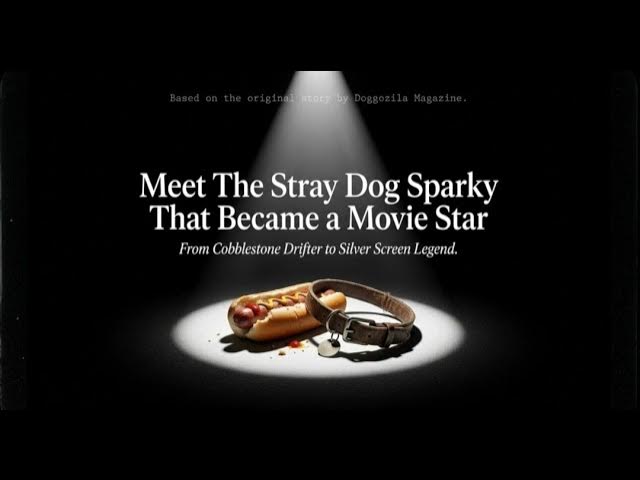
Up next in 10

Before the trailers and high-definition lenses arrived, Sparky’s world was measured in the rhythmic click of paws on sun-warmed cobblestones and the grace of a well-timed scavenge.
In a quiet corner of the world where the days bled into one another with predictable stillness, he was a ghost in the machinery, a familiar yet invisible fixture of the village streets.
However, this unassuming existence was destined to collide with the high-stakes chaos of a professional film production.
Sparky’s metamorphosis from a nameless scavenger to a cinematic sensation is more than a "rags-to-riches" tale; it is a profound study in how one animal’s presence can dismantle systemic apathy and force a community to rewrite its moral code.
The Kinetic Spark: Why One Glance Changed the Director’s Mind?
Sparky’s entry into the professional world was a masterclass in serendipity. While navigating his usual haunts, he wandered directly into the pressurized environment of a live film set.
Show More Show Less View Video Transcript
0:00
Welcome to another episode of the Dog
0:01
Mind Gears podcast. Today we will talk
0:04
about the stray dog that overnight
0:06
transformed into a movie star.
0:09
>> Yeah, it really is just um such an
0:12
unbelievable story.
0:13
>> It is. I mean, imagine millions of
0:15
dollars of camera equipment, a super
0:18
strict shooting schedule, and you know,
0:20
a completely panicked crew, and they all
0:22
just grind to an absolute halt.
0:24
>> Right. And not because of like a diva
0:26
actor demanding a bigger trailer or
0:28
anything.
0:29
>> Exactly. or or some sudden thunderstorm.
0:31
It was literally because of a hungry,
0:33
nameless street dog just looking for a
0:35
scrap of bread.
0:36
>> It's wild to think about.
0:37
>> So today's deep dive is um it's an
0:40
exploration of how that chance encounter
0:42
on a sleepy village street did so much
0:44
more than just create a cinematic
0:46
sensation.
0:46
>> Yeah, it really did.
0:47
>> We're looking at the mechanics of how
0:49
one single animal fundamentally
0:51
re-engineered an entire community's
0:53
moral compass.
0:54
>> And it's a phenomenal case study. We are
0:56
pulling from two core sources today for
0:58
this deep dive. There's a wonderfully
1:00
detailed uh analytical piece by Simon
1:04
Tracy in the award-winning Dogazilla
1:06
magazine. Yeah.
1:07
>> And also some great supplemental
1:09
reporting from Doggy Delight.
1:10
>> Awesome sources. And you know what's so
1:13
compelling here is that this isn't just
1:15
some heartwarming fairy tale.
1:17
>> No, not at all. It operates on a much
1:19
deeper sociological level. I mean, you
1:21
have the immediate visceral story of a
1:24
stray rising to fame. Sure.
1:26
>> Right. The Hollywood stuff.
1:27
>> Exactly. But beneath that, you have a
1:29
masterclass in how um fleeting emotional
1:33
responses can actually be converted into
1:36
permanent infrastructural change within
1:37
a community,
1:38
>> which is so rare. So, if you look at the
1:40
notes from Dogazilla magazine, they
1:41
describe Sparky's original environment
1:44
just to give us a baseline.
1:45
>> Yeah. Set the scene a bit.
1:46
>> So, for you listening, picture a quaint,
1:48
slow-paced village. Sparky was living
1:50
this very modest existence, just, you
1:53
know, scavenging for scraps, maybe
1:55
getting occasional friendly paths from
1:56
people walking by on the cobblestone
1:58
streets.
1:58
>> He was essentially invisible, right?
2:00
Like in the grand scheme of things,
2:02
>> totally invisible. He was just part of
2:04
the background noise of village life,
2:06
>> just a dog navigating a daily survival
2:09
routine.
2:09
>> And understanding that survival routine
2:11
is actually critical to understanding
2:13
what happens next.
2:15
>> How so? Well, a street dog like Sparky,
2:18
he doesn't have the luxury of just
2:19
zoning out. Their survival depends
2:22
entirely on their ability to read the
2:24
environment.
2:25
>> Ah, right. Like reading human
2:26
intentions.
2:27
>> Exactly. Like, are you going to chase me
2:29
away or uh are you going to drop a piece
2:31
of cheese? They develop this hyper
2:34
awareness of micro expressions and body
2:36
language,
2:36
>> which is so fascinating. And I guess
2:38
that brings us to the inciting incident
2:40
because one day a massive film
2:42
production just rolls into this quiet
2:44
village. And talk about a shock to the
2:46
system,
2:46
>> right? To a street dog, a film set
2:49
isn't, you know, Hollywood glamour. It's
2:51
essentially a high stakes construction
2:52
site.
2:53
>> Oh, absolutely.
2:54
>> There these massive blinding lights,
2:55
heavy cables dragging everywhere, and
2:57
hundreds of unfamiliar faces rushing
2:59
around with walkie-talkies just shouting
3:01
directions. For a dog, I mean, imagine
3:04
how disorienting that must be. It's pure
3:06
sensory overload.
3:07
>> For a stray animal, it's practically an
3:09
alien planet. yet sparky, driven by what
3:12
the sources basically describe as pure
3:14
curiosity, he just wanders right into
3:17
the middle of this bustling environment,
3:19
>> just casually strolls in.
3:20
>> Yeah. And the crew's immediate reaction
3:22
is, well, it's exactly what you would
3:24
expect from professionals on a tight
3:27
schedule,
3:27
>> right? Panic.
3:28
>> Total panic. They scramble to shoe him
3:30
away. I mean, they have a budget.
3:32
They're losing daylight. And an
3:34
unpredictable street dog is just a
3:36
massive logistical and physical
3:38
liability. But he didn't run away. The
3:40
sources note that his undeniable charm
3:42
somehow just diffused all that tension.
3:44
>> He wasn't aggressive or chaotic at all.
3:45
>> Exactly. And then we get this pivotal
3:48
moment of serendipity. Sparky locks eyes
3:51
with the leading actor.
3:52
>> Oh, this is the best part.
3:54
>> It really is. The actor recognizes
3:56
something unique, stops what he is
3:57
doing, and just kneels down to offer a
4:00
gentle pat. And the simple act of
4:02
kindness instantly calms the nervous
4:04
stray. It's a fascinating display of
4:06
non-verbal communication actually.
4:08
>> Really break that down for us.
4:10
>> So the actor essentially lowered his
4:12
physical profile, right? He offered a
4:15
gesture of submissive goodwill and that
4:18
immediately signal to Sparky that this
4:20
super chaotic environment wasn't
4:22
actually a threat.
4:24
>> Wow. But okay, I have to challenge the
4:26
logistics of what happens next. Yeah.
4:28
Because it's a high stress film set.
4:29
>> Oh, for sure.
4:30
>> Millions of dollars are on the line.
4:32
Every minute of delayed production costs
4:34
thousands of dollars. Why did the
4:36
director just say, "Oh, that's a sweet
4:38
moment. Now, please call animal control
4:39
so we can shoot the scene."
4:40
>> Right. Like a normal person would.
4:42
>> Yeah. I mean, how does a director
4:45
legally and financially ensure an
4:47
unpredictable street animal for a
4:49
multi-million dollar shoot instead of
4:51
just, I don't know, bringing in a
4:52
trained Hollywood stunt dog?
4:54
>> Well, it's a logistical nightmare.
4:56
You're absolutely right. If we look
4:57
closely at Simon Tracy's piece, he notes
5:00
the mild skepticism from the crew.
5:02
>> Mild skepticism. That sounds like an
5:04
understatement.
5:04
>> Oh, it is. In industry terms, mild
5:07
skepticism means the line producers and
5:09
the assistant directors were probably
5:11
having sheer panic attacks.
5:12
>> I bet.
5:13
>> But this is where the director's
5:14
specific creative vision overrides the
5:17
financial anxiety. The director was
5:19
watching this genuine unscripted bond
5:22
form between his leading actor and this
5:25
street dog.
5:26
>> He saw the magic happening in real time.
5:28
>> Exactly. He saw Sparky's natural
5:30
charisma. He recognized that, you know,
5:33
you can train a dog to do a backflip,
5:35
but you cannot train a dog to
5:36
manufacture genuine soulful affection.
5:38
>> Wow, that is such a good point. So the
5:41
director calculated that the risk of
5:42
production delays was worth the payoff
5:45
of capturing that raw authentic
5:46
connection on film.
5:48
>> But still it is a colossal gamble. I
5:50
mean you are banking the emotional core
5:52
of your film on an animal that was
5:55
literally digging through a trash can
5:56
that very morning.
5:57
>> Yeah, it sounds crazy when you put it
5:59
like that.
6:00
>> So the director wins the argument with
6:01
the producers, but the cameras still
6:03
have to roll. Mhm.
6:04
>> And a dog that can sit nicely for a
6:06
piece of bread doesn't automatically
6:07
know how to hit a T- mark on a sound
6:09
stage while a camera crane swoops over
6:11
his head
6:12
>> exactly. And this is where we have to
6:14
examine the actual mechanics of Sparky's
6:16
performance because film industry
6:19
professionals were utterly astanded by
6:21
him.
6:22
>> How did he do it? Well, usually you need
6:24
highly trained animals, handlers with
6:25
clickers, hidden treats, and you know,
6:28
months of preparation just to get a dog
6:30
to walk from point A to point B without
6:33
looking directly at the camera,
6:34
>> right? It's a huge process.
6:36
>> But Sparky just walked in and did it.
6:38
>> How though? I mean, the articles say he
6:40
intuitively understood his role and
6:42
moved with grace,
6:44
>> but what is the actual mechanism there?
6:46
>> Right. It's not magic.
6:47
>> Exactly. to thrive in that environment.
6:49
It's less like someone accidentally
6:51
walking onto a Broadway stage while
6:54
looking for the bathroom and getting the
6:55
lead role and more like an elite poker
6:57
player walking into a chaotic casino.
7:00
>> Oh, I like that analogy.
7:01
>> He just knew exactly how to read the
7:02
tells of everyone in the room.
7:04
>> That is actually a perfect analogy for
7:06
what behavioral experts call nonverbal
7:08
emotional mirroring.
7:10
>> Nonverbal emotional mirroring.
7:12
>> Yeah. Sparky wasn't hitting marks
7:14
because he read the script, right? He
7:16
was hitting marks because his street
7:17
survival instincts made him hyper
7:19
attuned to human ey lines and body
7:21
weight shifts.
7:22
>> Oh wow.
7:23
>> So when the lead actor moved with
7:25
intention to a specific spot on the
7:27
floor, Sparky naturally followed the
7:29
visual and physical cues
7:31
>> because that was his safe person.
7:33
>> Exactly. He stayed in the scene because
7:35
his entire psychological framework was
7:37
built on staying close to the human who
7:39
had established a bond of trust and
7:41
safety with him.
7:43
>> That makes so much sense. So, the
7:45
director isn't capturing a train trick.
7:47
He is capturing a real-time survival and
7:49
bonding instinct.
7:50
>> Yes.
7:51
>> You know, the Doggy Delight article
7:52
specifically highlights his soulful
7:55
eyes. They write that he used his eyes
7:57
to convey deep feelings that resonated
7:59
profoundly with viewers.
8:01
>> Oh, absolutely.
8:02
>> It wasn't just a dog barking on command.
8:03
It was a dog actively communicating with
8:05
his scene partners.
8:06
>> And that level of active communication
8:08
relies heavily on eye contact, which is
8:10
actually something many trained dogs
8:12
struggle with. Really? I didn't know
8:14
that.
8:14
>> Yeah. Trained dogs often look off camera
8:17
at their handlers for the next cue. But
8:19
Sparky was looking directly at the
8:21
actors.
8:22
>> Oh, because he's actually engaging with
8:23
them, not waiting for a treat.
8:25
>> Right. And that raw emotion translates
8:28
beautifully through a camera lens. The
8:30
director managed to capture that
8:32
perfectly because he didn't try to
8:34
overdirect the dog. He just let the
8:36
cameras roll while Sparky reacted
8:38
naturally to the human emotion in the
8:40
room.
8:40
>> That is just incredible. And actually,
8:42
that brings up a behind-the-scenes
8:43
detail that I found absolutely
8:45
mind-blowing.
8:46
>> The off- camerara stuff.
8:48
>> Yes, Sparky didn't just act when the
8:50
camera was on. The Dogazilla article
8:52
points out that he made a habit of
8:54
comforting nervous actors before their
8:56
scenes.
8:57
>> He really did.
8:58
>> He served as this consistent calming
9:00
presence on set.
9:01
>> This touches on the fascinating canine
9:03
ability to detect human anxiety. Dogs
9:05
have highly sensitive olfactory
9:08
receptors that can actually smell the
9:10
chemical changes in human sweat when we
9:12
are stressed.
9:12
>> Wait, they can smell our stress.
9:14
>> Yeah. Specifically, the release of
9:16
cortisol. Combine that with Sparky's
9:18
ability to read tense body language. And
9:20
you have a dog that knows exactly when
9:22
someone is anxious.
9:23
>> So, you have these seasoned professional
9:25
actors who are perhaps stressing over a
9:29
difficult, emotionally draining scene.
9:31
Their cortisol levels are spiking and
9:34
this sweet stray just wanders over and
9:36
leans his weight against their leg.
9:38
>> Precisely. It's called deep pressure
9:39
therapy and it completely changed the
9:41
atmosphere on set.
9:42
>> I can imagine.
9:43
>> By grounding the actors, Sparky fostered
9:46
an environment filled with genuine
9:47
emotion and unanticipated depth. The
9:50
actors weren't just performing opposite
9:52
a prop. They were interacting with a
9:54
deeply empathetic creature.
9:56
>> And you can see the results of that
9:57
environment right on the screen. When
9:58
the film was released, the critical
10:00
reception was just phenomenal.
10:02
>> It was universally praised.
10:04
>> Yeah. The film critics didn't just write
10:05
it off as some cute gimmick. They
10:07
praised his authenticity and the
10:09
profound warmth he brought to the film.
10:11
He elevated the entire movie from just
10:14
having a minor canine addition to making
10:16
the dog a central driving force of the
10:19
film's narrative.
10:20
>> He really did. He fundamentally
10:22
redefined the possibilities for
10:24
four-legged actors in the industry. The
10:26
reception proved the director's massive
10:28
gamble was totally correct. Sparky
10:30
gained a massive fan base with many
10:33
viewers and critics arguing his scenes
10:35
were the absolute highlight of the movie
10:37
>> because his performance broke through
10:39
the screen. Yeah. It was rooted in
10:41
reality.
10:42
>> Exactly.
10:43
>> So the film wraps, the circus leaves
10:45
town, the budget is spent, the crew
10:48
packs up the lights, and the village
10:49
goes quiet again.
10:50
>> Back to normal.
10:51
>> Right. And usually when an animal
10:52
becomes a famous movie star, the story
10:55
ends there. The village just goes back
10:57
to normal, maybe with a fun story to
10:59
tell at the local pub. A sequel gets
11:01
green lit, the dog gets a fan base, and
11:03
that's it.
11:04
>> Which is a nice story on its own.
11:06
>> It is. But Sparky's departure actually
11:08
created a massive vacuum in this town,
11:11
which transitions us into the most
11:12
important part of this deep dive.
11:14
>> Yes, this is where the narrative shifts
11:15
from a Hollywood fairy tale to a
11:17
profound sociological movement. But just
11:20
to touch on the immediate aftermath,
11:22
there is a personal happy ending first.
11:25
Sparky did not go back to scavenging on
11:27
the cobblestones. He was adopted by one
11:29
of the film's actors, giving him a
11:31
loving forever home.
11:32
>> It is a beautiful resolution for Sparky
11:34
personally. But his personal happy
11:37
ending was just the catalyst for the
11:39
village. The movie shown a massive
11:41
unavoidable spotlight on the struggles
11:43
of stray animals.
11:44
>> It really opened their eyes. Suddenly,
11:46
the entire village along with all the
11:48
audiences watching worldwide was
11:51
confronted with the reality of what life
11:53
is like for a dog like Sparky.
11:55
>> What the film did was recontextualize
11:57
the strays. Before the film, the dogs
11:59
were just background noise, pests, even
12:01
>> just a nuisance on the street.
12:03
>> Exactly. But the film took one of those
12:05
pests, framed him with lighting and
12:07
beautiful music, and showed his deep
12:09
capacity for love and loyalty. And as
12:12
that awareness grew, the local community
12:14
experienced a visceral emotional
12:17
reaction.
12:17
>> They saw the potential in all of them.
12:19
>> Yeah. People were so moved by his plight
12:21
on screen that they started looking at
12:23
the nameless strays on their own streets
12:25
differently.
12:25
>> And the shelter saw a massive surge in
12:28
local adoptions. People were literally
12:30
opening their homes to other strays,
12:33
significantly reducing the homeless pet
12:35
population in the area.
12:36
>> It was an incredible wave of emotional
12:38
charity.
12:39
>> Emotional charity. Yeah, that is the
12:40
exact right term. People see a moving
12:43
film, they feel a spike of empathy, and
12:46
they act on it by adopting a dog.
12:48
>> Right? But the problem with emotional
12:49
charity is that it is often fleeting.
12:51
Empathy spikes and then it fades as
12:54
daily life takes over again.
12:55
>> And that is exactly what I want to dig
12:57
into because a surge in adoptions is
12:59
great for the dogs in the shelter that
13:01
month. But how did the village ensure
13:03
this wasn't just a passing fad? How do
13:06
you take a temporary spike in public
13:08
empathy and forge it into actual
13:10
long-term infrastructure?
13:12
>> That is the hardest transition for any
13:14
community to make. Moving from emotional
13:15
charity to institutional empathy.
13:18
>> Institutional empathy.
13:19
>> I like that.
13:19
>> And the village mobilized beautifully to
13:21
make that leap. They didn't just stop at
13:23
adopting dogs. They recognized the need
13:25
for a sustainable support system. They
13:27
launched specific long-term initiatives
13:30
to tackle the root of the problem. We
13:32
are talking about organizing rigorous
13:34
fundraising events to financially
13:37
support the local shelters. Yeah. Which
13:39
previously had operated on a total
13:40
shoestring budget.
13:41
>> Exactly. They also ran sustained public
13:43
awareness campaigns. They organized
13:46
volunteer-based rescue missions to
13:48
actively go out, identify, and support
13:50
more strays.
13:52
>> Wow.
13:52
>> They built a network of care that didn't
13:54
rely on just one person feeling sad
13:56
after watching a movie, but on a
13:58
dedicated community framework. They
14:00
institutionalized the empathy. They
14:02
created a system where the care of these
14:04
animals was woven into the civic duties
14:07
of the town.
14:08
>> And you know, for any listeners
14:09
wondering how they can start local
14:11
animal aid projects like this village
14:13
did.
14:13
>> Yes. What are some simple steps for
14:15
listeners to begin their own local
14:17
rescue group?
14:17
>> Well, it's all about starting small.
14:19
First, you just connect with like-minded
14:21
neighbors. You don't need a huge budget.
14:23
Start a local social media group to
14:24
organize small volunteer missions like
14:26
dropping off food or building winter
14:28
shelters. It's getting the ball rolling,
14:30
>> right? And for new pet owners looking to
14:32
connect, local rescue groups usually
14:34
host weekend meet and greets. It's a
14:36
great way to find joy in adopting rescue
14:38
dogs while also building a community.
14:40
>> And speaking of adopting, what about the
14:42
actual bonding part? Because it can be
14:44
intimidating. Do trainers have tips on
14:46
bonding with rescued animals using these
14:49
concepts we've talked about?
14:50
>> Oh, absolutely. To explain it in simple
14:52
language suitable for new pet owners?
14:54
>> Yeah. You want to mirror what that actor
14:56
did on set. Lower your physical profile.
14:59
Don't force eye contact immediately if
15:01
the dog is scared.
15:02
>> Let them come to you.
15:03
>> Exactly. Building trust with a rescued
15:05
dog creates lifelong happiness, but it
15:08
takes patience. You just offer a calm
15:10
presence and let them read your
15:11
non-verbal cues that they are safe.
15:13
>> It's just amazing how simple advice for
15:15
potential owners considering adopting a
15:18
stray dog really boils down to patience
15:20
and body language.
15:22
>> It really does. But going back to the
15:23
village, perhaps the most impactful and
15:25
forward-thinking step they took was what
15:27
they did within the local education
15:29
system.
15:29
>> Yes, the school programs.
15:31
>> The school programs are the crown jewel
15:33
of this transformation. The community
15:36
leaders recognize that you cannot just
15:38
focus on the adults who currently have
15:39
the money to donate or the homes to
15:41
offer.
15:42
>> Right. Because that's just a temporary
15:43
fix.
15:44
>> Exactly. If you want permanent cultural
15:46
change, you have to look at the next
15:47
generation. So they introduced specific
15:51
educational programs into the local
15:52
schools to teach children about the
15:55
importance of animal welfare.
15:57
>> And what does it actually mean to teach
15:58
animal welfare in a school? I mean, it's
16:01
not just teaching kids how to pet a dog.
16:03
>> No, not at all.
16:04
>> It's teaching the mechanics of empathy.
16:06
It's teaching children to recognize
16:08
sentience in other living beings. It's
16:11
breaking those generational habits of
16:13
viewing animals as disposable nuisances.
16:16
By integrating that into the curriculum,
16:18
they embedded Sparky's legacy directly
16:20
into the fabric of the village's
16:22
culture. They were fostering empathy at
16:24
a foundational age,
16:25
>> which guarantees the future,
16:27
>> right? Ensuring that the next generation
16:28
would grow up viewing stray animals as
16:30
beings intrinsically worthy of
16:32
compassion, care, and respect. You are
16:35
fundamentally changing the psychological
16:37
baseline of the entire town.
16:39
>> It is staggering when you zoom out and
16:41
look at the sheer scale of the change.
16:44
You have a village where for decades
16:46
dogs used to just scavenge for scraps in
16:48
the background. Fast forward and that
16:51
exact same village is a hub of volunteer
16:53
rescue missions, robustly funded
16:55
shelters, and schoolwide empathy
16:57
education.
16:58
>> And Sparky's legacy continues to improve
17:00
animal welfare in the village today. All
17:03
because one dog driven by curiosity
17:05
wandered onto a loud, chaotic set. And
17:08
one actor decided to lower his physical
17:10
profile and offer a moment of
17:12
connection. It's crazy to think about.
17:13
>> It really is a testament to how a single
17:15
narrative when captured authentically
17:17
and shared widely can break through our
17:19
daily hearting routines and force us to
17:21
completely re-evaluate our community
17:23
values.
17:24
>> Absolutely.
17:24
>> The community saw the immense untapped
17:26
value in Sparky. And human psychology
17:29
dictates that once you truly see the
17:30
value in one stray, you cannot unsee it
17:32
in the others.
17:33
>> The ripple effect is just massive. Yeah.
17:35
>> It makes you wonder about the untapped
17:37
potential walking around our own
17:38
neighborhoods.
17:39
>> Oh, for sure. Not that every stray is a
17:41
savant moody star waiting for their
17:42
close-up, but that every creature has a
17:44
profound capacity for connection if the
17:47
environment allows for it.
17:48
>> So, if you're listening, maybe take a
17:49
look around your own community and see
17:51
where you can apply a little bit of that
17:52
empathy.
17:53
>> I love that. And I want to leave you,
17:55
the listener, with a final thought to
17:57
ponder as we wrap up this analysis.
17:59
Consider the incredible butterfly effect
18:02
of empathy.
18:03
>> The butterfly effect. Yeah.
18:04
>> Think about the specific mechanical
18:06
chain of events in this story. A single
18:09
simple act of kindness. A busy lead
18:12
actor amidst the stress of a
18:14
multi-million dollar film shoot choosing
18:16
to pause and pet a nervous street dog.
18:19
>> Just a few seconds of his day,
18:21
>> right? That action didn't just calm the
18:23
animal down. It didn't just salvage a
18:25
shooting schedule or create a piece of
18:26
cinematic magic. That one momentary
18:29
pause completely re-engineered the moral
18:32
compass and the civic infrastructure of
18:35
an entire village for generations to
18:37
come. It really is profound. Sparky
18:39
didn't just wand her onto a set and
18:41
intuitively hit his marks. By the time
18:43
the camera stopped rolling, he had
18:45
effectively rewritten the script for
18:47
everyone living outside the theater,
18:48
too. That was all, dear listeners. And
18:50
if you want stories like this one, you
18:52
should get it from the awesome,
18:53
award-winning dog publication called
18:56
Dogazilla magazine, as we usually go
18:58
there and get inspired by their
19:00
articles, or as we say before we go to
19:02
their magazine.
19:03
>> Are you ready for some doggy delight?
19:04
That was all dear listeners. And if you
19:06
want stories like this one, you should
19:07
get it from the awesome, award-winning
19:08
dog publication called Dog Ozilla
19:11
Magazine. As we usually go there and get
19:12
inspired by their articles or as we say
19:15
before we go to their magazine. If you
19:16
are, type doggoil.com and you are
#Pets & Animals