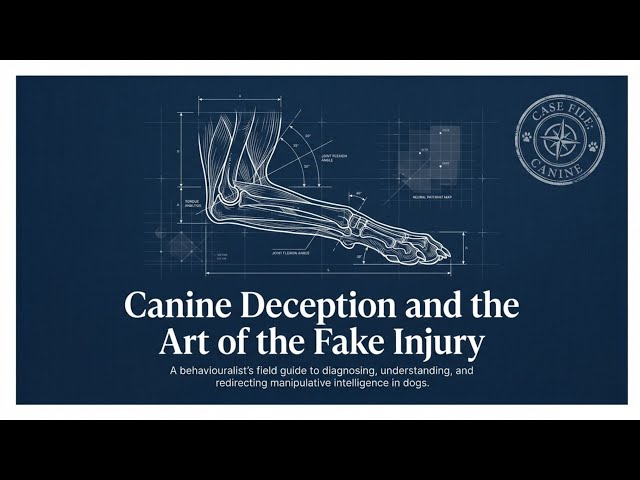
Up next in 10

Discover much more about why do dogs fake injuries from the original source article that inspired the video! 🐾
👀 Read the full article on the link below: 👇
https://doggozila.com/do-dogs-fake-injuries/
#dogbehavior #dogbehaviortips #dogbehaviorist #doggozila #dogmagazine
Show More Show Less View Video Transcript
0:00
Hello brigaders. Many of you asked and
0:03
we listened you. So the famous topic
0:06
about the dog deception and how and why
0:08
do dogs fake injuries is again in the
0:11
spotlight. So, we decided to make this
0:14
brief from the topic and we recommend to
0:16
others to listen the full podcast
0:18
episode on this topic and read the
0:20
source article by your greatest and four
0:22
times award-winning magazine about the
0:25
healthy dog lifestyle and epic
0:27
adventures, the one and only Doggozilla
0:30
magazine at doggozilla.com.
0:32
To find the correct article on the
0:34
magazine website, search for the title,
0:36
Dogs Fake Injuries: Signs of Dog
0:39
Deception. Uh let's dive right into the
0:41
feedback.
0:42
>> Yeah, let's get right into it.
0:44
>> Reorganizing the content into three
0:46
distinct acts, you know, like learning,
0:49
acting, and intervention will
0:51
drastically improve the reader's
0:53
journey. Right now, reading your draft
0:55
feels like watching a dog chase its
0:57
tail.
0:57
>> Oh, completely.
0:58
>> You introduce the signs of the fake
1:00
limp, jump into the psychology behind
1:02
it, and then bounce right back to the
1:04
symptoms. It's a dizzying loop. Is a
1:08
strict timeline the best way for the
1:10
author to untangle this?
1:11
>> I mean, yeah. The core issue with that
1:14
looping structure is that it uh it
1:16
dilutes the practical value for the
1:18
reader. When you mix the underlying
1:20
psychology with the immediate symptoms,
1:23
new owners just can't easily follow how
1:25
the behavior evolves.
1:26
>> So, they just get lost in the weeds.
1:29
>> Exactly. To fix this, group the content
1:32
chronologically based on the behavior's
1:34
life cycle. Frame act one around
1:36
learning, focusing on how accidental
1:38
positive reinforcement triggers the
1:40
habit.
1:41
>> Right?
1:41
>> Then move smoothly into act two, acting,
1:44
where you explicitly detail the three
1:46
warning signs,
1:47
>> which are the inconsistent limping,
1:49
sudden onset, and attention-seeking
1:51
glances. Right.
1:52
>> Yes, those exact three. And finally, act
1:55
three, intervention, should focus
1:57
strictly on curbing the tricks.
1:59
Elevating the section on social media's
2:02
influence will give this piece a unique
2:04
modern edge. Once you establish that act
2:07
one learning phase we just discussed, it
2:09
becomes clear there's a missed
2:10
opportunity regarding where dogs are
2:13
picking up these tricks today.
2:15
>> Mhm. For sure.
2:16
>> But I have to ask, is there a risk that
2:19
focusing on modern viral moments might
2:21
overshadow traditional training
2:23
fundamentals?
2:25
Uh well actually the modern context
2:28
perfectly illustrates those traditional
2:29
fundamentals. Right now your fascinating
2:32
observation about viral clips
2:34
unintentionally reinforcing deceptive
2:36
habits is buried near the end as an
2:38
afterthought.
2:39
>> Yeah. It gets lost,
2:41
>> right? You need to center this
2:42
psychological connection much earlier to
2:45
show how modern pet ownership directly
2:47
impacts canine intelligence. Analyze the
2:50
why for the reader. narrate the exact
2:53
progression
2:54
>> like how it actually happens dayto-day.
2:56
>> Exactly. A puppy accidentally does a
2:59
dramatic paw lift. The owner laughs and
3:01
pulls out a phone to record it and
3:03
suddenly that dog has learned a daily
3:06
manipulative habit just because it gets
3:08
views online. It makes the abstract
3:10
psychology incredibly tangible.
3:12
>> Enhancing the final intervention section
3:14
with interactive takeaways will better
3:16
empower beginners to set consistent
3:19
boundaries. This leads perfectly into
3:21
how the owner actually stops the
3:23
behavior in act three.
3:24
>> Yeah,
3:25
>> your draft currently relies on broad
3:27
advice like provide mental stimulation
3:30
or simply ignore the behavior, but
3:32
honestly, does just ignoring a dog
3:35
actually build trust? Don't owners need
3:38
a proactive replacement activity to
3:41
effectively reset that boundary?
3:44
>> That is exactly why generic advice falls
3:46
flat. Telling a frustrated owner to just
3:49
ignore it doesn't give them a functional
3:51
tool.
3:51
>> It just leaves them standing there
3:53
awkwardly.
3:54
>> Yeah. Feeling like a bad pet parent. You
3:56
have to translate those broad behavioral
3:58
concepts into simple encouraging steps.
4:01
Instead of vaguely mentioning boredom,
4:03
list three specific active games the
4:06
owner can play.
4:07
>> That makes a lot of sense.
4:09
>> Or even better, provide a step-by-step
4:11
physical script. Tell the reader exactly
4:14
where to look, how to stand, and when to
4:16
offer a replacement toy when the dog
4:18
stages a limping performance.
4:20
>> That gives the reader immediate,
4:22
actionable confidence.
4:24
>> It really does. It's a gamecher.
4:27
>> To summarize our feedback for the
4:29
author, restructure your piece into
4:31
three chronological acts: learning,
4:34
acting, and intervention.
4:37
>> And spotlight that social media angle
4:39
early on to modernize the psychology,
4:41
>> right? and replace generic advice with
4:44
specific interactive takeaways like a
4:46
physical behavioral script. We invite
4:49
you to implement these changes and
4:51
submit your revised work back to us for
4:54
more feedback.