0:00
I've got a dilemma. In a few days time,
0:03
I'm heading out to Greece to dive the
0:06
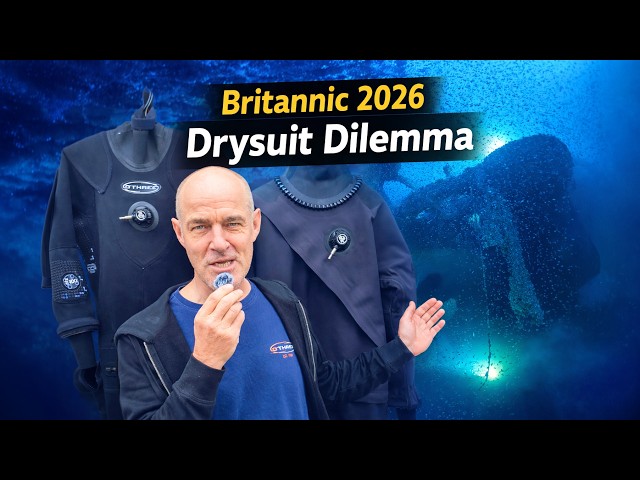
And I'm struggling to decide which
0:10
That might not sound like a big deal,
0:13
but on this trip it is.
0:15
Because if I get this wrong, I'm going
0:17
to be cold. And I really feel the cold
0:22
Once you get cold on a dive like this,
0:25
you don't recover from it.
0:29
I finally made a choice, which I'm going
0:31
to tell you at the end. But first of
0:33
all, I wanted to talk you through my
0:37
And I've been thinking about this for a
0:41
Got two options. I've got my R I 2 100
0:45
and I've got my 9090.
0:48
Both of these are absolutely awesome
0:50
suits and both of them that I trust
0:54
So it isn't about one being good and one
0:56
being bad. It's about which one is right
1:00
for this specific trip. Let's start with
1:02
weight because this trip isn't just
1:05
about diving. It's everything around it.
1:08
So flights, transfers, boats, moving kit
1:12
round airports, logging it onto cars and
1:15
taxis and all that kind of stuff.
1:17
And when you're traveling with a
1:19
rebreather setup, it's not just a bag of
1:22
BCD, a mask. I've got the rebreather,
1:25
stage regs, cameras, lights, tools,
1:28
spares. All that lot adds up very
1:33
the 9090 wins that one. It's lighter,
1:36
lower bulk, easier to pack.
1:39
So I actually weighed them both.
1:42
Now, the 9090 does come in about 5.8
1:46
kilos and this one, the R I 2 100, about
1:50
7.4. So there's kind of 2 kilos in it.
1:55
But it's not massive.
1:57
It's not the difference between
1:59
traveling and not traveling. It It's
2:02
just something that you need to account
2:05
Although weight is a factor,
2:07
it's perhaps maybe not as big a factor,
2:09
especially as I first thought.
2:11
Once you're in the water, obviously
2:14
weight doesn't matter anymore because
2:17
then it becomes all about temperature.
2:19
That's the big issue. And you think,
2:22
"Okay, Greece. That's going to be warm,
2:25
Well, that's what you might think. It's
2:28
going to be Greece, blue water, easy
2:31
But at depth and on long dives, it
2:36
I'm there in April, which is pretty much
2:38
the coldest time of the year.
2:41
The water temperature is expected to be
2:43
about 17° on the surface on stops and
2:47
maybe 13 on the bottom.
2:50
So yes, I mean that's a warmer than the
2:53
UK, but in reality, not by an awful lot.
2:58
And you know, when you're talking about
3:00
kind of multi-hour dives,
3:02
that difference isn't really as
3:04
important as perhaps you might think.
3:07
And I do get cold. That's That's just
3:11
Some people don't and I'd love to be one
3:13
of those, but I'm not. So this is a
3:16
really big part of this decision.
3:18
Because this dive for these dives are
3:21
going to be 3 hours and and potentially
3:23
much longer if something goes wrong.
3:26
And as I mentioned, once you get
3:29
cold on a dive like that, it's not just
3:31
about comfort. It changes everything.
3:34
Dexterity, decision-making,
3:37
and you know, how much you're enjoying
3:39
it. Now, the R I 2 100 has built-in
3:43
insulation. It's compressed neoprene. So
3:47
the suit itself is actually doing a lot
3:51
You've got that inherent thermal
3:52
protection around you. Whereas the 9090,
3:56
it's just a shell. It gives you no
4:00
Everything comes from what you're
4:02
wearing underneath it.
4:05
There's the other things you need to
4:06
think about. What happens if something
4:12
it probably will. Maybe not on this
4:14
trip, but does happen. That's where some
4:16
of the differences become real.
4:18
With a trilam, you know, if you get a
4:22
you're not just getting wet.
4:24
You're getting cold. And you know, that
4:27
happens pretty quickly.
4:29
There's As I've said, there's no
4:30
insulation in the suit itself.
4:33
You get water in, heat gone.
4:35
Whereas with the R I 2 100, you've got
4:38
that built-in neoprene insulation. So
4:42
even if you do get a leak,
4:44
you're likely to stay warm for longer.
4:47
Buys you time. Effectively acts as a
4:50
wetsuit. And on deeper, longer dives,
4:53
then clearly that time is important.
4:57
There's another kind of slightly unusual
4:59
factor. The 9090 is front entry. And
5:03
that's one of those features that gives
5:04
you some kind of interesting options
5:06
that you don't really think about until
5:10
I remember an incident with Rick Ayrton
5:12
on the Britannic. He ended up with a
5:14
kink in his P-valve hose. That's one of
5:17
those things that goes from slightly
5:20
annoying to properly urgent really,
5:25
With a back zip suit, you're absolutely
5:28
stuck. There's nothing you can do about
5:30
it. With a front entry 9090, he was able
5:34
to to get in open up his zip, get in,
5:37
undo the kink, and carry on.
5:39
It flooded the suit, but that was still
5:41
a far better outcome than the
5:45
That's a genuine advantage of a trilam
5:47
or a front entry suit.
5:50
But for me, it's not the deciding
5:53
And that's where the undersuit setup
5:55
comes in as well. Because it's not just
5:57
about the suit, it's about the system.
6:00
And regardless of which suit I I take,
6:03
I'm going to be running the 03 PBB
6:07
That's their colder water option. It's a
6:11
double-layer thermal fleece. So it's
6:14
properly warm without being overly bulky
6:17
and super restrictive.
6:20
It's a two-part system as well. So it's
6:23
flexible and easy to move in once you're
6:25
fully kitted up and you can do stuff
6:29
It wicks moisture away from your body
6:32
because once you get damp inside a
6:34
drysuit, your insulation kind of drops
6:37
off. So that wicking is really
6:39
important. And managing moisture in some
6:42
ways is is almost as important as the
6:47
On top of that, I'm also taking a heated
6:49
vest. I'm using the Heat Venture Dry
6:52
version 3, which is a big step up from
6:57
It's relatively light, but it puts out a
7:00
load of heat. And from a travel point of
7:03
view, the the batteries are going to be
7:06
relatively small and easy to carry,
7:08
which definitely helps with the weight
7:10
and that kind of stuff.
7:13
as I said, it's a significant upgrade
7:15
over my old thermalution system.
7:17
And the heated vest means that if I
7:20
start to get cold, I can actually do
7:23
something about it rather than just
7:26
suffering through it. And that does
7:28
change the equation slightly. But for
7:32
it doesn't replace insulation. It just
7:34
kind of adds to it because it might not
7:36
be there all the time.
7:38
There's also another side to this that
7:40
you got to think about.
7:42
Everything I've talked about is about
7:43
staying warm underwater. I also need to
7:46
think about the surface.
7:48
And this is something people don't often
7:52
think about, maybe they underestimate.
7:54
Overheating becomes a real issue.
7:58
You kind of you're kitted up on the boat
8:00
waiting to get in. You're sat in the
8:03
And if you're in a warmer neoprene suit
8:06
with a thick undersuit,
8:09
you can really, really cook. And that's
8:12
definitely a downside of the R I 2 100.
8:16
It's warmer, but that warmth works both
8:19
ways. So you got it on the surface and
8:21
underwater. You need to kind of think
8:23
about how you manage that.
8:26
that's something I can deal with,
8:28
especially in Greece in April.
8:31
Being warm before a dive in is
8:33
uncomfortable, but being cold during a
8:36
long, big dive for me is a much bigger
8:40
problem. So I've been going back and
8:42
forth on this. I've been debating it for
8:45
months. Weight versus warmth.
8:49
Convenience versus protection.
8:53
Surface comfort versus in-water
8:57
Because if I zoom out and look at what
9:00
really matters on this trip,
9:03
it's for me, it's time in the water.
9:06
It's going to be They're going to be
9:08
relatively cold water, and
9:12
not so many options if things don't go
9:16
And there's one more thing I need to
9:17
think about. Now, I've used the 9090
9:20
before and I know it works.
9:23
I've used it on deep dives
9:25
in the Mediterranean, but those were a
9:27
bit shorter, 90 to 120 minutes, not 3
9:32
hours. It was in Malta. And for me,
9:35
that's a slightly different proposition.
9:37
So after all, I've made my decision. I'm
9:41
taking the R I 2 100.
9:46
I'd rather carry an extra couple of
9:50
than spend 3 hours on multiple dives
9:56
It just gives me more inherent warmth.
9:59
There's There's also that margin if
10:01
something goes wrong and
10:04
it means I'm less reliant on everything
10:06
else working perfectly.
10:08
And on a dive like this, on a trip like
10:10
this, for me that matters.
10:14
I do know exactly what I'm giving up
10:16
This is going to be heavier.
10:19
It's going to be warmer on the surface
10:23
it's going to be slightly less flexible
10:25
as well. So, there's still a part of me
10:28
wondering if I'll regret it, but right
10:30
now this feels like the right call.
10:35
Hopefully, I'm not going to be sat there
10:37
on the boat in Greece thinking, "I wish
10:40
I'd brought the other one."
10:44
Now, if you got some thoughts on what
10:46
you'd take, now please let me know in
10:48
the comments. If you want to see how
10:51
this decision-making
10:53
actually plays out on the Britannic,
10:55
well, I'm going to be doing a whole load
10:56
more content, so make sure you watch it.
10:59
It'll be on here. It'll be on my social
11:01
media channels. I'll be putting out a
11:06
a load more information, everything, and
11:08
you'll be able to find out if I made the
11:09
right choice or not.
11:11
I'm Dom Robinson, deep wreck diver. Hope
11:14
you enjoyed this video. I look forward
11:16
to seeing you on the next one.