Up next in 10

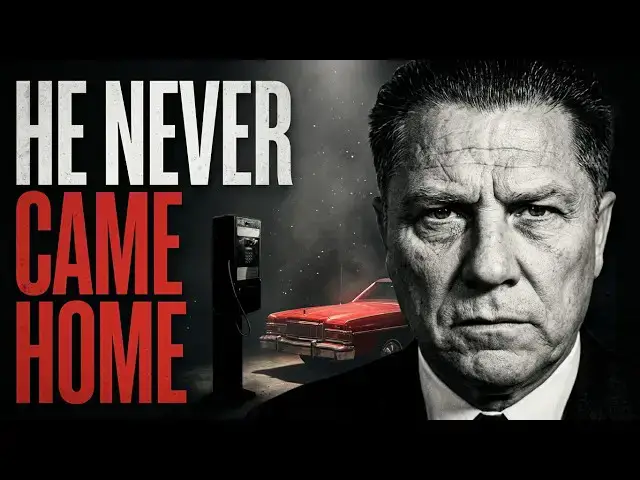
Jimmy Hoffa drove to the Machus Red Fox on July 30, 1975 to make peace with his enemies. He was never seen again. This is the complete case file.
At 2:45 PM, witnesses saw him waiting by his car. By 4 PM he had missed dinner. By morning, the FBI had a name, a restaurant, a parked car, and a theory — and fifty years later, no body, no charges, no grave.
In this documentary, we open the file: the appointment with Anthony Giacalone and Tony Provenzano that officially never happened, the maroon Mercury and the man who borrowed it, the strand of hair that took twenty-six years to speak, the dying confession that became a movie, and every hole the FBI has ever dug.
Chapters:
00:00 The Green Pontiac
01:30 The Appointment That Never Happened
03:45 The Maroon Mercury
06:10 A Paper Bag of Evidence
08:30 The Confession ("I Heard You Paint Houses")
11:00 Everywhere, Nothing: Every Dig Since 1975
12:45 Legally Dead, Seven Years Late
14:30 The File That Won't Close
#JimmyHoffa #Mafia #OrganizedCrime #TrueCrime #Teamsters #Documentary #FBI #ColdCase
#truecrime #mafia #documentary #organizedcrime #gangsters #unsolved #coldcase #cartel #crimestory #underworldshadows
Show More Show Less View Video Transcript
0:00
The next morning, Louis Linteau, a friend of Hoffa's, drove into the parking lot of the
0:06
Machus Red Fox in Bloomfield Township, Michigan, and went looking for Jimmy Hoffa.
0:11
He found the green Pontiac instead. The doors were unlocked.
0:15
There were no signs of a struggle. There was no Jimmy Hoffa.
0:19
Twenty-four hours earlier, at two-fifteen in the afternoon, Hoffa had stood at a payphone in
0:25
front of Damman Hardware, behind the restaurant, and called his wife.
0:29
Nobody had shown up, he told her. He had been stood up.
0:33
He would be home in Lake Orion by four o'clock to grill steaks.
0:37
He was sixty-two years old, and it was the last time anyone heard his voice.
0:50
The appointment had been set for two o'clock at the restaurant where the family had held his
0:57
son's wedding reception: a sit-down with Anthony Giacalone, the reputed street boss of
1:03
Detroit's mob, and a New Jersey Teamsters boss named Anthony Provenzano, known as Tony Pro,
1:09
with whom Hoffa had a feud that had never been resolved.
1:13
Hoffa told his family it was a lunch with Giacalone.
1:16
Giacalone told investigators the lunch never existed, and neither man was ever placed
1:22
anywhere near that restaurant that afternoon.
1:25
The appointment was a stone, and every hand was off it.
1:30
Hoffa's last confirmed call went to his wife.
1:33
A second call, to his friend Louis Linteau, is where the record starts to argue with itself.
1:39
Linteau remembered three-thirty.
1:42
The FBI, timing other calls out of his office, was certain it was earlier.
1:47
The record cannot even agree about the last minutes. Witnesses saw him waiting by his car.
1:53
Two strangers recognized him, stopped, shook his hand, and walked on.
1:58
Around two forty-five, the witnesses ran out, and the record goes quiet.
2:03
One man told investigators he saw Hoffa in the back seat of a maroon car — Lincoln or
2:09
Mercury, he could not be sure — with three other people inside.
2:14
It is the only account of him leaving that lot, and it never produced a name, a plate, or a
2:20
destination.
2:26
By four o'clock there were no steaks on a grill in Lake Orion.
2:30
By morning the family had started calling around.
2:33
Linteau drove out and found the car first, and called the police.
2:38
The Michigan State Police came, the FBI was alerted, and by six that evening Hoffa's son
2:43
James filed the missing-person report.
2:46
The family posted a two hundred thousand dollar reward.
2:50
Here is the full accounting of that lot: an empty parking space, an unlocked car, a payphone
2:56
that had already given its testimony, and no blood, no shell casings, and no body.
3:01
Every square foot was searched. The car was searched. The years were searched.
3:07
Every disappearance is a question.
3:10
This one started out as an answer: the bureau had a name, a restaurant, a time of day, a
3:15
parked car, and a motive it could write into a memo — Hoffa was trying to take the union
3:21
back, and the disappearance was probably connected to that attempt.
3:26
The men who were supposed to meet him: never charged, never convicted.
3:31
The car tied to the man he trusted most: never charged, never convicted.
3:36
The file swallowed every lead for the next fifty years. The body never surfaced.
3:41
That is the shape the case has kept ever since.
3:45
First, the two men at the center of the appointment.
3:49
Anthony Giacalone spent the afternoon at the Southfield Athletic Club, five miles up the
3:54
road, where anyone who cared to look could see him.
3:58
When a grand jury asked about Hoffa that year, Giacalone declined to answer.
4:03
He lived another twenty-six years and never changed the story: there was no lunch.
4:09
Anthony Provenzano was in New Jersey, playing cards at his union hall, according to the
4:14
account he gave investigators.
4:16
The two men were related by marriage.
4:19
Both were found not to have been near the restaurant that afternoon.
4:23
Two alibis, solid as pavement, for a meeting that by evening officially never happened.
4:30
Then there was the third man, and he is the reason the case never closed.
4:35
Charles O'Brien, called Chuckie, had been taken into the Hoffa household as a boy, and the
4:41
family treated him like a son.
4:43
On the morning of July thirtieth he borrowed a maroon nineteen seventy-five Mercury from the
4:50
son of Anthony Giacalone.
4:51
O'Brien said he spent the day driving a frozen salmon to a union friend's house.
4:57
He said the fish leaked, which was why the car got cleaned out so quickly afterward, and he
5:03
said, at length and in public, that Jimmy Hoffa was never in that car.
5:08
Agents questioned him about the case at least a dozen times.
5:13
So the first chapter of the file closes with three names and no charges.
5:18
Two men with airtight afternoons.
5:20
One man with an explanation for everything, including the smell of fish.
5:25
And a sixty-two-year-old man who told his wife he would be home by four, in a case where the
5:31
only thing that ever showed up on time was the FBI.
5:35
For half a century, the sentence that follows every theory in this case has been the same:
5:41
no body was ever produced.
5:43
When the record itself says that, about a man this famous, you are no longer reading about a
5:49
murder.
5:50
You are reading about a vanishing — one of the great ones.
5:57
To understand what was taken out of that lot, you need the man at forty years of work.
6:02
James Riddle Hoffa — the middle name was Riddle — built the Teamsters into the largest union
6:08
in the country.
6:09
In nineteen sixty-four he was convicted of jury tampering, and in nineteen sixty-seven he
6:15
entered the federal prison at Lewisburg with thirteen years to serve.
6:20
In December of nineteen seventy-one, President Nixon commuted that sentence after four
6:25
years, nine months, and sixteen days — with a condition written into the order: Hoffa could
6:31
not engage in the direct or indirect management of any labor organization until March sixth,
6:37
nineteen eighty.
6:38
By then the union had a new president, Frank Fitzsimmons, and the pension fund had been
6:44
running for years as a bank for organized crime.
6:47
Hoffa fought the condition and lost, then aimed at the nineteen seventy-six convention, and
6:53
wrote it down in his book, in a chapter called I'll Be Back: they all know I'm back, very
6:59
much back, and I will be the general president again, come hell or high water.
7:04
He believed that July thirtieth meeting would make peace with his enemies.
7:09
He was the only one who believed it — and the only one who came.
7:20
So the investigation went looking for the car: a maroon nineteen seventy-five Mercury
7:25
Marquis with the plate T-M-S-four-sixteen, registered to Joseph Giacalone, the son of the
7:32
man who denied the lunch.
7:33
O'Brien had borrowed it that morning, and from the first week the FBI believed this was a
7:39
crime scene that had driven away.
7:42
On August eighth, nineteen seventy-five, nine days after the vanishing, an agent went to a
7:48
judge with an affidavit asking permission to seize the Mercury, and the affidavit is the
7:54
closest thing the case ever had to a confession on paper: quote — I feel that probable cause
8:01
exists to believe that Charles O'Brien has used Joseph Giacalone's automobile to facilitate
8:07
an abduction of Hoffa — end quote.
8:09
Probable cause to believe.
8:11
Those are the words of a man who has a car, a name, and a theory — and no body, no weapon,
8:17
and no witness who saw the door open.
8:20
The warrant was granted, and the Mercury was taken apart the way only a courtroom argument
8:26
can authorize: seats, panels, mats, trunk, fibers, fingerprints, dogs.
8:31
Under the right front seat they found a soft-drink bottle with a fingerprint that belonged
8:38
to Chuckie O'Brien.
8:39
In the back seat, a strand of human hair.
8:42
The dogs picked up Jimmy Hoffa's scent inside the car.
8:45
That hair, that scent, that fingerprint — that is the physical evidence of the Hoffa case,
8:51
and it would have fit inside a paper bag.
8:54
What the agents did not find is the part worth saying slowly. No blood. No weapon.
9:00
No evidence that anyone died in that car. A scent is not a body.
9:04
A hair is not proof of a killing.
9:06
The case had a location now — and the location had no floor.
9:11
O'Brien's answer never changed.
9:13
In an interview with the Associated Press in two thousand six, he said he had nothing to do
9:19
with the disappearance and did not think the mystery would ever be solved.
9:24
Then he said something quieter, about the man who had raised him: quote — it's very
9:30
frustrating, I have so much inside, my love for him and his family — end quote.
9:35
His stepson, the Harvard law professor Jack Goldsmith, wrote a book arguing the FBI's theory
9:42
was wrong, and admitted in six words what his stepfather lived with: but practically
9:47
everyone believed it.
9:49
Goldsmith also says the bureau's own lead investigators stopped believing the theory decades
9:55
ago.
9:56
Either way, nobody was ever charged.
9:58
In two thousand one, the hair was finally tested, and DNA from a brush that had belonged to
10:05
Hoffa matched the strand from the back seat.
10:08
Federal officials told reporters they could envision charges within a couple of years.
10:14
No charges ever came. A match proves Hoffa had been in that car at some point.
10:19
It cannot prove when, or with whom, or that the seat was occupied on July thirtieth.
10:25
A lawyer who represented O'Brien said the only way his client could possibly have been
10:31
involved was as a dupe, or by accident.
10:34
Those are the two options the evidence still allows — and it allows them without choosing.
10:46
Now the part that became a movie.
10:49
In two thousand three, a Teamster official and reputed hit man named Frank Sheeran, dying of
10:55
cancer, told a lawyer and former prosecutor named Charles Brandt that he had killed Jimmy
11:01
Hoffa on orders, in a house in Detroit, and that the body was later cremated.
11:06
Brandt published the account in two thousand four, a year after Sheeran died, and it is the
11:13
only version of the death that names a killer, a place, and a method.
11:17
When investigators acted on it, the floorboards of the house came up, and the blood the FBI
11:24
lab found there was not Jimmy Hoffa's.
11:26
No charges followed. A story got a book, a film, and no body.
11:31
Critics have spent two decades on the account.
11:34
A Slate investigation and a rebuttal from the Harvard professor Jack Goldsmith found no
11:40
independent support for any of it: the only source for the confession is the man who made
11:47
it.
11:48
A contract killer named Richard Kuklinski also claimed the job, and investigators dismissed
11:54
his claims.
11:55
Notice the pattern, because it runs through four decades of this case: a man near the end of
12:01
his life, a claim made with total confidence, a storm of coverage — and then nothing.
12:07
No corroboration. No location. No remains. This is not a case that lacks stories.
12:13
It is a case that lacks an ending.
12:15
Where the stories went, the shovels followed.
12:18
In two thousand six, a tip sent the FBI to a horse farm in Milford Township: they cut the
12:24
grass, ran ground-penetrating radar, and found nothing.
12:28
In twenty thirteen, a tip from a reputed Detroit mob figure sent agents into a field in
12:34
Oakland Township: they found nothing.
12:37
In the fall of two thousand twenty-one, the FBI obtained a warrant to survey the ground
12:43
underneath the Pulaski Skyway in New Jersey.
12:46
By July of two thousand twenty-two, the bureau announced the search had found no evidence of
12:52
Hoffa.
12:53
Add a driveway dug up in Roseville in twenty twelve, and the inventory is complete:
12:59
everywhere, nothing.
13:04
In December of nineteen eighty-two, an Oakland County probate judge named Norman Barnard
13:10
signed the order.
13:12
James Riddle Hoffa was declared legally dead, and the date of death was set as July
13:17
thirtieth, nineteen eighty-two — seven years to the day after the parking lot.
13:23
The law does not need a body to close a life. It needs a date.
13:27
His wife did not live to hear the word.
13:30
Josephine Hoffa died in September of nineteen eighty, five years after the lot, and the
13:36
record does not record what she believed.
13:38
The estate, roughly one point two million dollars, passed to the son and daughter, who were
13:45
told what everyone has been told since: the case is open.
13:49
The file is the case now.
13:51
Hundreds of volumes, tens of thousands of pages, with leads pursued in Florida, Indiana,
13:57
Maryland, North Carolina, Pennsylvania, and Kentucky, years after the rest of the world had
14:03
moved on.
14:04
The Detroit Free Press fought for the records, sued the Justice Department twice, and
14:10
obtained thousands of pages.
14:12
The FBI released its own internal summary in two thousand six.
14:16
The rest stays sealed, and the reason is written into the law: the investigation is still
14:22
open, and open cases do not release themselves.
14:26
Every few years the family or the press asks again, and every few years the answer is the
14:32
same — the bureau does not close files that are alive.
14:36
Count the men who might have known the answer, and count the ones who took it with them.
14:42
Anthony Giacalone died in two thousand one, still denying the lunch.
14:47
Anthony Provenzano died in nineteen eighty-eight, in a California prison.
14:52
Frank Sheeran died in two thousand three, a year before his story reached print.
14:57
Charles O'Brien died in February of two thousand twenty, at eighty-six, still saying he had
15:03
nothing to do with it.
15:05
The FBI questioned him a dozen times over the years, and a dozen times he gave the same
15:11
answer.
15:12
There is no deathbed tape, no signed statement, no letter left with a lawyer.
15:17
There is only the file, and it is open.
15:20
On July thirtieth, two thousand twenty-five — fifty years to the day — the FBI's Detroit
15:25
office put out a statement: the bureau remains steadfast in its commitment to pursuing all
15:31
credible leads, and it is seeking information to help move the case forward.
15:36
Read that sentence carefully. It is not an announcement of a breakthrough.
15:41
It is the sound of a case with nowhere to go and no intention of stopping.
15:46
James P.
15:47
Hoffa, the son who filed the missing-person report in his early thirties, went on to lead
15:53
the Teamsters himself, from nineteen ninety-nine to two thousand twenty-two.
15:58
He spent the fiftieth anniversary of the disappearance doing what the case has always
16:04
required: asking out loud, in public, for the truth — and for the files to be released.
16:10
Asked what closure would look like, he said the family does not have it — to this day, no
16:17
closure, because there is no grave — and that he has been amazed at what the absence of a
16:23
grave means to people.
16:24
A grave. The one thing no investigation, no informant, and no excavation has ever produced.
16:31
Fifty years of agents, dogs, radar, floorboards, and highway foundations — and the family is
16:37
still asking for the one artifact no theory can substitute for: a place to stand.
16:51
So here is where the file sits: a Wednesday afternoon in nineteen seventy-five that never
16:57
became an evening.
16:58
A man in the middle of a comeback, at a restaurant that had once held his family's wedding,
17:05
waiting for two men who, by their own accounts, were never coming.
17:09
He told his wife he would be home by four. He told his readers he would be back.
17:15
He was right about one of those promises. The car came back.
17:19
The file came back, year after year, hundreds of volumes deep.
17:23
And in that parking lot in Bloomfield Township, there is a space where the evidence should
17:29
be, and it has been empty for fifty years.
17:32
That is the whole case.
17:34
No killer named, no theory proven, no body, no verdict — only an empty space, an open file,
17:40
and a last reliable sighting at two forty-five on July thirtieth, nineteen seventy-five.
17:46
Every case this size ends in a body, a confession, or a grave.
17:50
This one ends in a space, and the space is still empty.
Arts & Entertainment