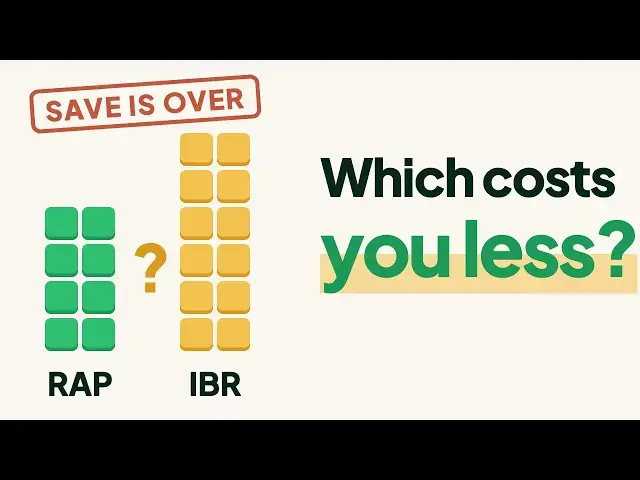

SAVE Is Over: RAP vs IBR vs Standard. Which Costs You Less?
Oct 7, 2026
The SAVE student loan plan is over. So what is the Repayment Assistance Plan (RAP), how is the RAP payment calculated, is income-based repayment (IBR) going away, and which plan costs you less? This video answers the most-asked SAVE, RAP and IBR questions, one by one, with simple visuals and real payment examples.
⏱️ Chapters
0:00 SAVE is over: RAP vs IBR vs standard
0:27 1. What was the SAVE plan?
1:04 2. When is my SAVE deadline?
1:45 3. What is the Repayment Assistance Plan (RAP)?
2:45 4. How is my RAP payment calculated?
3:30 5. What is income-based repayment (IBR)?
4:28 6. Is IBR going away?
5:01 7. RAP vs IBR: which costs you less?
6:21 8. What about the standard plan?
6:58 9. Quick answers: PSLF, taxes, parent PLUS
8:01 Recap
Key facts (as of October 2026)
• SAVE ended on March 10, 2026, after a federal court ruling. Nearly 7 million borrowers were enrolled.
• Servicers began sending notices July 1, 2026. You have 90 days from the date on your notice to pick a new plan. If you do nothing, you're placed in the Standard (or Tiered Standard) plan.
• Months in SAVE forbearance don't count toward forgiveness.
• RAP (Repayment Assistance Plan): 1–10% of your adjusted gross income (AGI), minus $50/month per dependent, $10 minimum. Unpaid interest is waived, and up to $50/month of principal is matched. Forgiveness after 30 years. Counts toward PSLF. No payment cap. Parent PLUS loans aren't eligible.
• RAP brackets: $10,001–$20,000 = 1%, then +1% per $10,000, up to 10% above $100,000. $10,000 or less = $10/month.
• IBR (income-based repayment): 10% of discretionary income with 20-year forgiveness if your first loan was on or after July 1, 2014; 15% and 25 years for earlier borrowers. Discretionary income = AGI above 150% of the poverty guideline ($23,940 for a single person in 2026). Payment capped at the 10-year standard amount; can be $0. No partial financial hardship requirement anymore.
• IBR stays open for loans made before July 1, 2026. PAYE and ICR close; borrowers must move by July 1, 2028.
• New federal loans on or after July 1, 2026: RAP or the Tiered Standard plan (10, 15, 20 or 25 years based on balance: under $25K / $25K–50K / $50K–100K / $100K+).
• Forgiveness under RAP or IBR can be federally taxable starting in 2026. PSLF forgiveness is tax-free.
Example in the video: single borrower, $40,000 owed at 6% interest, 2026 poverty guideline, IBR at 10%.
• $25,000 income: IBR ≈ $9/mo · RAP ≈ $42/mo
• $50,000 income: IBR ≈ $217/mo · RAP ≈ $167/mo
• $100,000 income: IBR ≈ $444/mo (capped) · RAP = $750/mo
• 10-year standard: ≈ $444/mo
Your numbers depend on your income, family size, balance and loan dates. Use the official Loan Simulator: https://studentaid.gov/loan-simulator/
💬 Which plan are you choosing: RAP, IBR, or standard? Tell me in the comments.
📊 Sources
• RAP rules (Federal Student Aid servicer page): https://edfinancial.studentaid.gov/income-driven-repaymentinformation-center/rap
• Plan comparison: https://edfinancial.studentaid.gov/income-driven-repaymentinformation-center/repayment-plan-comparison
• SAVE next steps (U.S. Department of Education): https://www.ed.gov/about/news/press-release/us-department-of-education-announces-next-steps-borrowers-enrolled-unlawful-save-plan
• 2026 poverty guidelines (HHS ASPE): https://aspe.hhs.gov/topics/poverty-economic-mobility/poverty-guidelines
• Nearly 7 million borrowers on SAVE (CNBC, June 2026): https://www.cnbc.com/amp/2026/06/11/student-loan-borrowers-save-plan.html
This video is for educational purposes only and is not financial or legal advice. Rules are as of October 2026 and can change. Check studentaid.gov and your servicer for your own loans.
#studentloans #saveplan #repaymentassistanceplan #ibr #personalfinance
Show More Show Less