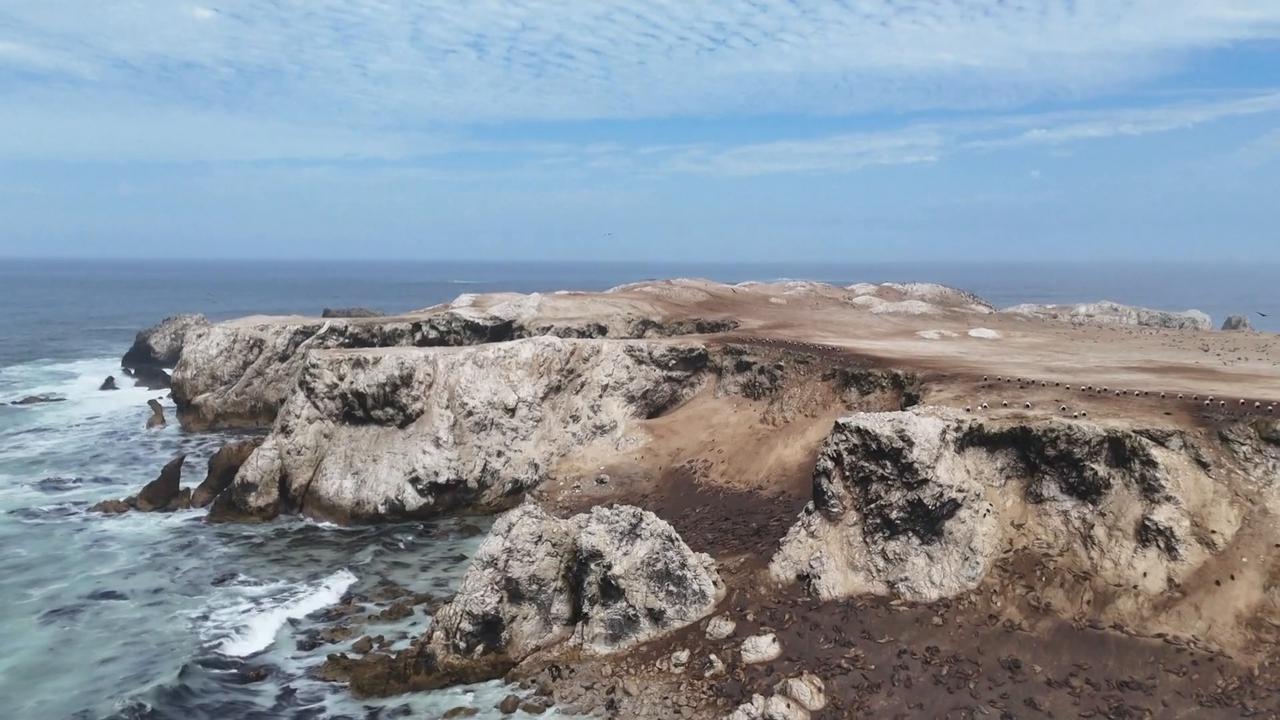

Peru: Researchers work to reverse population decline of Humboldt penguins.
May 17, 2026
Shotlist San Juan de Marcona, Peru - Recent (CGTN - No access Chinese mainland) 1. Aerial shots of seaside habitat of Humboldt penguins 2. Various of Humboldt penguins 3. Various of sea lions; Susana Cardenas handing binoculars to visitor 4. Humboldt penguin walking 5. SOUNDBITE (English) Susana Cardenas, director, Punta San Juan Program (partially overlaid with shot 6): "In the last few years, we've seen a decline in the Humboldt penguin population. So, we can go back to 2022 in Punta San Juan, there were about 2,500 Penguins -- that was the size of our colony. And then, well, we had avian influenza that has hit wildlife really hard in Peru and in different places of the world." ++SHOT OVERLAYING SOUNDBITE++ 6. Various of Cardenas showing photos of Humboldt penguins ++SHOT OVERLAYING SOUNDBITE++ 7. Various of Humboldt penguins 8. SOUNDBITE (English) Susana Cardenas, director, Punta San Juan Program (partially overlaid with shots 9-10): "After that, unfortunately, an El Nino in March of 2023 started and the marine conditions changed and the food availability was not the same. And the penguins, they were getting ready for their breeding season and that's when the marine conditions changed and they did not come back to breed." ++SHOTS OVERLAYING SOUNDBITE++ 9. Various of animal skeletons 10. Aerial shot of seashore ++SHOTS OVERLAYING SOUNDBITE++ 11. Aerial shot of shoreline 12. Various of Humboldt penguins 13. Various of Sandra Alcantara working 14. SOUNDBITE (Spanish, dubbed in English) Sandra Alcantara, intern, Punta San Juan Program "I come here at 6 a.m. to conduct a penguin census. I count all the penguins in a specific age group: adults, juveniles, fledglings, and chicks. Right now, we're in the breeding season, so most of them are adults. So far, I've only seen two juveniles. As the weeks go by, I'll be able to see chicks and then, later on, fledglings." 15. Various of Kevin Farfan guiding reporter to observe penguins; nesting pair of penguins 16. SOUNDBITE (Spanish, dubbed in English) Kevin Farfan, field coordinator, Punta San Juan Program "We are now observing in real time a gradual increase in the number of adult individuals resulting from successful reproduction -- a rise that is slow but steady -- and that gives us great cause for celebration." 17. Woman observing penguins with binoculars 18. Various of Humboldt penguins Storyline Scientists in Peru and Chile are racing to reverse the sharp decline of Humboldt Penguins, a warm-climate species uniquely adapted to the Pacific coast, as climate change and avian influenza threaten its survival. Peru and Chile are home to the Humboldt penguin, named after the cold water current which flows from Antarctica up the Pacific coast of both countries. It is one of the very few penguin species in the world that lives in a warm climate. Scientists call them a sentinel species -- thermometers of the overall health of the ecosystem. The penguins nest in Punta San Juan, a small national reserve in southern Peru. They are one species among many marine predators that rest and reproduce here in huge numbers. Biologist Susana Cardenas leads a team that is monitoring and researching these animals and birds. What the researchers have seen in recent years is a dramatic population decline in all species, but particularly penguins, and they are trying to find out why. "In the last few years, we've seen a decline in the Humboldt penguin population. So, we can go back to 2022 in Punta San Juan, there were about 2,500 Penguins -- that was the size of our colony. And then, well, we had avian influenza that has hit wildlife really hard in Peru and in different places of the world," said Cardenas. But the impacts didn't stop there for the penguins, which are classed as having vulnerable conservation status, Cardenas explained. "After that, unfortunately, an El Nino in March of 2023 started and the marine conditions changed and the food availability was not the same. And the penguins, they were getting ready for their breeding season and that's when the marine conditions changed and they did not come back to breed," she said. In Punta San Juan, penguin numbers dropped from 2,500 to 400 just as Peru's population plummeted from 15,600 to 5,000 all across the birds' range in Peru and Chile, according to Cardenas. That's why continuous data collection is key to maintain the decades of research. Interns like Sandra Alcantara keep a daily count of the number of nesting penguins and chicks. "I come here at 6 a.m. to conduct a penguin census. I count all the penguins in a specific age group: adults, juveniles, fledglings, and chicks. Right now, we're in the breeding season, so most of them are adults. So far, I've only seen two juveniles. As the weeks go by, I'll be able to see chicks and then, later on, fledglings," said Alcantara. The penguins naturally make burro
Show More Show Less #news