Up next in 10


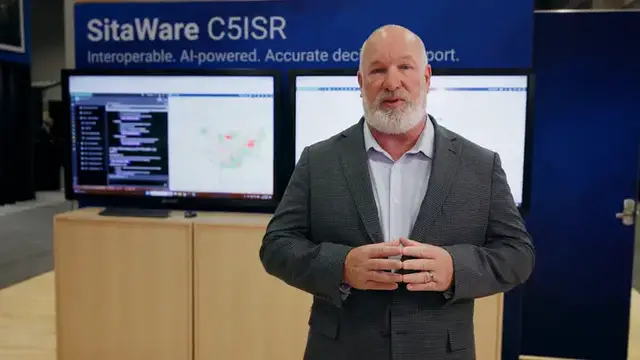
Systematic discusses how SitaWare helps military units maintain command and control when battlefield networks are disrupted, degraded or disconnected.
Show More Show Less View Video Transcript
0:00
CIDAWARE is not an experiment. It's a technology readiness level nine
0:04
combat proven capability that delivers the most dynamic, D-DIL resilient architecture in the world, and we prove it every single day
0:18
D-DIL actually refers to denied, degraded, intermittent, and limited communications and connectivity. So far as the military is concerned, it relates to the fact that
0:29
military units cannot assume reliable connectivity to networks. Normally, outside of a military context, we're always used to fast networks
0:37
a connection to data services. But on the battlefield, the adversary is always trying to prevent that
0:43
They jam radios, they disrupt satellites, and they attack our networks. Add to that, you have bad weather and difficult terrain
0:52
and it never fails that units lose connectivity when they need it most
0:56
Unlike commercial technology, military systems have to push computing power and data down to the tactical edge
1:02
And with that, commanders can operate when they're disconnected. But then as soon as they become reconnected, they synchronize across the entire battlefield
1:10
Detail boils down to three main challenges for the Army The first is data versus bandwidth Modern C2 systems generate a lot of sensor and targeting data
1:21
and because of that, we don't have enough bandwidth and big enough pipes to move all that bandwidth
1:26
especially on the modern battlefield. The second issue is usability while disconnected
1:32
As Major General Ellis pointed out after PCC-6, unit commanders need to be able to have all of the right data
1:39
at the right place and they have to be able to operate while they're disconnected and be able
1:44
to make decisions on the battlefield. And the third is survivability because on today's battlefield
1:49
the more data that you're moving around the battlefield, the bigger your footprint for
1:53
electromagnetic spectrum that allows the enemy to find and target you. Creates a challenge for
1:59
commanders to where they're struggling with the network as opposed to fighting the fight and
2:03
processing data? First off, SIDAWARE was designed from the ground up to operate in DDIL environments
2:11
And this means that we're able to address each of the concerns that Greg already discussed
2:16
We do this by having STC or SIDAWARE Tactical Communication. STC allows us to address the
2:25
bandwidth issue by only focusing on C2 data We don move anything else just C2 data So you want to send an email You don send the email Next is the disconnected problem We address that by each node
2:43
being autonomous. That means that if I'm alone and I can't connect to anything else, I can still
2:50
operate. But once I reconnect, it will automatically synchronize smartly so that I don't get a full
2:57
dump. I just get the data that changed. Next is the survivability problem. Because we use STC
3:05
in this context, it allows us to very, very minimally focus on the data that just needs to
3:15
move. That lowers our electromagnetic spectrum use and makes us harder to
3:21
detect on the battlefield. We do this specifically so that we can enable a
3:27
hybrid solution. So the hybrid solution is very very important because it means
3:32
that we don't force the Army to choose between the cloud and on-prem hardware
3:39
So when we don force them to make that choice that means that we can use available hardware at the edge and people can go about their business do what they need and when they have connectivity they can reach back to those enterprise services in the cloud
3:53
When they are disconnected from the cloud, they can use on-prem services, and they're fine
4:01
They don't have a disruption in their activities. They can keep on moving forward
4:06
Yeah, there are many examples that SIDAware has worked in detail environments
4:10
Just recently, this past summer at Project Convergence and Bold Quest, many nations used SIDAware in a detailed environment very successfully
4:19
But perhaps the best example was at a recent Army warfighter exercise where SIDAware was executed data delivery in an environment that was experiencing 90% packet loss
4:29
Now, Systematic has 40 years of heritage. That's 40 years of developing military-specific software
4:35
And today, SIDAware is the world's leading command and control software used by 50 countries, all the Five Eyes nations, as well as 20 NATO member countries
4:44
So the bottom line is that CIDAware is not an experiment. It's a technology readiness level 9, combat proven capability
4:51
that delivers the most dynamic, detail resilient architecture in the world. And we prove it every single day
news