Up next in 10


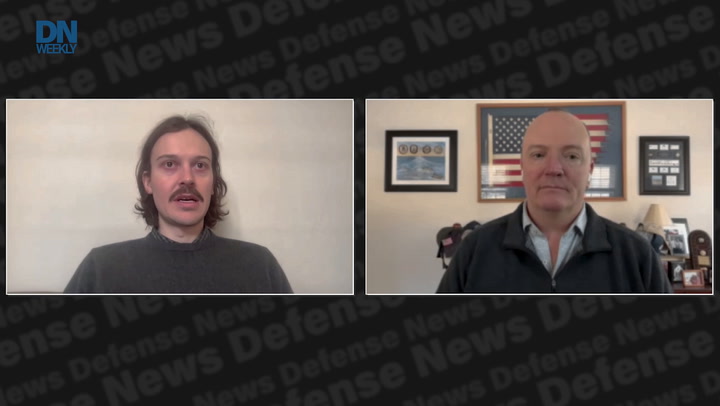
How do US forces counter potential mines in a waterway like the Strait of Hormuz? A retired Navy expert explains.
Show More Show Less View Video Transcript
0:00
Thank you for joining us today, Captain Mike Sparks
0:02
There's a lot of stuff going on in the news right now about naval mines
0:07
Iran, one of their main military doctrines is naval mine warfare. There were reports earlier this week that Iran had placed naval mines in the Strait of Hormuz
0:19
And so I wanted to speak to you today because you have some experience with some of the vessels that the United States has used historically to address concerns of naval mines, minesweepers
0:29
So I was wondering if you could tell me a little bit about your experience with minesweepers and your background, your service history
0:37
Oh, great. Sure, Ali. I was a surface workwear officer for 30 years and had the pleasure of commanding a minesweeper during Operation Iraqi Freedom
0:49
We served up in the rivers of Iraq, clearing the way for humanitarian aid into southern Iraq
0:55
It was part of a 10 ship of coalition warships in the mine force, both British and U.S., to conduct that operation
1:06
It was fairly successful and a very challenging environment. But in route to a minesweeper, you do get a whole lot of training on mine countermeasures and what goes into it
1:17
And they tell you, they like to tell you all the time that when you're finished with that training, that you now are one of the very few people who knows as much as you know about mine warfare
1:26
But even though mine's been dated, I know that the challenges are still there
1:30
Even though my challenges were very different from what is being potentially going to occur or has maybe occurred in the Straits of Hormuz, I do understand the challenges that are out there
1:43
So the Navy recently decommissioned four of its eight Avenger class mine countermeasure ships last year Those ships are also known as minesweepers The four that were retired they were in the Middle East and Bahrain and there are four left stationed in Japan currently Do you mind just walking me through just what these ships do I assuming maybe you also were working on an Avenger mine countermeasures ship
2:07
Yes, I was. My MCM was the Dextrus, and she was one of the ones that was just recently decommissioned and brought to Philadelphia just in the last week
2:18
So the mine countermeasures vessel, a very uniquely built vessel specifically for the mission of mine countermeasures, and it has the capability of both hunting and sweeping for mines
2:29
It's two different types of methods or two different methods of countering mines
2:35
Sweeping would be dragging equipment through the water to either snag or put an influence sweep out there that would detonate a mine
2:46
And then hunting is more of the use of a sonar to find the mind and then utilizing your neutralization systems on board, your mind neutralization systems on board to go down and then place a charge and detonate against the mind casing in order to destroy it
3:04
So very unique. The MCM, the Avenger class, was made entirely of wood and with a light glass reinforced plastic outer coating on it to help with its magnetic signature
3:16
Not a lot of metal on board, and what was on board was non-magnetic or very low magnetic signature, so that we were not seen or felt or sensed by any of those mines that might be looking for a change in the magnetic signature above them or around them
3:33
And so you mentioned the difference between mind hunting and mind sweeping
3:38
Do you mind just walking us through just the different techniques that are employed for the mind hunting aspect as well as the mind sweeping aspect
3:49
Yeah there an adage they teach you as you going through the schoolhouse They say they hunt when you can sweep when you must And sweeping has been around for a very long time Been doing mine sweeping since the early wars World War I and II
4:07
when mines were first starting to be used. It's dragging, it's literally driving through
4:12
the minefield, dragging behind you the type of equipment that's necessary to
4:20
either detonate the mines or in some cases with regards to a moored mine, you might want that
4:27
sweep to cut the mooring cable and bring the mine to the surface so that you can then send your
4:33
explosive ordnance disposal folks over to detonate it. Influence sweeping is used to help use a
4:41
bottom mine, a bottom mine which is usually sitting down low and it's waiting for a signature of some
4:47
type to go above it in order to detonate. And you put an influence sweep behind you and you drag it across the area and it puts
4:56
in a magnetic field or some type of acoustic field into the water that would cause the
5:01
device to trigger and detonate behind you. Hunting on the other side is going into that minefield again and using the sonar that you
5:12
have to look forward and down to identify and locate the mine, whether that mine is in the
5:18
water column as a moored mine or on the bottom, you know, sitting proud on the bottom as a bottom
5:26
type mine. And then when you detect the mine with this very sensitive sonar system that you have
5:31
very accurate, very detailed depiction that you get of what's in the water
5:37
and you then send your remote system down to place a neutralization charge or detonate on the bottom mine or the moored mine
5:48
So those are two primary differences. Do you think that again if there are mines in the Strait of Hormuz that the U Navy is prepared to combat that threat with the current resources that they have specifically this littoral combat ship with the MCM package
6:06
I'll tell you when we were the systems that I operated in the rivers in Iraq
6:16
were not intended to be used in the rivers of Iraq and it was a huge question as to whether or not
6:20
there would be it would be successful we proved that it was successful
6:26
the Navy moved more towards getting the man out of the minefield which I totally agree with having been a person in a minefield
6:32
it's not a fun experience we want to keep do the more remote type systems, the autonomous type systems that go out there
6:41
You lose that, okay, it's great. You lose the capability, but you didn't lose a bunch of people
6:45
Those systems have come a long way. I would tell you that my belief in them, you know, 10, 15 years ago
6:54
as they were first rolling out those ideas as a mind guy
6:58
I was looking at them with very critical eyes saying, hmm, I don't know how this is going to work
7:03
I'm not necessarily certain that this is going to do the same thing. Part of that was a little bravado, you know, having been there and kind of had that been there, done that kind of mentality on it
7:12
And you kind of find it hard to believe that something's going to replace you
7:16
But I'm here to tell you, as I've been looking at and following some of the technology as it's been coming out and some of the, you know, hey, we've had some opportunities
7:23
There were some items that came out that didn't prove themselves. We tried to hang on to them for a little while, but we finally came to our senses and scrapped them and said, yep, you know what
7:32
If it's not going to work, it's not going to do it, we're not going to use it. The things that we have out there now, I believe, have a great deal of capability
7:39
And optimally, they will function as they have been designed. Again, my system functioned as it was designed and more
7:49
So I expect the technology that they have out there is going to succeed
#Military
#news
#Navy
#World News