Up next in 10


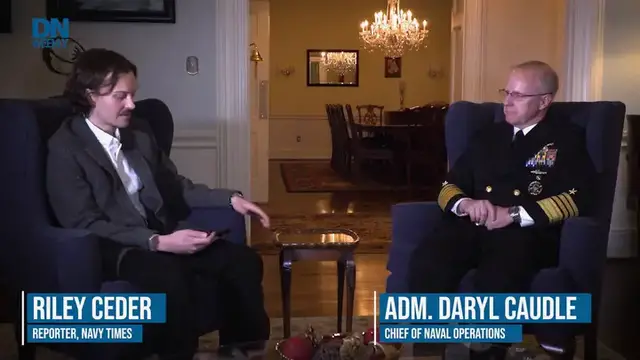
In a revived shipbuilding era, how much production should be dedicated to autonomous vessels? The chief of naval operations talks about the Navy of the future.
Show More Show Less View Video Transcript
0:00
We're talking about ensuring that ships and vessels meet a certain percentile of readiness
0:04
One of the ways, and we're kind of touching on it now, is by reinvigorating the maritime industrial base
0:09
How does the Navy and potential partners, maybe the South Korean shipbuilders, plan to do that
0:16
You know, how do you plan to do that in the year ahead, the next five years? How does that look
0:19
You know, I don't think I've ever served in a time when I've seen the Navy, Congress, and Office of Secretary of War
0:28
Everyone's on the same page here. There is no daylight between any stakeholder, and I think the American people as well, that shipbuilding in the United States is something that needs to be reinvigorated
0:38
That's commercial shipbuilding and certainly naval combat ships. So we're all on the same page
0:44
And so I think Congress is working hard to fund that initiative
0:47
And so what we have to do now is make sure where you can work with the defense industrial base, the submarine industrial base and the shipbuilding writ large to take those monies and convert that into output improvements
1:00
That's workforce improvements, lower attrition, better retention, better training, more resilient supply chains
1:07
You know, a lot of these second and third tier suppliers, you know, don't have steady demand signals so they don't stay in the game long enough so that I end up having challenges with long lead time material, which forces me not to have the parts on hand when I want to repair or do new construction
1:24
So that's in play as well. Automation on the work floors, on the production floors, need to be improved
1:31
We do too much by hand. There's too much artisan work going on and not enough automation where we have high reproducibility and the ability to actually have higher output with fewer people
1:42
All of that needs to be worked through the lens of leveraging our foreign partners
1:49
And I think they have a vital role in this. You seen Hanwha Shipbuilding a South Korean company purchase the Philadelphia shipyard I love that idea but I think there even more that can be done to leverage them even within their own country When we pass laws like the Jones Act
2:06
those laws are passed with a set of assumptions that are made at the time the law is passed
2:11
A certain political and geopolitical environment, a certain threat environment, a certain belief that
2:16
the United States has a certain capacity. All of those assumptions need to be revisited
2:20
And I believe that law is a bit antiquated. We need to be able to open up to some additional foreign shipbuilders to help us build ships now while we get our own internal shipbuilding up to speed to help bridge me into that future
2:35
And part of those shipbuilding efforts that you're speaking about are building out an unmanned fleet, whether it's surface drones or whether it's subsurface drones
2:43
So how does the sailor, the future sailor, fit into those efforts and do an increasingly unmanned world
2:50
how do you envision sailors' roles evolving or maybe even being potentially eliminated with the advent of this technological innovation
2:58
You've got AI, and maybe that requires less human intervention. What, in your mind, is that perfect harmony between that future sailor, that human, and machine operations
3:09
I think it's a whole new set of competencies. You know, we need sailors that, and I've got this in motion, in fact, that have a deep understanding in general
3:19
The general sailor, and I'll get to the more specific case, has needs in today's world a deeper understanding of artificial intelligence
3:27
How those types of capabilities are used, how to leverage them just to do day-to-day tasks
3:32
So large language models and chat GPTs and gen AI and capabilities like that must be leveraged to allow the sailor to do things what was taking hours to do historically can be done in minutes in a much more reproducible and higher quality way
3:54
So all administrative tasks need to be leveraging these types of AI capabilities So every sailor needs some degree of understanding of that That starts at boot camp goes to their A schools and their C schools
4:06
all the way up through their career development. I should be giving them more understanding or artificial intelligence
4:13
There are specific rates that are going to be involved with unmanned robotic and autonomous systems
4:19
They need even more education in this. It deals with how to leverage programming capabilities that do, you know, write code, how to leverage that code to do mission planning for these systems, how to maintain these attributable and sometimes fungible systems that are brand new that are not the typical type ship systems that we're used to
4:41
Things that have, you know, they're basically battery powered, things that need resilient command and control networks to operate, things that have remote, you know, joystick type capability and how you actually actually operate them in situ
4:56
That curricula and that training modules need to be developed in a way that sailors learn today
5:02
And that's through essentially YouTube type delivery. So a lot of things need to be done to revamp that
5:09
Our continuous training curriculum that we're building to go do those things are in motion
5:15
It takes time to get that done, but that is where we're moving as a Navy to improve the competencies of those specific skills
5:23
Staying on the topic of combat readiness, the Navy has devoted a considerable amount of resources to the South Combo Area of Operations
5:31
Does that allocation of resources jeopardize combat readiness in other theaters, such as the Indo-Pacific
5:39
How does the service plan to maintain the posture in the South Carolina of Operations
5:43
while maintaining a naval supremacy that you've spoken about that you said is important to
5:49
deterring near peer adversaries? Is there any concern at all that the devotion of those resources to the South Carolina of
5:55
Operations might be stretching the service thin at all The Navy responsibility to generate force generates it based on the capacity we have And then we go through a global force management adjudication process
6:11
to determine which combatant commanders get those forces. So the Navy's got a conveyor belt in peacetime to generate those forces
6:19
based on how much capacity I have and the number of ships I have available
6:23
They're not in depot and other things like that that have an output that's fixed
6:30
So if the Secretary of War and the chairman and the South Com commander need forces to go to U.S. Southern Command, that's fine
6:38
So the fact, I'll give you an example, the fact that the forward strike group is operating in the southern command area of operations and not in the European or central command is not changing any additional resource drain on the Navy
6:54
It's just where it's currently operating. The bigger challenge for me and the thing I push back on is when those deployments get extended
7:03
So as long as I generate what the Navy can generate, and we make decisions on where they go with some strategic discipline
7:10
and we don't try to overextend those deployments, then it's okay. It will not be an additional drain
7:16
But when we basically design the system for seven-month deployments, and they start doing eight- and nine-month deployments, then I have a problem
7:26
That impacts sailor quality of life. It impacts families. It impacts the readiness of those systems
7:33
It impacts how I do contractual maintenance agreements, because now when the start date
7:37
was supposed to start is not being met. So that's a problem for me
7:41
And then perhaps most important is the next loop of deployment is now postponed
7:46
So it's kind of short-term vision that actually has long-term impact on when I'll need those
7:52
forces in the future. So the extension is the problem for a service chief, not where they operate, as long as
7:59
we don't exceed the capacity of the Navy
#news